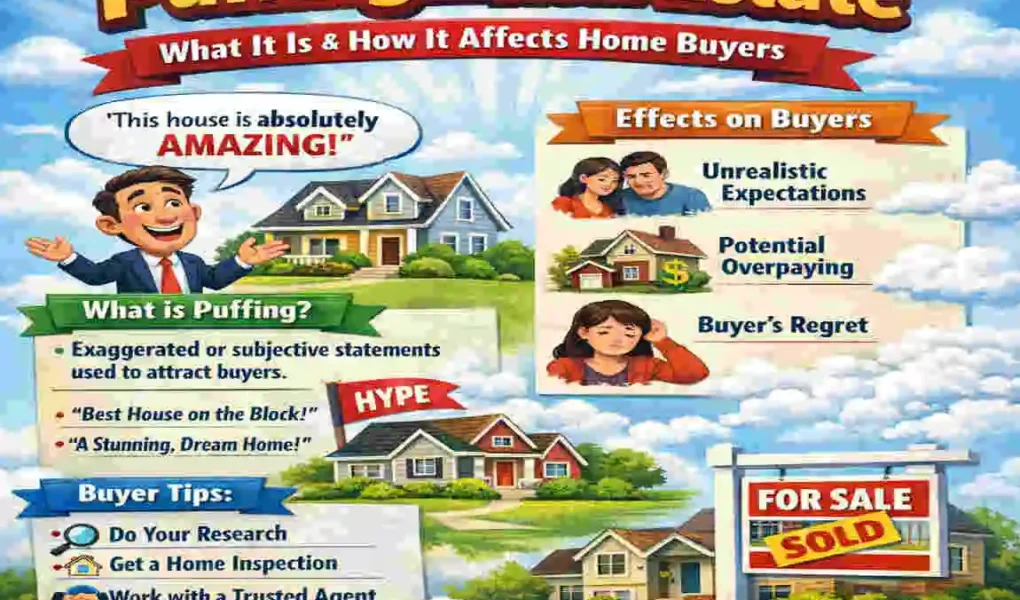
If you have ever walked into a home after reading a listing that promised a “spacious dream home,” only to find tight rooms, low ceilings, and a yard that barely fits a grill, you have already bumped into the idea of puffing in real estate meaning.
This kind of language can sound exciting. It can make a property feel warmer, newer, larger, and more valuable than it really is. Sometimes that is harmless sales talk. Other times, it can quietly push buyers toward poor decisions.
That is why understanding the meaning of puffing in real estate matters so much.
In simple words, puffing is exaggerated praise or opinion-based hype used in real estate marketing. It is usually not treated the same way as a false fact. Saying a house has the “best view in town” is different from saying it has three bedrooms when it actually has two. One is an opinion. The other is a measurable fact.
Even when puffing is legal, it can still be misleading. It can create pressure, foster false expectations, and prompt buyers to act too quickly in a competitive market. If you are buying a home, you need to spot this early.
| Aspect | Description | Example | Legal Status |
|---|---|---|---|
| Definition | Exaggerated hype to make property appealing | “Best home on the block!” | Legal (opinion) |
| vs. Fact | Subjective, not provable | “Cozy starter home” (for small space) | Not actionable |
| vs. Fraud | Crosses line if stated as fact | “New roof” (if false) | Illegal misrepresentation |
| Buyer Risk | Unrealistic expectations, overpaying | “Unlimited potential” hides issues | Verify with inspections |
| Protection | Ignore hype; demand data | Ask for appraisals, history | Use buyer’s agent |
What Is Puffing in Real Estate?

At its core, puffing in real estate refers to enthusiastic, exaggerated statements that sound persuasive but are usually subjective and hard to prove.
Think of it as a sales flavour. It is the kind of language that makes a property seem more impressive than an ordinary description would. It often uses words like:
- beautiful
- stunning
- perfect
- unmatched
- dream
- rare
- incredible
- best
These words are not always wrong. In fact, they are very common in marketing. The problem begins when hype blurs the line between opinion and reality.
Core Definition and Legal Status
Puffing usually refers to general praise rather than a specific claim. It is often treated as an opinion rather than a binding promise.
For example:
- “This is the best home on the block.”
- “You will love this charming space.”
- “This property has amazing potential.”
These statements are hard to prove or disprove because they are based on taste, taste, and personal judgment. One buyer may agree. Another may not.
That is why puffing is often considered legal in real estate marketing. Courts and regulators usually recognise that sellers and agents use some level of sales language. They understand that not every glowing statement is meant as a literal fact.
But legal does not always mean harmless.
If puffing is so overdone that it misleads a reasonable buyer, it can become a problem. The closer a statement comes to a factual promise, the riskier it becomes.
Puffing vs. Misrepresentation
This is the most important distinction for buyers to understand.
Puffing is usually about opinion.
Misrepresentation is usually about facts.
Here is a simple comparison:
AspectPuffingMisrepresentation
Nature Opinion or exaggeration False statement of fact
Example “Gorgeous view” “New roof installed last year”
Proof: Subjective and hard to measure. Objective and verifiable
Legality : Generally allowed , often illegal or actionable
Buyer impact can mislead expectations and can directly cause financial harm
Let’s make it even clearer.
If an agent says, “This kitchen feels like the heart of the home,” that is puffing.
If an agent says, “This kitchen was completely remodelled in 2024,” and it was not, that is a factual claim. If false, it may be a misrepresentation.
That difference matters because buyers often react emotionally to sales language before they stop to check the facts.
Why Puffing Exists in Real Estate
Puffing is common because real estate is emotional.
A house is not just a product. It is a place where people imagine their lives. Buyers picture birthdays, holidays, quiet mornings, and future growth. That emotional connection makes strong marketing language very effective.
Agents and sellers know this. They use vivid words to make listings stand out in crowded markets. And in many cases, that is normal advertising.
The issue is not that all enthusiasm is bad. The issue is when enthusiasm starts replacing truth.
A good buyer should learn to enjoy the story a listing tells, while still checking the facts behind it.
Common Examples of Puffing in Real Estate
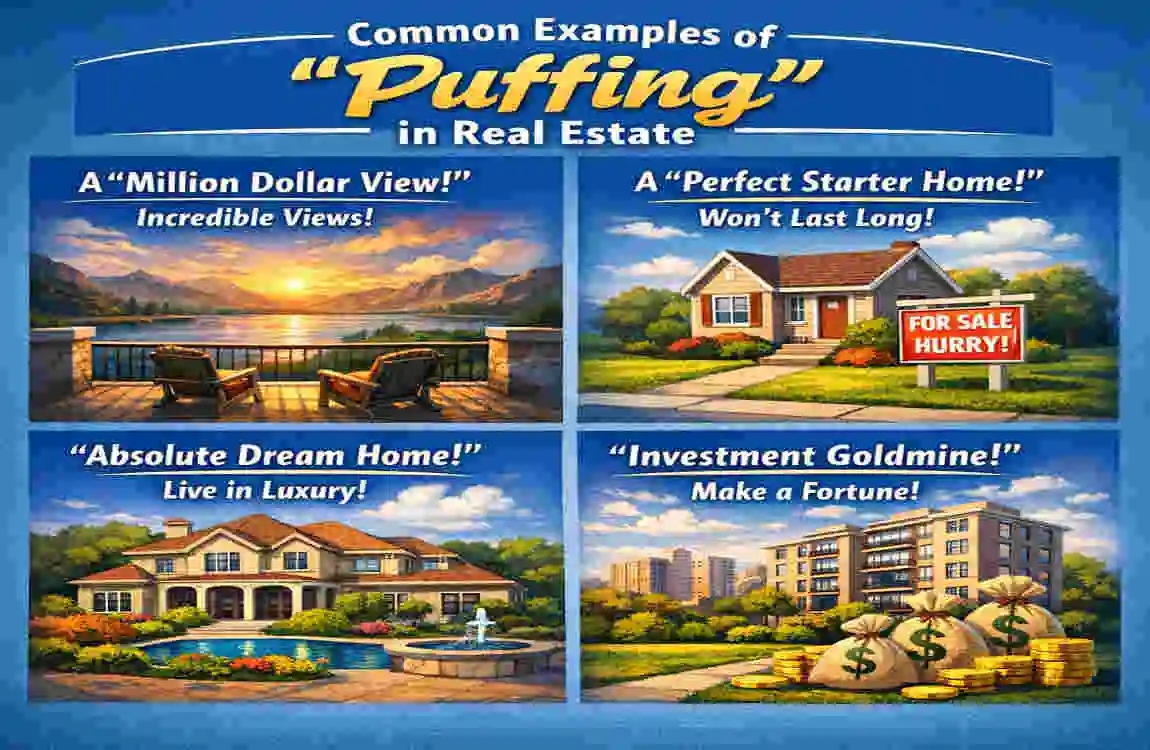
One of the easiest ways to understand the meaning of puffing in real estate is to look at real-world examples. You will see that puffing often hides in plain sight.
Residential Listing Examples
In home listings, puffing often appears as emotional or flattering language.
Here are some common examples:
- “Cozy home”, when the rooms are actually quite small
- “Charming fixer-upper” when the property needs major repairs
- “Move-in ready” when several updates are still needed
- “Rare opportunity” when similar homes are listed nearby
- “Entertainer’s paradise” for a simple patio with little usable space
- “Light-filled living” when the windows are small, or the space is dim
- “Spacious layout” when the square footage is modest
These phrases are not automatically false. But they can shape expectations that are not fully grounded in reality.
Imagine a buyer reading “spacious dream home” and expecting open, airy rooms. Then they arrive and find narrow hallways and a cramped floor plan. That gap between expectation and reality is exactly where puffing can create disappointment.
Commercial Property Examples
Puffing is not limited to residential homes. It also appears in commercial real estate.
Examples include:
- “Booming neighbourhood” when the area is actually slowing down
- “Prime investment opportunity” without supporting financial data
- “Unbeatable foot traffic” without traffic studies
- “High-income potential” with no rental analysis
- “Future development hotspot” based only on speculation
Commercial buyers often rely on numbers, market trends, and long-term returns. So puffing can be especially risky when vague hype is used instead of real data.
Online Listing Examples
Online listings are full of puffing because digital marketing thrives on attention.
You may see phrases like:
- “Pinterest-worthy kitchen”
- “Luxury living”
- “Instagram-ready backyard”
- “A one-of-a-kind gem”
- “Unbelievable value”
- “A true must-see”
These phrases are designed to stop the scroll and pull you in. That is not necessarily wrong. But as a buyer, you should remember that a catchy phrase is not a substitute for actual property details.
Before-and-After Buyer Perspective
Here is how puffing can affect a buyer’s thinking:
- Before seeing the home: “This sounds like the perfect place.”
- After seeing the home, “It is nice, but it is not nearly as amazing as the listing made it sound.”
That emotional drop matters. Once a buyer feels disappointed, they may still stretch their budget just to avoid losing out on the property.
That is how puffing can influence decisions even when it does not technically cross the line into fraud.
How Puffing Affects Home Buyers
The effect of puffing is not just about words. It changes how people think, feel, and act.
Buyers often make decisions under pressure. They may already be worried about rising prices, limited inventory, or bidding wars. Add exaggerated listing language to the mix, and the pressure intensifies.
Psychological Impact
Puffing can create a strong emotional pull.
When a listing sounds exciting, buyers may start imagining a future that has nothing to do with the home’s actual condition. They may picture a stylish lifestyle, a better neighbourhood feel, or a sense of exclusivity that isn’t really there.
This can lead to:
- unrealistic expectations
- FOMO, or fear of missing out
- quick emotional attachment
- less critical thinking
- Greater trust in the wrong signals
Once that emotional bond forms, buyers may ignore warning signs. They may forgive obvious issues because they do not want to lose their home.
That is one of the biggest risks of puffing. It does not just advertise. It nudges behaviour.
Erosion of Trust
Another major effect is the loss of trust.
If buyers arrive expecting something luxurious and find something ordinary, they may begin to distrust the agent, the seller, or the whole market process. Even if the property is not a bad deal, the gap between the promise and reality can leave a bad taste.
Trust matters in real estate because buying a home is already a stressful process. Buyers need clear, reliable information. When hype gets in the way, confidence drops.
Financial Risks
Puffing can also create real financial problems.
A buyer who is emotionally caught up in a property may:
- overbid
- skip careful comparison shopping
- accept a higher price than they planned
- reduce negotiation pressure
- Rush through inspection or due diligence
Even a small emotional overreaction can become expensive.
If a buyer thinks a home is far more valuable than it is, they may stretch their budget by thousands of dollars. That extra money could have gone toward repairs, closing costs, savings, or future upgrades.
Long-Term Effects
The effects of puffing do not stop at closing.
A disappointed buyer may later realise the home is:
- smaller than expected
- harder to resell than expected
- less renovated than promised
- located in a less desirable area than suggested
- more expensive to maintain than they planned
This can lead to buyer’s remorse.
It can also make resale more difficult. If the property was sold with heavy hype, a new buyer may react similarly unless the home truly lives up to the claim.
In other words, puffing may help sell a property quickly, but it does not build lasting satisfaction.
Is Puffing Illegal? Understanding the Legal Boundaries
This is where things get a little more serious.
In most cases, puffing itself is not illegal because it is treated as opinion rather than fact. But there is a thin line between harmless sales talk and unlawful behaviour.
Where Puffing Ends and Fraud Begins
Puffing becomes dangerous when it moves from opinion into false factual claims.
For example:
- “This home feels huge” is an opinion.
- “This home has 2,400 square feet” is a fact.
- “The roof looks great” is an opinion.
- “The roof was replaced last year” is a factual claim.
If a seller or agent knowingly makes a false factual statement, that can lead to legal trouble.
That is why the line between puffing and fraud matters. A statement that sounds like harmless excitement can still create liability if it is tied to a real fact and the fact is false.
What Usually Gets Buyers in Trouble
Buyers sometimes assume that anything written in a listing must be true. That is not always safe.
Some of the most problematic areas include:
- square footage
- renovation dates
- flood history
- property boundaries
- school district claims
- zoning use
- repair history
- income potential for investment properties
These are not puffing if they are presented as factual details. They are measurable and checkable.
If those details are wrong, the issue is not just hype. It may be a false statement.
Why State Rules Matter
Real estate laws can vary depending on where the property is located.
Different places may have different disclosure requirements, advertising rules, and consumer protections. In some areas, seller disclosure obligations are strict. In others, the rules may be more limited.
That is why buyers should never assume that all listing language is equally safe or equally meaningful. A general statement in one region may be acceptable, while a similar statement in another context may raise concerns.
Ethical Standards Matter Too
Even when something is legal, it may still be unethical.
Real estate professionals are expected to market properties honestly and avoid misleading language. Ethical marketing does not mean boring marketing. It means using honest words that do not hide major problems or inflate value unfairly.
A strong listing can still be truthful.
That is the better path.
Puffing vs. Misrepresentation: Why the Difference Matters So Much
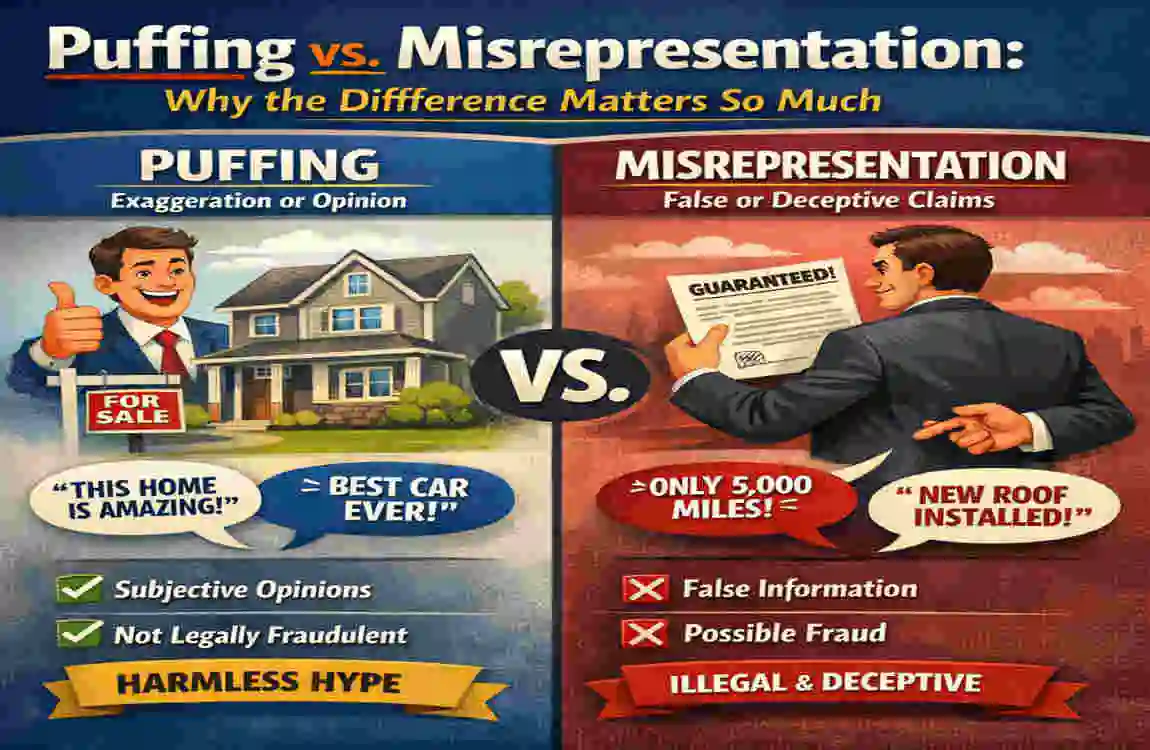
This distinction deserves its own space because it is the heart of the topic.
Many buyers hear a polished description and assume the seller or agent is promising something specific. But the law often treats words differently depending on whether they are subjective or objective.
Puffing Is About Feelings
Puffing tries to influence how a property feels.
It might describe a home as:
- warm
- elegant
- luxurious
- rare
- perfect
- beautifully located
These statements are broad and emotional. They cannot usually be proven true or false in a strict sense.
Misrepresentation Is About Facts
Misrepresentation is different because it involves a false statement that can be tested.
Examples include:
- claiming a home has a new roof when it does not
- saying the basement has never flooded when it has
- stating the house has three bedrooms when one room is not legally a bedroom
- saying the HVAC system was replaced when it was not
- claiming a property is in a certain school zone when it is not
These are not matters of taste. They are matters of record.
Why Buyers Should Care
The difference affects how buyers respond.
If you treat all marketing language as fact, you may believe the home is better than it is.
If you dismiss all marketing language as harmless fluff, you may miss a serious falsehood hidden inside a flashy description.
The smartest approach is a balanced one: listen to the pitch, then verify the facts.
How Buyers Can Protect Against Puffing
The good news is that puffing is manageable. You do not have to become suspicious of every listing. You just need a clearer process.
Ask Better Questions
When a listing sounds too polished, slow down and ask questions that move the conversation from opinion to fact.
Try questions like:
- What exactly does “updated” mean?
- When was the last roof replacement?
- Has the electrical system been upgraded?
- What is the actual square footage?
- Are the nearby amenities verified or just estimated?
- Can I see the repair history?
- Has the property had any water issues?
These questions force the conversation into specifics.
Verify Claims Independently
Never rely only on the listing description.
Instead, look for outside confirmation through:
- home inspections
- appraisals
- property records
- tax assessments
- permit history
- seller disclosure forms
- neighborhood comparisons
If a claim matters financially, check it twice.
Look Past the Headline Language
A listing headline may say “dream home”, but the details may tell a different story.
Pay more attention to the facts in the description than the emotional phrases at the top. Square footage, lot size, age of major systems, and renovation details matter far more than a catchy slogan.
Take Your Time
Puffing works best when buyers feel rushed.
If possible:
- Visit the property more than once
- Tour it at different times of day
- Compare it with similar homes
- bring a second set of eyes
- think before making an offer
A calm buyer makes better decisions than a pressured one.
Buyer Protection Checklist
Here is a simple checklist you can use:
- Request the property history report
- Review seller disclosures carefully
- Tour the home more than once
- Ask direct questions about upgrades and repairs
- Compare the listing to similar homes nearby
- Hire a trusted inspector
- Speak with your buyer’s agent before making a big decision
This checklist is not complicated, but it is powerful.
How to Spot Puffing in Listings and Sales Talk
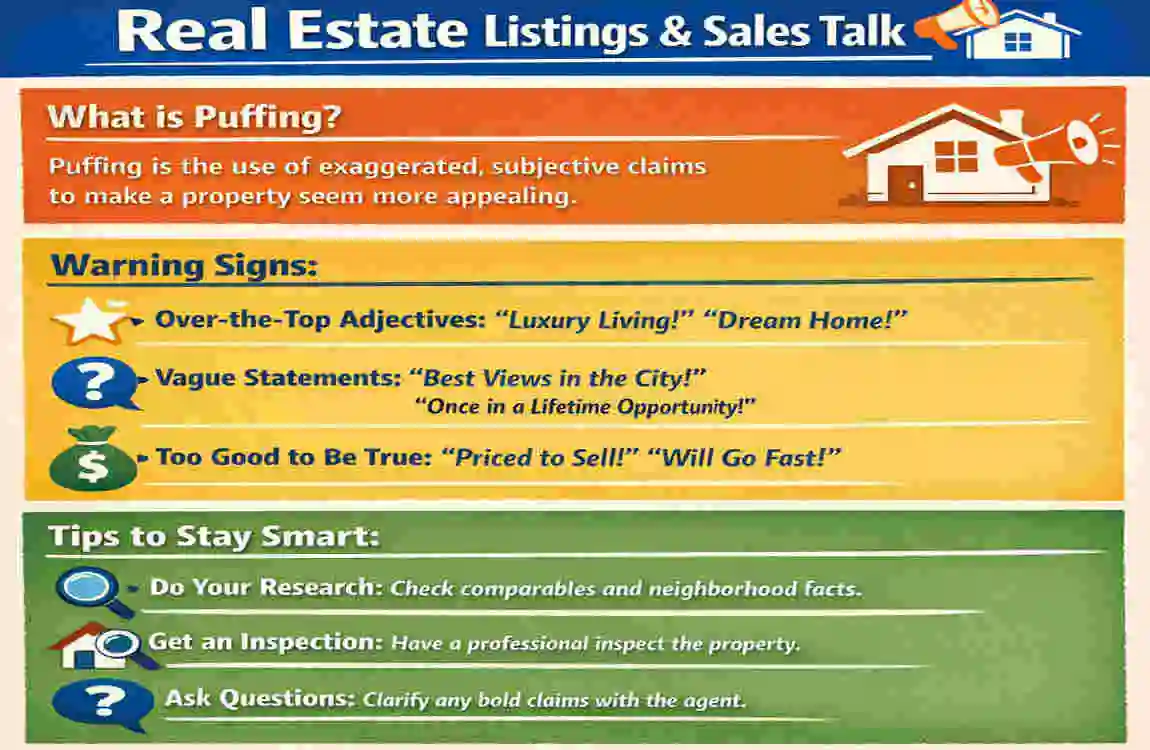
Once you know what to look for, puffing becomes easier to recognise.
Watch for Vague Superlatives
Words like best, ultimate, perfect, stunning, and luxury may sound impressive, but they often tell you very little.
The more vague the word, the more you should look for hard details.
Notice When Facts Are Missing
A listing that leans too heavily on emotional language may be trying to distract you from what is missing.
If you see a lot of hype but very few concrete details, pause and dig deeper.
Compare the Words With the Photos
Photos can also make a property look better.
Wide-angle shots can make rooms look larger. Bright editing can make a dated home look newer. Selective angles can hide flaws.
If the photos and language both seem unusually polished, that does not mean the home is bad. It simply means you should verify everything carefully.
Read Between the Lines
Sometimes the wording itself gives away the puffing.
For example:
- “Great opportunity for the right buyer” may mean the home needs work.
- “Bring your imagination” may mean the layout is awkward.
- “As-is charm” may indicate visible issues.
- “Potential plus” may mean the current condition is not ideal.
These phrases are not always bad. But they often signal that the seller wants you to focus on potential rather than the present reality.
Ethical Marketing for Real Estate Professionals

If you work in real estate, puffing is more than a legal question. It is a trust question.
The best long-term marketing does not depend on exaggeration. It depends on clarity.
Use Facts First
Strong listings should start with the facts:
- square footage
- number of bedrooms and bathrooms
- major upgrades
- lot size
- neighborhood features
- school information was allowed
- special amenities
Once the facts are clear, a little personality can help the listing feel human.
Use Mild Opinion, Not False Hype
It is fine to say:
- “This home offers a warm and inviting feel.”
- “The layout works well for everyday living.”
- “The backyard is ideal for relaxing or entertaining.”
These are soft opinions that help the reader picture the home.
But avoid claims that sound specific unless you can support them.
Build Trust Through Transparency
A truthful listing may not sound as flashy at first, but it often performs better over time.
Why?
Because buyers respect honesty.
When people feel that a seller or agent is straightforward, they are more likely to keep reading, book a showing, and move toward an offer with confidence.
That is better for everyone involved.
Practical Table: Puffing vs. Clear Facts in Real Estate
To make the difference even easier to see, here is a simple table you can use as a reference.
Type of Statement: Puffing Example, Clear Fact Example, Why It Matters
Size “Feels spacious” “1,850 square feet” One is subjective, the other is measurable
Condition : “Beautifully maintained” “New roof installed in 2023” Facts can be verified
Location “Best location in town” “Located 0.8 miles from downtown” Opinion vs. data
Value “Amazing investment” “Rental income averages $2,400/month” Buyers need proof
Appeal “A true dream home” “Four bedrooms, two baths, remodelled kitchen” Clear details help decisions
This table is a good reminder that the more specific the claim, the more careful you should be.
Real Estate Buyers and the Power of Smart Thinking

Buying a home is emotional, but it should never be careless.
You do not need to reject every positive description. You just need to stay grounded. A smart buyer listens to the sales pitch, then asks, “What is the evidence?”
That one habit can save you money, stress, and regret.
Stay Curious
Curiosity protects you.
If something sounds too perfect, keep asking questions. If something feels vague, ask for the details. If a phrase feels like marketing fluff, compare it with hard facts.
Stay Patient
Puffing often works because buyers are in a hurry.
Patience gives you room to think clearly. It lets you compare options, negotiate better, and avoid emotional mistakes.
Stay Objective
Try to judge the property by what it actually is, not what the listing wants you to imagine.
A home can still be great without being “stunning.” It can still be valuable even if it’s not “rare.” And it can still be the right fit without sounding like a magazine cover.
Puffing in Real Estate – FAQ
What is puffing in real estate?
Puffing refers to exaggerated or promotional statements made by a seller or agent to make a property sound more attractive. These are usually opinions, not facts.
Is puffing legal?
Yes, puffing is generally legal because it’s considered subjective opinion rather than a factual claim.
Example of puffing?
Saying “This is the best house in the neighborhood” or “You’ll fall in love instantly” are common puffing statements.
Is puffing the same as misrepresentation?
No. Puffing is opinion-based, while misrepresentation involves false or misleading facts, which can be illegal.
Can buyers rely on puffing statements?
No, buyers should not rely on puffing. They should verify all important details independently.
Why do agents use puffing?
Agents use it as a marketing technique to create interest and highlight the property’s appeal.