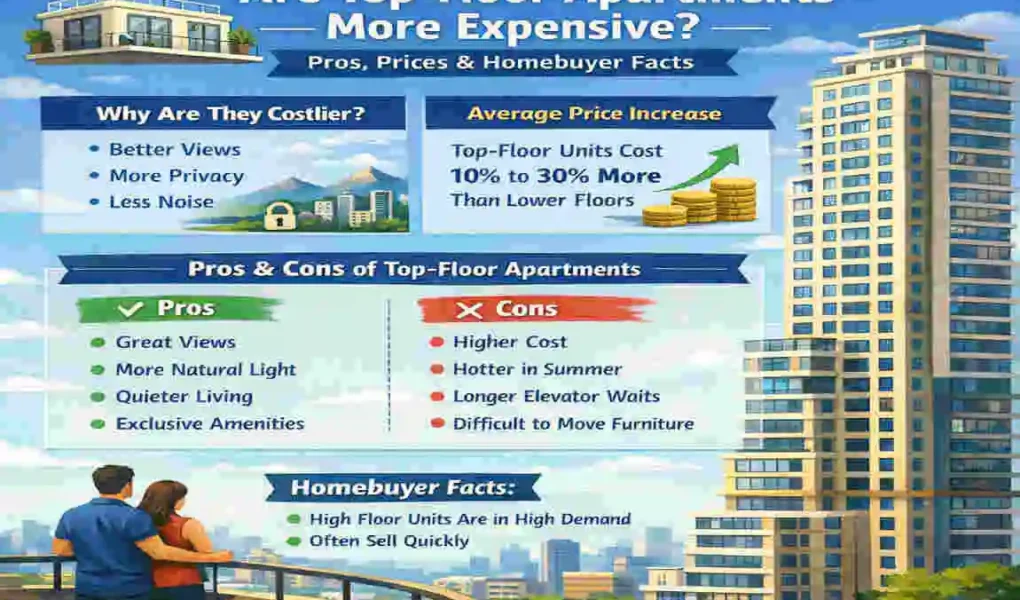
Are top-floor apartments more expensive than mid-floor or lower-floor units? In many buildings, the answer is yes. But that does not mean every top-floor apartment automatically comes with the highest price tag. The final cost depends on a mix of things, like the city, the type of building, the quality of construction, the view, the local climate, and what buyers in that market value most.
If you are trying to decide whether paying extra for a top-floor home is worth it, you are in the right place. This guide breaks the topic down in a simple, practical way. We will look at why top-floor apartments often cost more, when they do not, and what benefits and drawbacks come with living at the top. We will also compare top-floor, mid-floor, and ground-floor pricing so you can see where the real value may be. Most importantly, we will help you think like a smart buyer, not just a dreamer chasing a nice view.
| Aspect | Detail |
|---|---|
| Are top‑floor apartments more expensive? | Yes, top‑floor apartments are usually more expensive than ground‑ or lower‑floor units in most modern residential buildings, especially in cities with elevators and higher‑rise towers. |
| Why do they cost more? | Buyers pay a premium for better views, more natural light, greater privacy, and perceived security; developers often add a “floor premium” per level. |
| Typical price difference | Top‑floor units can be 5–30%+ more than comparable mid‑floor units, while penthouse‑style top floors may be significantly higher depending on location and amenities. |
| When they may not be more expensive | In older buildings with poor insulation, heat issues, or roof‑leak risks, top‑floor prices can be discounted or similar to lower floors. |
| Key buyer considerations | Heat, roof‑related maintenance, elevator dependence, and higher potential cooling/heating bills can reduce the value of paying extra for a top‑floor unit. |
What “Top-Floor Apartments” Actually Mean

Before we talk about pricing, it helps to define the term clearly. A top-floor apartment is the apartment on the highest occupied floor of a building. In some cases, it may be a regular unit on the top level. In other cases, it may be a penthouse, a duplex, or a special corner unit that sits above the rest of the building.
That difference matters because not every top-floor home is the same. A top-floor unit in a four-story walk-up is very different from a top-floor apartment in a 30-story high-rise. The first may offer a little more privacy and a bit more light. The second may offer a dramatic view, stronger prestige, and a much bigger price gap compared with lower floors.
Regular top-floor vs penthouse or duplex
A regular top-floor apartment is usually just the highest standard unit in the building. It may have a better layout, better views, or a quieter setting, but it is still a normal apartment.
A penthouse is different. It is often the most premium unit in the building and may include large terraces, luxury finishes, larger indoor space, and a more exclusive location. A duplex can also sit on the top floors and span two levels, which can further raise the price.
So, when people ask, “Are top-floor apartments more expensive?” they may actually be asking about several different kinds of homes at once. That is why the answer is not always simple.
Top-floor in low-rise vs high-rise buildings
The meaning of “top-floor” changes depending on the building style.
In a low-rise building, the top floor might mean the third or fourth floor. In a high-rise tower, the top floor could be the 25th, 30th, or even 50th floor. That difference affects everything from view quality to heat and wind exposure to elevator reliance, and, of course, price.
In a low-rise building, the top floor may be slightly more desirable, but the premium may be modest. In a high-rise tower, the top floor can feel like a luxury product, and the price jump may be much larger.
Are Top-Floor Apartments More Expensive?
Yes, top-floor apartments are often priced higher than mid-floor or ground-floor units, especially in modern buildings, prime neighbourhoods, and luxury developments. But the size of the premium can vary a lot.
In some buildings, the top-floor unit may cost only a little more. In others, the difference can be dramatic. Some buyers are willing to pay more for the view, privacy, and status. Developers know this, so they often position top-floor units as the premium choice.
That said, price is never only about floor number. It is also about demand. If buyers in that market care more about easy access, lower heat, or lower maintenance, then a top-floor apartment may not command a huge premium. In some older buildings, it may even be priced lower if the roof has problems or the building has poor insulation.
Why top-floor units are priced higher
There are a few big reasons top-floor homes often cost more.
There are fewer of them.
Scarcity is a major pricing factor. A building might have many mid-floor units, but only one or two top-floor units. When something is limited, it often becomes more valuable.
That limited supply can create a “premium” feeling. Buyers may see the top floor as special because it is not available to everyone.
Better views
One of the biggest selling points of a top-floor apartment is the view. From higher up, you may enjoy a wider city skyline, a clearer horizon, or less visual clutter from nearby buildings and trees.
Many buyers love the feeling of openness. If a top-floor unit offers a great view, the market often rewards it with a higher asking price.
More privacy
Top-floor apartments usually have fewer people passing by the door. You also do not have neighbours above you, which means fewer footsteps, moving chairs, or ceiling noise.
That extra privacy can feel like a luxury, especially in dense cities where apartment living can feel crowded.
Less noise from above
One of the most common frustrations in apartment life is noise from upstairs neighbours. Living on the top floor removes that problem completely.
For many buyers, that alone is worth paying extra. Quiet has value, and people are willing to pay for it.
Premium marketing
Developers know how to package a top-floor unit. They often market it as the most exclusive choice in the building. Phrases like “best view,” “private living,” “penthouse feel,” and “premium position” help create demand.
This marketing can push prices even higher because buyers often associate the top floor with a higher standard of living.
How Big Is the Price Premium?
The premium for a top-floor apartment can be small, moderate, or substantial, depending on the building and market.
In a simple residential project, the top floor may cost only 5% to 15% more than similar lower units. In a luxury tower, the gap may rise to 20% to 50% or more, especially if the unit includes special design features, a terrace, or a penthouse-style layout.
In some cases, the premium becomes even more extreme if the top-floor apartment is a signature unit. Then the price may reflect not just the floor, but also the status of the home.
It is also important to remember that the premium does not always stay the same during resale. A buyer may pay a high launch price for a top-floor unit, but the resale market may not fully repeat that same premium later. That is why long-term value matters just as much as the initial purchase price.
A simple example of price spread
Imagine three nearly identical apartments in the same building:
- A ground-floor unit might be the base price.
- A mid-floor unit may cost a little more because it offers balance and convenience.
- A top-floor unit may command a higher price because of the view and privacy.
If the building is plain and the location is average, the gap may be small. If the building is elegant and the view is impressive, the gap may be much bigger.
When Top-Floor Apartments Are Not More Expensive
Now for the part many buyers overlook: top-floor apartments are not always more expensive. In some cases, they can even be cheaper.
That may sound surprising, but it makes sense when you think about how people actually live.
Older buildings with roof problems
If a building is older or poorly maintained, the top floor may pose additional concerns. Roof leaks, moisture, insulation issues, and poor heat retention can make the unit less appealing.
When buyers know a roof has a history of problems, they often hesitate to pay a premium. In some markets, they may even ask for a discount.
Buildings with weak insulation
A top-floor apartment under a hot roof can get uncomfortable quickly if the building is poorly insulated. In that case, the unit may cost more to cool in summer and may feel less comfortable year-round.
If buyers expect higher utility bills, they may not want to pay extra for the unit upfront.
Markets where ground-floor units are in demand
Not every buyer wants to live high up. In some places, ground-floor or low-floor units are in greater demand because they offer easier access, faster entry, and better convenience for older adults, families with young children, or people who use wheelchairs or strollers.
In certain buildings, ground-floor units may even be more useful because they are close to parking, common areas, or street access.
Oversupply of similar units
If the market has many apartments with similar views and layouts, the floor level may not matter much. When too many similar units compete for the same buyers, the top floor may lose part of its price advantage.
In a crowded market, the buyer’s focus often shifts from “Which floor?” to “What is the overall value?”
Pros of Living on the Top Floor
If you are considering a top-floor apartment, the benefits can be very appealing. Let’s go through them one by one.
Better views and natural light
This is usually the first thing people think of. Higher floors often offer more open views and fewer obstructions from nearby buildings, walls, or trees.
Natural light can also be better on upper floors. A brighter home often feels larger, warmer, and more welcoming. For many people, that makes daily life more enjoyable.
If you love reading by a window, enjoying sunsets, or simply having a home that feels airy, the top floor can be a wonderful choice.
More privacy and quieter living
One of the biggest advantages of the top floor is privacy. Fewer people pass your apartment, and you do not have to deal with footsteps from above.
That can make a huge difference in everyday comfort. A quiet home is easier to relax in, sleep in, and often enjoy.
If you work from home, study from home, or just value peace, this benefit may matter a lot to you.
Higher sense of security
Many people feel safer on higher floors because they are harder to reach from outside. That does not mean they are magically secure, but it can reduce the risk of street-level intrusion.
There is also less casual traffic near your window or balcony compared with a ground-floor unit. For some buyers, that feeling of separation adds peace of mind.
Better airflow and ventilation
Upper floors often get better air movement. In some climates, this can improve comfort and reduce stuffiness.
If the apartment has good window placement, cross-ventilation can help fresh air move through the space more easily. That can make the home feel cleaner and more pleasant.
Status and lifestyle appeal
Let’s be honest: top-floor living has a certain image. It can feel more exclusive, more private, and more aspirational.
For many buyers, this emotional value matters. They are not only buying walls and windows. They are buying a feeling. And the top floor often delivers that feeling better than a lower unit does.
Cons of Living on the Top Floor

The top floor has many benefits, but it also has real drawbacks. If you ignore these, you may end up paying extra for a home that does not fit your daily life.
Higher temperatures and heat retention
This is one of the most common issues. Top-floor apartments can get hotter because they sit directly under the roof and often receive more sun exposure.
If the building has weak insulation, heat can build up quickly. That may mean more use of air conditioning and higher energy bills.
If you live in a warm climate, this is a big factor to check before you buy.
Elevator dependency and access issues
When you live on the top floor, elevators become very important. If the elevator breaks down or needs maintenance, your daily routine can become inconvenient very quickly.
This matters even more if you have young children, older family members, groceries, luggage, or mobility concerns. A few flights of stairs may not sound like a big deal at first, but daily life can tell a different story.
Roof-related leaks and maintenance issues
Top-floor units are closer to the roof, which means they are more exposed to roof leaks, waterproofing failures, and poor maintenance problems.
If the roof is not well-maintained, you may face damp spots, mould, peeling paint, or costly repairs. This is especially important in older buildings.
Before buying, always ask about the roof condition, waterproofing history, and any past leak complaints.
Wind and weather exposure
Higher floors often face stronger wind. That can create noise, affect balcony comfort, and sometimes make the apartment feel less sheltered during storms.
Windows, balcony doors, and outdoor furniture may also face more wear if the apartment is exposed to harsh weather.
Possible higher maintenance or insurance costs
In some buildings, top-floor owners may end up paying more in maintenance-related costs if roof issues, insulation upgrades, or weather-related repairs are shared among owners.
Even if the monthly payment is not much different, the total cost of ownership can still rise over time.
Resale uncertainty
This is where many buyers get caught off guard. A premium paid at the time of purchase may not always come back in the resale market.
A future buyer might love the top floor, but they might also worry about heat, reliance on the elevator, or roof problems. That can limit demand in some situations.
So, while top-floor units can be valuable, they are not always the easiest to resell at a high price.
Pricing Differences: Top-Floor vs Mid-Floor vs Ground Floor
This is where the practical side of the decision becomes clear. To help you compare the options, here is a simple table showing how the floors often differ.
Floor Type, Typical Price, Trend, Main Advantages, Main Drawbacks, Best For
Ground Floor Often cheapest, but not always Easy access, convenient for families, less stair use More noise, less privacy, less light, security concerns Buyers who value convenience
Mid-Floor Usually moderate pricing Balanced comfort, decent views, less heat risk, easier access Less prestige than top floor Buyers who want good value
Top Floor Often the most expensive Best views, more privacy, less upstairs noise, premium appeal Heat, elevator dependency, roof issues, wind exposure Buyers who want lifestyle benefits
How developers usually price by floor
Many developers apply a floor premium. This means the higher the floor, the more the apartment can cost.
The premium may rise slowly in some buildings and more sharply in others. In luxury developments, floor level can become a major pricing factor. In simpler buildings, the difference may be small and mostly tied to view and convenience.
Why mid-floor often offers the best value
For many buyers, the mid-floor is the sweet spot.
It often gives you:
- A decent view
- Less noise than the ground floor
- Less heat and roof risk than the top floor
- A more balanced price
If you want comfort without paying the highest premium, a mid-floor apartment can be the smartest choice.
When the top floor still makes sense
Even if it costs more, a top-floor apartment may still be worth it if you truly value privacy, light, views, and a premium feel.
Think about your daily routine. If these things will improve your life every single day, then the extra cost may be easier to justify.
Regional and Market Variations
Not every market treats top-floor apartments the same way. What feels premium in one city may feel ordinary or even inconvenient in another.
City-centre towers vs suburban buildings
In dense city centres, top-floor units often command a higher premium because views, privacy, and status matter more. The skyline is part of the appeal.
In suburban areas or low-rise neighbourhoods, the top floor may matter less. Buyers may care more about parking, access, storage, and overall practicality.
Climate makes a big difference.
Climate can completely change how people view the top floor.
In hot climates, top-floor units may be less attractive if heat buildup becomes a problem. Buyers may not want to pay extra if they expect higher cooling bills.
In cooler or coastal cities, top-floor apartments may feel more comfortable because the airflow is pleasant and the views become a stronger selling point.
Cultural and local preferences
In some places, top-floor homes are seen as luxury products. In others, they are seen as less convenient.
Cultural habits, building design, elevator quality, and even local ideas about comfort can shape the market. That is why the same floor in an apartment can mean different things in different countries or even different neighbourhoods.
How to Decide If a Top-Floor Apartment Is Worth It
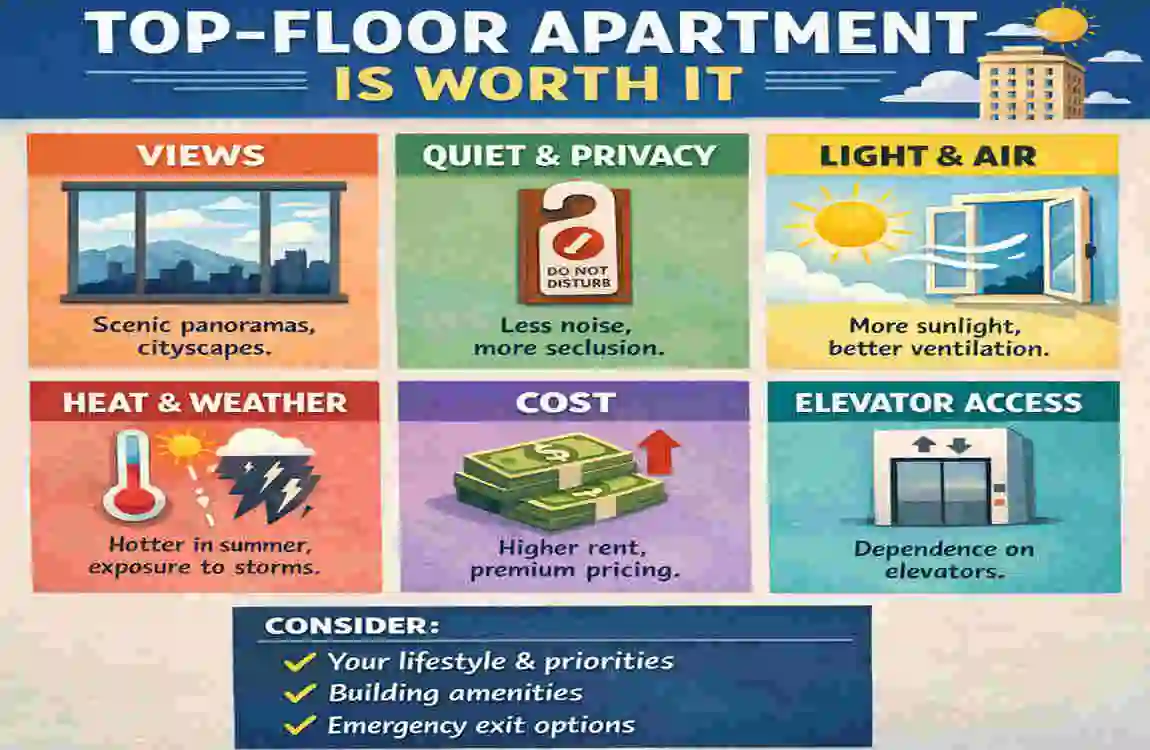
This is the real question you need to answer. The right choice is not just about price. It is about how the apartment fits your life.
Ask yourself the right lifestyle questions.
Before you pay more for the top floor, ask yourself:
- Do I really want privacy and views more than easy access?
- Am I comfortable depending on elevators?
- Will I be fine in a heat-prone apartment?
- Do I have children, older family members, or mobility concerns?
- Do I plan to live here long enough to enjoy the premium?
These questions matter because a top-floor apartment can feel amazing for one buyer and frustrating for another.
Check the building quality carefully.
This is one of the most important steps.
Do not assume every top-floor unit is a good purchase. Inspect the building quality, especially the roof, insulation, windows, and ventilation. Ask about past leaks, repairs, and complaints from current residents.
If the building is strong and well-maintained, the top floor becomes more attractive. If it is weak and poorly managed, the premium may not be worth it.
Compare total ownership cost, not just the purchase price.
A smart buyer looks at the full cost, not just the sticker price.
Think about:
- Purchase price
- Monthly maintenance fees
- Cooling or heating costs
- Possible repair issues
- Insurance or special building charges
- Resale potential later on
A cheaper unit can become expensive if it requires more energy, more repairs, or more patience than you expected.
Use negotiation wisely
If you like a top-floor apartment but feel the price is too high, do not be afraid to negotiate.
You can point out concerns like:
- Potential heat buildup
- Dependence on elevators
- Roof maintenance risk
- Possible repair costs
You can also ask for concessions such as better insulation, upgraded windows, maintenance guarantees, or a better payment plan. Even if the seller does not lower the price much, you may still improve the deal in other ways.
Quick Buyer Checklist for Top-Floor Apartments
If you want a simple way to judge a top-floor apartment, use this checklist before making an offer.
- Check the roof condition and ask about past leaks.
- Test the elevator and ask how often it goes out of service.
- Look at the sunlight at different times of day.
- Feel the temperature inside, if possible.
- Inspect window seals and insulation.
- Ask about maintenance fees and whether roof work is shared.
- Compare it with mid-floor options in the same building.
- Think about resale demand in your area.
If you can answer these points confidently, you will be in a much better position to decide whether the top floor is truly worth the premium.
FAQs: Common Questions About Top-Floor Apartments
Do top-floor apartments get hotter than lower floors?
Yes, they often do. The roof sits directly above them, allowing them to absorb more sunlight. This becomes more noticeable in warm climates or in buildings with weak insulation. Good ventilation, proper window design, and efficient cooling can reduce the problem, but you should still check it carefully before buying.
Are top-floor apartments always more expensive?
No, not always. They are often more expensive, but not every market or building follows that pattern. Older buildings, poorly insulated homes, or apartments in less desirable areas may not command a premium. In some cases, top-floor units may even sell for less if buyers worry about leaks, heat, or elevator access.
Are top-floor apartments safer than ground-floor units?
They can feel safer because they are farther from street-level access and less exposed to casual entry. That said, safety is not guaranteed by floor level alone. Building security, door quality, lighting, and management all matter. You should think of floor height as just one part of the safety picture.
Is a mid-floor apartment better than a top-floor apartment?
For many people, yes. Mid-floor units often offer a strong balance of price, comfort, and practicality. You may still get a good view and better privacy than the ground floor, without paying as much or dealing with the extra heat and maintenance risks that can come with the top floor.
Do top-floor apartments have higher resale value?
Sometimes they do, especially in luxury buildings or neighbourhoods where views and exclusivity matter a lot. But resale value is not guaranteed. In some markets, the premium narrows when the apartment is sold again. A top-floor unit may be desirable, but it still needs to match buyer demand in your area.
Are top-floor apartments noisy?
Usually, they are quieter than those on lower floors because there are no upstairs neighbours. However, they can still be affected by wind, rooftop equipment, nearby traffic, or elevator noise if the shaft is close by. So while they are often quieter overall, noise is not eliminated.
Is a top-floor apartment a good choice for families?
It can be, but it depends on the family. Some families love the extra privacy and views. Others find the elevator dependence inconvenient, especially with small children, groceries, or strollers. If you have elderly family members or mobility concerns, a mid-floor unit may be more practical.