
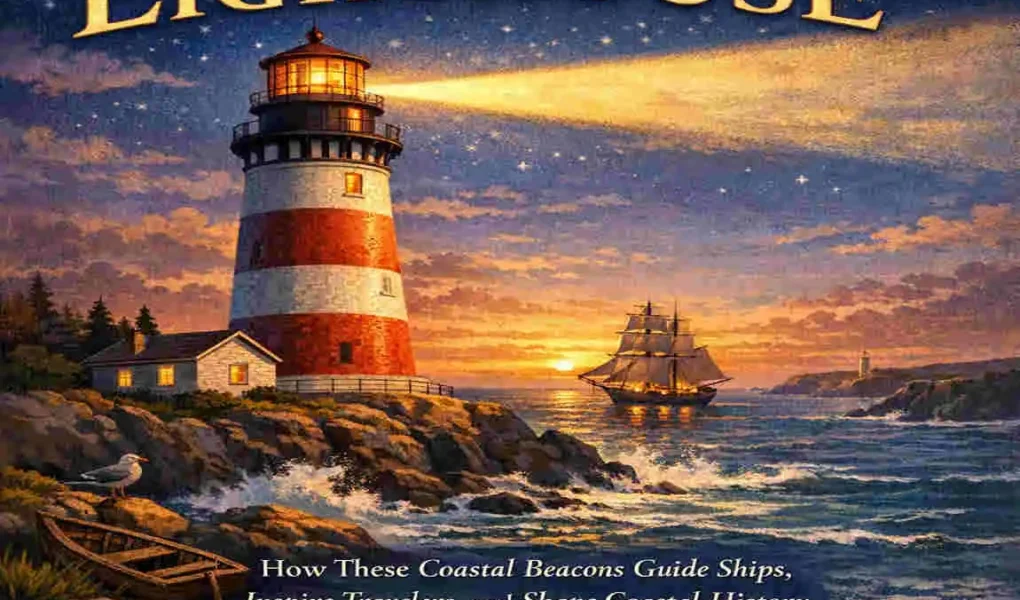
Standing on a jagged, wind-swept cliff at the very edge of the world. The air is heavy with the scent of salt and the chill of the ocean mist. Beneath you, massive waves crash violently against the dark rocks. Then, cutting through the thick, blinding fog, a brilliant beam of light sweeps across the dark water.
Have you ever felt that undeniable, magnetic pull toward a lighthouse? You are certainly not alone. For centuries, these towering structures have stood as ultimate symbols of hope, resilience, and safety. They are the silent guardians of the sea, watching over sailors in their darkest hours.
Today, over 18,000 lighthouses worldwide still stand proudly as coastal beacons. While modern technology has changed how we navigate the oceans, the magic of the lighthouse remains completely untouched. They no longer guide massive cargo ships and tiny fishing boats; they now inspire modern travellers, photographers, and history lovers to explore the edges of our continents.
The Engineering Marvels Behind Every Lighthouse
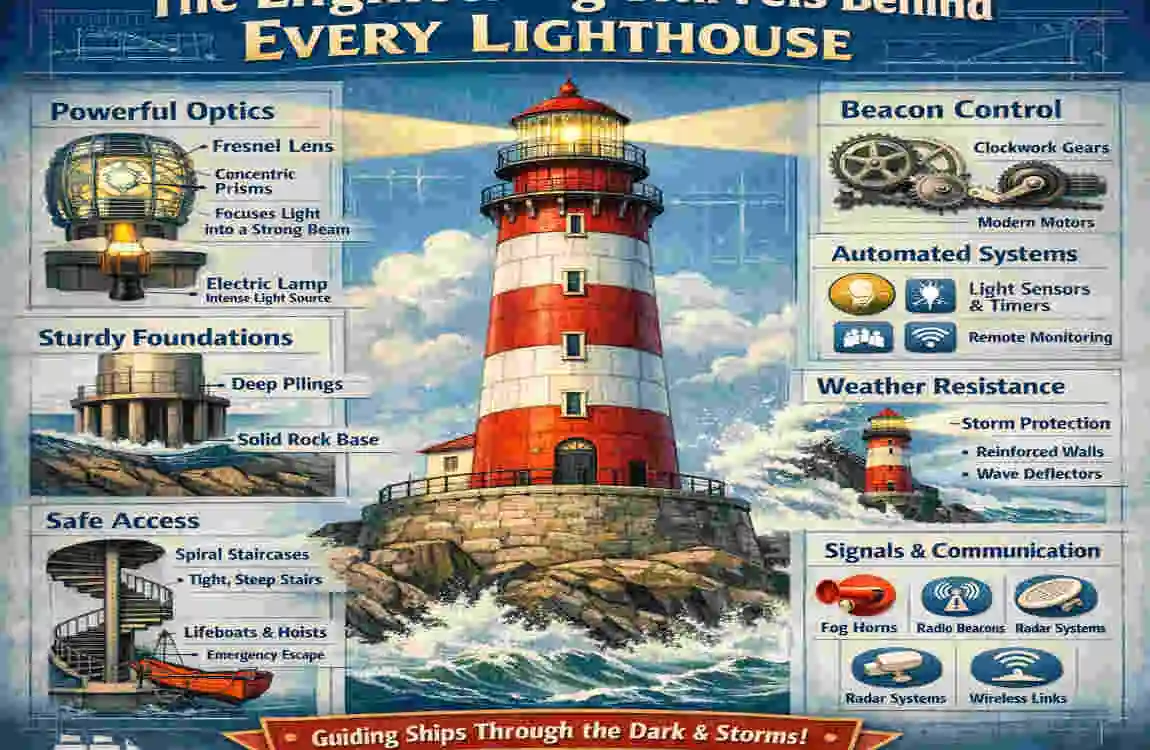
When you look at a towering lighthouse, you might see a beautiful building. But beneath that painted brick or cast iron exterior lies a true engineering masterpiece. Building a structure that can survive centuries of crashing waves, hurricane-force winds, and corrosive saltwater requires absolute genius.
Let’s break down the hidden mechanics and brilliant construction secrets that make these coastal beacons function.
How Lighthouses Work: Light, Lenses, and Illumination
At the very heart of every lighthouse is its light source and its lens. How does a simple light bulb manage to shine for miles across the open ocean? The secret lies in a brilliant invention called the Fresnel lens.
Invented in 1822 by French physicist Augustin-Jean Fresnel, this lens revolutionised lighthouse navigation. Think of the Fresnel lens as a giant, glowing glass beehive. Instead of just letting light scatter in all directions, this lens uses hundreds of perfectly angled glass prisms. These prisms capture the scattered light and bend it into a single, intensely focused, and powerful beam.
Because of this lens, a relatively small light source can be seen from over twenty miles away! The lens assembly was often placed on a rotating mechanism. In the early days, lighthouse keepers had to manually wind up heavy clockwork weights every few hours to keep the lens turning. This rotation is what creates the famous “flashing” effect, allowing sailors to identify specific lighthouses based on their unique flash patterns.
Take the Portland Head Light in Maine, for example. Over the decades, it has evolved from using smelly whale oil lamps to highly efficient, modernised LED upgrades. Yet, the core principle of focusing light to guide ships remains exactly the same.
Strategic Locations and Construction Secrets
Have you ever looked at a lighthouse perched on a tiny, wave-battered rock and thought, “How in the world did they build that?” The builders of these coastal beacons were fearless. They had to place lighthouses in the most dangerous, ship-wrecking locations imaginable.
Engineers specifically sought out hidden reefs, treacherous cliff sides, and shallow sandbars. To construct these towers, they used materials designed to defy the anger of the ocean. Early builders used heavy, interlocking blocks of solid granite. They designed the towers with a wider base that gently sloped upward, forcing the energy of massive waves to roll up the side of the tower rather than smashing directly into a flat wall.
Later, engineers began using skeletal iron structures. These open-framework towers look like metal spiderwebs. They are brilliant because they allow fierce wind and water to pass right through them, preventing the tower from being blown over in a hurricane.
Evolution of Lighthouse Technology
The story of the lighthouse is a story of constant human innovation. We have come a long way from burning piles of wood on a hillside.
To give you a clear picture of how this technology evolved, let’s look at a timeline of lighthouse innovations:
Time Period Primary Light Source Core Technology Used Visibility Range
1600s – 1700s Wood and Coal Open roaring fires in metal baskets 1 to 5 miles
Late 1700s Whale Oil Argand hollow-wick lamps with metal reflectors , 5 to 10 miles
1800s Kerosene / Lard The revolutionary Fresnel Lens and clockwork rotation 15 to 25 miles
1900s Electricity High-powered incandescent light bulbs 20+ miles
Modern Day Solar Power Automated, weather-proof LED arrays 20+ miles
As you can see, every leap in technology meant that fewer ships crashed on hidden rocks. The transition from open fires to solar-powered beacons today showcases our endless drive to conquer the dark and protect those at sea.
Lighthouse History: Beacons That Shaped Maritime Fate
To truly appreciate a lighthouse, we have to step back in time. Lighthouse history is filled with stories of towering ambition, tragic shipwrecks, and incredible bravery. These beacons did not just light up the night; they actively shaped the fate of maritime trade, navies, and global exploration.
Ancient Origins to Medieval Milestones
The concept of a coastal beacon dates back thousands of years. The most famous early example is the incredible Pharos of Alexandria. Built in Egypt around 280 BC, this massive structure is widely considered the world’s first true lighthouse. Standing at an estimated 330 feet tall, it was so magnificent that it was named one of the Seven Wonders of the Ancient World. A roaring fire at its peak guided ancient galleys safely into the busy port.
Later, the mighty Roman Empire realised the immense value of lighthouse navigation. As they conquered Europe, they built sturdy lighthouse towers along the coastlines of Spain, France, and England. One famous Roman tower, the Tour d’Ordre in France, guided ships across the English Channel for centuries.
The Golden Age: 18th and 19th Century Expansion
The true “Golden Age” of the lighthouse took place during the 1800s. Global trade was booming, but so were tragic shipwrecks. Governments realised they needed organised systems to protect their valuable cargo ships.
In 1789, the newly formed United States government created the U.S. Lighthouse Board to oversee the construction of coastal beacons along the treacherous Atlantic coast. Meanwhile, in Britain, a strict organisation known as Trinity House took charge of illuminating the dangerous British shorelines.
One of the most legendary stories from this era involves the Eddystone Lighthouse in England. The Eddystone Rocks were a notorious ship-killer. Building a lighthouse there seemed impossible. The first two wooden lighthouses built on the rocks were destroyed—one by a horrific storm that washed the tower and its inventor away, and the other by a massive fire.
Finally, a brilliant engineer named John Smeaton stepped in. He modelled his new stone lighthouse after the trunk of a mighty oak tree, giving it a wide base that curved upward. His interlocking granite blocks survived the wildest storms the ocean could throw at them, setting the standard for all rock lighthouses that followed.
20th Century Decline and Historical Preservation
As we moved into the late 20th century, the lonely life of the lighthouse keeper came to an end. In the 1960s and 1970s, widespread automation took over. Computers, timers, and automatic bulb-changers replaced the men and women who used to polish the brass and trim the wicks.
While this was a victory for efficiency, it left many historic lighthouses abandoned and decaying. Fortunately, passionate local communities stepped in. They refused to let these beautiful towers crumble into the sea.
Today, preserving lighthouse history is a massive global effort. Many towers have been designated as protected UNESCO World Heritage sites. In America alone, there are over 700 U.S. lighthouses proudly listed on the National Register of Historic Places. Thanks to preservationists, you and I can still climb these steps and touch the history etched into the walls.
Iconic Lighthouses Around the World: Must-Visit Coastal Gems
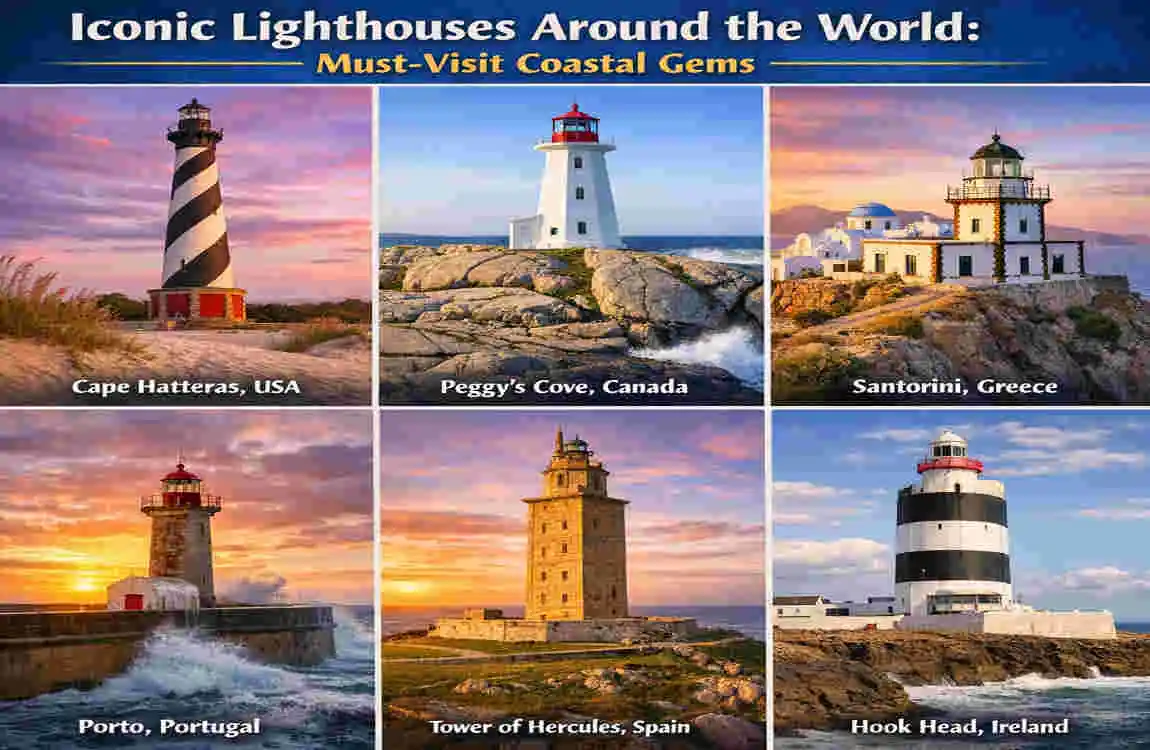
Are you ready to pack your bags? If you love dramatic scenery and rich history, you need to visit these famous lighthouses. From the rocky shores of Scotland to the sunny coasts of California, here is a traveller-focused list of the most incredible coastal gems on Earth.
Europe’s Timeless Towers
Europe is home to some of the oldest and most dramatically placed lighthouses in the world.
The Bell Rock Lighthouse (Scotland). Located off the coast of Scotland, Bell Rock is the world’s oldest surviving sea-washed lighthouse. Built by Robert Stevenson (the grandfather of the famous author Robert Louis Stevenson), this tower is an offshore engineering wonder. It sits on a reef that is completely submerged during high tide. When you see it, it looks as though the tower is floating magically on the surface of the North Sea.
La Jument (France) If you want wave-battered drama, look no further than La Jument in Brittany, France. You might actually recognise this lighthouse from a world-famous photograph taken in 1989. In the photo, the lighthouse keeper stands casually in the open doorway while a monstrous, eighty-foot wave wraps completely around the tower behind him. For photographers and thrill-seekers, seeing La Jument during a winter storm is an absolute dream. Traveller Tip: The best sunset views of La Jument can be seen by taking a local boat charter from the nearby coastal villages.
America’s Dramatic Coastal Beacons
The United States boasts a stunning variety of lighthouses, each with its own distinct personality and local legends.
Cape Hatteras Lighthouse (North Carolina), known famously as “Blackbeard’s Lighthouse,” protects ships from the Graveyard of the Atlantic. Its bold, black-and-white spiral stripes make it one of the most recognisable towers in the world. Because of severe beach erosion, engineers had to lift this massive, 4,800-ton brick structure in 1999 and slowly roll it half a mile inland! When you visit, you are standing in the very waters where the infamous pirate Blackbeard once sailed.
Pigeon Point Lighthouse (California) Perched gracefully on a cliff south of San Francisco, Pigeon Point is tied for the tallest West Coast lighthouse. It stands 115 feet tall and offers breathtaking views of the Pacific Ocean. During the annual whale migration, you can stand at the base of this tower and watch grey whales breaching in the water below.
Global Hidden Treasures
If you want to step off the beaten path, there are incredible lighthouses tucked away in lesser-known corners of the globe.
Kõpu Lighthouse (Estonia) Tucked away in the forests of Hiiumaa island, Kõpu is a true ancient survivor. Built in the early 1500s, it is one of the oldest continuously operating lighthouses on the planet. Unlike modern, slender towers, Kõpu looks like a massive, square stone fortress. It was built heavy and thick to support the massive bonfires that keepers used to light on its roof.
Les Éclaireurs (Argentina) Nicknamed the “Lighthouse at the End of the World,” Les Éclaireurs sits in the freezing, windy waters of the Beagle Channel near Ushuaia, Argentina. Painted in striking red and white bands, it stands against a backdrop of towering, snow-capped mountains. Taking a catamaran cruise to see this beacon is a highlight for anyone travelling to Patagonia.
Lighthouses in Pop Culture: From Literature to the Silver Screen
Lighthouses do much more than guide ships; they capture our collective imagination. There is something inherently mysterious and romantic about a solitary tower at the edge of the world. Because of this, lighthouses have served as a massive source of inspiration for artists, writers, and filmmakers.
The Lighthouse as a Literary and Artistic Muse
Writers have long used the lighthouse as a symbol of isolation, longing, and illumination. The most famous example is Virginia Woolf’s masterpiece, To the Lighthouse. In her novel, the lighthouse represents an unreachable goal and the passage of time, forever flashing its light across the dark water.
In the art world, classic painters were equally obsessed. The legendary British landscape painter J.M.W. Turner painted dozens of dramatic maritime scenes featuring lighthouses. He expertly captured the terrifying contrast between the violent, dark, uncontrollable ocean and the warm, steady, artificial light fighting against it.
Film and Modern Media Stars
Hollywood loves a good lighthouse. These coastal beacons provide the perfect, isolated setting for both thrilling horrors and heartwarming romances.
Recently, the 2019 psychological thriller The Lighthouse, starring Willem Dafoe and Robert Pattinson, showed the terrifying, maddening side of living in total isolation. The film perfectly captured the harsh, gritty reality of 19th-century lighthouse keeping, where the deafening foghorn and crashing waves could slowly drive a person insane.
On a lighter note, who could forget the beautiful running montage in the movie Forrest Gump? When Forrest runs from coast to coast, he reaches the Atlantic Ocean at the gorgeous Marshall Point Lighthouse in Maine. That iconic wooden runway leading up to the light is now a massive tourist attraction for movie fans.
Traveller Stories: Personal Lighthouse Quests
Beyond movies and books, everyday travellers create their own beautiful stories at these coastal beacons. People plan massive cross-country road trips specifically to visit as many lighthouses as they can.
Because lighthouses represent a guiding light and enduring strength, they have also become incredibly popular spots for romantic marriage proposals. Picture yourself getting down on one knee at sunset, with a historic lighthouse behind you and the ocean stretching out forever. It is the ultimate romantic setting.
The Modern Role of Lighthouses: Beyond Navigation
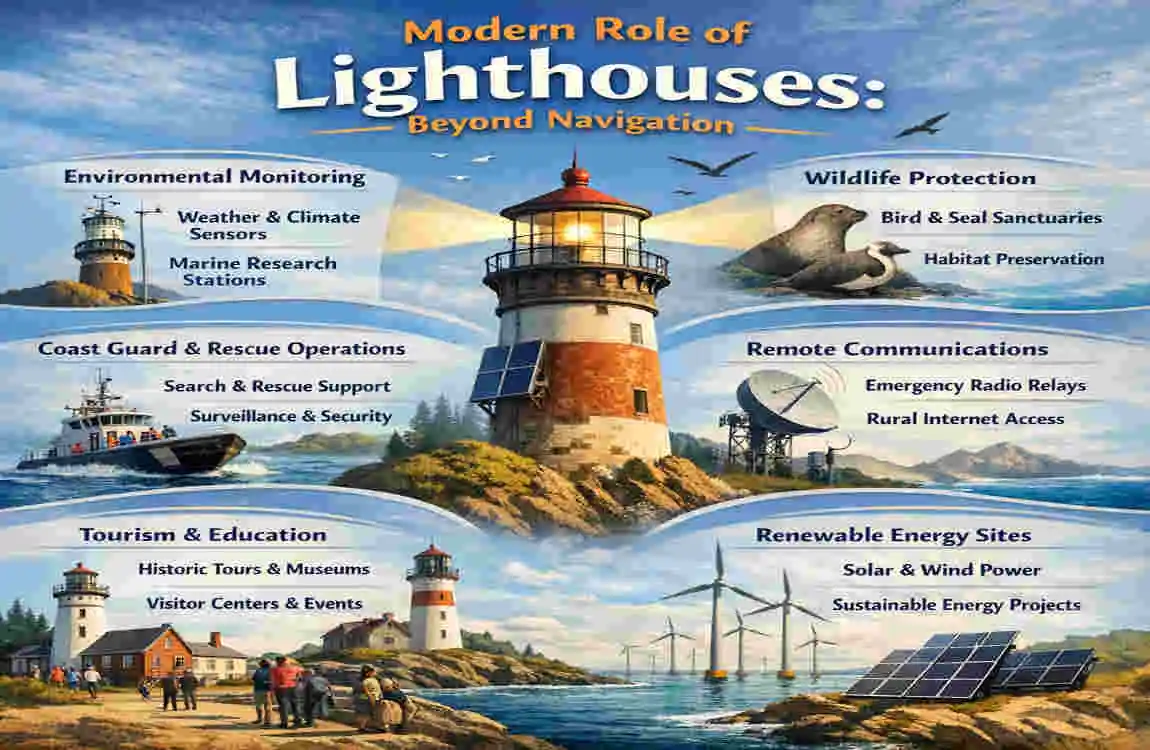
You might be asking yourself, “With modern technology like GPS, do we actually still need lighthouses?”
The answer is a resounding yes! However, the daily job description of a modern lighthouse has evolved significantly. Let’s look at the fascinating lighthouse secrets of the 21st century.
Safety and High-Tech Upgrades Today
While giant cargo ships have digital maps, technology can always fail. Batteries die, screens break, and satellites lose connection. In these emergency moments, a physical, visual beacon is absolutely priceless.
Today, modern lighthouses serve as vital GPS backups. Many are now integrated with AIS (Automatic Identification Systems), broadcasting electronic signals to ship dashboards. Furthermore, many towers have been repurposed into high-tech weather stations. They house automated sensors that monitor wind speed, barometric pressure, and wave height, sending crucial storm warnings back to the mainland to protect coastal communities.
Tourism and Eco-Tourism Hotspots
With the original keepers long gone, lighthouses have found a new life as massive hubs for tourism.
Did you know that you can actually sleep inside a lighthouse? Across the Great Lakes, particularly in Michigan, several historic lighthouses have been transformed into incredibly charming bed-and-breakfasts. You can volunteer to be a “keeper” for a weekend, sleeping in the historic quarters and watching the ships pass by your window.
They are also prime locations for eco-tourism. Because lighthouses are situated in remote, untouched coastal areas, they are perfect for birdwatching. Millions of migratory birds use coastlines to navigate, and lighthouse grounds often serve as protected wildlife sanctuaries.
Conservation Challenges and How You Can Help
Despite their popularity, lighthouses face serious threats today. The biggest enemy is coastal erosion. Rising sea levels and increasingly violent storms are eating away at the cliffs these towers stand upon. Furthermore, maintaining historic brick and iron in a corrosive saltwater environment requires constant, expensive funding.
So, how can you help? Travellers can make a huge difference. You can participate in local “Lighthouse Challenge” events, where visitors buy tickets to climb multiple towers in a single weekend. The proceeds go directly to restoration funds. Simply by visiting, paying a small entry fee, and buying a souvenir from the gift shop, you are actively helping to save lighthouse history.
Visiting Lighthouses: Your Traveller’s Guide to Coastal Adventures
Are you feeling inspired to plan your own coastal adventure? Visiting a lighthouse is a fantastic experience, but a little bit of planning goes a long way. Here is your ultimate traveller’s guide to making the most of your trip.
Top Tips for Planning Your Lighthouse Trips
Before you hop in the car and drive to the coast, make sure you are prepared. Keep these essential tips in mind:
- Check the Climbing Schedule: Not all lighthouses are open to the public every day. Some only allow visitors to climb the tower during the summer months or on specific weekends. Always check their official website before you travel.
- Pack Smartly for the Coast: Coastal weather is notoriously unpredictable. Even if it is sunny inland, it can be freezing and windy at the lighthouse. Pack windbreakers, wear rubber-soled shoes (lighthouse stairs are steep and slippery), and bring a hair tie!
- Download the Right Apps: Use digital tools like the Lighthouse Directory app to find hidden beacons near your travel destination.
- Bring a Good Camera: Lighthouses are a photographer’s dream. Try to visit during “Golden Hour” (just after sunrise or just before sunset) for the most magical, glowing lighting.
Budget Adventures vs. Luxury Experiences
The beauty of lighthouse tourism is that it fits absolutely any budget.
If you want a budget-friendly adventure, simply visiting the grounds of a lighthouse is usually completely free. You can pack a picnic, hike the surrounding coastal trails, and enjoy the stunning exterior architecture without spending a dime. Climbing the tower usually only costs a few dollars.
If you are looking for a luxury experience, you can book VIP guided tours. Some locations offer exclusive nighttime ghost tours, catered sunset dinners at the top of the tower, or even private helicopter tours that fly you over offshore lighthouses that cannot be reached by boat.
FAQs: Quick Answers on Lighthouses
To wrap up our journey, let’s answer some of the most common questions people ask about these fascinating structures.
What is the oldest lighthouse still in use? The Tower of Hercules in Coruña, Spain, holds the title of the oldest existing lighthouse. Built by the ancient Romans in the 1st century, it still stands today! Meanwhile, the Kõpu Lighthouse in Estonia is famous for being one of the oldest continuously operating lighthouses, having been active since the 1530s.
How do lighthouses guide ships today? While physical light beams are still used as visual aids, modern lighthouses are high-tech hubs. They are equipped with automated, solar-powered LED lights, fog horns, and electronic Automatic Identification Systems (AIS) that beam direct signals to the digital navigation dashboards of passing ships.
Which is the tallest lighthouse in the world? When discussing traditional lighthouses, it can be tricky depending on how you measure them. The Jeddah Light in Saudi Arabia is widely considered the absolute tallest at 436 feet (133 meters). However, other massive beacons like the Faro de Punta Maysi in Cuba are often celebrated regionally for their immense size and striking presence on the coastline.
Are there still lighthouse keepers? For the most part, no. Widespread automation in the late 20th century eliminated the need for traditional, full-time keepers. However, some remote or historic lighthouses still employ caretakers to maintain the grounds, give tours, and monitor the automated equipment.
Can I visit and sleep in a lighthouse? Yes! Many historic lighthouses around the world, especially in the United States, the UK, and Europe, have been converted into stunning coastal bed-and-breakfasts, allowing travellers to experience a taste of the keeper’s life.