
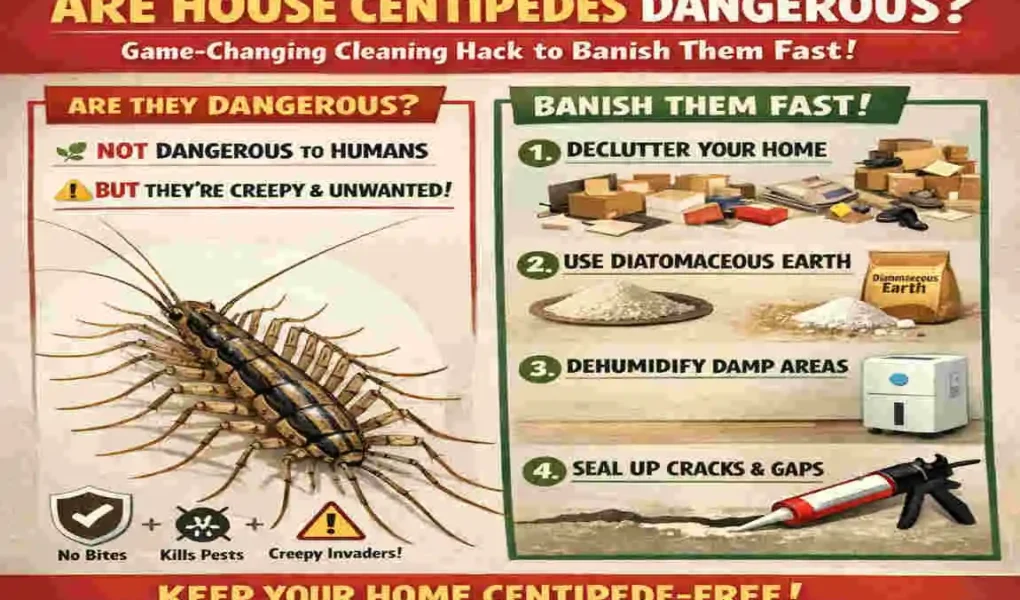
It is 2:00 AM. You have just woken up with a dry throat, stumbling into the kitchen for a glass of water. You flick on the light switch, and there, scuttling across your pristine floorboards at what looks like the speed of light, is a creature that seems to be made entirely of legs and nightmares. It is fast, it is erratic, and it triggers a primal “fight or flight” response that leaves you clutching your chest. If this sounds familiar, you have officially met the house centipede.
However, knowing they are “good guys” does not mean you want them as roommates. I get it—they are creepy. That is why this guide isn’t just about reassurance; it is about action. We are going to dive deep into a game-changer cleaning hack involving natural ingredients that will banish them fast without turning your home into a toxic waste dump.
House Centipede Basics: Know Your Enemy
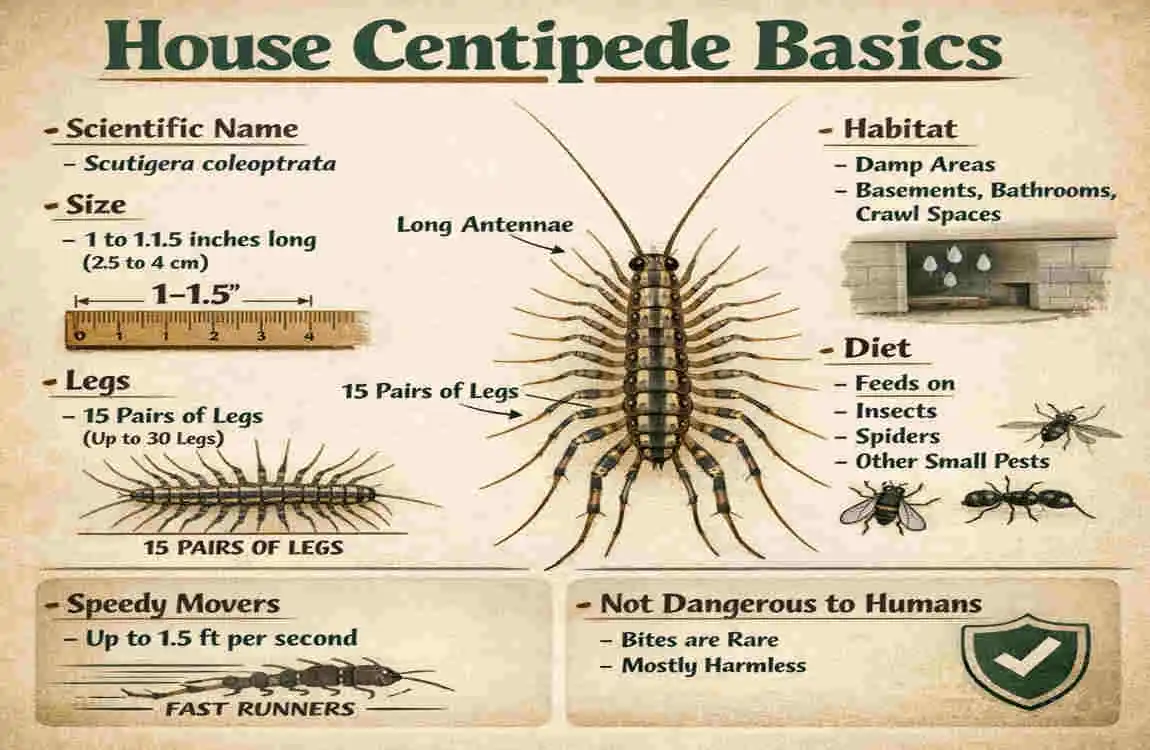
To effectively manage any pest, you first have to understand what makes them tick. The house centipede, scientifically known as Scutigera coleoptrata, is a fascinating creature, even if it is terrifying to look at. Unlike the slower, worm-like millipedes that curl up when scared, the house centipede is built for speed and hunting.
The Appearance: A Leggy Nightmare
Let’s talk about the elephant in the room—or rather, the monster in the basement. The most distinct feature of the house centipede is its legs. An adult female can have up to 15 pairs of legs. That is 30 legs in total, rippling in a wave-like motion that allows them to reach speeds of 1.3 feet per second. To put that in perspective, if they were human-sized, they would be running at incredible highway speeds.
Their bodies are usually a yellowish-grey with three dark stripes running down the length of their backs, while their legs are banded with dark stripes. They also possess incredibly long antennae that help them sense their environment and prey in the dark. Interestingly, their back legs are often as long as their antennae, making it difficult at a quick glance to tell which end is the head and which is the tail. This biological design is intentional—it confuses predators (and homeowners) just long enough for the centipede to dart away.
Lifecycle and Growth
House centipedes do not start out with all those legs. They go through a metamorphosis that is quite unique. When they hatch from eggs, they are larvae with only four pairs of legs. As they grow and molt (shed their exoskeleton), they gain more leg pairs. They go through several molts before reaching adulthood.
This lifecycle matters to you because it dictates how long they stick around. House centipedes are surprisingly long-lived for arthropods. While a housefly might annoy you for a few weeks, a house centipede can live anywhere from three to seven years. That means the big one you saw in the laundry room could technically be a long-term tenant if you don’t take action.
Preferred Habitats
Why do they choose your house? Specifically, why the basement or the bathroom? The answer is simple: hydration. House centipedes lack the waxy cuticle that helps other insects (like spiders or roaches) retain moisture. This means they are prone to drying out and dying rapidly if they are not in a humid environment.
This biological limitation forces them to seek out the dampest, darkest parts of your home. You will most frequently encounter them in:
- Basements and Cellars: The cool, damp concrete provides the perfect humidity levels.
- Bathrooms: specifically near drains, tubs, or leaky sinks.
- Garages: especially if they are uninsulated or have stored cardboard boxes.
- Laundry Rooms: The heat and moisture from washers and dryers create a spa-like environment for them.
Are House Centipedes Dangerous? The Truth Behind the Fear
This is the big question. We have established that they look like something out of a horror movie, but are house centipedes dangerous to you, your children, or your furry friends? Let’s break down the facts, the venom, and the bite risks to clear up the confusion.
Venom Facts: Built for Bugs, Not People
Technically speaking, yes, house centipedes are venomous. They possess a pair of modified front legs called forcipules. These look like pincer-like fangs located near the head. They use these forcipules to inject venom into their prey.
However, it is crucial to understand the scale here. Their venom is designed to paralyze small invertebrates—silverfish, crickets, roaches, and spiders. It is a potent neurotoxin for a bug that weighs a fraction of a gram. For a human who weighs 150 pounds? It is negligible. The strength of their forcipules is rarely enough even to pierce human skin.
Bite Risks and Symptoms
Bites from house centipedes are incredibly rare. Unlike mosquitoes or bed bugs, they do not feed on humans. Unlike wasps, they are not aggressive and territorial. A house centipede will almost always choose to run away rather than fight. A bite usually only happens if you accidentally squash one with your bare hand or step on one with your bare feet.
If you are unlucky enough to get bitten, the sensation is often compared to a minor bee sting. You might experience:
- Redness: A small red spot at the bite site.
- Itching: Similar to a mosquito bite as it heals.
- Mild Swelling: This usually subsides within a few hours to a day.
There is no risk of necrosis (flesh-eating wounds) or severe systemic reactions that you might worry about with something like a Brown Recluse spider. Serious allergic reactions are theoretically possible but are vanishingly rare in medical literature.
Safety for Pets
What about your curious cat or dog who loves to chase anything that moves? Generally, house centipedes are safe for pets. If your cat catches and eats one, the venom is not poisonous when ingested (venom must be injected into the bloodstream to work). The centipede might taste bad, and the legs might be ticklish going down, but it won’t harm your pet.
Comparison: House Centipede vs. Other Pests
To put your mind at ease, let’s look at how the house centipede stacks up against other common house guests.
Bite Type Pain Level Duration Risks
House Centipede Mild 1-2 days Minor swelling, itching. No long-term damage.
Wolf Spider Moderate 3-5 days Pain, potential for infection if scratched.
Bee Sting Sharp/Moderate 1-3 days Sharp pain, risk of severe allergic reaction (anaphylaxis).
Bed Bug None initially 1 week+ Intense itching, psychological stress, difficult infestation.
Mosquito Mild 3-4 days Itching, vector for diseases (West Nile, Zika).
As you can see, in the grand scheme of household pests, the house centipede is arguably the least dangerous to your health, despite being the scariest to behold.
Why They Invade Homes
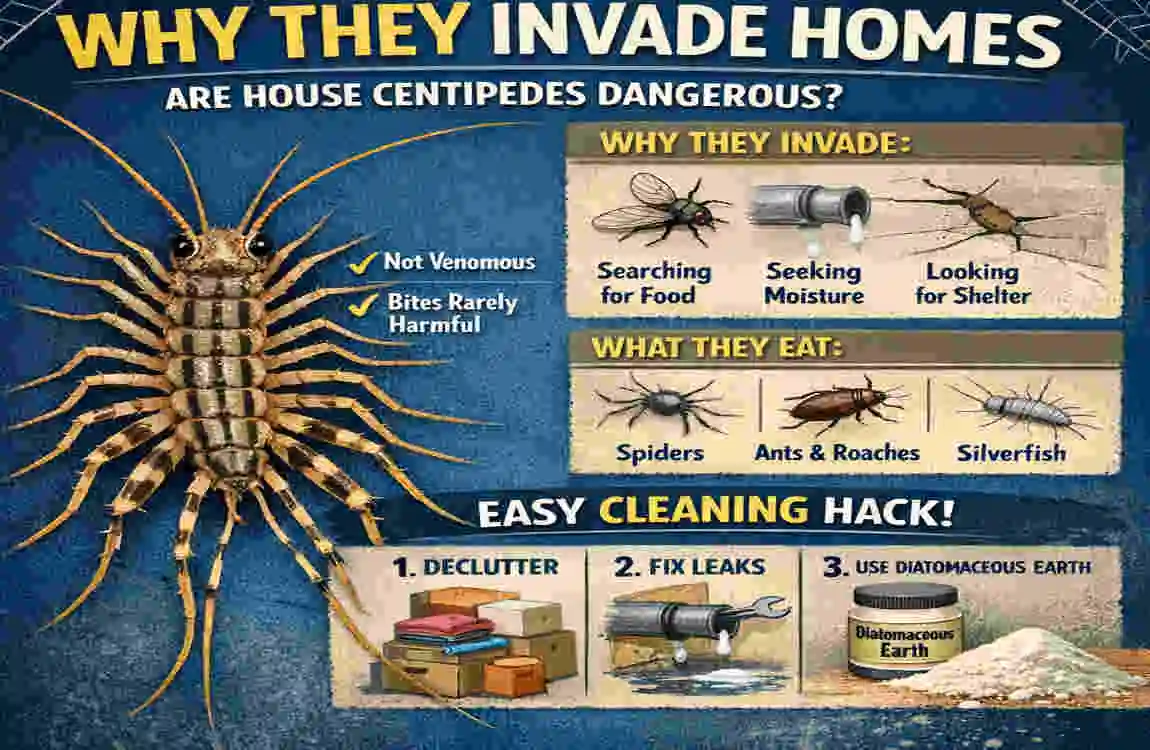
If you are seeing house centipedes, it is not just bad luck. There is a reason they have moved in. Understanding the “why” is the first step toward the “how” of getting rid of them. Generally, their presence signals an underlying issue in your home ecosystem.
The All-You-Can-Eat Buffet
The number one reason house centipedes are in your home is that there is food available. House centipedes are apex predators of the insect world. They are hunting machines. If you have a large population of centipedes, it is a strong indicator that you have a large population of other pests that they are eating.
They feed on:
- Silverfish: These love damp paper and glue.
- Cockroaches: A homeowner’s worst nightmare.
- Ants: Common kitchen invaders.
- Spiders: Yes, centipedes even eat spiders.
- Termites: They can be helpful in spotting a termite issue.
In a way, the centipede is providing a free pest control service. However, if you eliminate their food source (the other bugs), the centipedes will have no reason to stay and will either leave or die off.
Moisture and Humidity
As mentioned earlier, they need moisture to survive. A dry house is a death sentence for a house centipede. They are often drawn to homes with:
- Leaky pipes under sinks.
- Condensation on windows.
- Damp basements without dehumidifiers.
- Poorly ventilated bathrooms.
Seasonal Spikes
You might notice more of them during specific times of the year. In the spring, they come out to mate. In the fall, as the temperature outside drops, they migrate indoors seeking warmth and shelter to overwinter. They are smart enough to know that your heated living room is a better place to spend December than under a frozen rock in the garden.
Game-Changing Cleaning Hack: DE + Vinegar
Now, we get to the solution you have been waiting for. You want them gone, but you probably don’t want to spray harsh industrial neurotoxins all over the floor where your kids play, or your dog sleeps.
The focus keyword here is the ” house centipedes dangerous cleaning hack, and it revolves around a two-pronged attack using Diatomaceous Earth (DE) and a Vinegar/Peppermint spray. This method utilizes mechanical killing (physics) rather than chemical poisoning, making it safer for mammals but deadly for bugs.
The Preparation
Before you unleash the hack, you have to prep the battlefield.
- De-clutter: Pick up piles of laundry, move boxes off the floor, and clear out the corners of the basement. Centipedes love clutter because it provides hiding spots.
- De-humidify: Run a dehumidifier in the basement or trouble areas for 24 hours prior. Drying out the air stresses the centipedes and makes them more vulnerable to the treatment.
Diatomaceous Earth (The Barrier)
Diatomaceous Earth is a powder made from the fossilized remains of tiny aquatic organisms called diatoms. To us, it feels like soft flour. To a centipede (or any insect with an exoskeleton), it is like walking through shards of broken glass.
- How it works: When the centipede crawls over the powder, the microscopic sharp edges cut their protective waxy outer layer. This causes them to leak body fluids and dry out (desiccate), leading to death. They cannot build an immunity to this because it is a physical injury, not a chemical one.
- How to apply: Buy Food-Grade DE: Ensure you get “Food Grade” and not “Pool Grade” (which is dangerous to inhale).
- Dust the Perimeters: Use a duster or a spoon to lightly sprinkle the dust along baseboards, in corners, behind the toilet, and under appliances.
- Focus on Entry Points: Dust the thresholds of doors and window sills.
The Vinegar & Peppermint Spray (The Repellent)
While DE kills the ones that walk through it, the spray repels new ones and disrupts their hunting trails.
-
- The Recipe:1 cup of White Vinegar
- 1 cup of Water
- 15-20 drops of Peppermint Essential Oil
- 1 Spray Bottle
- Why it works: Vinegar contains acetic acid, which is an irritant to centipedes and destroys the scent trails they use to navigate. Peppermint oil contains menthol, which is a powerful natural insecticide and repellent. Most bugs, including centipedes and spiders, hate the smell of strong peppermint.
- How to apply: Shake the bottle well. Spray directly on baseboards, around cracks and crevices, and in dark corners. Note: Be careful spraying vinegar on natural stone or unsealed hardwood, as the acid can etch it. Test a small spot first.
Why This Hack Wins
Comparing this method to standard chemical sprays highlights why it is a game-changer:
Method Speed Safety Cost Long-Term Effect
DE + Vinegar Hack 3-7 days High (Food Grade) Low Excellent (DE stays active)
Chemical Sprays 1-3 days Medium/Low High Poor (Dissipates quickly)
Exterminator Immediate Varies Very High Good
Additional Removal Tips
Sometimes, an infestation is stubborn, or you want to throw everything you have at the problem. Here are a few extra tools for your arsenal.
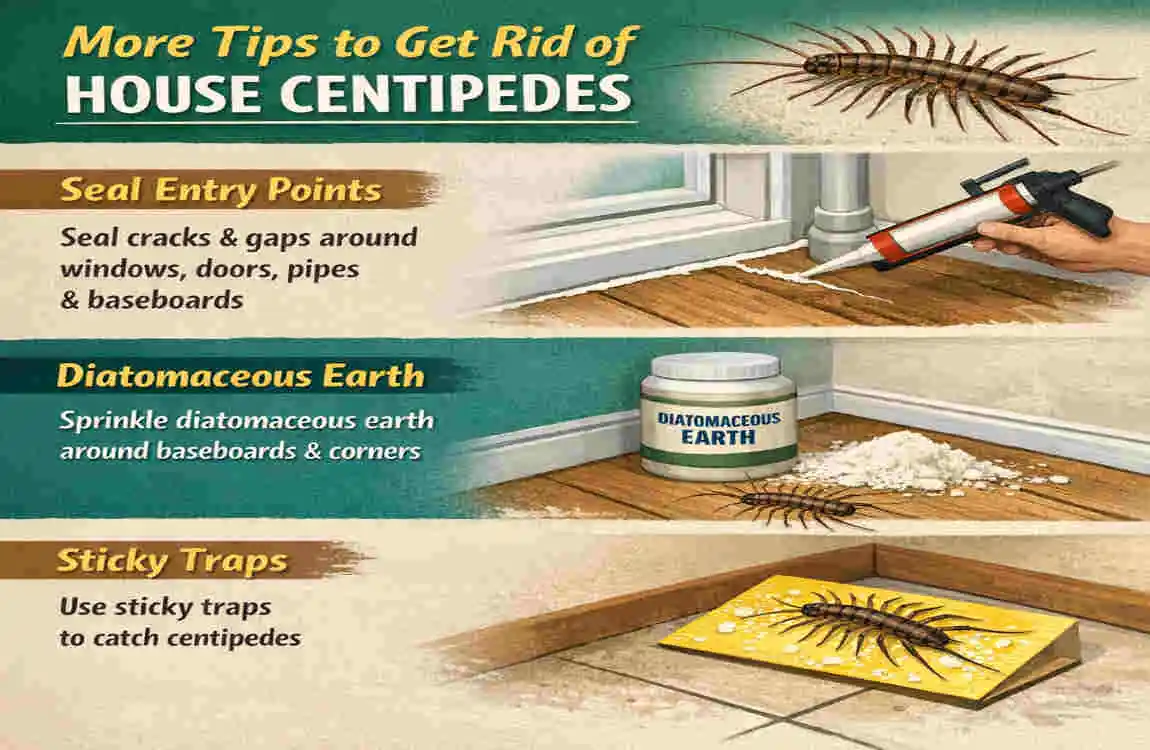
Sticky Traps
These are simple, non-toxic, and effective. Place “glue boards” or sticky traps in the corners of your basement or along the walls.
- The Strategy: Centipedes run along walls (thigmotaxis). Placing traps flush against the baseboard guarantees you catch traffic.
- The Bonus: These traps also catch the spiders and roaches that the centipedes are eating, helping to break the food chain.
The Vacuum Method
If you see a centipede and cannot bring yourself to squash it (or fear it running up your leg), the vacuum is your best friend.
- High Power: Suck them up using the hose attachment. The force of the air and the tumbling into the canister usually kills them instantly.
- Disposal: Empty the canister into an outdoor trash bin immediately, just in case one survives the ride.
Natural Repellents
Beyond peppermint, there are other scents that centipedes despise.
- Tea Tree Oil: Very potent. Apply a few drops to cotton balls and leave them in damp corners. (Warning: Tea Tree oil is toxic to dogs and cats if ingested, so use with caution.
- Cedar Wood: Use cedar blocks or shavings in your closets. It repels moths and silverfish (the food) as well as the centipedes.
When to Call a Pro
If you are seeing house centipedes daily, or if you see them in every room of the house, you might have a severe infestation of the prey insects. At this point, the centipedes are just a symptom of a larger rot or infestation problem. If the DIY hack doesn’t reduce numbers after two weeks, consider calling a professional pest control service to inspect for hidden colonies of carpenter ants or termites.
Prevention Long-Term: Keep Them Out for Good
You have used the hack, you have vacuumed up the stragglers, and your home is centipede-free. How do you keep it that way?
Home Maintenance
- Seal the Envelope: Go around the exterior of your house with a caulk gun. Seal gaps around pipes, cracks in the foundation, and spaces around windows. If a pencil can fit in the crack, a centipede can fit in easily.
- Fix Leaks: That dripping faucet under the bathroom sink isn’t just wasting water; it’s a watering hole for bugs. Fix it immediately.
- Install Door Sweeps: Put rubber sweeps on the bottom of all exterior doors to close the gap between the door and the threshold.
Yard Upkeep
- Move the Mulch: Mulch holds moisture and is a favorite habitat for centipedes. If you have mulch touching your home’s foundation, rake it back at least 12 inches. Create a “dry zone” around your house.
- Clear debris: Remove piles of leaves, rocks, or wood from near your foundation.
Monitoring
Make it a habit to inspect your basement and dark corners once a month. Keep a few sticky traps down as “monitors.” If they stay empty, you are good. If they start filling up, it is time to redeploy the DE and Vinegar hack.
FAQ Section
Q: Are house centipedes dangerous to humans? A: No, not really. While they are venomous, their venom is too weak to harm humans significantly. A bite is rare and typically feels like a mild bee sting, causing only temporary redness or itching.
Q: What is the best house centipede cleaning hack? A: The most effective natural hack is a combination of reducing humidity, applying food-grade Diatomaceous Earth (DE) to corners and baseboards, and using a vinegar and peppermint oil spray to repel them.
Q: Do house centipedes harm pets? A: Rarely. They are generally safe around cats and dogs. Even if a pet eats one, the venom is not poisonous when ingested. However, you should discourage pets from playing with them to avoid the slight chance of a defensive nip.
Q: Why do I suddenly have so many centipedes? A: A sudden surge usually indicates two things: a high moisture level in your home (perhaps a new leak) and an abundance of food (other pests like roaches or ants). They are there because the hunting is good.