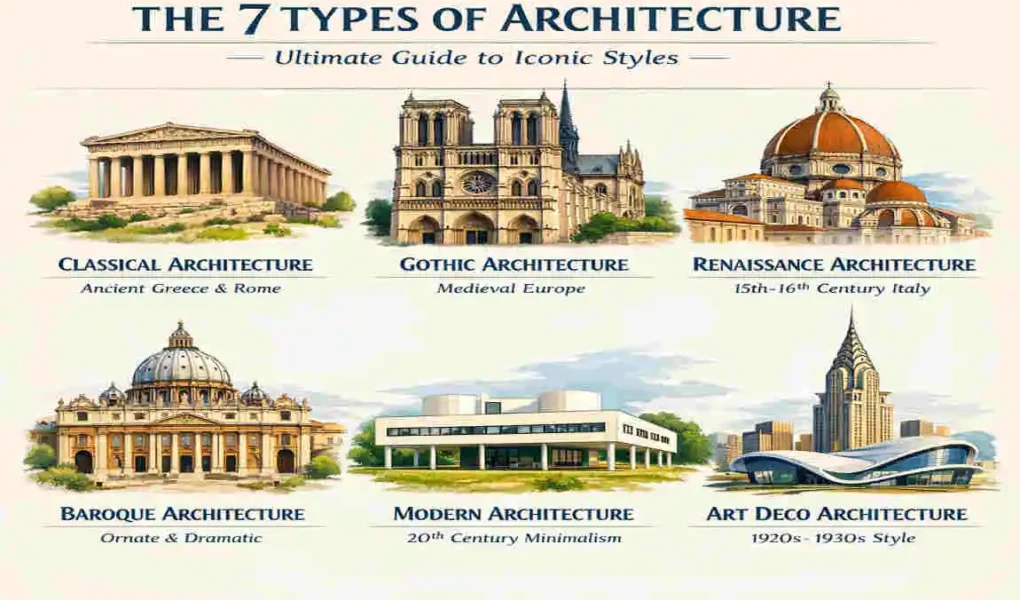
Ever wondered what are the 7 types of architecture that have shaped our world’s skylines? You have likely walked past buildings that made you stop and stare, wondering about the story behind those towering columns or that intricate stonework. Architecture is more than just shelter; it is a visual history book that tells us how people lived, what they valued, and how they dreamed.
From the ancient temples of Greece to the sleek glass skyscrapers of today, architectural styles have evolved dramatically. But if you want to understand the built environment around you truly, you need to know the “Big 7.” When experts and enthusiasts ask what the 7 types of architecture are, they generally refer to these distinct movements: Classical, Gothic, Renaissance, Baroque, Neoclassical, Modern, and Postmodern.
Why Understanding the 7 Types of Architecture Matters Today
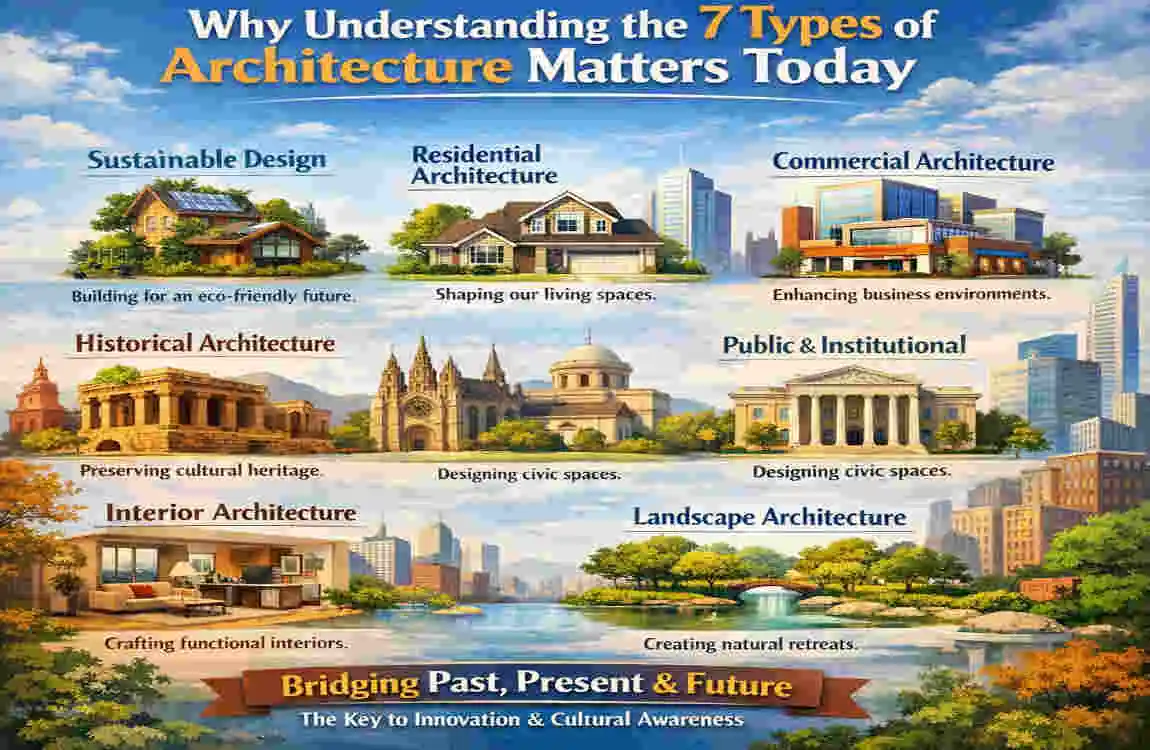
Before we break down what are the 7 types of architecture, it is important to understand why we should care about old buildings in the first place. The evolution of architecture isn’t just a timeline of construction; it is a timeline of human innovation. From the moment we moved out of caves, we have been trying to impose order and beauty on our environment.
Knowing these styles enhances your life in surprising ways. Have you ever traveled to a new city and felt overwhelmed? When you understand the architectural context, a walk through Rome or Paris becomes a conversation with the past. You stop seeing just “old buildings” and start seeing the political power of the Roman Empire or the religious fervor of the Middle Ages.
But let’s bring it closer to home. Modern applications of these ancient principles are everywhere. Sustainable building practices often look back to the thick walls of ancient structures for ideas on insulation, and urban planners use Renaissance concepts of symmetry to create walkable cities.
Here is why sharpening your architectural eye is beneficial:
- Cultural Heritage Preservation: You become an advocate for saving history when you understand its value.
- Interior Design Trends: Many current trends are throwbacks. For example, the “Dark Academia” aesthetic is heavily influenced by Gothic libraries, and the “Cottagecore” trend often borrows from rustic vernacular styles.
- Real Estate Value: Homes that authentically mimic iconic styles—like a true Craftsman or a well-executed Neoclassical colonial—often sell faster and for higher prices because they have “character.”
Classical Architecture: The Timeless Foundation
When we ask, “What are the 7 types of architecture?” we must begin at the source. Classical architecture is the mother of them all, the foundation upon which Western building traditions stand.
Origins and Historical Context
The roots of Classical architecture dig deep into the soil of Ancient Greece and Rome, spanning roughly from the 5th century BC to the 3rd century AD. This was an era where the pillars of democracy and empire were being established. The Greeks focused on harmony, order, and honoring their gods, while the Romans took those ideas and engineered them into massive structures to manage their sprawling empire.
It wasn’t just about stacking rocks; it was about math and philosophy. They believed that beauty was objective and could be achieved through perfect proportions.
Key Characteristics
You can spot Classical architecture from a mile away if you look for the “Order.” The style is defined by its columns, which fall into three main categories:
- Doric: Simple, sturdy, and plain (think of a man wearing a plain t-shirt).
- Ionic: More slender with scroll-like ornaments at the top (like a scroll of paper).
- Corinthian: Highly decorative, often featuring acanthus leaves (the fancy dress of columns).
Beyond the columns, look for these features:
- Symmetry: If you cut the building in half, both halves are mirror images of each other.
- Pediments: The triangular shape of the roof at the front of a building.
- Entablatures: The horizontal bands of moldings that sit right on top of the columns.
- Durable Materials: Massive use of marble, stone, and brick.
Key Aesthetic Principles:
- Proportions strictly based on the Golden Ratio.
- A preference for the clean, white marble aesthetic (though historians now know many were originally painted bright colors!).
- Rectangular windows and heavy, imposing doors.
Famous Examples Worldwide
- The Parthenon (Athens, Greece): The ultimate example of the Doric order. It is a temple dedicated to Athena and represents the pinnacle of Greek engineering.
- The Pantheon (Rome, Italy): Famous for its massive dome and the “oculus” (eye) in the center that lets in light.
- U.S. Capitol (Washington D.C., USA): A later revival, but a perfect example of how Classical forms communicate power and democracy.
Modern Influence and DIY Tips
Classical architecture is synonymous with elegance. You can bring this into your home without building a temple in your backyard.
- Columns: Consider adding column-inspired supports to your front porch or pergola. Even square pillars with simple molding can evoke the Doric style.
- Symmetry: When landscaping, plant identical trees or bushes on either side of your walkway to create that grand, classical entrance.
- Molding: Use crown molding and baseboards to mimic the entablatures of old.
Gothic Architecture: Soaring Spires and Spiritual Heights
If Classical architecture was about logic and earth, Gothic architecture was about emotion and the sky. When discussing what are the 7 types of architecture, Gothic is the dramatic middle child.
Origins and Historical Context
Emerging in Medieval Europe (roughly 12th to 16th century), this style coincided with the rise of the great cathedrals. During this time, the Church was the center of life. The goal of architects was to create spaces that were not just buildings, but spiritual experiences. They wanted structures that drew the eye upward toward heaven and flooded the interior with “divine light.”
Key Characteristics
The Gothic style solved a major engineering problem: how to build higher and let in more light without the roof collapsing. They achieved this through three revolutionary innovations:
- The Pointed Arch: Unlike the round Roman arch, the pointed arch directed stress downward more efficiently, allowing for taller ceilings.
- Ribbed Vaults: These stone skeletons reinforced the ceilings, allowing them to be lighter.
- Flying Buttresses: These are the spider-leg-like supports you see on the outside of cathedrals. They hold up the walls from the outside, meaning the walls themselves didn’t have to be solid thick stone.
Because the walls didn’t need to carry all the weight, architects could carve them out and fill them with:
- Stained Glass: Massive, intricate windows telling biblical stories.
- Intricate Stonework: Gargoyles (which were actually water spouts), statues of saints, and lace-like stone tracery.
Famous Examples Worldwide
- Notre-Dame Cathedral (Paris, France): Perhaps the most famous Gothic structure, known for its rose windows and flying buttresses.
- Chartres Cathedral (France): A UNESCO World Heritage site that retains most of its original stained glass.
- Washington National Cathedral (USA): A modern construction using medieval techniques, showing the style’s staying power.
Modern Influence and DIY Tips
Gothic architecture brings a sense of drama and history.
- Arched Windows: If you are building a custom home or an extension, a pointed-arch window can be a stunning focal point.
- Vertical Lines: Use vertical shiplap or tall bookcases to draw the eye up, mimicking the soaring verticality of a cathedral.
- Ironmongery: Swap out standard door handles for heavy, wrought-iron hardware to capture that medieval castle vibe.
Renaissance Architecture: Revival of Classical Glory
History often moves in cycles. After the spiritual heights of the Gothic era, architects looked back to the logic of the past. The third stop on our journey through the 7 types of architecture is the Renaissance.
Origins and Historical Context
Originating in Italy between the 14th and 17th centuries, the Renaissance (meaning “Rebirth”) was a time of awakening. Scholars rediscovered the writings of ancient Greece and Rome. Humanism became the driving philosophy—the idea that man was the measure of all things. Architects rejected the “disorder” and complexity of the Gothic style and returned to the clean, mathematical proportions of the Classics.
Key Characteristics
Renaissance buildings are designed to be understood by reason. They feel calm and grounded.
- The Dome: While Romans used domes, the Renaissance perfected them. They became the crowning jewel of major basilicas.
- Harmonious Proportions: Architects used geometry to ensure that the width of a building matched its height.
- Frescoes: Interiors were often painted with elaborate scenes, using the newly discovered technique of perspective to create depth.
- Symmetrical Facades: Windows and doors were aligned in a rigid, rhythmic pattern.
Famous Examples Worldwide
- St. Peter’s Basilica (Vatican city): The epicenter of the style, featuring contributions from Michelangelo and Bramante.
- Florence Cathedral (Florence, Italy): Filippo Brunelleschi’s massive brick dome is an engineering marvel that still baffles experts today.
- Château de Chambord (France): A French twist on the Italian style, mixing Renaissance symmetry with medieval castle features.
Modern Influence and DIY Tips
Renaissance style is perfect for those who love order and balance.
- Symmetrical Facades: If you are landscaping or painting your home exterior, aim for perfect symmetry around the front door.
- Geometric Tile: Use geometric, repeating patterns in your bathroom or kitchen flooring.
- Courtyards: If you have the space, a central courtyard or patio with a fountain echoes the Renaissance palazzo.
Baroque Architecture: Dramatic Opulence and Movement
If the Renaissance was calm and logical, Baroque was emotional and theatrical. It is the “show-off” of the architectural world.
Origins and Historical Context
Baroque architecture emerged in 17th-century Europe, largely as a tool of the Catholic Church during the Counter-Reformation. The Church wanted to wow the masses, to create spaces so magnificent that people would be awestruck by the power of God (and the Church). Later, kings and queens adopted the style to showcase their absolute power.
Key Characteristics
Baroque is all about movement and surprise.
- Curved Forms: Walls were no longer just straight; they rippled. Facades, both concave and convex, create a sense of motion.
- Ornate Details: Every inch was covered in decoration. Cherubs, flowers, gold leaf, and twisting columns.
- Dramatic Lighting: Architects intentionally directed light to create areas of high contrast (chiaroscuro) to highlight specific altars or statues.
- Illusionistic Ceilings: Painters created “trompe-l’œil” (trick of the eye) ceilings that looked like the roof had opened up to the heavens.
Famous Examples Worldwide
- Palace of Versailles (France): The ultimate symbol of royal Baroque. The Hall of Mirrors is a blinding display of light and gold.
- St. Peter’s Square (Vatican city): The massive oval colonnades that embrace visitors are pure Baroque theater.
- San Carlo alle Quattro Fontane (Rome, Italy): A small church with a facade that waves like a flag in the wind.
Modern Influence and DIY Tips
You don’t need a palace to add a touch of Baroque.
- Ornate Moldings: install picture frame molding or ceiling medallions.
- Mirrors: Use large, gold-framed mirrors to reflect light and make spaces feel grander.
- Rich Fabrics: Velvet curtains and silk cushions in deep colors (reds, purples, golds) bring that opulent vibe to a living room.
Neoclassical Architecture: Enlightenment Elegance
As we move into the 18th century, society began to tire of the Baroque’s excessive ornamentation. The pendulum swung back again. When asking what are the 7 types of architecture, Neoclassical is the style of the government and the museum.
Origins and Historical Context
Spanning the 18th and 19th centuries, this movement coincided with the Age of Reason (Enlightenment). Thinkers valued logic, science, and republican government. Naturally, they looked back to the democratic days of Greece and Rome for inspiration. This was also fueled by the archaeological discovery of Pompeii, which gave architects a fresh look at original Roman designs.
Key Characteristics
Neoclassical architecture is Classical architecture but “cleaned up” and scaled up.
- Grand Scales: Buildings became massive to inspire awe and respect.
- Simplified Elements: While they used columns and pediments, they stripped away the twisting, flowery decorations of the Baroque.
- Blank Walls: They weren’t afraid to leave some wall space empty to emphasize the building’s geometry.
- Porticos: A porch leading to the entrance of a building, supported by columns or enclosed by walls.
Famous Examples Worldwide
- The White House (Washington, D.C., USA): The most famous home in America is a textbook example of a Neoclassical mansion.
- British Museum (London, UK): Its massive columned facade says “serious knowledge lives here.”
- Arc de Triomphe (Paris, France): A Roman-style triumphal arch honoring those who fought for France.
Modern Influence and DIY Tips
Neoclassical design is popular in suburban home building.
- Pillared Entryways: A defining feature of many upscale homes.
- Neutral Palette: Stick to whites, creams, and cool grays for that “statue-esque” look.
- Formal Gardens: Keep hedges trimmed and lawns manicured. The exterior should feel controlled and orderly.
Modern Architecture: Form Follows Function
Now we arrive at the biggest rupture in architectural history. For thousands of years, architects decorated their buildings. In the 20th century, they stopped.
Origins and Historical Context
Modern Architecture (roughly 1900s to 1960s) emerged from the Industrial Revolution. New materials like reinforced concrete, steel, and plate glass were available. After the devastation of the World Wars, there was a desire to break from the past and build a new, efficient future. The famous slogan of this era was “Form follows function”—meaning a building should look like what it does, without hiding behind fake columns or gargoyles.
Key Characteristics
- Minimalism: The philosophy of “Less is more.” No unnecessary decoration.
- Industrial Materials: Exposed steel beams, concrete floors, and walls of glass.
- Open Floor Plans: Modernism destroyed the idea of small, boxy rooms. They opened up living spaces to flow into one another.
- Asymmetry: Unlike the strict symmetry of the Renaissance, Modern buildings were often asymmetrical and abstract.
Famous Examples Worldwide
- Fallingwater (Pennsylvania, USA): Frank Lloyd Wright’s masterpiece that sits directly over a waterfall, integrating with nature.
- Bauhaus Building (Dessau, Germany): The school that taught the world how to design in the modern style.
- Villa Savoye (France): Le Corbusier’s white box on stilts, looking like a machine for living.
Modern Influence and DIY Tips
This is the dominant style for many contemporary renovations.
- Open Concepts: Knocking down walls between the kitchen and living room is a purely Modernist move.
- Large Windows: replacing small windows with floor-to-ceiling glass connects the indoors with the outdoors.
- Sleek Kitchens: Flat-panel cabinets with no hardware are the epitome of Modern design.
7. Postmodern Architecture: Playful Rebellion
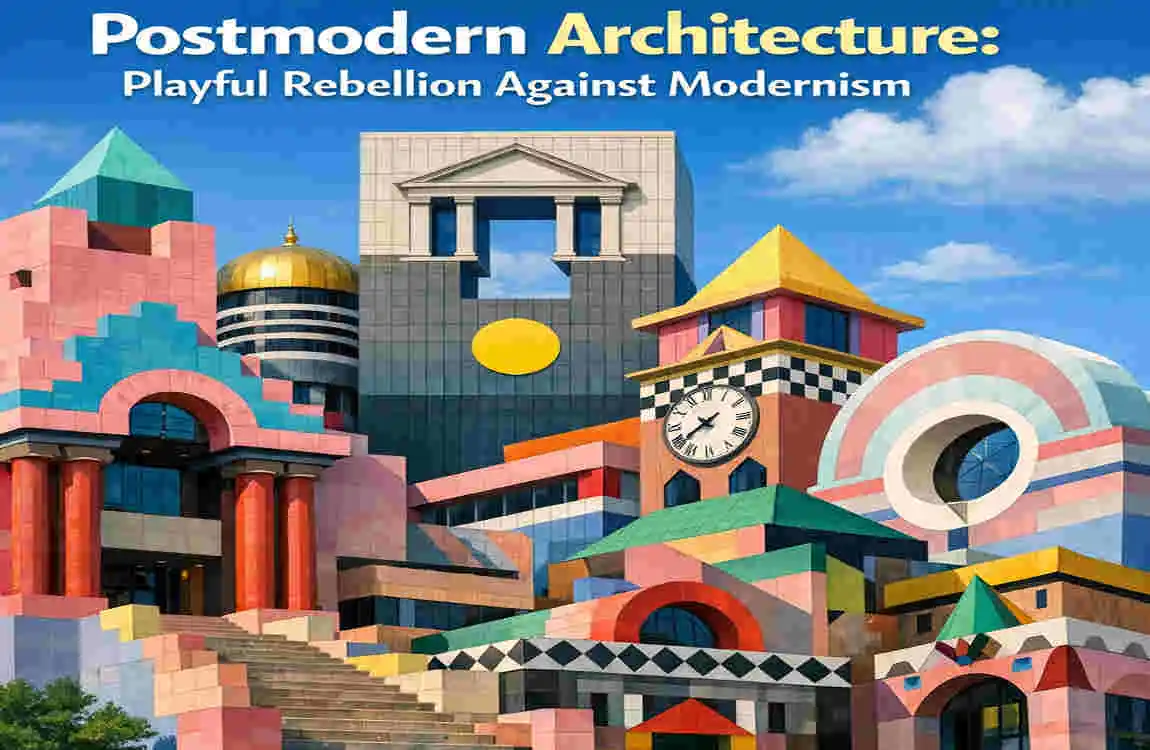
Finally, we reach the rebellious teenager of the group. If Modernism was serious and minimal, Postmodernism was ironic and loud.
Origins and Historical Context
Starting in the late 1960s and peaking in the 1980s and 90s, architects began to feel that Modernism was too boring, cold, and alienating. They wanted to bring back ornament, history, and fun. Robert Venturi famously countered the Modernist slogan with “Less is a bore.”
Key Characteristics
Postmodernism is hard to pin down because the whole point was to break the rules.
- Eclecticism: Mixing and matching styles. A Greek column next to a neon sign? Why not.
- Bold Colors: Pastels, bright reds, and patterns returned.
- Irony and Wit: Buildings that looked like giant baskets, or skyscrapers shaped like Chippendale furniture.
- Distorted Scale: oversized elements that look almost cartoonish.
Famous Examples Worldwide
- The Portland Building (Oregon, USA): A colorful, boxy building that looks like a giant present.
- Sony Tower (formerly AT&T Building, NYC): A sleek skyscraper topped with a “Chippendale” cabinet pediment.
- CCTV Headquarters (Beijing, China): A loop-shaped skyscraper that defies gravity and traditional form (often called “big pants”).
Modern Influence and DIY Tips
Postmodernism permits you to have fun.
- Mix-and-Match: Don’t be afraid to put a vintage velvet chair in a concrete industrial room.
- Statement Pieces: Use furniture that acts as art—weird shapes, bold colors.
- Playful Decor: It’s about personality. If it makes you smile, it belongs in the room.
Comparing the 7 Types of Architecture: Quick Reference Chart
Need a cheat sheet? Here is a quick breakdown to help you remember what are the 7 types of architecture.
Style Era Key Feature Iconic Example Vibe
Classical Ancient (850 BC – 476 AD) Columns, Symmetry Parthenon Ordered, Powerful
Gothic Medieval (1100 – 1450) Pointed Arches, Spires Notre-Dame Spiritual, Soaring
Renaissance 1400 – 1600 Domes, Geometry St. Peter’s Basilica Balanced, Humanist
Baroque 1600 – 1750 Curves, Gold, Drama Versailles Theatrical, Rich
Neoclassical 1750 – 1920 Big Columns, Grandeur White House Serious, Democratic
Modern 1900 – 1980 Glass, Steel, Minimal Fallingwater Functional, Clean
Postmodern 1960 – Present Color, Irony, Mixed Styles Portland Building Playful, Eclectic
How to Incorporate These Architecture Styles into Your Home
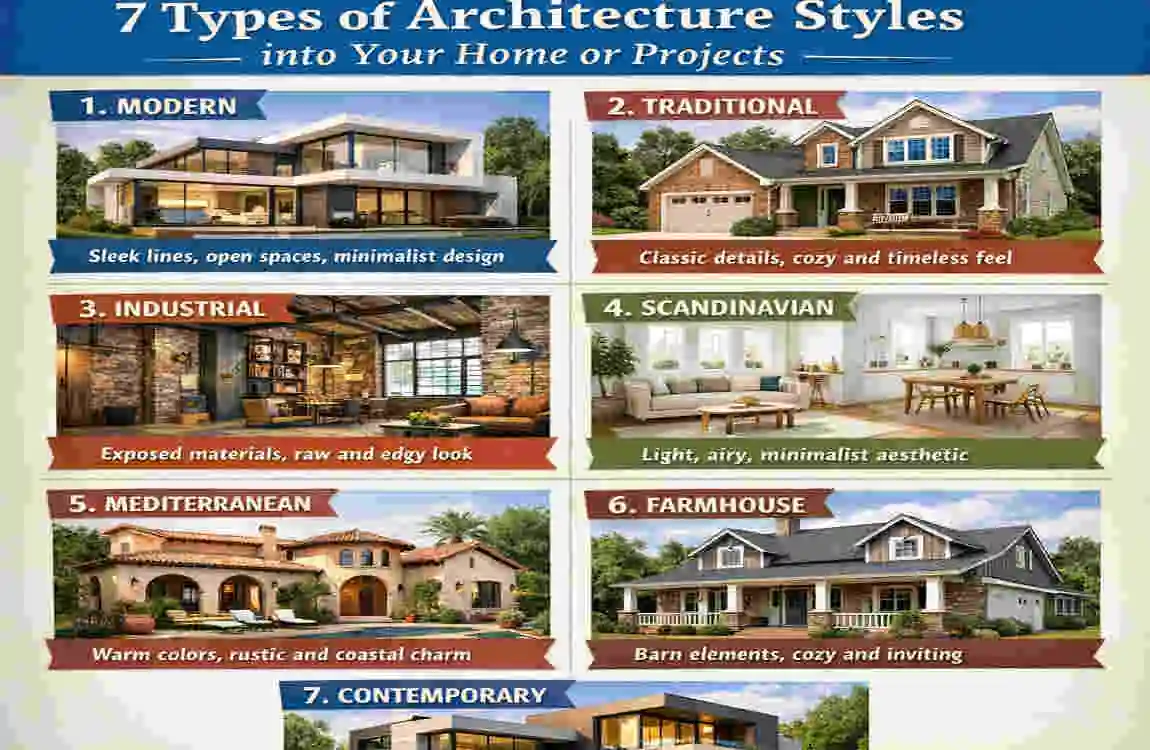
You don’t need to be an architect to use these concepts. Whether you are living in a flat in London or a house in Lahore, you can blend global styles to create a unique space.
Here are some rapid-fire DIY ideas:
- Classical: Add a simple bust statue to a bookshelf or use marble coasters.
- Gothic: install a heavy wooden door with iron hinges or use candlesticks for lighting.
- Renaissance: Focus on balance. If you hang a picture on the left wall, hang a similar one on the right.
- Baroque: Add a gold-framed mirror or a velvet throw pillow.
- Neoclassical: Paint your walls a crisp, clean white and use symmetrical furniture arrangements.
- Modern: Declutter! Clear surfaces and focus on functional furniture with clean lines.
- Postmodern: Paint an accent wall a surprising color or buy a lamp shaped like an animal.
Local Tip: In places like Lahore or Delhi, where history is rich, you often see a blend of Colonial (Neoclassical) and Mughal styles. Don’t be afraid to mix these with modern interiors for a “Transitional” look that honors the past but lives in the present.
Frequently Asked Questions (FAQ)
What are the 7 types of architecture?
The 7 generally accepted major types of architecture are Classical, Gothic, Renaissance, Baroque, Neoclassical, Modern, and Postmodern.
Which is the oldest type of architecture?
Classical architecture, originating in ancient Greece and Rome, is considered the oldest of the “formal” Western styles discussed here, though vernacular architecture (mud huts, caves) predates it.
What is the difference between Modern and Contemporary architecture?
Modern architecture refers to a specific time period (early to mid-20th century) focusing on function and minimalism. Contemporary architecture refers to whatever is being built right now, which can be a mix of many styles.
Can I mix different architectural styles in my home?
Absolutely! This is often called “Eclectic” or “Transitional” design. For example, a Modern kitchen in a Victorian (Gothic Revival) home is a very popular and stylish choice.
Why do government buildings often look Neoclassical?
Neoclassical style is associated with the democracies of ancient Greece and Rome. Governments use this style to project stability, power, and democratic values.