your home is bursting at the seams. Between the family car, a mountain of gardening tools, the kids’ bicycles, and that home gym equipment you swore you would use, you are entirely out of space. You find yourself dreaming of a spacious, dedicated storage area. But almost immediately, a wave of dread washes over you. You picture endless forms, bureaucratic red tape, and months of waiting for the local council to approve your project.
If this sounds familiar, you are definitely not alone. The fear of getting tangled up in local planning rules stops countless homeowners from improving their properties. However, there is some incredibly good news. You might be wondering how big a home garage can be without planning permission. In the UK, a set of rules known as permitted development (PD) rights allows you to build outbuildings up to certain sizes—often giving you a generous 40 to 60 square metres of space, or sometimes even more—without ever needing formal council approval.
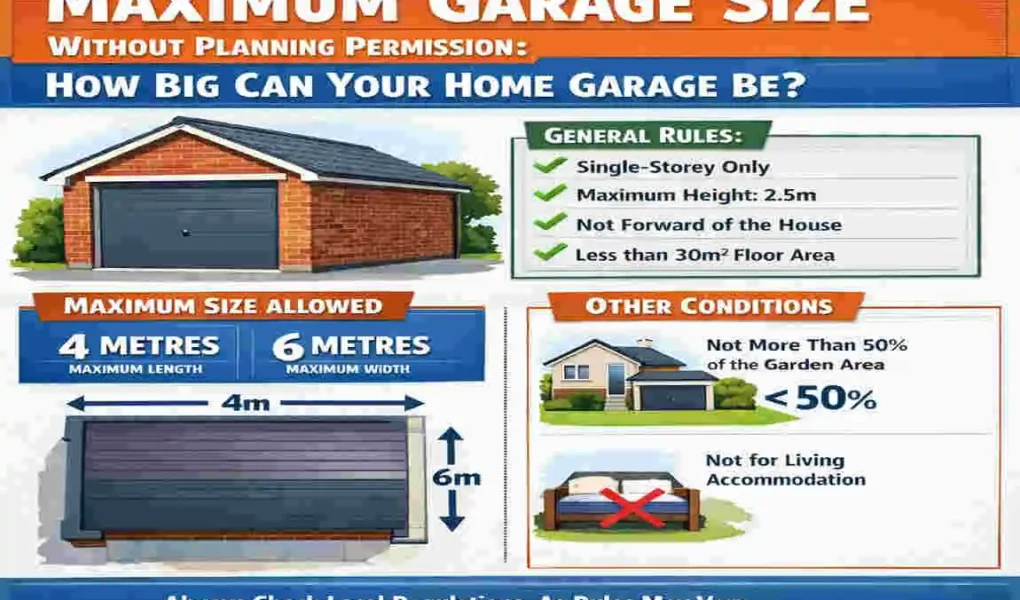
Under these permitted development garage rules, adding a new structure to your property doesn’t have to be a headache. As long as you follow specific guidelines on height (usually capped between 2.5 and 4 meters, depending on the location and roof style) and ensure the building doesn’t take up more than half of your garden space, you can fast-track your project.
| Topic | Short Answer | What You Should Know |
|---|---|---|
| Maximum garage size without planning permission | It depends on local rules | In many places, a garage may be allowed without planning permission under permitted development rules, but size limits vary. |
| How big can a home garage be? | Usually limited by height, width, and total floor area | The garage often must stay within set limits and must not cover too much of the property. |
| Do all garages need permission? | No | Small detached or attached garages may be allowed without full planning approval if they meet the rules. |
| What affects approval? | Location, height, boundary distance, and size | Bigger garages, garages near boundaries, or garages that change the look of the property may need permission. |
| Best next step | Check with your local planning authority | Rules can differ by area, so always confirm before starting work. |
Understanding UK Permitted Development Basics
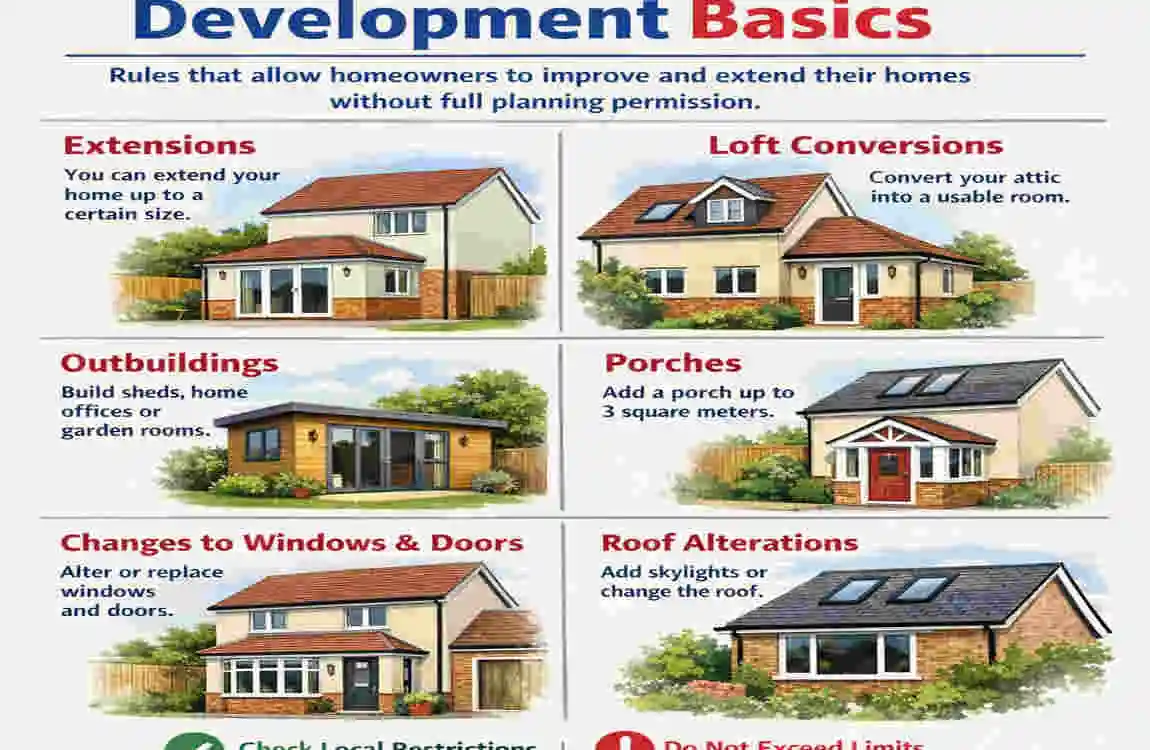
Before we dive into the exact measurements and limits, let’s take a moment to understand the framework that makes all of this possible. What exactly is “permitted development“?
What is Permitted Development?
In simple terms, permitted development rights are a fantastic scheme granted by Parliament that allows homeowners to perform certain types of building work or make specific changes to their homes without needing to apply for full planning permission. Think of it as a pre-approved green light from the government. As long as your project stays within the predefined rules, you are legally allowed to proceed with the build.
When we talk about outbuildings like sheds, greenhouses, and standard detached garages, we are referring specifically to Class E of the permitted development rules. Class E is designed to give you the freedom to enhance your property, provided the new structure is for purposes “incidental to the enjoyment of the dwellinghouse.” In plain English, that means the space must be used for standard domestic activities—like parking your car or storing your lawnmower—and not as a separate living area or a commercial business hub.
Where Do These Rules Apply?
It is important to note that planning policies can vary slightly depending on where you live. While this guide primarily focuses on the rules in England, the general principles are highly similar in Wales, Scotland, and Northern Ireland. However, if you live outside of England, you should always double-check with your local authority, as some height restrictions and boundary rules can be a bit stricter, particularly in Scotland.
Furthermore, permitted development generally only applies if your garage is single-storey, is located at the rear or side of your home, and does not push forward past the front wall of your house.
Here is a quick breakdown of the planning classes you need to know about:
Class Type Building Structure Key Benefit Under Permitted Development
Class E Detached outbuildings (Garages, sheds, gyms) Allows you to cover up to 50% of your garden space without full planning permission.
Class A Attached garages (Extensions to the main house) Allows you to extend your home, following specific house extension depth and height rules.
Always remember to check for any local restrictions. You can easily do this by visiting the national Planning Portal or giving your local planning department a quick phone call.
Maximum Size Limits: How Big Can You Go?
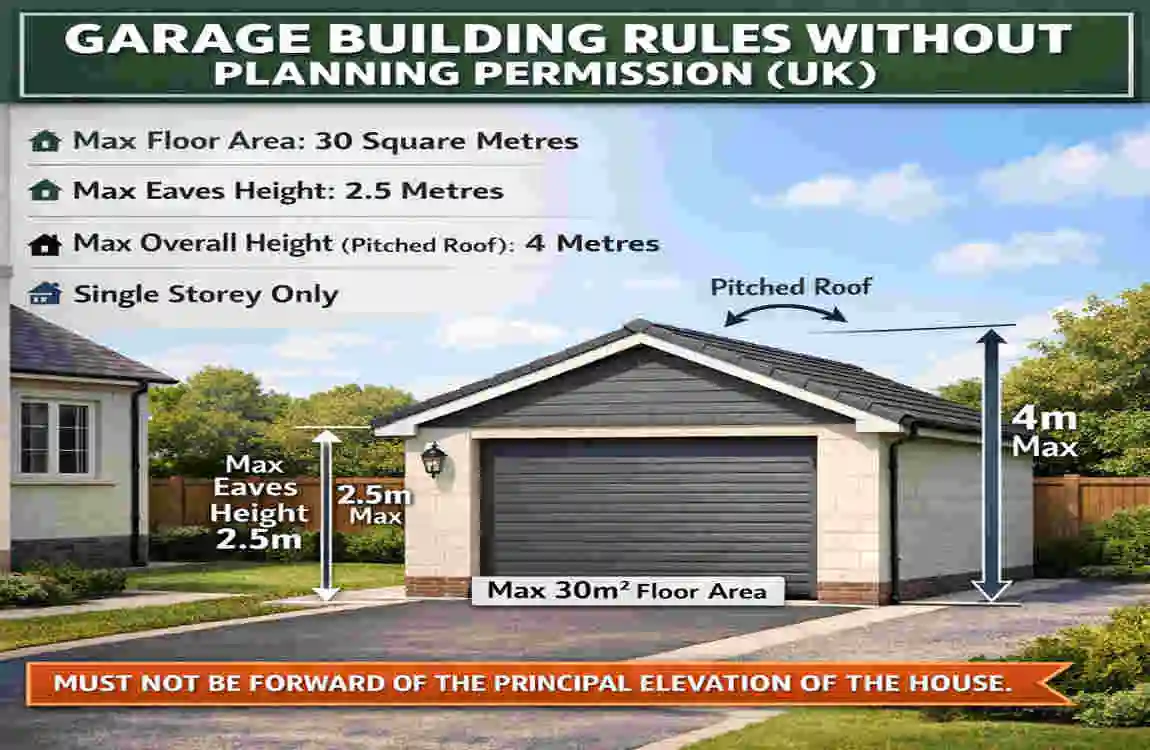
The most common question homeowners ask is about the absolute maximum garage size that doesn’t require planning permission. People often expect a strict, one-size-fits-all number, like “you can only build up to 30 square metres.”
The 50% Garden Coverage Rule
Surprisingly, there is no fixed maximum square meter limit set in the permitted development rules. Instead, the size of the garage you can build is entirely dependent on the size of your specific plot of land.
The golden rule of Class E permitted development is this: Your new garage, combined with any other existing outbuildings, cannot cover more than 50% of the total land around the “original house.”
The term “original house” is crucial here. It refers to the house as it stood on July 1, 1948 (when the modern planning system was introduced), or as it was when first built if constructed after that date. This means if a previous owner built a large rear extension or a massive garden shed, those structures eat into your 50% allowance.
Practical Examples for Different Plot Sizes
To give you a clearer picture, let’s look at a few practical scenarios:
- The Small Urban Garden: Let’s say your total outdoor space (excluding the house’s original footprint) is 200 square meters. Half of that is 100 square metres. If you already have a 20-square-metre patio deck that counts as an extension and a 10-square-metre garden shed, you have used up 30 square metres of your allowance. Therefore, your maximum garage size without planning permission would be around 70 square metres.
- The Large Suburban Plot: If you are lucky enough to have a sweeping 800-square-metre plot, your 50% allowance gives you a massive 400 square metres to play with. In this scenario, you could easily build a huge 100+ square metre multi-car garage, provided you meet all the other height and boundary conditions.
Footprint Flexibility vs. Height Restrictions
While you have a surprising amount of flexibility in the footprint (ground area) of your garage, the real limiting factor is almost always the height.
Here are some visual benchmarks to keep in mind when planning your footprint:
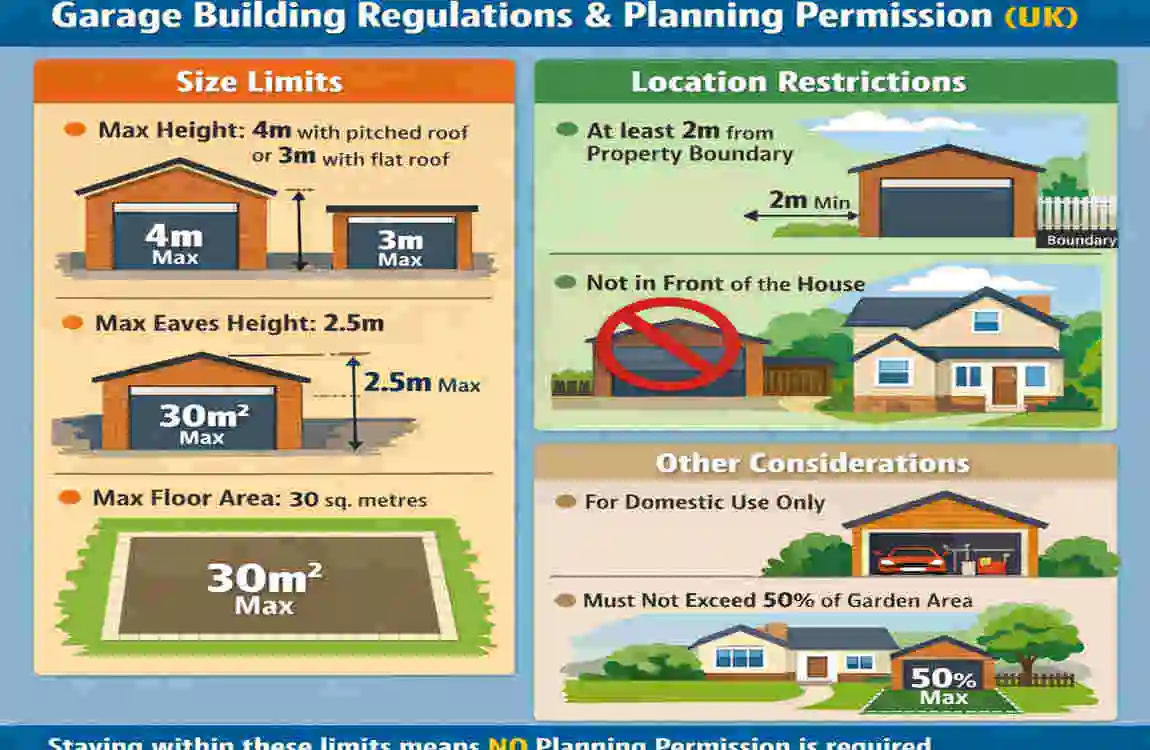
- Detached Garages: A common and highly practical size for a comfortable double garage is roughly 5 by 6 meters (30 square meters). Staying at or below 30 square metres is often a smart move because, as we will explain later, it can exempt you from strict building regulations.
- Attached Garages: If your garage is attached to your home, it is classified as an extension rather than an outbuilding. Under Class A rules, a single-story rear extension can typically project only 3 to 4 meters from the original back wall of the house, severely limiting the size of an attached garage under permitted development.
Decoding Garage Height Limits
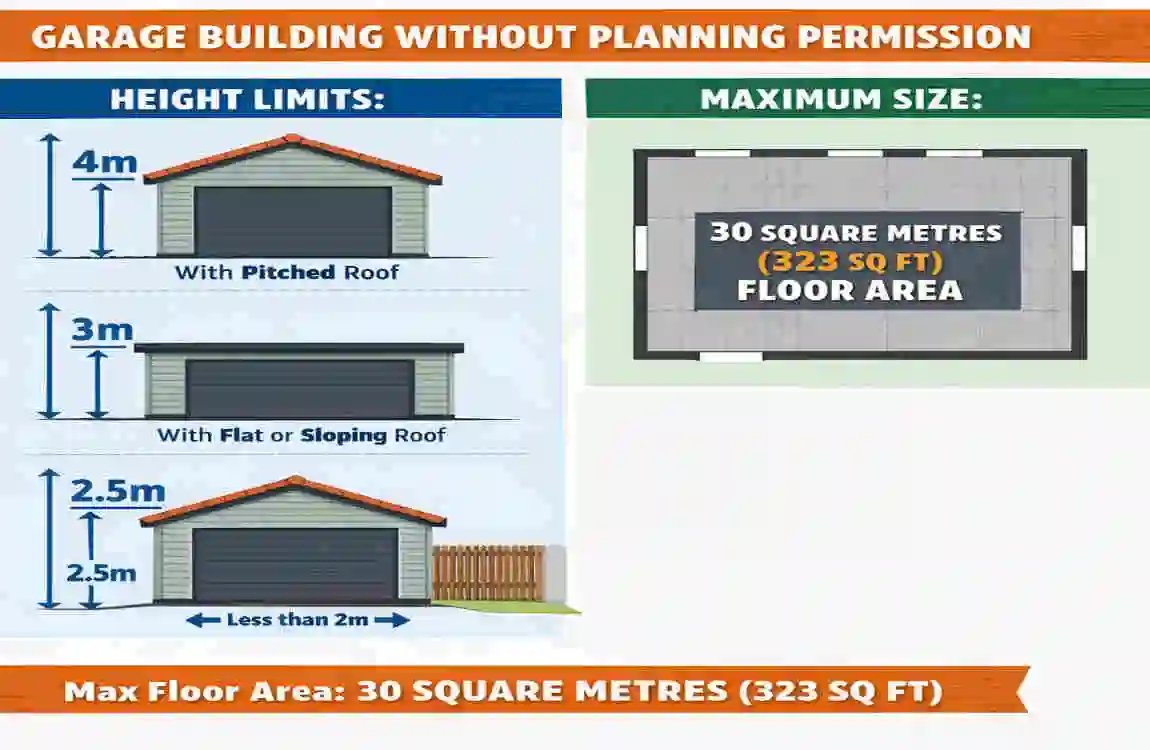
We have established that the footprint of your garage is flexible. Still, when it comes to the vertical space, the rules are incredibly strict. In fact, height is usually the single biggest factor that dictates whether a project is feasible under permitted development.
Why Height is Your Biggest Restrictor
The government imposes strict height limits to prevent homeowners from building towering structures that block their neighbors’ sunlight or become eyesores in the community. If you want to know how big can a home garage be without planning permission, you must memorize the height restrictions.
The rules change depending on two main factors: the style of roof you choose to build, and how close the garage is located to your property boundary (the fence or wall separating your land from your neighbours).
Here is a clear table outlining the specific garage height limits you must follow:
Roof TypeDistance from the Property BoundaryMaximum Overall HeightMaximum Eaves Height
Dual-pitched roof (An apex or ‘V’ shape roof) More than 2 metres away 4 metres 2.5 metres
Flat roof or other styles (Sloping or curved) More than 2 metres away 3 metres 2.5 metres
Any roof style 2 metres or less 2.5 metres 2.5 metres
Understanding the 2.5-Metre Boundary Rule
Let’s break down what this means in the real world. If you want to build your garage tucked right into the corner of your garden, pressed up against the boundary fence, the absolute maximum height of the entire structure—including the very tip of the roof—cannot exceed 2.5 metres.
For many modern cars, particularly large SUVs or vans, a 2.5-meter ceiling can feel quite restrictive once you factor in the thickness of the roof materials and the floor slab.
If you want the luxury of a tall, vaulted ceiling—perhaps with a dual-pitched roof reaching up to 4 metres high—you must position every single part of the garage at least 2 metres away from any boundary line.
Pro Tip: When measuring height, you must measure from the highest point of the natural ground level immediately adjacent to the building. If your garden is on a steep slope, this can get complicated, so it is always wise to design a lean, low-profile structure to maximize your interior space without exceeding the height limit.
Coverage and Location Rules to Keep in Mind
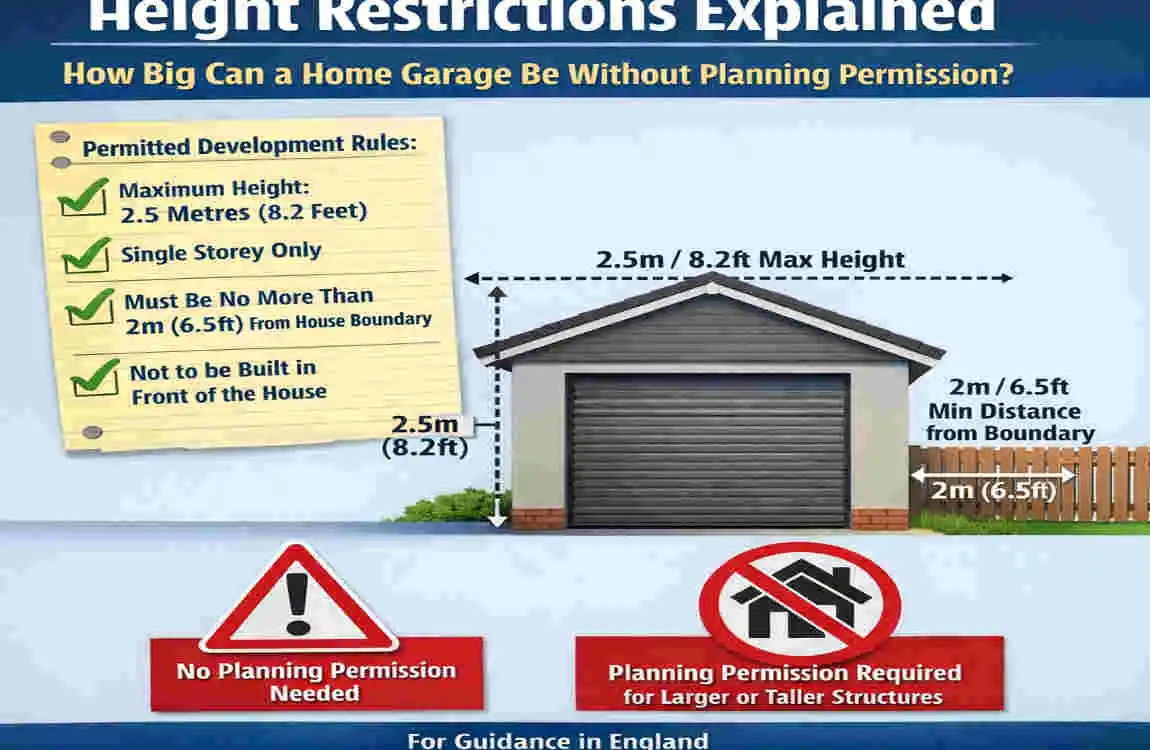
Beyond size and height, where you place your garage on your property is strictly governed by permitted development rules for garages.
Rear and Side Placements Only
The most fundamental location rule is that permitted development does not allow you to build an outbuilding forward of the “principal elevation” of your house. In everyday language, the principal elevation is usually the front of your house where your front door is located, facing the street.
If you want to build a garage in your front garden or driveway, you will almost certainly need to apply for formal planning permission. Permitted development is strictly reserved for structures built behind or to the side of your home.
Navigating Designated Areas
The rules we have discussed so far apply to standard homes in standard neighbourhoods. However, your permitted development rights are severely curtailed if you live in a “designated area.”
Designated areas include:
- Conservation Areas
- Areas of Outstanding Natural Beauty (AONB)
- National Parks
- World Heritage Sites
- The Norfolk or Suffolk Broads
If your home falls into one of these categories, the rules change dramatically. For example, in a National Park or AONB, the maximum area to be covered by outbuildings situated more than 20 metres from any wall of your house is strictly limited to 10 square metres. Furthermore, in Conservation Areas, you cannot build any garage or outbuilding at the side of your house under permitted development—it must go entirely in the rear.
A Case Study in Garden Coverage
Let’s picture a standard detached house in a typical suburban neighborhood, boasting a generous 300-square-meter rear garden. The homeowner wants to build a workshop and a garage.
Because they are not in a designated area, they can utilize up to 50% of the garden. This gives them a massive 150 square metres of potential building footprint. As long as they keep the structures under 2.5 metres high (if near the fence) or position them 2 metres away from the boundary (to allow for a 4-metre pitched roof), they can safely construct a massive 100-square-metre outbuilding without ever submitting a planning application.
Building Regulations vs. Planning Permission
This is where many enthusiastic homeowners get tripped up. It is absolutely vital to understand that planning permission and building regulations are two completely separate things.
Planning permission concerns how a building looks, where it sits, and how it impacts the surrounding environment and neighbors. Building regulations, on the other hand, are concerned with safety. They ensure the building is structurally sound, fire-safe, and energy-efficient.
Skipping Planning Doesn’t Mean Skipping Regs
You might perfectly follow the permitted development garage rules and skip planning permission, but that does not automatically mean you are exempt from building regulations.
Here is how building regulations apply to garages:
- Small Detached Garages (Under 15 square metres): These are generally completely exempt from building regulations, provided they do not contain sleeping accommodation.
- Medium Detached Garages (Between 15 and 30 square meters): These are normally exempt from building regulations if they are at least 1 meter from any boundary. If they are closer than 1 metre to the boundary, they must be constructed substantially from non-combustible materials (like brick, concrete block, or metal) to prevent the spread of fire.
- Large Detached Garages (Over 30 square meters): If your garage exceeds 30 square meters of internal floor space, building regulations will always apply, regardless of where it is positioned or the materials you use.
When Do Building Regs Always Apply?
Even if your garage is tiny, certain elements of the build will always require building control sign-off.
If you plan to run electricity to your new garage for lights, power sockets, or an electric vehicle charging point, this electrical work must comply with “Part P” of the building regulations. You must either use an electrician who is registered with a competent person scheme (who can self-certify the work) or have the local authority inspect it.
Furthermore, if your garage is attached to your home, building regulations will always apply, regardless of its size. You will need to ensure proper foundations, adequate drainage, and crucially, a certified fire door separating the house from the garage.
Exceptions and Special Cases: When PD Fails
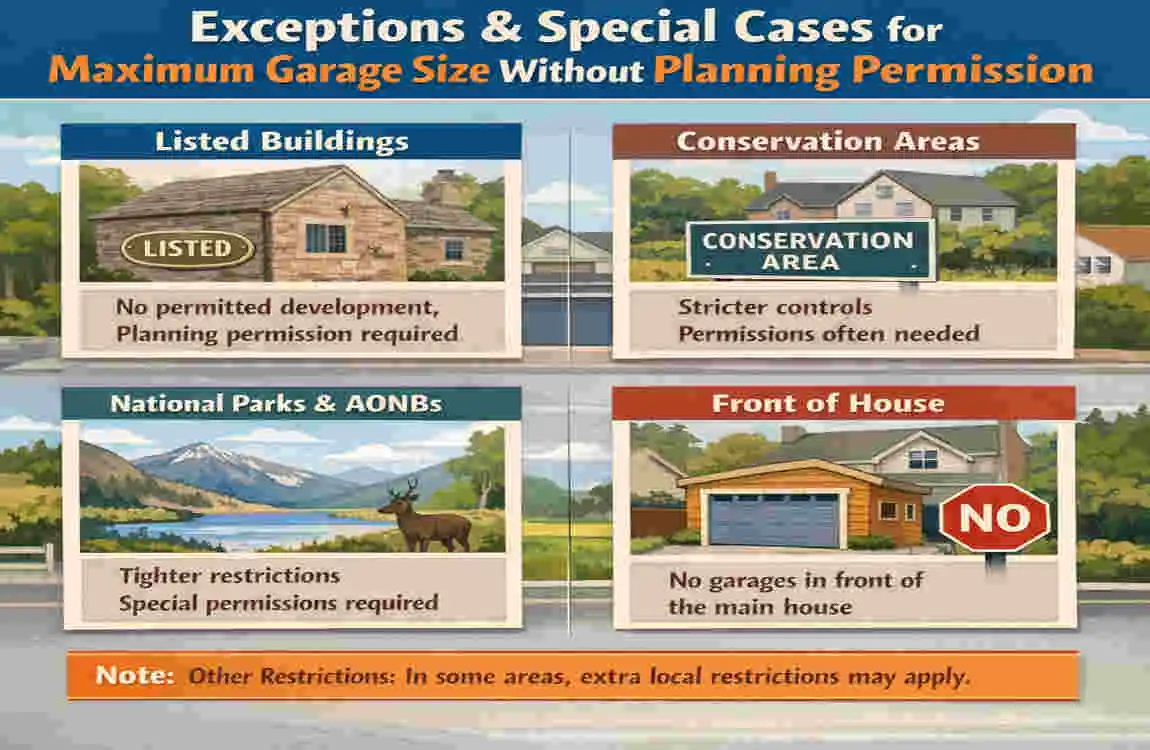
While permitted development rights are generous, they are not a universal get-out-of-jail-free card. There are several scenarios where these rights are either removed entirely or heavily restricted. When you find yourself in one of these special cases, you must apply for formal planning permission.
Listed Buildings and Flats
If you live in a Listed Building (a building of special architectural or historic interest), you have no permitted development rights for erecting outbuildings in the grounds. You will always need to apply for Planning Permission and Listed Building Consent before laying a single brick.
Similarly, permitted development rights for outbuildings apply strictly to “houses.” If you live in a flat, a maisonette, or a commercial property, you do not have these rights. You must apply for planning permission for any external structure.
Conversions and Two-Storey Builds
Sometimes homeowners want to convert an existing detached garage into a living space, such as a granny annex or an Airbnb rental. Creating a self-contained living accommodation is a major change of use, and while internal conversions might sometimes fall under building regulations only, using an outbuilding as an independent dwelling almost always requires planning approval.
Additionally, permitted development for outbuildings applies only to single-story structures. If you dream of building a two-storey garage with a staircase leading up to a lofty home office, you will definitely need to go through the full council approval process.
Regional Differences and Article 4 Directions
Be aware that local councils can remove permitted development rights in specific neighborhoods through an “Article 4 Direction.” This is common in highly protected historic towns or specific streets where the council wants to maintain tight control over the area’s visual character.
Here is a quick reference table showing common scenarios where permitted development fails:
Your Specific ScenarioDo You Need Full Planning Permission?The Main Reason Why
Living in a Listed building : Yes, always . Historic consent is strictly required by law.
Exceeding 50% garden coverage Yes, always You have exceeded the core limits of permitted development.
Building a front garage : Yes, always . Outbuildings forward of the principal elevation are not permitted.
Living in a Flat or Maisonette Yes, always PD rights for outbuildings only apply to standalone houses.
Detached vs. Attached Garages: Which is Easier?
When deciding how big can a home garage be without planning permission, your first major design choice is whether to attach the garage to your existing house or build it as a standalone, detached structure.
Class E Detached Garages
Building a detached garage is generally the much easier route when trying to avoid planning permission. As we have discussed, detached outbuildings fall under Class E of the permitted development rules.
Class E gives you the incredible flexibility of the 50% garden coverage rule. As long as you respect the boundary height limits (2.5 metres if near the fence), you can design a very large, sprawling structure. Furthermore, if you keep a detached garage under 30 square metres, you can often bypass the stress and cost of building regulations entirely.
Class A Attached Garages
Building an attached garage is a different beast altogether. Because it physically connects to your home, it is classed as an extension under Class A permitted development rights.
The rules for extensions are much more restrictive regarding size. For a single-storey rear extension, you are typically only allowed to extend up to 3 metres beyond the original rear wall of an attached house, or 4 metres for a detached house. A 3-metre deep garage is barely large enough to fit a modern compact car, making attached garages very difficult to execute successfully without applying for full planning permission.
Additionally, as soon as you attach a structure to your house, building regulations immediately apply, meaning you will need building control inspectors to check your foundations, structural beams, and fire safety measures.
Here is a comparison table to help you weigh your options:
Design FeatureDetached Garage (Class E)Attached Garage (Class A)
Maximum Size Limit Highly flexible, limited mostly by your plot size (50% rule). Strictly limited to 3-4 metre depths from the original wall.
Building Regulations : Often fully exempt if under 30 sqm and placed correctly. Always requires full building control approval and inspections.
Impact on the Home Can be placed out of sight at the bottom of the garden. Alters the flow of the house, blocks light to existing windows.
Design Tips to Maximize Your Garage Space
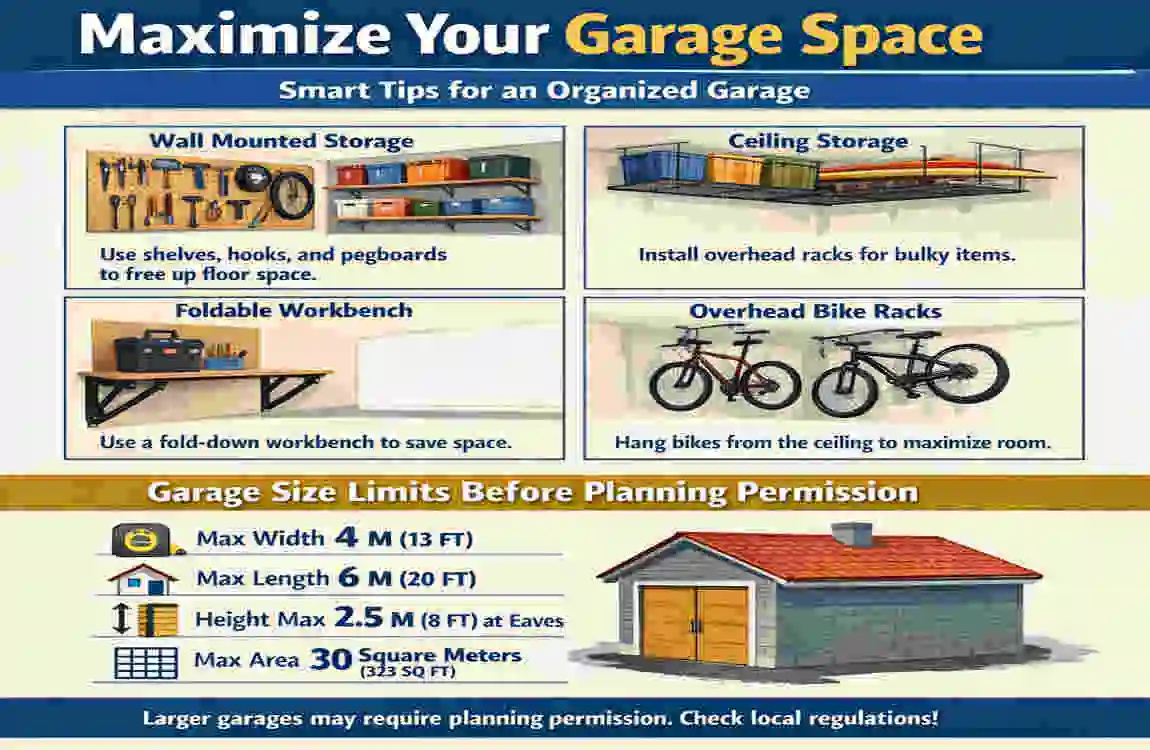
If you are determined to squeeze every single centimeter of usable space from your permitted development rights, smart design is essential.
Playing with Roof Pitches
The easiest way to maximize internal volume is to utilize the 4-metre height allowance. To do this, you must design a garage with a dual-pitched roof and position the entire structure at least 2 metres away from every boundary line.
A 4-metre high ceiling opens up incredible opportunities. Instead of a flat, oppressive ceiling, you can leave the roof trusses exposed, creating a vaulted ceiling. This vertical space is perfect for installing overhead storage racks, hanging bicycles from pulleys, or even fitting a tall car lift for automotive enthusiasts.
Utilizing Modular Builds
To make the most of your square footage, consider a modular build. Prefabricated timber or metal garages have thinner walls compared to traditional double-skin brick walls. Because the 50% coverage rule and the 30-square-metre building regulation threshold are based on external and internal measurements respectively, thinner walls mean you get slightly more usable space on the inside for the same external footprint.
Furthermore, a lean-to design can be a clever trick if you must build close to a boundary. By keeping the eaves low (2.5m) on the boundary side and sloping the roof up toward the center of your garden, you can comply with the rules while still gaining valuable headroom inside.
Cost and Practical Advice for Your Build
Embarking on a garage build is a significant financial investment. Even if you save money by skipping the planning application fees, you still need a realistic budget.
Estimating Your Budget
As a general rule of thumb in the UK, you should expect to pay anywhere from £1,000 to £2,000 per square metre for a newly built garage, depending on the materials used and the complexity of the groundworks. A basic prefabricated concrete garage will sit at the lower end of this scale. At the same time, a custom-built, brick-matching structure with a tiled pitched roof and automated roller doors will push you toward the higher end.
Getting Pre-Approval Peace of Mind
Even if you are 100% confident that your design perfectly matches the permitted development garage rules, you should never just start digging trenches.
The smartest practical step you can take is to apply for a Lawful Development Certificate (LDC) from your local council. For a small fee, you submit your plans to the council, and they provide you with a legally binding document confirming that your project does not require planning permission. This certificate is absolute gold when it comes time to sell your house, as future buyers’ solicitors will always demand proof that your garage was built legally.
You can use the interactive tools on the official Planning Portal website to run quick checks before submitting your LDC application.
Common Mistakes to Avoid During Your Project
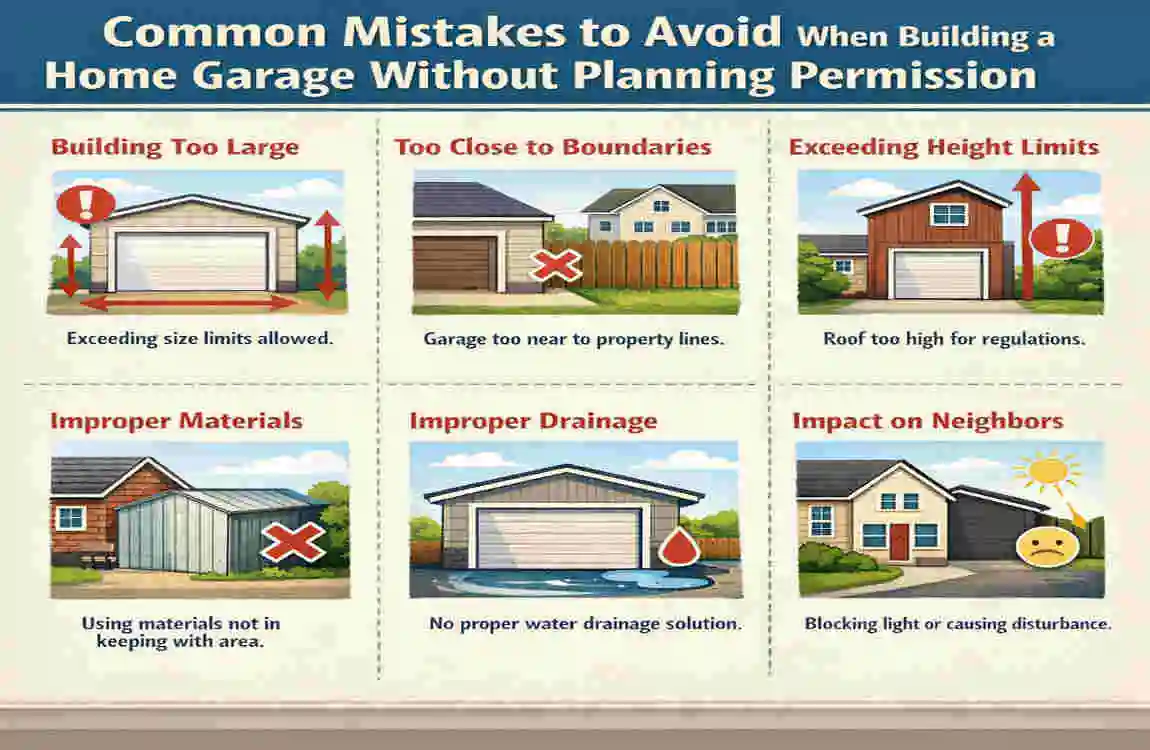
Over the years, many well-intentioned homeowners have made costly errors by misinterpreting the rules. Here are the most common mistakes you must avoid:
Ignoring the 2-Metre Boundary Rule
The most frequent error is misunderstanding the boundary height limits. Homeowners will build a beautiful 3-meter-high flat-roof garage, but place it 1.5 meters from their neighbor’s fence. Because it is within 2 metres of the boundary, the maximum legal height is 2.5 metres. The council can, and often will, issue an enforcement notice requiring the homeowner to tear down the roof and rebuild it lower, at immense personal cost.
Over-Coverage and Forgetting the Shed
Another major pitfall is miscalculating the 50% garden coverage. People often measure out a garage that takes up exactly half their lawn, entirely forgetting that the old greenhouse in the corner and the conservatory they built ten years ago already count towards that 50% limit. Always calculate the total area of all outbuildings and extensions combined.
Assuming You Don’t Need Regs
Finally, assuming that bypassing planning permission automatically bypasses building regulations is a dangerous mistake. Always double-check the 30-square-metre threshold and the fire safety boundary rules, especially if you plan to wire the building for electricity.
Frequently Asked Questions (FAQs)
To summarize the key points, let’s address some of the most commonly asked questions about outbuildings and planning rules.
How big can a home garage be without planning permission? There is no strict maximum square metre limit. You can build as large as you like, provided that the new garage and any existing outbuildings do not cover more than 50% of the total land area around your original house.
What is the maximum height allowed near a boundary? If any part of your garage is within 2 metres of your property boundary, the absolute maximum height of the entire structure (including the roof) cannot exceed 2.5 metres.
Is a 50sqm garage OK to build under permitted development? Yes, a 50 sq m garage is perfectly fine, but only if your total available garden space is large enough. If 50sqm represents less than half of your total outdoor space (accounting for other sheds/extensions), and you meet the height rules, you are legally allowed to build it.
Are the rules different if I live in Scotland? While the core concepts of permitted development are similar, Scotland has slightly different and sometimes stricter height and boundary rules. Always check with your specific local Scottish authority before starting any work.
What are the fines for breaching planning rules? If you build a garage that breaks planning rules, the local council can issue an enforcement notice demanding you alter or demolish the structure. If you ignore this notice, you can face an unlimited fine and prosecution in a magistrates’ court.