Wondering what size roofing nails for 5/8 sheathing will ensure your roof stands strong for decades? You’re not alone. Many homeowners overlook the importance of choosing the right nail size, which can lead to costly roof failures. Studies show that improper nailing is one of the leading causes of roofing issues, especially in regions prone to high winds and storms.
Understanding 5/8 Sheathing: The Foundation of Your Roof
Before diving into nails, it’s crucial to grasp what 5/8 sheathing really means and why it matters.
What Is 5/8 Sheathing?
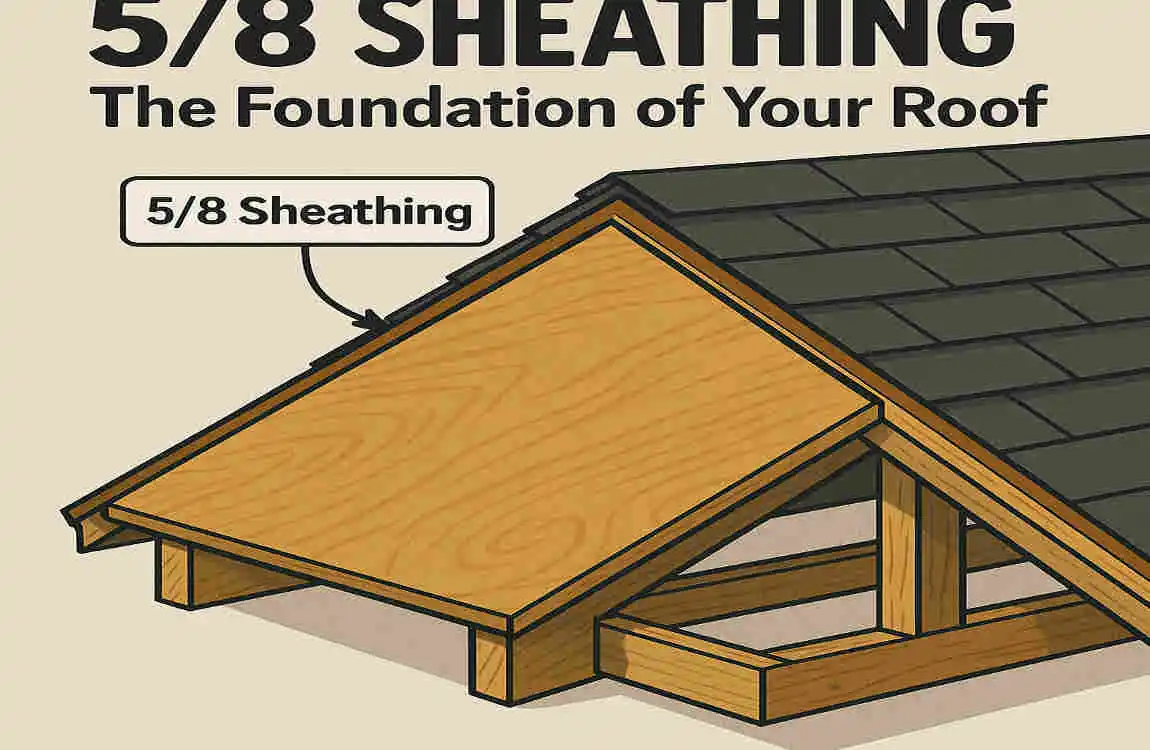
5/8-inch sheathing refers to plywood or OSB (Oriented Strand Board) panels that are 5/8 inches thick, sometimes noted as 19/32 inch. These panels form the base layer under your roof shingles, providing structural support and a surface for nailing.
This thickness is common in many modern homes, especially in areas where building codes require stronger roofs to withstand winds or seismic activity. For example, the International Residential Code (IRC) often recommends 5/8-inch sheathing in high-wind zones to improve durability.
Compared to the more standard 1/2-inch sheathing, 5/8-inch panels are:
- Stronger and stiffer, reducing flex underfoot.
- Less likely to warp or sag over time.
- Heavier and slightly more expensive.
Why Sheathing Thickness Affects Nail Choice
Choosing the right nail size depends heavily on the thickness of your sheathing. Nails must penetrate through the sheathing and embed deeply enough into the roof’s framing (rafters or trusses) for a secure hold.
The general rule is that nails should penetrate at least 3/4 to 1 inch into framing lumber beyond the sheathing. With 5/8-inch sheathing, this means your nails need to be longer than those used for thinner panels.
Local building codes, such as the International Building Code (IBC) and the IRC, specify these requirements to ensure safety. Ignoring them can cause shingles to blow off in storms or create leaks.
Sheathing Type Thickness Typical Use Pros Cons
1/2-inch Plywood 0.5″ Standard residential roofs Lightweight, inexpensive Less stiff, may flex
5/8-inch OSB 0.625″ High-wind zones, heavy loads Strong, durable, code-compliant More costly, heavier
What Size Roofing Nails for 5/8 Sheathing? The Definitive Answer
Here’s the core of your question: What size roofing nails for 5/8 sheathing should you use?
Recommended Nail Sizes by Roofing Material
Roofing Type Nail Length Shank Type Gauge Notes
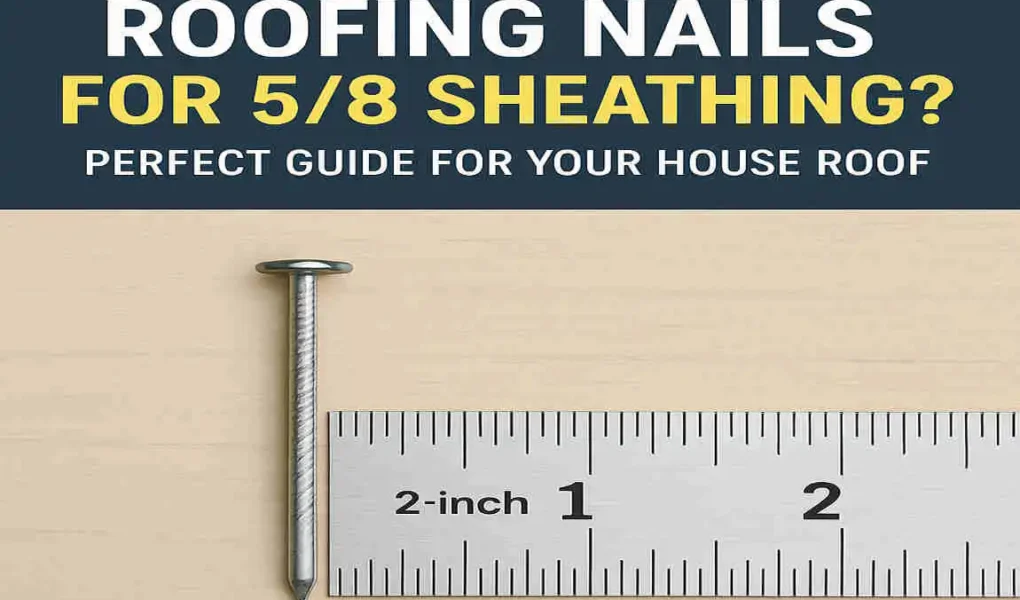
Asphalt Shingles 1-1/2″ to 2″ Smooth or Ring Shank 11-12 At least 3/4″ penetration into framing
Metal Roofing 1-1/4″ to 1-1/2″ Ring Shank 10-12 Corrosion-resistant nails preferred.
Wood Shakes 2″ to 2-1/2″ Barbed 8-10 Hot-dipped galvanized for durability
Why these sizes?
- The nail must pass entirely through the 5/8″ sheathing.
- Then, it needs to embed deeply (minimum 3/4″) into the rafter or truss wood.
- The extra length ensures a secure grip, preventing nail pull-through during high winds.
Key Factors: Why Not All Nails Are Equal
- Length Formula: Nail length = Sheathing thickness (5/8″) + minimum penetration into framing (3/4″-1″) + allowance for shingle overlap.
- Head Size Matters: Nails with a head diameter between 3/8″ and 7/16″ hold shingles better and resist pull-through.
- Shank Type: Ring shank nails provide superior grip compared to smooth shanks, especially important in wind-prone areas.
Building Code Requirements for Roofing Nails on 5/8 Sheathing
Following building codes ensures your roofing job passes inspections and lasts for decades.
IRC and IBC Standards
The International Residential Code (IRC) section R905.2.1 specifies:
- Nail gauge: 11- to 12-gauge nails.
- Quantity: Minimum four nails per asphalt shingle.
- Nail penetration: At least 3/4″ into the roof framing.
- In high-wind zones, ring shank nails or other enhanced fasteners are mandatory.
The International Building Code (IBC) echoes similar specifications but adds that nail size and type can vary depending on the roofing material and local conditions.
State-Specific Codes
Some states have additional rules based on climate risks:
- California: Seismic zones may require specific nail types and spacing.
- Florida: Hurricane-prone areas demand ring shank nails spaced closer together (often 6 inches on-center).
Common Code Violations and Fixes
- Using nails that are too short.
- Insufficient number of nails per shingle.
- Incorrect nail spacing.
- Using smooth shank nails where ring shank is required.
Fixes include:
- Removing and replacing the wrong nails.
- Adding extra nails to meet spacing requirements.
- Upgrading to ring shank nails.
Types of Roofing Nails: Choosing the Best for 5/8 Sheathing
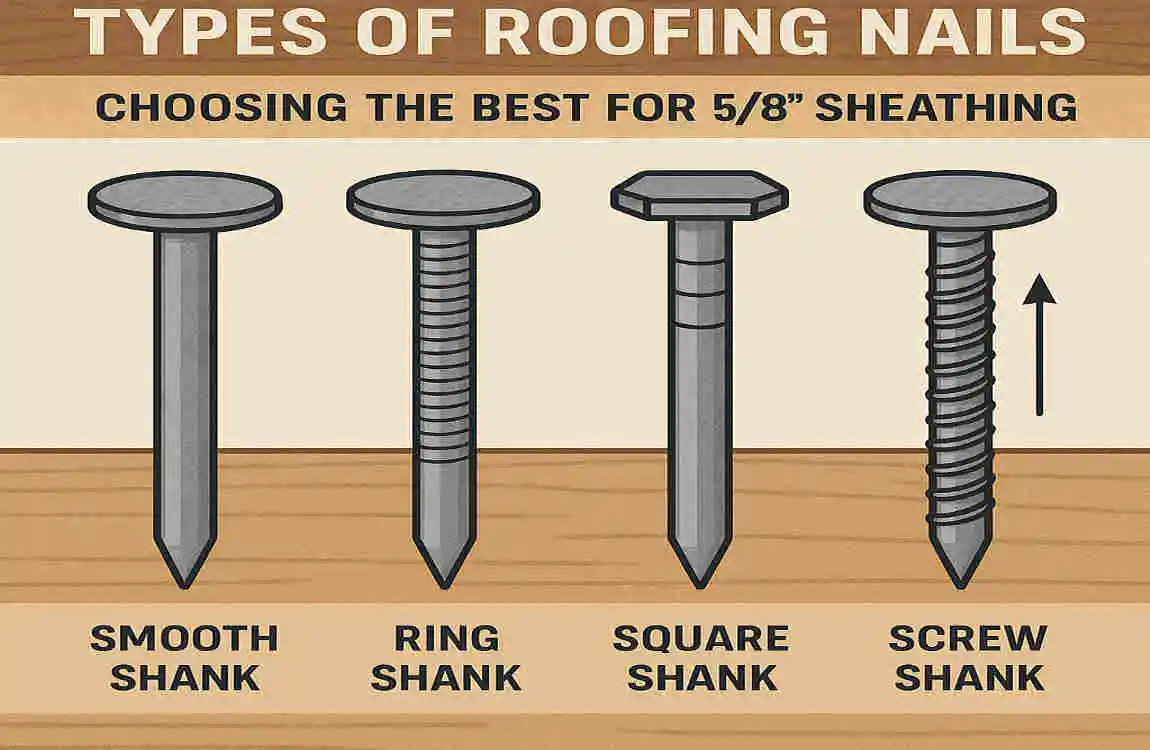
Not all roofing nails are created equal. Here’s a breakdown of your options.
Shank Types Explained
- Smooth Shank: Basic nails with a smooth shaft. Easier to drive but less resistant to pulling out.
- Ring Shank: Features ridges along the shaft, increasing grip by up to 40%. Ideal for areas with strong winds.
- Screw Shank: Spiral threads provide maximum holding power and are mostly used for metal roofs.
Material Options
- Galvanized Steel: Coated with zinc for rust resistance. Usually G90 or G185 rating (higher = better).
- Stainless Steel: Excellent corrosion resistance, ideal for coastal areas.
- Aluminum: Lightweight and corrosion-resistant, but less strong.
Nail Head Styles
- Flat Head: Most common for asphalt shingles.
- Clipped Head: Used for certain metal roofing applications.
- Mushroom Head: Provides more holding power in wood shakes.
Nail Type: Pros and Cons
Smooth Shank Easy to drive, cheaper Lower pull-out resistance
Ring Shank Superior grip, wind-resistant slightly harder to drive
Screw Shank Maximum holding power More expensive, less common
Step-by-Step Installation Guide: Nailing 5/8 Sheathing Perfectly
Let’s nail it down with a simple step-by-step guide!
- Prep the Sheathing
- Check the 5/8-inch panels for gaps or damage. Make sure panels are securely fastened to rafters.
- Nail Placement
- Place nails at least 3/4″ from the edges of the sheathing and 6″ apart along the rafters. This prevents splitting.
- Use the Right Tools
- A pneumatic nailer set to 70-90 PSI works best for consistent, clean nail driving.
- Pro Tips
- Avoid overdriving nails (don’t sink heads too deep). Check that nails penetrate framing at least 3/4″.
Common Mistakes and How to Avoid Them with 5/8 Sheathing Nails
Even pros slip up sometimes. Watch out for these common issues:
- Using Undersized Nails
- Leads to nails pulling out during strong winds.
- Wrong Nail Gauge
- Thin nails tear through sheathing instead of holding tight.
- Poor Nail Spacing
- Causes shingles to loosen and leak.
Quick Fixes:
- Use a nail puller to remove bad nails.
- Replace with recommended 1-1/2″ to 2″ nails.
- Check spacing and add nails as needed.
Cost Breakdown and Where to Buy Roofing Nails for 5/8 Sheathing
Roofing nails are affordable but vary by type and brand.
- Price Range: $20 to $50 per 1-pound box, depending on nail size and coating.
- Popular Brands: Grip-Rite, Bostitch, Paslode.
- Where to Buy: Home Depot, Lowe’s, Amazon.
Retailer Price Range Notes
Home Depot: $20- $45 per lb. Wide selection, in-store pickup available
Lowe’s: $22-$50 per lb. Often bundles with tools
Amazon $18 – $40 per lb , Convenient delivery