You are looking at your property tax bill or your original floor plans, and you see a glorious number—let’s say, 2,500 square feet. But then, the appraiser comes out, measures your home, and hands you a report stating your home is only 2,100 square feet. Where did those missing 400 square feet go? Usually, the answer lies right behind your garage door.
Understanding house appraisal square footage rules is absolutely critical for your bottom line. It directly impacts your home’s official value, how your listing looks to buyers, and even how much you pay in property taxes. For instance, an unexpected 200 to 400 square foot exclusion could potentially lower the perceived value of your living space by $20,000 to $50,000, depending on your local real estate market.
The Core Rules of Home Measurement
Before we can accurately answer our main question, we need to understand the fundamental rules that govern how houses are measured. Real estate is not a guessing game; it relies on strict definitions and standards to keep things fair and consistent for everyone involved in a transaction.
What Actually Counts as Square Footage?
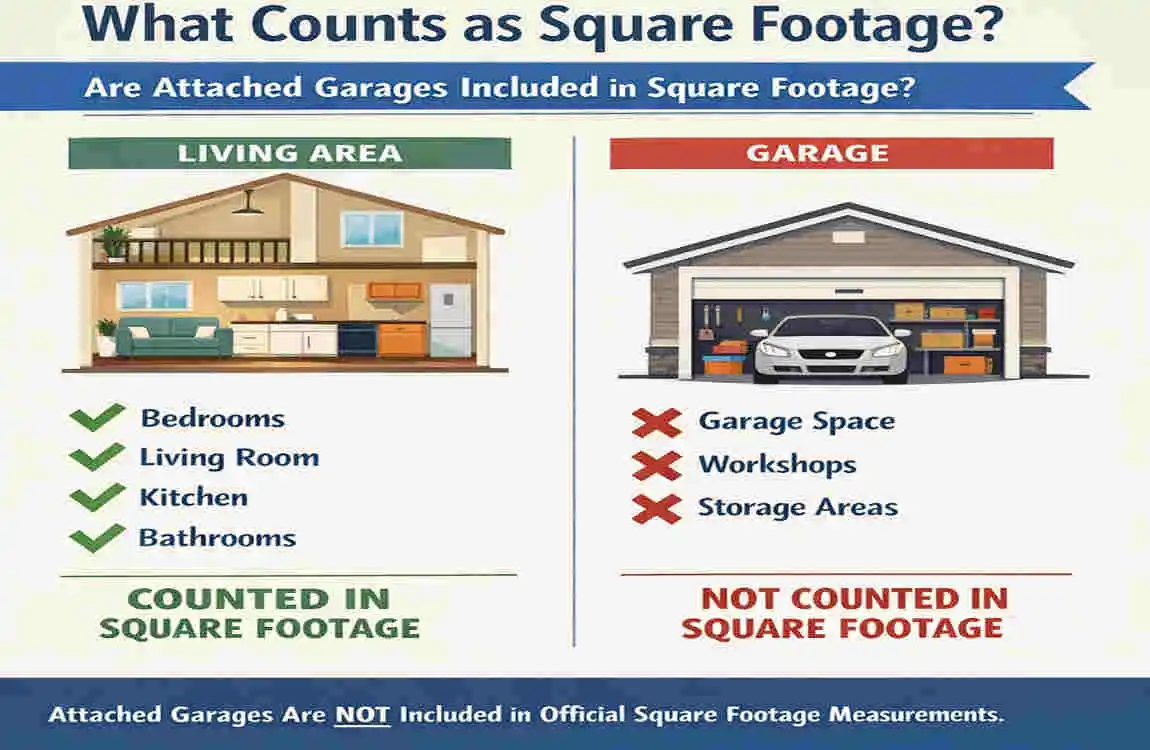
When real estate agents and appraisers talk about a home’s square footage, they are usually referring to the Gross Living Area (GLA). You can think of the GLA as the actual, everyday living space inside your home. It is the space where you sleep, cook, watch television, and entertain guests.
To be officially included in the Gross Living Area, a space must meet a few very specific requirements. First, it must be above-grade. This means the space is situated entirely above the ground level. Spaces that are completely or partially below ground, like most basements, are usually placed in a separate category, even if they are beautifully finished.
Second, the space must be finished and heated. It needs to have proper flooring, finished walls (like drywall), a finished ceiling, and a permanent heat source that ties into the rest of the home. Finally, it must be completely habitable year-round.
Professional appraisers measure a home by looking at the exterior walls. They calculate the total area from the outside, but they strictly exclude any spaces that do not meet the criteria for habitable living space. This means things like open porches, unfinished attics, and external storage sheds are tossed right out of the GLA calculation.
Are Attached Garages Included in Square Footage?
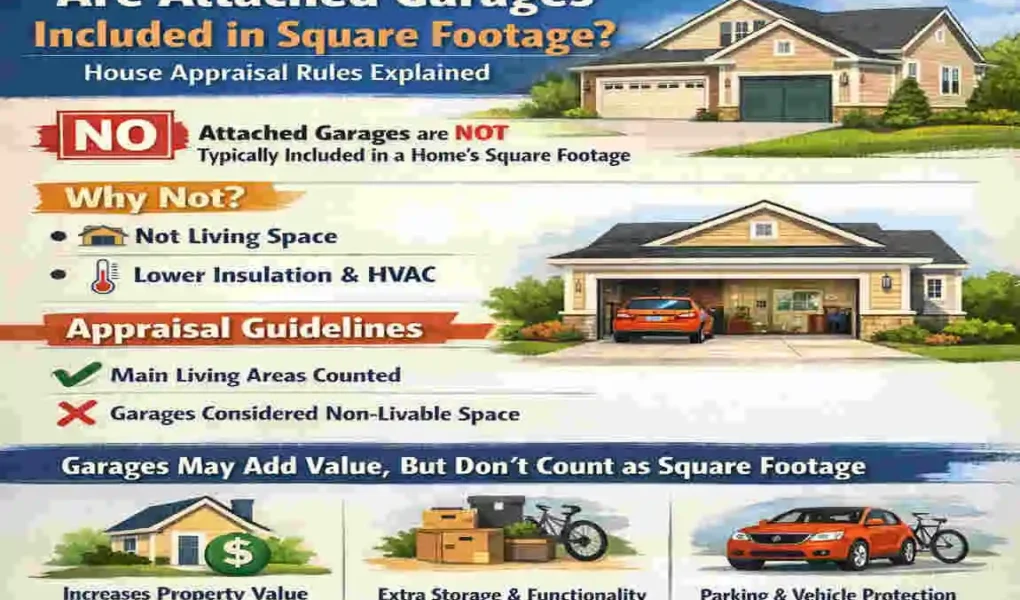
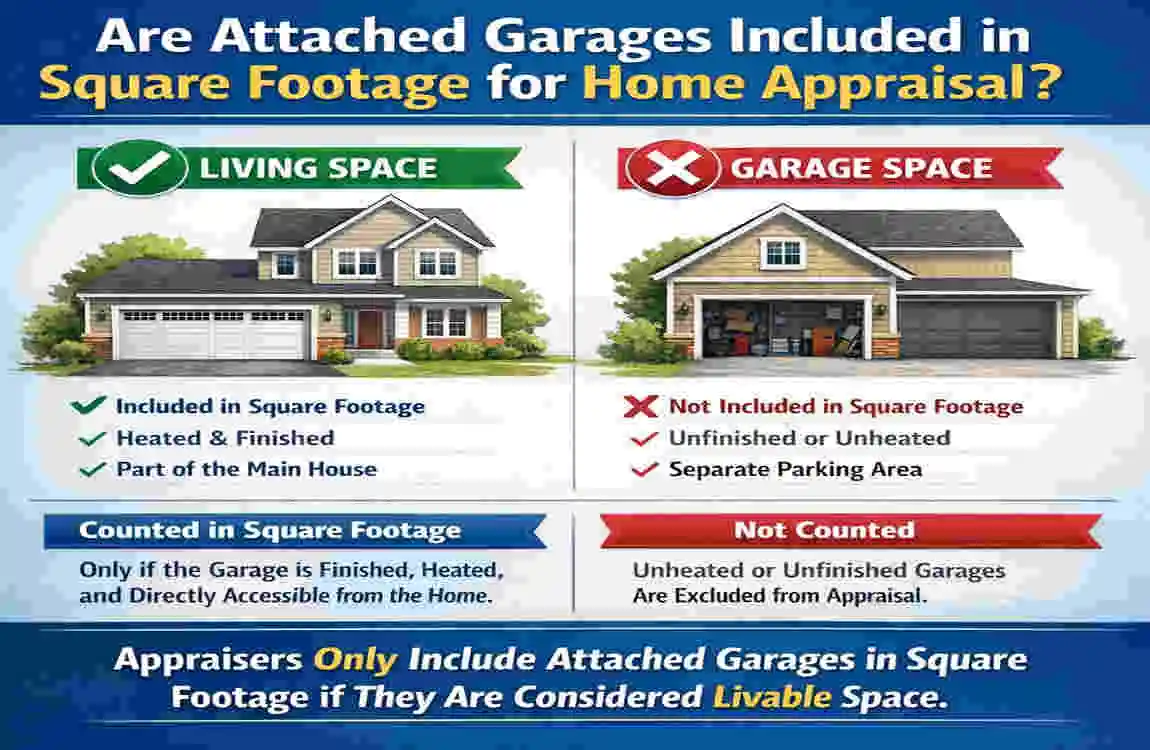
Now, let’s answer the big question directly: Are attached garages included in square footage? No, as a standard rule, attached garages are not included in your home’s Gross Living Area.
Even though an attached garage is physically connected to your house and shares a wall with your living room or kitchen, appraisers view it as non-habitable space. Its primary purpose is for parking vehicles and storing items, not for human habitation. Therefore, it does not meet the strict criteria required to be grouped with your bedrooms and living areas.
However, do not panic! Just because your garage is excluded from the main square footage does not mean it is worthless, far from it. Appraisers still measure your garage meticulously. They report its size separately on their appraisal forms because a garage provides significant contributory value. Depending on your neighborhood, a nice attached garage can add 10% to 20% to your home’s total price. Buyers love garages, and the market rewards you for having one.
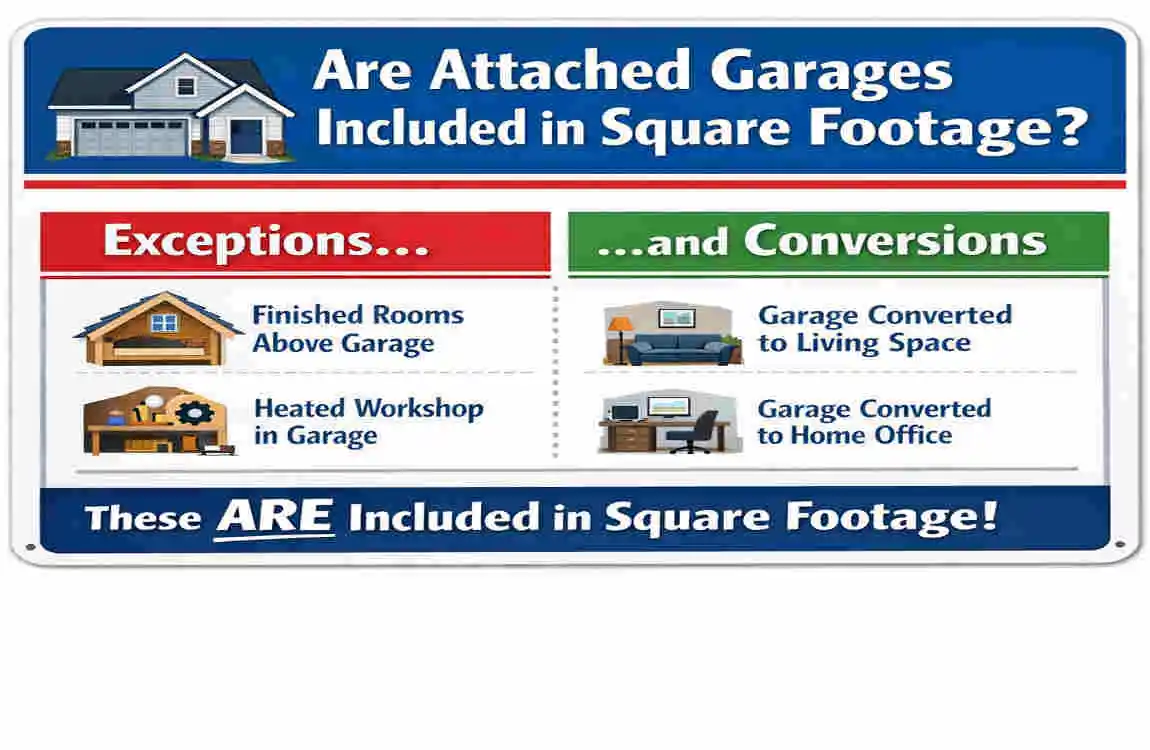
As a quick side note, detached garages are also excluded from your primary living space. But what about a finished apartment above an attached garage? That is a different story. If the space above the garage is fully finished, heated, and accessible from the main living area without having to walk outside or through the unfinished garage, it may count toward your total square footage.
Understanding Appraisal Standards
To really grasp why things are measured the way they are, we need to look at the rulebooks that appraisers are legally required to follow. Appraisers do not just make up the rules as they go; they adhere to strict national guidelines to ensure every house is measured identically.
ANSI Z765 Guidelines Explained
The primary standard used across the United States for measuring single-family homes is known as ANSI Z765. Created by the American National Standards Institute, this document outlines the exact procedures for calculating square footage.
When it comes to the ANSI Z765 garage rules, the guidelines are crystal clear: garages are never included in the Gross Living Area, even if they are fully finished, painted, and look like a giant bonus room. If it is built as a garage and functions as a garage, it stays out of the GLA.
The ANSI standards also bring up other interesting rules—for example, ceiling height matters. For a room to count as living space, the ceiling must be at least 7 feet high for the majority of the room. If you have a funky attic room with low, sloping ceilings, a significant portion of that floor space might not count.
When an appraiser visits your home, they will take out their measuring tools and record the length and width of your garage separately. When they fill out their official report, they will place the home’s living area in one box, and the garage’s dimensions in a completely different section designed specifically for car storage.
Fannie Mae and FHA Rules
While ANSI sets the measuring standards, the organizations that back your mortgage also have a say in how your home is evaluated. Fannie Mae, one of the largest backers of conventional mortgages, recently adopted ANSI Z765 as their mandatory standard. They are very strict: garages are excluded from the main square footage. Furthermore, if you try to claim a converted garage as living space, Fannie Mae requires appraisers to verify that the conversion was done legally with proper permits.
On the other hand, the Federal Housing Administration (FHA) has slightly different nuances. The FHA is known for helping first-time buyers and those with lower credit scores. Their rules state that a garage is not living space, but they have specific guidelines on what happens if you convert that garage. For FHA loans, converted garage square footage can sometimes count, but the space must be fully accessible from the inside of the house, it must have a permanent, safe heat source, and it must comply with all local building codes.
To make this easier to understand, let’s look at a breakdown of how these different entities view your garage space.
Standard / Entity Garage Inclusion in GLA Requirements for Garage Conversions
ANSI Z765 Never included in GLA Must be legally permitted, have a 7ft ceiling, and be a fully conditioned space.
Fannie Mae completely excludes requirements for legal, permitted finishes, and the permanent removal of the garage door.
FHA Loans Evaluated for Separate Value: Requires a permanent heat source, interior access, and strict safety compliance.
Exceptions and Garage Conversions
While the general rule is a firm “no,” the world of real estate always has exceptions. Many homeowners, looking for more space without the hassle of a full addition, choose to convert their garages into living areas. This leads to the question: when does a converted garage actually become part of the house?
When Garages Might Actually Count
If you want your converted garage square footage to count toward your home’s official Gross Living Area, you have to jump through several very specific hoops. You cannot simply throw down an area rug, plug in a space heater, and call it a family room.
To be considered a legal, habitable conversion, the space must be completely transformed. First, the space must be fully finished to the exact same quality as the rest of the house. This means proper insulation, drywall, and high-quality flooring. Second, it must have a permanent HVAC system. A window AC unit or a plug-in radiator will not cut it; the space usually needs to be tied into the home’s central heating and cooling system, or have a permanent mini-split system installed. Third, the original garage door must be completely removed and replaced with an actual wall, often featuring a window to match the exterior styling of the house.
Statistics show that a well-executed, legal garage conversion can boost a home’s value by 15% to 25%, depending on the market. Families love having an extra bedroom, a dedicated home office, or a separate living suite for aging parents. The process involves pulling the right permits from your local city or county, framing new walls, ensuring proper electrical wiring, and creating safe egress (escape routes) in case of a fire.
The Hidden Risks of Illegal Conversions
Here is where many well-meaning homeowners get into trouble. If you convert your garage without pulling the proper building permits, you are creating an illegal conversion.
During an appraisal, this can turn into an absolute nightmare. When an appraiser sees a finished room where the city records say a garage should be, they have to investigate. If there are no permits on file, the appraiser cannot legally count that space as Gross Living Area.
Illegal conversions can actually deduct from your home’s value. Why? Because the appraiser knows that the new buyer might be forced by the city to tear out the unpermitted work and convert it back into a garage. This costs money and causes stress. Furthermore, government-backed loans like FHA and VA will often flat-out reject a home with an illegal, unpermitted conversion because it is deemed a safety hazard.
Always verify your property records before making structural changes. If you are unsure about your home’s status, it is always best to consult with a professional.
Measurement Methods: How the Pros Do It
You might be wondering how appraisers actually get the numbers they use in their reports. Do they walk around the inside of your house with a tape measure? Not exactly. Understanding their methods can help you see why discrepancies between public records and actual appraisals happen so often.
How Appraisers Calculate Your Space
When calculating your home’s square footage, professional appraisers primarily use the exterior measurement method. This means they measure the outside footprint of your home.
Why the outside? Because measuring the exterior accounts for the thickness of your exterior walls, which is legally considered part of your home’s total area. Appraisers will walk the perimeter of your house using highly accurate tools, such as advanced laser distance meters and specialized measuring tapes. As they measure, they sketch out your home’s footprint on graph paper or a tablet.
When they reach the attached garage, they measure its exterior walls, but they purposely wall off that section on their sketch. They calculate the area of the garage, note it down, and then subtract it from the overall footprint of the main structure.
The spaces they do include in the interior GLA are hallways, closets, stairwells, and pantries—essentially any finished space above ground. They meticulously exclude basements (even finished ones), open patios, screened-in porches, and, of course, the garage.
A DIY Square Footage Check for Homeowners
If you are curious about your own home’s size and want to do a quick check before an appraiser arrives, you can do a DIY measurement. Here are the simple steps you can follow:
- Grab your tools: You will need a long tape measure (at least 100 feet is ideal) or a digital laser measure, plus some grid paper and a pencil.
- Sketch the footprint: Walk around the outside of your home and draw the basic shape of your foundation on the grid paper.
- Measure the walls: Measure every straight exterior wall to the nearest inch and write the numbers on your sketch.
- Separate the non-living areas: Identify the attached garage, the unfinished sunroom, or the open porch on your sketch. Measure these separately.
- Calculate: Break your home’s sketch into simple rectangles. Multiply the length by the width for each rectangle to get the area. Add the living space rectangles together, making sure to leave out the garage calculation completely.
A quick warning: Be careful when looking at real estate listings. Many homeowners and sometimes even real estate agents unintentionally inflate square footage by relying on old, inaccurate tax records or by mistakenly including the garage. A professional appraisal will always correct these errors, providing the most accurate reflection of your home’s true living space.
The Impact on Your Home’s Overall Value
So, if the attached garage is not included in the square footage, does it mean it is financially worthless? Absolutely not. Let’s explore how attached garage appraisal value really works and how it affects your bottom line.
The Garage’s Separate Value
In the real estate world, garages hold incredible weight. While they are excluded from the Gross Living Area, they are assigned a distinct, separate value on the appraisal report.
Appraisers use a grid to compare your home to other recently sold homes in your neighborhood. On this grid, the garage gets its very own line item. Depending on the size of the garage and the norms of your local market, a standard two-car attached garage can easily add anywhere from $15,000 to $40,000 to the total appraised value of a home.
Not all garages are created equal, either. An attached garage is generally favored over a detached garage. Buyers love the convenience of pulling into their garage during a rainstorm and walking directly into their kitchen without getting wet. Because of this convenience factor, an attached garage typically holds a 10% to 15% value Premium over a similarly sized detached one.
Furthermore, a “finished” garage—one with painted drywall, epoxy floors, and built-in storage cabinets—will command an even higher Premium than a bare-stud, unfinished garage. Even though it is not a living space, buyers are willing to pay top dollar for a clean, usable hobby or parking area.
Smart Selling and Listing Tips
If you are getting ready to put your house on the market, transparency is your best friend. Because the rules of square footage can be confusing to the average buyer, it is crucial that your property listing is clear and accurate.
When you or your agent writes the listing description, list the garage square footage separately. Instead of just saying you have a 2,900 square foot home, say something like: “Features 2,500 square feet of beautifully updated living space, plus an oversized 2-car attached garage (400 sq ft) perfect for storage and hobbies.”
By breaking the numbers down, you eliminate any potential confusion. Statistics show that properties with highly accurate, transparent square footage listings actually sell up to 20% faster because buyers feel they can trust the seller and the listing data. Buyers hate feeling misled, and discovering that a house is smaller than advertised right before closing is a common reason that sales fall through.
Busted: Common Myths About Home Size
Because real estate terminology can be so complex, several myths have developed over the years regarding home measurement. Let’s bust the three most common myths we hear from homeowners every single day.
Myth : If it is attached, it is included.Fact: This is the most common misconception. Many people assume that because a garage shares a roof and a structural wall with the living room, it must be part of the total square footage. As we have discussed, livability rules dictate the measurement. It does not matter how strongly it is attached; if it is meant for cars, it does not count as living space.
Myth : If I paint it and finish the walls, it counts.Fact: Simply painting the drywall and throwing down a piece of carpet does not magically turn a garage into Gross Living Area. Unless you have permanently removed the garage door, added centralized heating and cooling, and pulled the legal permits for a full structural conversion, it is still just a very nice garage in the eyes of an appraiser.
Myth : Property listings always include the whole footprint.Fact: Many buyers think the number on a real estate website represents every square inch of the structure. In reality, a proper listing should explicitly state the habitable GLA. If a listing incorrectly includes the garage, an appraiser will catch the mistake, which can cause the buyer’s loan to fall short of the asking price.
Frequently Asked Questions (FAQs)
Are Attached Garages Included in Square Footage?
No, they are firmly excluded from the Gross Living Area (GLA). Because they are designed for vehicles and storage rather than continuous human habitation, appraisers do not count them toward the main square footage of the house. However, they are measured separately and add significant independent value to the property.
Does a Converted Garage Count Toward Square Footage?
Yes, but only under very strict conditions. For a converted garage to count, it must be legally permitted by the local municipality. It must be finished to the same quality as the rest of the house, possess a permanent heating and cooling source, and the original garage door must be permanently removed and walled off. If it is an illegal, unpermitted conversion, appraisers will not count it.
How Do Appraisers Measure a Garage for Appraisal?
Appraisers measure the garage from the exterior walls, just like the rest of the house. They will use a laser measure or tape to find the length and width of the garage space. They then report this specific square footage in a separate, dedicated section of the appraisal report to calculate its contributory value.
Does Excluding the Garage Impact My Property Taxes?
Yes, it certainly can. Property taxes are often calculated based heavily on the Gross Living Area of your home. Because the garage is not counted as living space, it generally triggers a lower tax rate than a bedroom or living room would. This is why having a smaller GLA is not always a bad thing—it can save you money on your annual tax bill!
Is There a Difference Between Detached and Attached Garages in Appraisals?
When it comes to the main square footage calculation, there is no difference—both attached and detached garages are completely excluded from the home’s living space. However, when calculating the home’s total monetary value, appraisers generally give a higher Premium to attached garages because buyers prefer the convenience and security of direct indoor access.