you are pulling into your driveway after a long, exhausting day at work. You hit the button on your remote, the garage door slowly rumbles open, and you carefully inch your vehicle inside. As you open your car door to step out, whack—you bump it right into the side of your partner’s car, or perhaps against the hard garage wall. If you have ever experienced this frustrating dance of squeezing out of a vehicle in a tight space, you are certainly not alone.
Homeowners who are building new properties, planning renovations, or simply measuring their garages for upgrades find themselves asking one crucial question: how wide is a double garage door?
It might seem like a straightforward question, but the answer carries a lot of weight. The dimensions of your garage directly matter for a multitude of reasons. First and foremost, they dictate your everyday vehicle fit. Can you comfortably park two large SUVs, or is your space better suited for a couple of compact sedans? Beyond practical parking, these dimensions heavily influence your home’s curb appeal. The garage often takes up a large portion of your home’s front facade, so its proportions can make or break your exterior aesthetics. Furthermore, having a spacious, easily accessible garage significantly boosts your property’s long-term resale value.
Standard Dimensions
When you start shopping for a new door, you will quickly realize that the industry heavily favors a few specific measurements. Understanding these standard double garage door dimensions is your very first step toward making an informed, confident purchase.
Core Size Breakdown
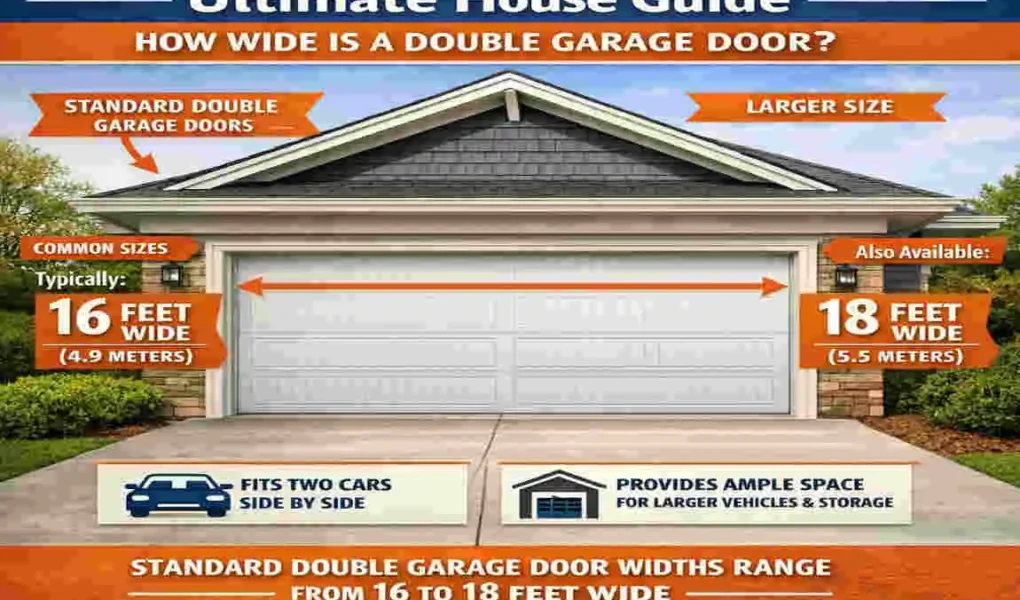
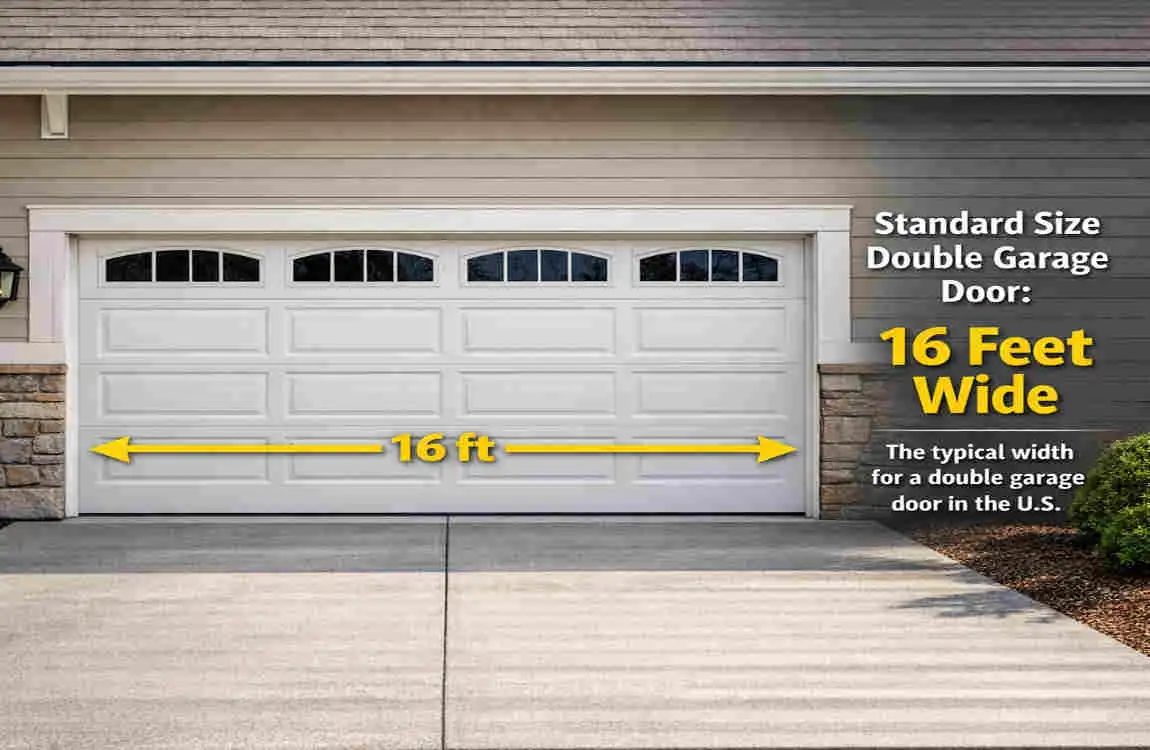
If you take a stroll down almost any suburban street in the United States and whip out a tape measure, you will find incredible consistency. The vast majority of U.S. homes use a standard dimension of 16 feet wide by 7 feet high for double garage doors. This classic size is intentionally designed to fit two standard cars side-by-side while leaving just enough room for you to walk between them.
Let us break that down into different units for absolute clarity. In inches, a standard double door measures 192 inches wide by 84 inches high. For our global readers who utilize the metric system, this translates to roughly 4.87 meters wide by 2.13 meters high.
But you might be wondering, why did 16 feet become the golden standard? The answer lies in the post-WWII suburban boom. As families moved out of cramped city centers and into sprawling suburbs in the 1950s, the two-car household became a symbol of the American dream. However, cars back then were massive steel cruisers with wide tailfins. Builders realized that anything less than 16 feet led to countless scratched paint jobs. The 16-foot standard offered a perfect compromise—it was wide enough to accommodate two vehicles, but narrow enough to keep construction costs down and prevent the garage door from sagging under its own weight.
Height Pairings
While we spend a lot of time focusing on how wide a double garage door is, you cannot ignore its height. Widths must pair perfectly with vertical dimensions to create a functional entry point.
Most 16-foot-wide doors are paired with either 7-foot or 8-foot heights. The 7-foot height has been the standard for decades and works beautifully for standard sedans, compact cars, and low-profile sports cars. However, as consumer tastes have shifted dramatically toward taller pickup trucks, lifted Jeeps, and bulky SUVs with roof racks, the 8-foot-tall garage door has surged in popularity. An 8-foot height provides that vital extra clearance so you do not accidentally scrape your roof box off when pulling inside.
When planning the standard width and height of your garage door, you also need to account for the “rough opening.” The rough opening is the framed space in the wall before the door tracks and weather stripping are installed. Generally, you need to add a few inches to your door’s dimensions to determine your rough opening.
Here is a handy comparison table to help you visualize these standard pairings:
Dimension Type Width (ft)Height (ft)Best Suited For Required Rough Opening
Standard 16 7 Sedans, hatchbacks, and small crossovers 16’4″ x 7’4″
Tall 16 8 Large SUVs, lifted trucks, and vans 16’4″ x 8’4″
By understanding these core sizes, you can quickly assess whether a standard double car garage door size will meet your family’s daily parking needs, or if you need to start looking at custom options.
Common Variations
Standard sizes are fantastic, but they do not work for absolutely everyone. Homes come in all shapes and sizes, and so do the vehicles we drive. If you find yourself asking, “How wide is a double garage door for oversized vehicles?” then you are ready to explore common sizing variations.
Going Wider for Maximum Space
Sometimes, 16 feet just does not cut it. If you own dual full-size pickup trucks with extended mirrors, or if you simply crave a lot of space to easily maneuver, you should consider wider options.
18- and 20-foot widths are increasingly popular, especially in luxury custom builds and modern farmhouse designs. An 18-foot door gives you a massive 216 inches of horizontal space. This means you gain an extra two full feet of buffer room. You can open your car doors completely wide without ever touching the neighboring vehicle. While less common in older subdivisions, these wider doors are rapidly gaining popularity among homeowners who double their garages as home gyms, woodworking shops, or storage havens for ATVs and motorcycles.
It is also fascinating to note regional and international differences. While Americans love their massive 18-foot doors, European double garages often start much smaller, typically ranging from 13 to 16 feet (4 to 5 meters). Because European roads and vehicles tend to be far more compact, their garage structures reflect a need for space-saving efficiency rather than sprawling width.
Narrower and Custom Fits
On the flip side of the coin, you might be dealing with a lot with strict property lines or a historic home layout. In these tight situations, you might need a narrower double door.
A 14-foot wide door is the absolute minimum size considered for a double garage. It is excellent for incredibly compact garages and urban townhomes. However, you must be honest with yourself: a 14-foot door is going to be a very tight squeeze for two vehicles. You will likely be restricted to parking two subcompact cars, or perhaps one standard car alongside a motorcycle or golf cart.
If none of these dimensions work, top manufacturers offer entirely custom sizes. You can order doors up to 24 feet wide. These massive installations are perfect for multi-vehicle collectors or commercial-style home workshops.
Let us break down the pros and cons of moving away from the 16-foot standard:
Width (ft)Major ProsPotential Cons
14 Feet Incredible space-saving design for tight lots Extremely tight for two modern cars; high risk of door dings
18+ Feet Extra room for oversized vehicles and storage Noticeably higher upfront cost; requires heavy-duty hardware
As you can see, choosing a variation requires carefully balancing your desire for space with your budget and property constraints.
Measuring Your Space
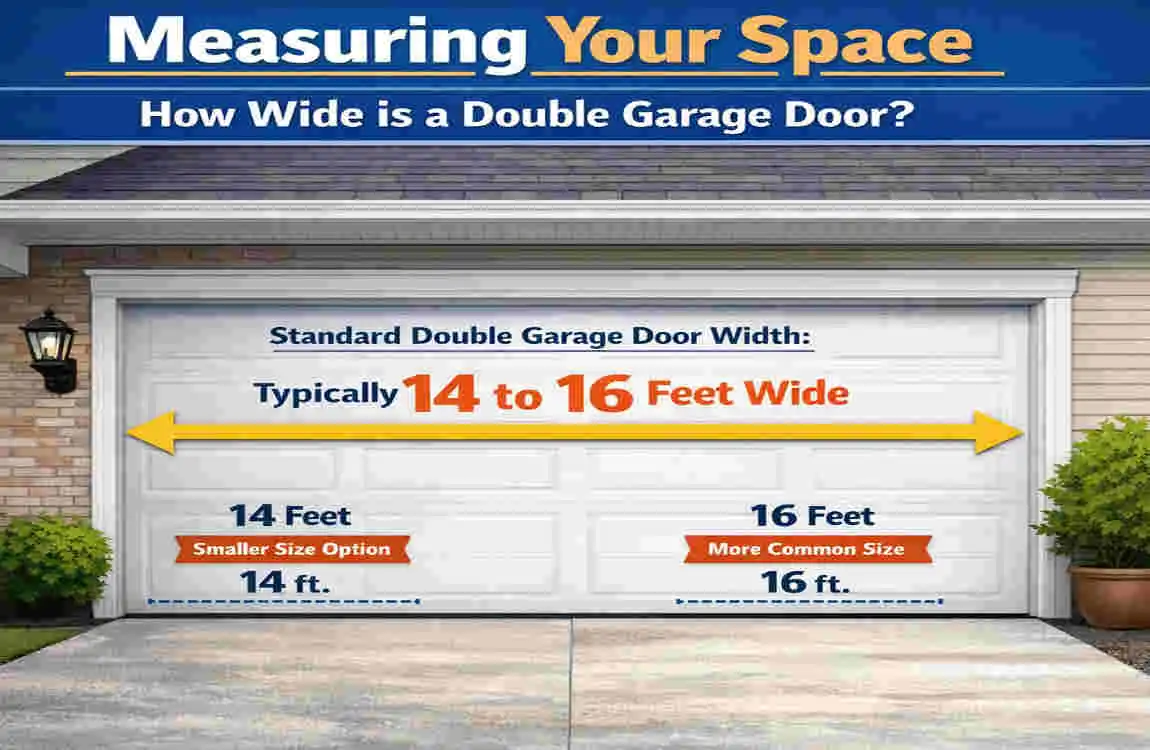
You should never assume your garage dimensions just by looking at them. Before asking how wide is a double garage door, you must measure your space accurately. Eyeballing the width can lead to disastrous and wildly expensive mistakes. Grab a reliable steel tape measure, a notepad, and a step stool. Let us walk through exactly how to measure your garage to ensure a flawless installation.
A Simple Step-by-Step Guide
Measuring for a new door involves much more than just measuring the hole in the wall. You need to account for all the surrounding hardware.
- Measure the Rough Opening Width and Height: This is the most critical step. Measure the exact width and height of the finished opening where the door will sit. Measure the width at the top, middle, and bottom, as framing is rarely perfectly plumb. Take the smallest measurement as your true width.
- Account for the Side Room (Tracks): Your door does not magically float; it needs steel tracks to glide up and down. Measure the wall space on both sides of the opening. You generally need to add at least 3 to 4 inches of clear, unobstructed space on each side for the vertical tracks to be installed safely.
- Check Your Headroom Clearance: Headroom is the space between the top of the garage door opening and your actual ceiling. This space houses the heavy torsion springs and the automatic opener track. Most standard double doors require a minimum of 12 to 15 inches of headroom. If you have less than this, you will need to purchase special “low headroom” hardware, which can increase your costs.
- Measure the Backroom (Depth): The distance from the garage door opening to the rear wall of the garage. Your door needs room to retract horizontally. Make sure your backroom is at least the height of your door plus an additional 18 inches for the motorized opener.
Common Measurement Mistakes to Avoid
Even seasoned DIYers can fall into measurement traps. The most common mistake homeowners make is ignoring ceiling height obstructions. You might measure 15 inches of clear headroom right at the door, but fail to notice a hanging light fixture, an air duct, or a structural beam situated halfway back in the garage. When the wide double door rolls up, it will smash right into that obstruction.
Another frequent error is forgetting to check for floor slope. Garages are intentionally built with a slight slope toward the driveway to allow water to drain out. If your concrete floor is severely unlevel from left to right, a perfectly rectangular 16-foot-wide door won’t seal correctly at the bottom. This allows cold drafts, rain, and pesky rodents to enter your home. Always check the floor with a long carpenter’s level to see if custom bottom weatherstripping is required.
Taking your time with the tape measure guarantees that when your massive new door arrives, it fits like a perfectly tailored glove.
Factors Influencing Width Choice
Now that you know how to measure and understand the standard double garage door dimensions, how do you actually pick the right width? You cannot make this decision in a vacuum. Several crucial lifestyle and architectural factors should heavily influence your final choice.
Matching Your Vehicle Size
The vehicles you drive right now—and the vehicles you plan to drive in the future—are the biggest dictators of your ideal garage door width.
Consider the math. The average modern car or mid-size SUV is roughly 6 feet wide. If you park two 6-foot-wide vehicles inside a standard 16-foot-wide door, those cars take up 12 feet of horizontal space. That leaves you with exactly 4 feet of buffer. When you divide that 4 feet between the left side, the middle gap, and the right side, you are left with just about 16 inches of clearance per side.
Sixteen inches is barely enough room to squeeze out with a grocery bag in your hand. Because modern SUVs and trucks are trending wider and bulkier every single year, many families are realizing that a 16-foot door feels incredibly restrictive. If you drive two large vehicles, an 18-foot-wide lane is highly recommended to preserve your sanity and protect your car’s paint from daily door dings.
Home Layout and Curb Appeal
Your geographical location and home layout also play a massive role. If you live in a dense urban neighborhood, a wider door might physically be impossible due to strict property boundaries. In suburban or rural settings, however, wider doors are the gold standard.
Never underestimate the power of curb appeal. Because a double garage door is so vast, it is often the very first thing visitors and potential buyers notice about your home. A beautifully proportioned, wide garage door can make your entire house look grander and more substantial. In fact, real estate experts frequently note that upgrading to a wider, high-quality garage door can boost your home’s overall value by 5% to 10%. It is one of the highest return-on-investment exterior upgrades you can perform.
Navigating Strict Building Codes
You cannot just knock down a wall and install an ultra-wide door without checking the rules. Local building regulations and municipal codes have strict say over what you can and cannot build.
Many local codes require a minimum width of 9 feet per vehicle bay. If you want a double garage, the code naturally mandates a minimum of an 18-foot opening. Additionally, you must consider structural integrity. A 20-foot-wide garage door removes a significant portion of the load-bearing wall supporting your roof. You will likely need an engineer to sign off on a heavy-duty steel header to span that wide gap safely.
Fire ratings also affect your choices. If your garage is attached to your living space, building codes dictate specific fire-rated materials. Wider doors made of heavy, solid wood or thick steel will behave differently in a fire than lightweight aluminum, which might restrict your material choices when going exceptionally wide.
Crucial Installation Considerations
Once you have settled on the perfect width, you must prepare for the realities of installation. The width of a double garage door impacts installation ease, overall costs, and the structural hardware required.
Budgeting for Width
As you might expect, wider doors require more materials and therefore cost more. Depending on the width, material, and design style you choose, a standard double garage door installation typically costs between $1,500 and $4,000.
If you stick to the standard 16×7 foot size in basic steel, you will hover on the lower end of that spectrum. But if you decide to upgrade to an 18-foot wide custom carriage-house style door made of real cedar wood, your costs will quickly climb to the top of that range, or even exceed it.
The DIY vs. Professional Debate
Can you install a double garage door yourself? Technically, yes. Should you? Probably not.
Double garage doors are incredibly heavy and cumbersome. A standard 16-foot steel door can easily weigh over 150 pounds, while insulated wood doors can weigh upwards of 350 pounds. Wrestling this massive panel into perfectly aligned vertical tracks is not a one-person job. Furthermore, double garage doors require highly tensioned torsion springs to lift that massive weight. If you do not know exactly what you are doing, winding a torsion spring is incredibly dangerous and can cause severe physical injury. We highly recommend leaving wide double-door installations to seasoned professionals.
Insulation and R-Values
When you install a double garage door, you are essentially installing a massive moving wall in your home. If that wall is completely uninsulated, your garage will be freezing in the winter and sweltering in the summer.
Because a double door covers a large area, investing in high-quality insulation is crucial for energy savings. Look for doors with high R-values. R-value is the measure of thermal resistance. A standard uninsulated door has an R-value of 0. For a double garage, you want an R-value between R-8 and R-16. Doors filled with dense polyurethane foam offer the best insulation, keeping your garage comfortable and reducing the energy costs of your adjoining living spaces.
The Tangible Benefits of Right-Sizing

Taking the time to research “how wide is a double garage door” and choosing the perfect size for your specific needs yields massive daily benefits. Right-sizing your garage door transforms your garage from a frustrating parking puzzle into a highly functional extension of your home.
The most immediate benefit is drastically improved access. You no longer have to fold your mirrors in, hold your breath, and pray you do not scrape the frame every time you reverse out of the driveway. Teen drivers, who might not yet have perfect spatial awareness, will especially benefit from the forgiving buffer room of an 18-foot-wide door.
Additionally, right-sizing frees up valuable storage space. When you are not constantly trying to squeeze between two tightly parked cars, you suddenly have room along the side walls.
Take, for example, a recent case study of a suburban family who upgraded from a standard 16-foot door to a wider 18-foot model during a renovation. Because they could park their two vehicles closer to the center of the widened opening, they freed up three full feet of wall space on the right side of the garage. This allowed them to install a permanent, heavy-duty workbench and tall storage cabinetry—completely transforming the garage into a usable workshop without sacrificing their indoor parking spots.
Furthermore, combining the right width with proper insulation results in exceptional energy efficiency, ensuring your large garage remains a temperate, comfortable space year-round.
Maintenance Tips for Wide Garage Doors
Because double garage doors span such a wide width, they are subjected to significant stress and gravity forces every time they open and close. To protect your investment and keep your door running silently, you must prioritize regular maintenance.
First and foremost, you need to lubricate the tracks, hinges, and rollers at least twice a year. Because a 16-foot or 18-foot door is so heavy, friction is your biggest enemy. Use a high-quality silicone-based garage door spray—never use heavy grease, which attracts dirt and grime.
Secondly, wide doors are highly susceptible to width-related warping, particularly in areas with extreme weather fluctuations. A massive 18-foot wooden door can bow in the center if exposed to relentless direct sunlight and high humidity. Always inspect the structural integrity of your horizontal struts. These long metal bars run across the inside panels of the door to reinforce its width. If you notice your door sagging in the middle when it is open, call a professional immediately to reinforce the struts before the door panels buckle under their own weight.
Frequently Asked Questions
How wide is a standard double garage door?
The absolute industry standard for a double garage door is 16 feet wide. This measurement has been the go-to size for decades, offering a reliable balance of space and cost-efficiency, allowing two standard-sized vehicles to park side-by-side safely.
Can I customize the width of my double garage door?
Yes, absolutely! While 16 feet is the standard, top manufacturers offer a wide array of custom sizes. You can order narrower doors down to 14 feet for tight urban lots, or massive, commercial-grade doors that stretch up to 24 feet wide for large workshops and custom home builds. If you have the budget and the structural framing, your options are incredibly vast.
What is the rough opening for a standard 16-foot door?
The rough opening is the raw, framed hole in your garage wall before any finishing materials are applied. For a standard 16-foot wide by 7-foot tall garage door, the rough opening should generally measure 16 feet 4 inches wide by 7 feet 4 inches high. That extra few inches provides the necessary tolerance to properly install the door jambs, tracks, and weather sealing without cramping the mechanical parts.
Double door vs. two single doors: Which is better?
This is a classic architectural debate. Two single doors (usually 8 or 9 feet wide each) separated by a central pillar offer a highly traditional, carriage-house aesthetic that many homeowners adore. However, a single, wide double door is vastly simpler for wide access. You do not have to worry about dodging a central pillar when backing out a wide SUV, and maneuvering a boat or trailer into the garage is infinitely easier without an obstacle in the middle of the room.
Are 18-foot wide doors becoming more common?
Yes, they are growing rapidly in popularity. As consumer preferences continue to lean heavily toward larger vehicles—like full-size pickup trucks, heavy-duty SUVs, and family minivans—the traditional 16-foot width is beginning to feel claustrophobic. Many modern home builders are adopting the 18-foot door as their new default to accommodate larger vehicles and provide homeowners with comfortable breathing room.