How much does laminate flooring expand in your home? You’re not alone! If you’re planning to install laminate flooring yourself or just curious about how it behaves, understanding its expansion is crucial. Laminate flooring typically expands about 0.1% to 0.3% of its length, which translates to roughly 1/4 to 1/2 inch of expansion around each room’s perimeter. This expansion depends mainly on changes in humidity and temperature inside your home.
Why Laminate Flooring Expands
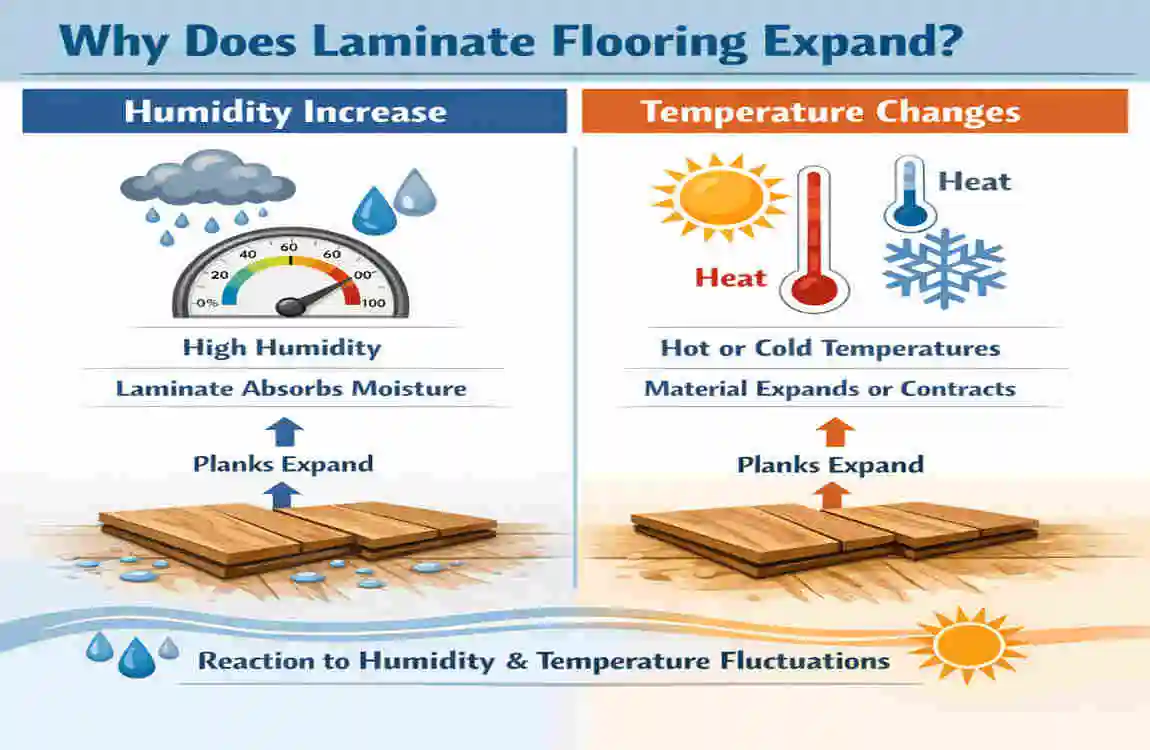
Understanding why laminate flooring expands starts with knowing what laminate is made of. At its core, laminate flooring features a High-Density Fiberboard (HDF) core made from compressed wood fibres. Wood is a natural material that absorbs moisture from the air, causing it to swell. When the air is dry, the wood fibres contract. This constant cycle of swelling and shrinking is what causes laminate flooring to expand and contract.
The Role of Humidity and Temperature
Humidity is the main culprit behind laminate expansion. When the air is humid, moisture seeps into the HDF core, making the planks swell. Conversely, dry air causes the planks to shrink. Temperature also plays a role: heat speeds up the expansion and contraction cycles, while cooler temperatures slow them down.
How Laminate Differs from Hardwood
How does laminate compare to hardwood flooring? Hardwood is solid wood, so it expands and contracts more than softer woods. Laminate, with its engineered core and protective top layer, is less prone to drastic changes, but it still needs room to expand. Ignoring this can lead to problems like buckling or warping.
How Much Movement to Expect?
In climates with significant seasonal changes, laminate floors can shift up to 1/2 inch across a room. This might not sound like much, but without proper expansion gaps, even small movements can cause big headaches.
Visual Tip: Imagine a plank that looks perfectly flat in winter but slightly raised or warped in summer due to expansion. This is why planning for expansion is essential.
How Much Does Laminate Flooring Expand?
Let’s get to the heart of the question: how much does laminate flooring expand? The answer depends on the size of your room, the plank length, and environmental conditions.
Typical Expansion Range
- Linear expansion: About 0.1% to 0.3% of the plank length.
- Perimeter gap: Usually between 1/4 inch (6mm) and 1/2 inch (12mm) around the edges of the room.
For example, a 10-foot-long plank might expand by 1.2-3.6mm. While that sounds tiny, it adds up across an entire floor.
Room Size and Expansion
Here’s a handy table showing expected expansion based on room length:
Room Length, Expected Expansion (inches), Recommended Gap Size
Up to 10 ft 0.25 – 0.36 1/4 inch
10 – 20 ft 0.36 – 0.5 3/8 to 1/2 inch
Over 20 ft 0.5+ 1/2 inch or more; use transition strips
As you can see, larger rooms require bigger gaps or even transition strips to accommodate expansion.
Thickness Matters
Laminate planks come in different thicknesses, usually between 8mm and 12mm. Thicker planks tend to expand slightly more because they contain more wood fibres. So, if you’re using 12mm planks, plan for the higher end of expansion.
Real-World Example
Think about winter versus summer: in winter, dry heated air causes the floor to contract, making gaps more visible. In summer, higher humidity causes the floor to swell, potentially pushing against walls or furniture if gaps are too small.
Factors Affecting Laminate Flooring Expansion
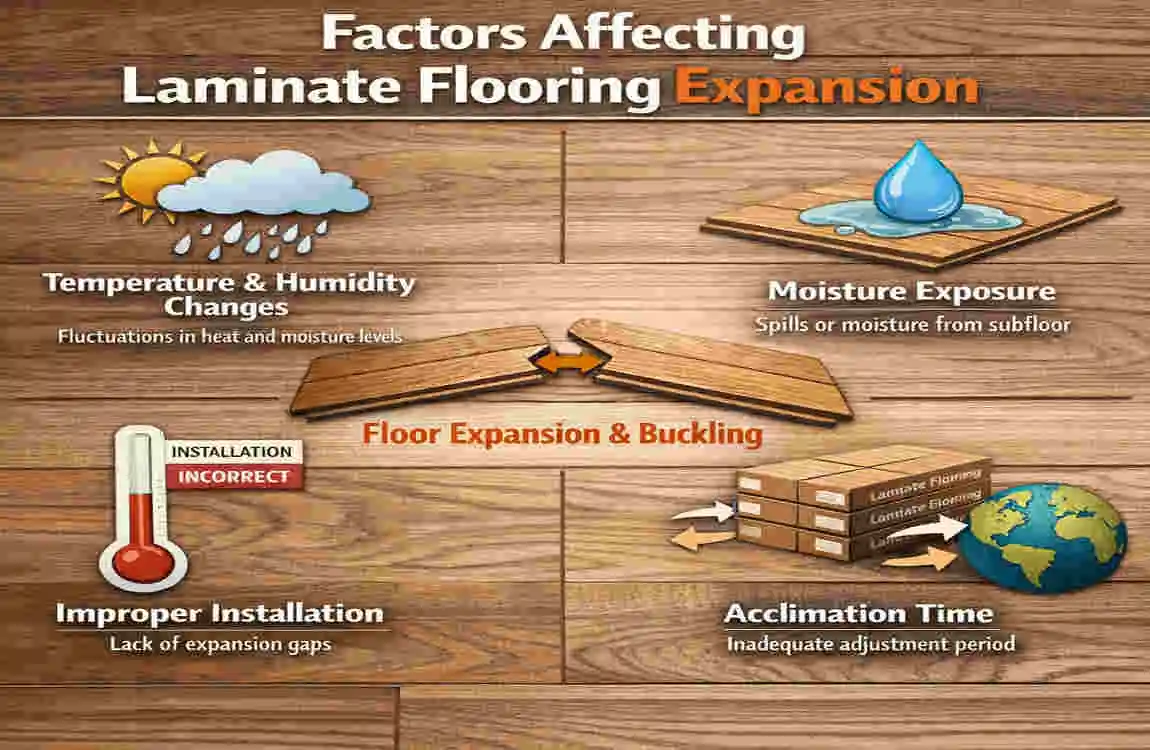
Several factors influence how much your laminate floor will expand or contract. Understanding these helps you plan better.
Key Influencers
- Humidity: Ideal indoor humidity is between 40% and 60%. When humidity rises above 70%, laminate can swell up to 0.3% of its length.
- Temperature: The best range is 65°F to 80°F. Higher temperatures speed up expansion cycles.
- Subfloor Type: Concrete subfloors tend to retain moisture longer than plywood, which can affect how much moisture the laminate absorbs.
- Acclimation: Laminate must be acclimated for 48-72 hours before installation to adjust to room conditions. Skipping this step can cause excessive expansion later.
- Regional Climate: If you live in a humid area (like Lahore in summer), expect up to 20% more expansion than average.
Why Acclimation Is Crucial
Acclimation means letting your laminate planks sit in the room where they’ll be installed for a few days. This allows the wood fibres to adapt to local humidity and temperature, reducing surprises after installation.
Expert Guide to Laminate Flooring Expansion Gaps
Now that you know why and how much laminate expands, let’s talk about how to install expansion gaps properly.
Standard Gap Sizes
- Perimeter gaps: Between 1/4 inch (6mm) and 1/2 inch (12mm) around all walls and fixed objects.
- Rule of thumb: Use a gap equal to the plank thickness plus 0.1% of the room length.
How to Calculate Expansion Gaps
Here’s a simple formula:
Expansion Gap = Plank Thickness + (0.1% × Room Length)
For example, if you have 10mm thick planks in a 15-foot room:
- 0.1% of 15 feet (180 inches) = 0.18 inches
- Gap = 10mm (~0.4 inches) + 0.18 inches ≈ 0.58 inches (about 1/2 inch)
Step-by-Step Installation Tips
- Use spacers: Place spacers between the wall and the flooring planks during installation to maintain consistent gaps.
- Fill gaps: After installation, fill gaps with baseboards or quarter-round moulding for a clean look.
- Large rooms: For rooms longer than 20-30 feet, install T-mouldings or transition strips to accommodate expansion breaks.
- Seasonal checks: Measure gaps after installation and during different seasons to ensure they remain adequate.
Installation Best Practices for Expansion Gaps
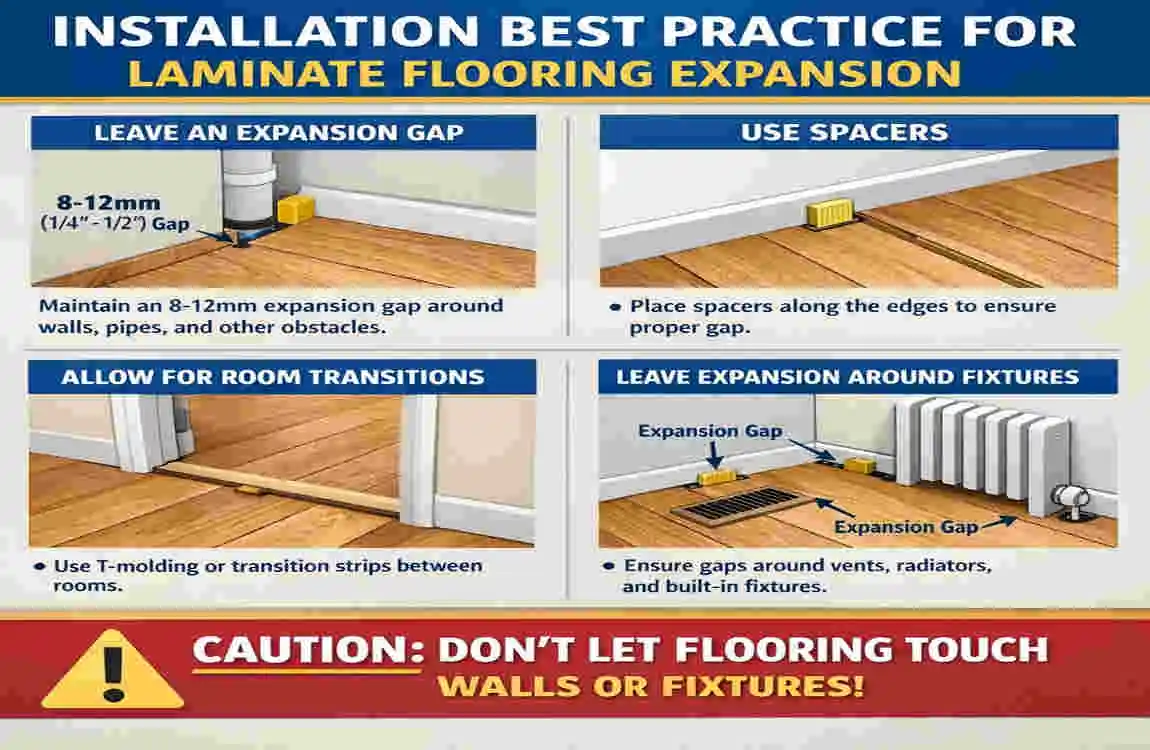
Proper installation is key to preventing laminate flooring issues.
Acclimation Process
- Keep the planks in the installation room for 2-3 days before starting the installation.
- Maintain room temperature between 65°F and 80°F and humidity between 25% and 70% during acclimation.
Essential Tools
- Spacers: To maintain expansion gaps.
- Underlayment: Helps with moisture control and sound dampening.
- Moisture meter: To check subfloor moisture before installation.
Floating Installation Tips
Laminate floors are usually installed as floating floors, meaning they aren’t glued or nailed down. This allows the floor to “breathe” and expand naturally. Make sure your underlayment and spacers are properly used to support this.
Maintenance Tips
Control indoor humidity with dehumidifiers or humidifiers as needed. Keeping humidity stable reduces the amount of expansion and contraction your floor experiences.
Common Problems and How to Fix Them
Even with the best intentions, mistakes happen. Here are common issues related to laminate expansion and how to fix them.
Buckling and Gapping
- Cause: No or insufficient expansion gaps.
- Fix: Remove affected planks and reinstall with proper spacers and gaps.
Cupping in Bathrooms
- Cause: Excess moisture exposure.
- Fix: Use wet-rated laminate flooring designed for moisture-prone areas.
Prevention Checklist
- Always acclimate planks before installation.
- Use correct expansion gaps.
- Control indoor humidity.
- Avoid installing laminate in areas with standing water.
FAQs About Laminate Flooring Expansion
Q: How much does laminate flooring expand?
A: Typically between 1/4 inch and 1/2 inch around room edges.
Q: What is the minimum expansion gap for laminate?
A: At least 1/4 inch is recommended.
Q: Does laminate expand in all directions?
A: Yes, laminate expands lengthwise and widthwise.
Q: Can I install laminate without expansion gaps?
A: No, skipping gaps often leads to buckling and damage.
Q: How long should laminate acclimate before installation?
A: 48 to 72 hours in the installation environment.