Ever wondered, “What year was my house built in?” while eyeing that quirky vintage light fixture or planning a massive kitchen renovation? You are certainly not alone. Every day, thousands of homeowners and prospective buyers ask this exact question. Sometimes, it is driven by pure historical curiosity. Other times, it is a matter of absolute necessity.
Knowing the exact age of your home is much more than a fun trivia fact to share at dinner parties. It is a vital piece of information that dictates how you maintain, upgrade, and protect your property. For example, statistics show that homes built before 1978 are significantly more likely to contain lead-based paint. This single factor can dramatically alter your renovation plans, impact your home insurance premiums, and even affect your eventual resale strategy.
| Method | Steps | Best For | Location Notes |
|---|---|---|---|
| Real Estate Sites | Search address on Zameen.com, Redfin, Rightmove | Quick estimate | Pakistan: Zameen.com; Global: Local portals |
| Land Authority Portal | punjab-zameen.gov.pk → Select Tehsil → Search by CNIC/Khasra | Ownership & basic records | Lahore/Punjab: PLRA Fard |
| Tax/Assessor Records | Council/County site → Postcode search | Official year built | UK: Council tax; US: Assessor APN |
| Title/Deeds | Check purchase docs or registry office | Exact first sale/registration | Pakistan: Local registrar; Global: Deeds |
Why Knowing Your House’s Build Year Matters

You might be thinking, “Why does the age of my house actually matter if the roof is not leaking?” The truth is, the construction year impacts almost every financial and structural aspect of homeownership.
First and foremost, your home’s age directly influences your insurance premiums. Insurance companies know that older homes generally cost more to repair and are more prone to issues such as electrical fires or plumbing leaks, which can lead to higher monthly rates.
Secondly, knowing your build year is non-negotiable for safe renovation planning. If your home was constructed before the 1980s, you might uncover dangerous asbestos wrapped around your heating pipes or hiding in your floor tiles. For buyers, knowing a home’s age reveals hidden issues before you sign the dotted line, such as outdated, dangerous wiring. Finally, the historical age can deeply influence your resale value and current tax assessments.
To make this simple, take a look at the quick comparison table below. It outlines the common risks and impacts associated with different home-building eras.
Home Age Risk and Impact Table
Build Era Key Risks Insurance Impact Renovation Notes
Pre-1940 Asbestos, lead paint, foundation settling Higher premiums Full inspections needed before drilling or tearing down walls
1940-1970 Knob-and-tube wiring, galvanized plumbing Moderate hikes Expect to upgrade electrical panels and replace old pipes
1970-1990 Potential radon, aluminum wiring Standard rates Check for urea-formaldehyde foam insulation
Post-2000 Fewer structural issues, modern codes Lowest costs Energy-efficient baseline makes cosmetic updates much easier
This table helps you instantly match your home’s specific era to actionable items. If your home falls into an older category, you now know exactly what to tell your home inspector or general contractor.
Check Your Property Documents (Easiest for Owners)
If you already own the home, you are in luck. The absolute easiest and most accurate way to answer “what year was my house built in” is to simply check the paperwork you already possess. When you purchased your home, you were likely handed a massive folder or digital file filled with legal documents.
These documents are not just legal jargon; they are the historical blueprint of your property. Deeds, titles, mortgage statements, and closing paperwork often list the exact build year explicitly. You just need to know where to look.
The Step-by-Step Document Hunt
Here is how you can systematically check your paperwork:
- Dig out your original deed or title: Go to your filing cabinet or open your secure digital purchase files. Find the document labeled “Property Deed” or “Title Insurance Policy.”
- Scan for the “Year Built” field: Look near the property’s legal description. You will often find a line item labeled “Year Built,” “Year of Construction,” or “Effective Year Built.”
- Cross-reference with your inspection reports: Find the home inspection report you commissioned before buying the house. Home inspectors always list the estimated build year on the very first page of their summary.
- Check the seller’s disclosure: If you kept the seller’s property information form, review it. Sellers are legally required to provide the best information they have regarding the property’s history, including its age.
Search County Assessor or Tax Records (Free & Accurate)
If you cannot find your paperwork, or if you are looking into a home you do not own yet, your next best friend is the local government. Specifically, you want to consult your county tax assessor’s office.
The county assessor is responsible for determining the taxable value of every single piece of real estate within their jurisdiction. To do this accurately, they absolutely must know when the home was constructed. Because this is public information, these records are a free, highly accurate way to discover your home’s age.
How to Navigate Public Property Records
Most counties across the United States have digitized their property records, making this a simple online search. Here is how you can find yours:
- Google your local assessor: Open your search engine and type “[Your County Name] property assessor” or “[Your County Name] property tax records.”
- Locate the property search tool: Once on the official government website, look for a button that says “Property Search,” “Parcel Search,” or “Public Records.”
- Input the property address: Type in the street address. If the address is finicky, you can also search using the APN (Assessor’s Parcel Number) if you happen to know it.
- Review the property card: Click on the matching result. This will pull up a digital “property card.” Scroll down until you see the building specifications. Right next to the bedroom count and square footage, you will find the definitive “Year Built.”
Global Variations and Verifying the Data
It is important to note that the layouts of these websites vary widely depending on your location. Some county websites look incredibly modern, while others look like they were built in the 1990s. Be patient and read the fields carefully.
For our international readers, the process is similar but uses different agencies. For instance, in the UK, you would utilize the HM Land Registry to pull title registers, which often contain historical construction data.
When you find the year on the assessor’s site, take a quick second to note the square footage listed. This helps you verify that the county is taxing you on the correct size of your home!
Use Online Real Estate Portals & Free Tools
Let’s say you want an answer right this second, and you do not want to navigate a clunky government website. The fastest quick-win method is to use popular online real estate portals.
Massive websites like Zillow, Redfin, and Realtor.com are incredibly powerful data aggregators. They pull their information directly from the Multiple Listing Service (MLS) and public tax records. Because of this, they almost always display the year a home was built right on the main listing page.
The Quick Real Estate Portal Method
Using these platforms is incredibly straightforward:
- Enter the full address: Go to Zillow, Redfin, or your portal of choice and type the exact address into the main search bar.
- Navigate to the “Facts” tab: Scroll past the photos and the price estimate. Look for a section titled “Home Details,” “Public Facts,” or “Property History.”
- Locate the year: You will usually see “Year Built” listed right next to the heating/cooling type and lot size.
Advanced Online Tools
If the major portals draw a blank, you can try slightly more advanced real estate tools like PropertyShark. These websites cater more to real estate investors and often offer a deeper dive into APN data and permit history.
For a more historical approach, especially if you suspect your home is over a century old, you can turn to genealogy and historical sites. Searching census data on platforms like Ancestry can be incredibly revealing. If your address suddenly appears in the 1910 census but is completely missing from the 1900 census, you have successfully narrowed your home’s construction date to that exact decade!
A Word of Caution: Always verify data in the online portal across multiple sites. If Zillow says 1955 but Redfin says 1975, you will need to dig a little deeper using one of our other methods.
Looking to optimize your own real estate listings? Head over to our SEO Tool Recommendations post to see what software the pros use!
Consult Real Estate Pros & Title Companies
Sometimes, the internet gets it wrong. Data entry errors happen, records get lost in digital transitions, and older homes simply fall through the cracks. When digital tools and your personal files fail, it is time to call in the professionals.
Leaning on Real Estate Agents
If you are a home buyer, your real estate agent is your greatest asset. Agents pay for exclusive access to the local Multiple Listing Service (MLS). The MLS contains a deep, historical archive of every time a property has been bought or sold.
Your agent can look at past listings of the home from ten, twenty, or even thirty years ago. Often, an older listing will have more accurate historical notes written by a previous agent.
Utilizing Title Companies
If you are a current homeowner, you have another powerful professional in your corner: the title company.
Look back at your closing documents and find the name of the title company that handled your transaction. Title companies specialize in researching a property’s legal history to ensure there are no hidden claims against it. As a result, they have massive, highly detailed databases regarding property histories.
Give your title agent a quick phone call. Explain that you are trying to confirm the exact year your home was built for insurance or renovation purposes. Because you are a past client, many title companies will happily run a quick search through their archives completely free of charge.
Check out our Real Estate Agent Tips guide for more advice on how to effectively communicate with your local housing professionals.
Inspect Physical & Architectural Clues
What if your local government records burned in a historical fire? What if your house is so old that standard paperwork simply does not exist? When the paper trail runs completely cold, it is time to grab your magnifying glass and play architectural detective.
Homes are essentially massive time capsules. The materials used, the design style, and even the hardware on the doors can tell a vivid story about when the foundation was poured.
Examining Physical Evidence
You do not need an architectural degree to spot these clues. Start by taking a walk around your home and looking for these specific physical identifiers:
- Inspect the Toilet Tank: This sounds strange, but it is one of the best tricks in the book! Lift the heavy lid off the back of your toilet tank and look underneath it. Manufacturers almost always stamp the exact manufacturing date into the porcelain. If your bathroom features its original fixtures, this date is usually within a few months of the home’s construction year.
- Look at the Electrical Panel and Wiring: If you have an unfinished basement or attic, check the wiring. “Knob-and-tube” wiring instantly dates your home to between 1880 and the 1940s. Aluminum wiring was primarily used for a brief period between 1965 and 1973.
- Examine the Window Glass: Older homes (pre-1920s) often feature wavy, slightly imperfect glass. Furthermore, older window panes are generally much thinner than modern, double-pane energy-efficient windows.
- Search for Foundation Stamps: Walk around the exterior perimeter of your home. Sometimes, the concrete workers who poured your foundation or laid your driveway stamped the exact year into the wet cement.
- Check the Attic Beams: Occasionally, carpenters working on historical homes would sign and date the wooden crossbeams in the attic. Grab a flashlight and carefully inspect the exposed wood.
Identifying Architectural Styles
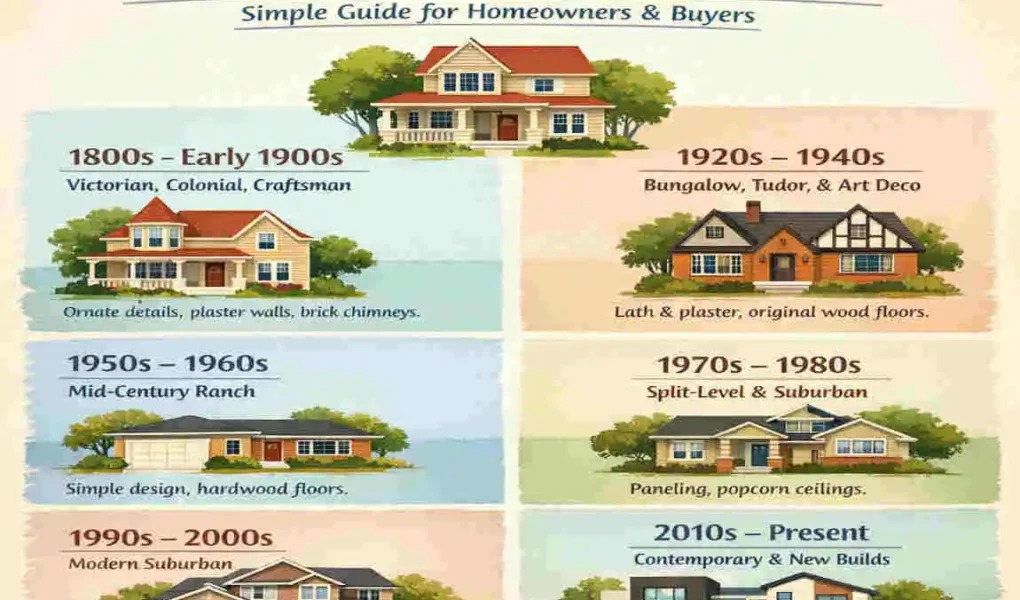
The overall shape and layout of your house is a massive giveaway. Home design trends change rapidly. By identifying your home’s architectural style, you can estimate the era in which it was built. Use this table as your guide:
Architectural Style Typical Years Key Identifier
Victorian 1840-1900 Ornate exterior trim, steep rooflines, bright colors, asymmetrical shapes
Craftsman / Bungalow 1905-1930 Low pitched roofs, wide front porches, exposed rafters, built-in cabinetry
Mid-Century Modern 1945-1970 Flat or slanted roofs, large floor-to-ceiling windows, open floor plans
Ranch / Split-Level 1950-1980 Single-story living, long and low rooflines, attached garages, sliding glass doors
If your house features an open floor plan with massive windows, it is highly unlikely to have been built in 1890. Conversely, if your home has ornate Victorian gingerbread trim and a wraparound porch, you are definitely not living in a 1960s build.
Advanced Searches (Permits, Census, Historical Maps)
For the truly dedicated homeowner, or those living in properties boasting a century or more of history, basic methods might not be enough. If you really want to dive deep into the specific historical origins of your property, you need to turn to advanced archival searches.
This method requires a bit more legwork, but it is incredibly rewarding. You will uncover not just the year your home was built, but the fascinating story behind it.
Digging Up Building Permits
Your local city hall or municipal building department is responsible for issuing construction permits. Every time a legal structure is built, altered, or demolished, a permit must be filed.
Visit your local building department (many now have online portals, though older records require an in-person visit). Request a copy of the permit history for your specific address. You are looking for the original “Certificate of Occupancy” or the very first foundation permit. Finding this document gives you the exact, indisputable year your home was born.
Tracking Census Records
If your home dates back to the 1800s or early 1900s, the United States Census is a brilliant tool. The census has tracked who lived where every ten years.
By using free trials on genealogy sites like Ancestry or FamilySearch, you can look up your street address. If a family is listed as living at your exact address in the 1880 census, but the address does not exist in the 1870 census, you can confidently deduce that your house was built sometime during the 1870s.
Exploring Sanborn Fire Insurance Maps
In the late 19th and early 20th centuries, the Sanborn Map Company created highly detailed city maps specifically to help fire insurance companies evaluate the liability of buildings.
These maps are famously accurate. They show the footprint of every building, the materials used (brick, wood, stone), and property lines. Many local libraries and historical societies hold vast collections of Sanborn maps. By comparing a map from 1895 to a map from 1905, you can visibly see exactly when your house magically appears on the street!
A Quick Warning: While tracing history is fun, be very cautious about third-party websites that charge steep fees for “historical home reports.” Almost all of this information—from permits to census data to maps—can be accessed entirely for free through your local library or government offices.
Common Challenges & Troubleshooting
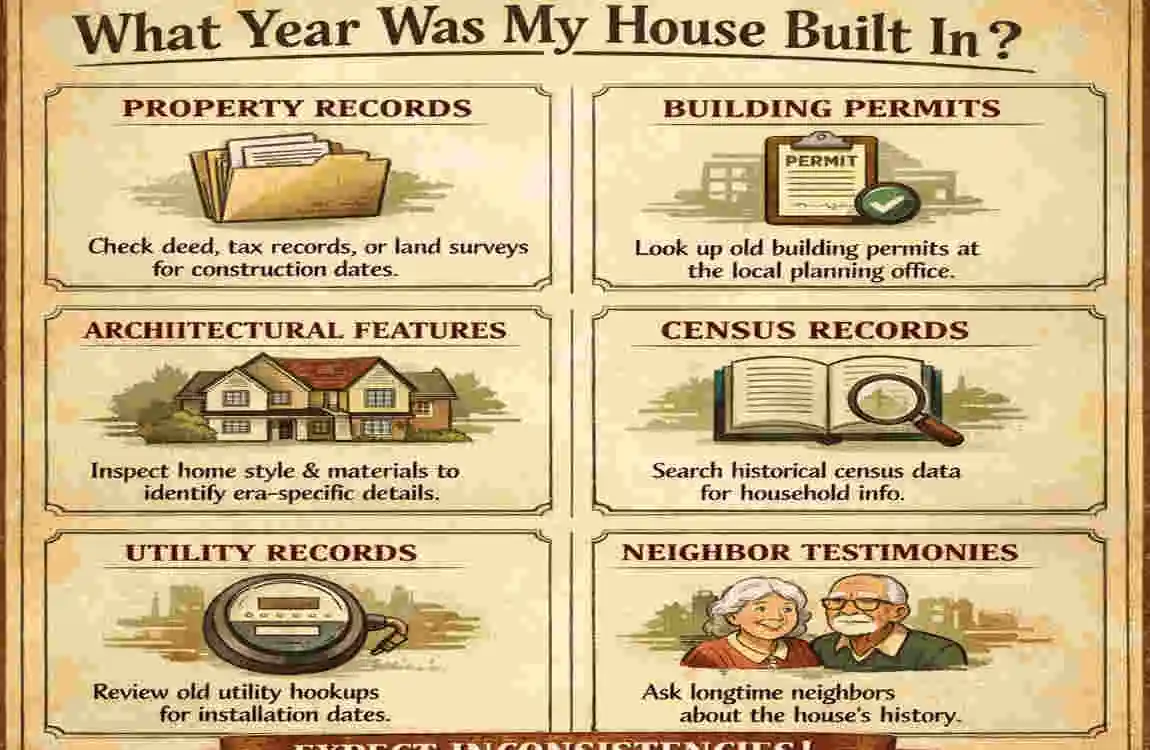
Even with all these incredible methods at your disposal, answering “what year was my house built in” isn’t always smooth sailing. You might run into a few frustrating roadblocks along the way. Here are the most common challenges and exactly how to troubleshoot them.
Inaccurate Online Data
The most frequent issue homeowners face is conflicting data. Zillow might say 1940, your tax assessment might say 1952, and the physical architecture looks like it is from the 1920s. Which one is correct?
When digital records conflict, always trust official government records (like original permits or deeds) over online real estate portals. Zillow and Redfin rely on automated data scraping, which is prone to error.
Major Renovations Resetting the Clock
Sometimes, your tax records might show a build year of 1995, even though your house is clearly a 1920s Craftsman bungalow. Why does this happen?
If a previous owner undertook a massive, “down-to-the-studs” gut renovation or added a major structural addition, the county assessor may update the “Effective Year Built” to reflect the year of the renovation. This is done for taxation and insurance purposes. If you suspect this is the case, you will need to rely on historical maps or original building permits rather than current tax cards.
Multi-Unit Builds and Subdivisions
If your home was originally a massive single-family estate that was later carved into multi-unit condos, the records can get incredibly messy. The city might list the build year as the year the property was legally subdivided, rather than the year the original structure was built.
The Ultimate Solution: If you have cross-verified three or more sources and the records still fiercely conflict, your best option is to hire a professional residential appraiser. Appraisers are highly trained to evaluate historical data and physical structures to determine a property’s true, legal age.
What to Do Next: Insurance, Renovations & Selling
Congratulations! You have successfully played detective and definitively answered the question, “What year was my house built in?” Now that you hold this valuable information, it is time to put it to practical use.
Update Your Homeowners Insurance
First, call your insurance agent. If you discovered your home is actually newer than previously thought, or if you found proof of a recent major structural update, you might be eligible for a reduction in your insurance premiums. Conversely, if your home is older, you need to ensure you have adequate coverage for age-specific issues, such as “ordinance or law” coverage, which pays to bring an older home up to modern building codes during a repair.
Plan Renovations Safely
If your home was built before the 1980s, you must proceed with caution before swinging a sledgehammer. Knowing your home’s era means you now know to test for lead paint before sanding window sills and for asbestos before pulling up old vinyl flooring. It also helps you budget properly; if your home was built in the 1950s, you should probably set aside funds to replace old galvanized plumbing.
Boost Your Selling Appeal
If you are planning to sell, age is not a detriment—it is a marketing tool! Buyers love historical charm. Highlighting that your home is an authentic “1920s Craftsman” or a “True Mid-Century Modern built in 1958” can dramatically boost your listing’s appeal and help you stand out in a crowded market.
Ready to make your property listing shine? Contact our team for professional property SEO audits to ensure your home’s unique history reaches the right buyers so you can sell faster and for top dollar!
FAQs
What year was my house built if there are absolutely no records?
If paper trails and digital records are completely nonexistent—which often happens in rural areas or with homes over 150 years old—you must rely entirely on physical architectural clues and census data. Examine the construction materials, such as the type of nails used (square nails indicate a pre-1890s build), the foundation style, and the thickness of the window glass. You can also research the history of your specific plot of land through early local census records.
Is Zillow accurate for finding out ‘what year was my house built in’?
Zillow is generally accurate, but it is not infallible. Because Zillow pulls its data automatically from local municipal public records and regional MLS feeds, it is only as accurate as the data originally entered by human clerks. Typographical errors do happen. It is highly recommended that you use Zillow as a starting point, but always verify the year with your county assessor’s official website or your property deed.
How does the build year affect my home’s overall value?
The build year affects value in two opposing ways. On one hand, older homes often possess unique architectural character, mature landscaping, and premium locations in established neighborhoods, which can drive up the value. On the other hand, older homes generally require significantly more maintenance, feature outdated energy efficiency, and carry higher insurance costs, which can deter some buyers. Ultimately, a well-maintained older home holds excellent value.
Are there free tools for non-US homeowners to check property age?
Yes! While the systems differ by country, almost all modern nations keep meticulous public property records. In the United Kingdom, you can search the HM Land Registry. In Australia, you can utilize state-specific Land Titles Offices. In many European countries, you can check the local cadastre (the official public registry of land ownership and boundaries), which is typically accessible through municipal government portals.
What if my house was heavily renovated—does the “year built” change?
Legally, the original “Year Built” remains the date the foundation was poured and the original structure was erected. However, county tax assessors will often introduce a second date called the “Effective Year Built.” If you completely gut a 1930s home, upgrade all the plumbing, electrical, and roofing to modern 2026 standards, the assessor may classify the effective age as brand new, which heavily impacts your tax assessment and insurance rates.