We see numbers on listing sheets all the time—1,500 sq ft, 2,400 sq ft, 3,000 sq ft. But unless you are a builder or an architect, those numbers can feel pretty abstract. Does 2,000 square feet mean you’ll have a ballroom, or does it mean your sofa will touch the kitchen island?
Understanding how big a square-foot house is crucial, whether you are buying your first starter home, upgrading for a growing family, or downsizing for retirement.
At its most basic level, square footage is a math equation: you multiply the length of a room by its width to get the total livable area. But here is the catch—that number on the real estate listing usually excludes the garage, the porch, and sometimes even the basement.
What is Square Footage? Understanding the Metric
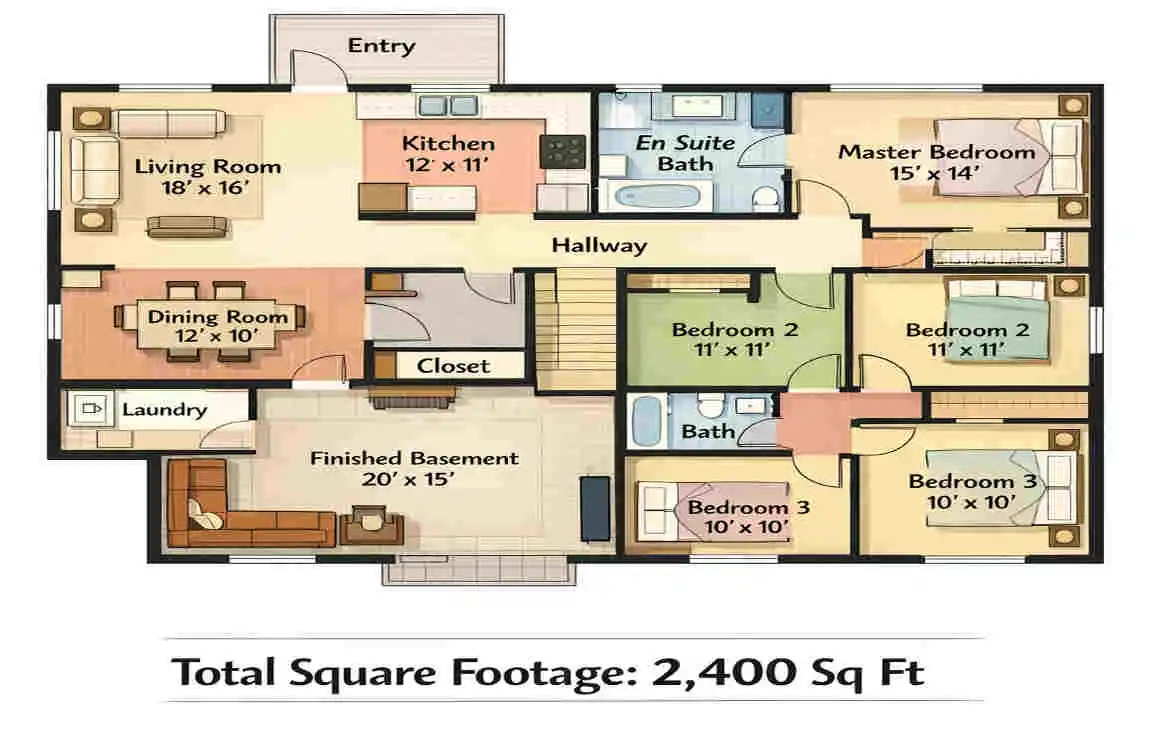
Before we can answer “how big is a square foot house,” we need to agree on what we are actually measuring. It seems simple. It’s just the size of the floor. However, in the real estate world, it is a bit more nuanced than that.
Defining the Livable Space
Technically, square footage measures the interior floor space of a home. But it isn’t just any floor space. Real estate agents and appraisers generally only count “livable” or “gross living area” (GLA).
What does that mean for you? It means the space must be finished, heated, and cooled. If you can’t live in it comfortably year-round, it usually doesn’t count toward the official number.
The Calculation Formula
You don’t need a degree in calculus to figure this out. If you are walking through a house and want to double-check a room, here is the formula:
Width (feet) x Length (feet) = Square Footage
Let’s look at a real-world example. Say you are standing in a rectangular living room.
- The room is 15 feet wide.
- The room is 20 feet long.
- 15 x 20 = 300 square feet.
If you are looking at a simple rectangular home that is 20 feet wide and 50 feet long, you are looking at a 1000 sq ft house.
Pro Tip: Most houses aren’t perfect rectangles. For irregular shapes, professional appraisers break the floor plan into separate rectangles, calculate each one, and add them together. You can use free online calculators to help you do this if you have the floor plan handy.
Common Exclusions
This is where most buyers get tripped up. When you ask, “How big is a square foot house?” the number you get typically excludes:
- Garages: Even if they’re finished, if you park a car in them, they usually don’t count.
- Unfinished Basements: Concrete floors and exposed beams? Not square footage.
- Patios and Porches: Outdoor spaces, covered or not, are excluded.
- Attics: Unless they are finished with proper ceiling height and HVAC, they are just storage.
Metric Conversions for Global Readers
If you are reading this from outside the US or are used to the metric system, “square feet” might sound alien. Here is a handy conversion to keep in mind:
- 1 square foot = 0.0929 square meters.
So, a 1,000 sq ft house is roughly 92.9 square meters. If you are familiar with measurements like the marla (common in South Asia), conversions can get tricky, but the square foot remains the gold standard for international real estate comparisons.
Average Square Feet House Size: The National Benchmark
To understand if a house is big or small, you need a baseline. What is “normal” these days?
Current U.S. Averages (2024-2026)
As of late 2024 and moving into 2026, the average square feet house size for new construction in the United States hovers between 2,200 and 2,367 square feet.
Interestingly, this number has actually started to dip slightly. After decades of homes getting bigger and bigger, affordability issues and a desire for sustainability are leading to a slight retreat in size. We aren’t returning to the tiny cottages of the 1940s, but the era of the “McMansion” is cooling off.
Regional Variations
Location changes everything. A “big” house in the city is a “tiny” house in the country.
- The Northeast: Homes here tend to be larger, averaging around 2,590 sq ft.
- The Midwest: You will find slightly smaller averages, closer to 2,242 sq ft.
- Urban vs Rural: A 1,200 sq ft condo in downtown Manhattan is a palace. A 1,200 sq ft farmhouse in rural Ohio might feel like a starter home.
Historical Trends
It is fascinating to look back. In the 1970s, the average American home was about 1,700 square feet. By 2015, it had ballooned to nearly 2,500 square feet.
Now, we are seeing a shift. Families are smaller, and energy costs are higher. The trend is moving toward “quality over quantity.” People want better finishes and smarter layouts rather than just empty cavernous rooms.
Global Context
Americans definitely like their space. In comparison:
- Europe: Average homes often range from 1,000 to 1,500 sq ft.
- Asia: Depending on the density of the city, family homes can be under 1,000 sq ft.
Buyer Preferences Breakdown
Who is buying what? This table breaks down what different sizes feel like for the average buyer.
Size Range (Sq Ft)% of Buyers Example “How Big is a Square Foot House” Feel
Under 1,200 8% Cozy Starter: Ideal for singles or couples. Usually 2 bedrooms, 1 bath.
1,200 – 1,600 18% Compact Family: Manageable. Fits 3 bedrooms and 2 baths, but has tight storage.
2,000 – 3,000 38% The Standard: Spacious. 4 bedrooms, 2.5 baths, flex space for office/play.
4,000+ 6% Luxury Estate: Multiple living areas, guest suites, extensive amenities.
Small House: Under 1500 Square Feet
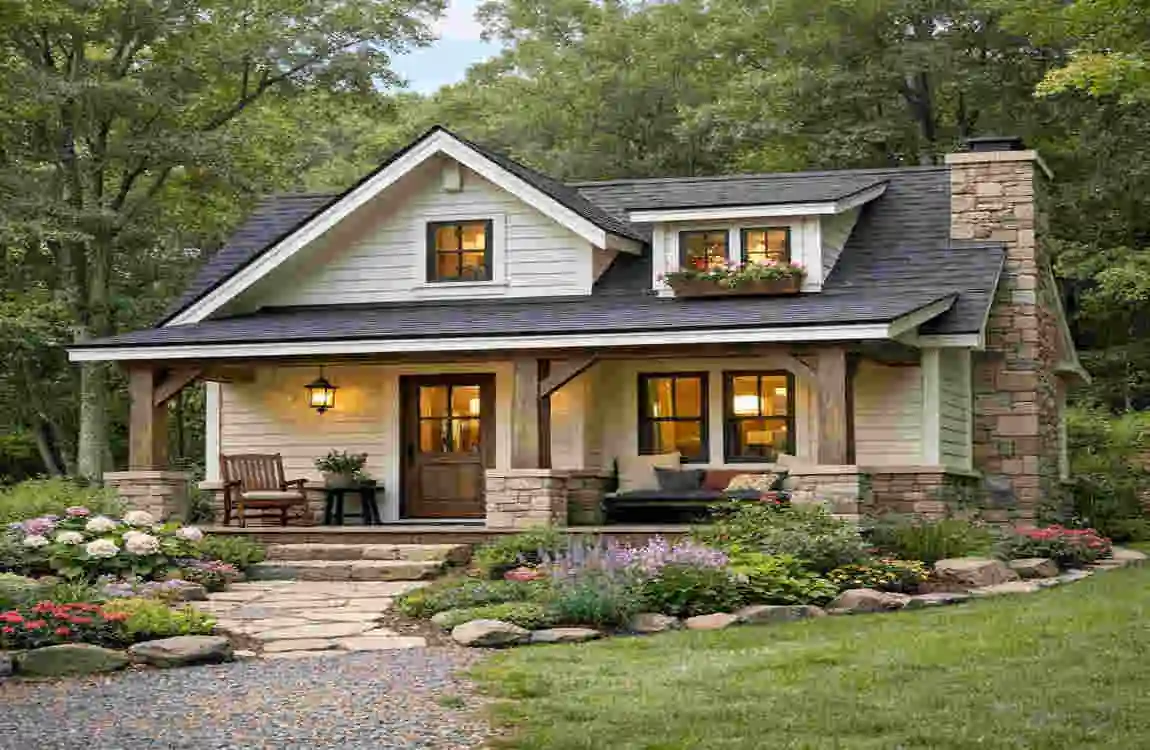
Let’s zoom in on the smaller end of the spectrum. When people ask, “How big is a square foot house?” in the context of affordability or minimalism, they are usually looking at this category.
Who is this for?
A home between 800 and 1,500 square feet is typically designed for 1 to 3 people. This is the realm of the “starter home,” the empty-nester downsize, or the committed minimalist.
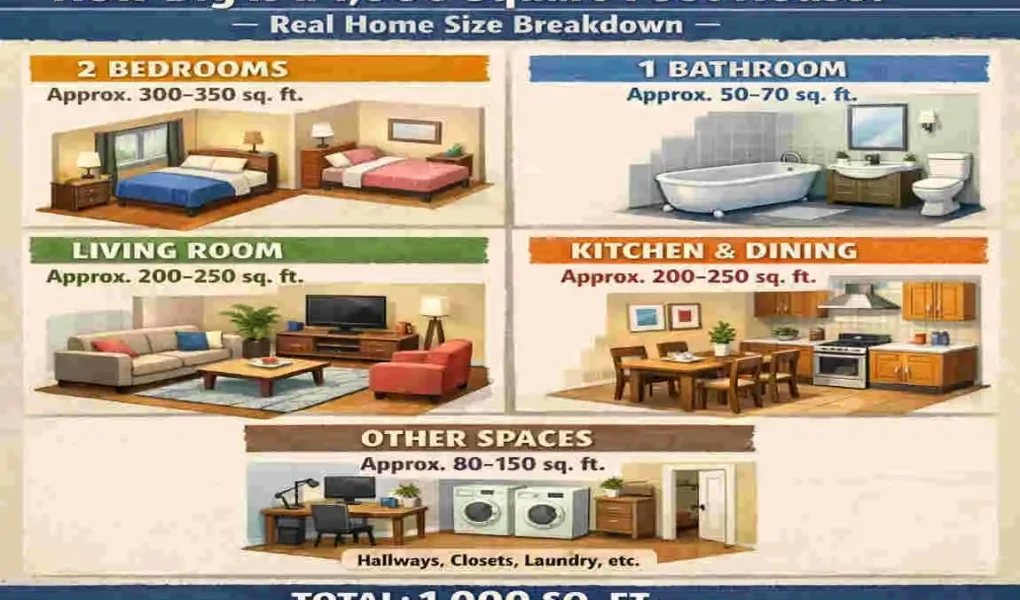
Visualising 1,000 Square Feet
Imagine a rectangle that is 25 feet wide and 40 feet long. That is exactly 1,000 square feet. In terms of layout, this size feels like a very large, luxurious apartment, but as a standalone structure.
Room Breakdown
If you buy a small house, square feet property, here is what you can realistically fit inside:
- Bedrooms: 2 modest bedrooms (about 12×12 feet or 144 sq ft each).
- Kitchen: A functional kitchen (roughly 150 sq ft), likely a galley style or U-shape.
- Living Area: One main gathering space (about 300 sq ft).
- Bathrooms: Typically 1, 1.5 if the layout is clever.
The Pros and Cons
The Good:
- Cost: These are the most affordable, often averaging around $150,000 to $200,000, depending on the area.
- Maintenance: Cleaning the entire house takes two hours, tops.
- Utilities: Heating and cooling bills are minimal.
The Bad:
- Storage: You will need to be ruthless with clutter. Closets are small.
- Privacy: With shared walls and smaller rooms, noise travels. There isn’t much space to “get away” from other occupants.
Real World Trend: The Tiny Home
Post-2020, the interest in homes under 1,000 sq ft skyrocketed. People realised they didn’t need massive mortgages to be happy. However, living in a small square-foot house requires a lifestyle change—you buy fewer things because you literally have nowhere to put them.
Medium House: 1500-2500 Square Feet
This is the sweet spot. When you look at the “average square feet house,” you are landing right here.
The “Goldilocks” Size
For most families, 2,000 square feet feels “just right.” It isn’t so big that you need an intercom to find your kids, but it isn’t so small that you are tripping over the dog.
Dimensions and Layout
A 2,000 sq ft home might look like a two-story structure with a footprint of roughly 40 x 25 feet per floor, or a sprawling ranch-style home measuring 40 x 50 feet.
Room Configuration:
- Bedrooms: 3 to 4 bedrooms. These are decent sizes, usually around 200-250 sq ft for the master and 120 sq ft for kids’ rooms.
- Living Space: You get an open-concept kitchen flowing into a living room (500+ sq ft combined).
- Bathrooms: Standard is 2.5 baths (Master bath, family bath, and a powder room for guests).
How It Feels
“How big is a square-foot house in this range? It feels ample. You have room for a dedicated home office—a must-have in the remote work era. You might have a separate dining room or a playroom for the kids. The flow of the house allows for entertaining without everyone being squeezed into the kitchen.
Cost Insights
Building or buying a medium-sized home is a significant investment. You are looking at average costs ranging from $300,000 to $500,000. However, these homes are often more energy-efficient per person than small homes because the heated volume is shared among more people.
Space Per Person
Experts often cite that the ideal space for a comfortable modern life is about 600 square feet per person.
- Family of 3 = 1,800 sq ft.
- Family of 4 = 2,400 sq ft. This math aligns perfectly with the “Medium House” category, explaining why it is the most popular segment in the market.
Large House: 2500-4000+ Square Feet
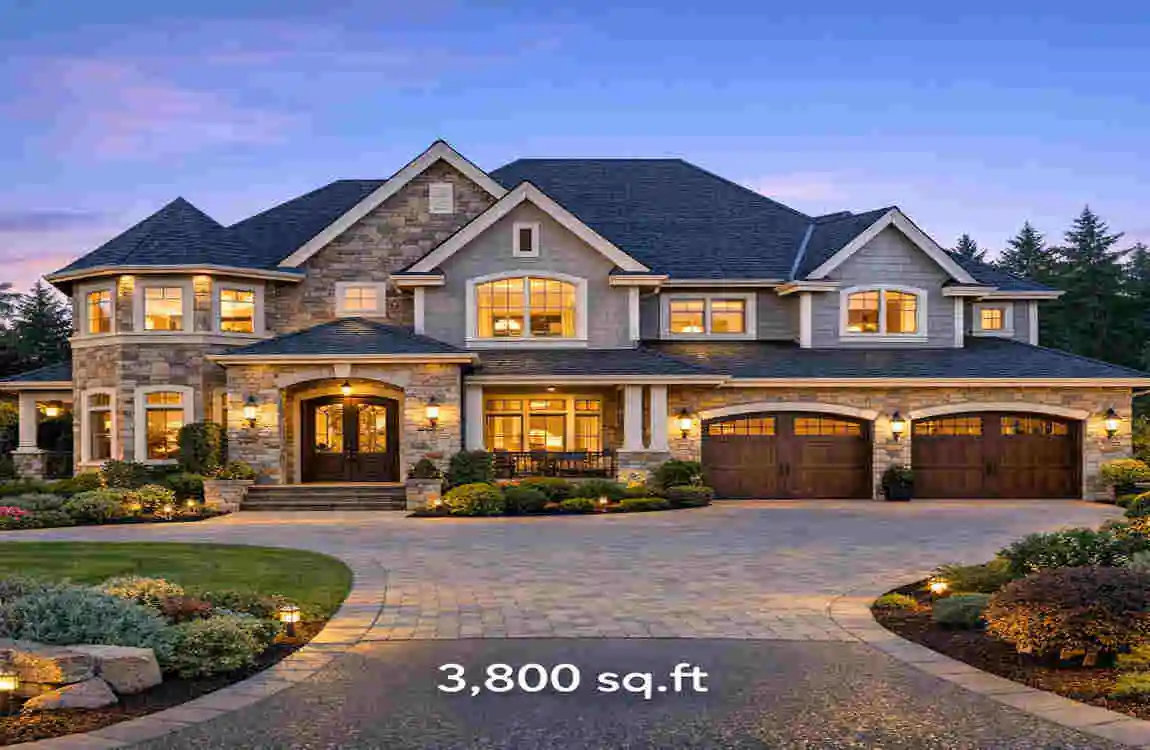
Now we are entering the territory of “luxury” and “forever homes.”
The Luxury Experience
A 3,000 sq ft house is significantly larger than the average. It offers a sense of grandeur.
- Footprint: Think 50 x 60 feet or larger multi-story layouts.
- Rooms: You are looking at 4 to 5+ bedrooms.
What You Get for the Extra Space
When you jump from 2,000 to 3,000+ sq ft, you aren’t just getting bigger bedrooms; you are getting specialised rooms.
- Media Rooms / Home Theatres.
- Home Gyms: Dedicated 300 sq ft spaces for equipment.
- Dual Offices: Perfect for two remote-working parents.
- Guest Suites: A bedroom with an attached bathroom for in-laws or visitors.
The Multigenerational Trend
About 14% of buyers are specifically looking for homes in the 3,000+ range to accommodate multigenerational living. This means grandparents, parents, and children all under one roof. A large square-foot house allows for “zones” of privacy, so different generations can coexist without driving each other crazy.
The Challenges of Going Big
It’s not all sunshine and extra closets.
- Utilities: Heating a 4,000 sq ft home is expensive. You might need dual HVAC systems.
- Cleaning: It takes a long time to clean 4.5 bathrooms. Many owners in this bracket hire cleaning services.
- Furnishing: An empty big house echoes. You have to buy enough furniture to fill it, which is a hidden cost many forget.
Visualising Square Feet House Sizes: Real World Comparisons
Numbers are abstract. Let’s make “how big is a square foot house” concrete with some comparisons.
Sports Analogies
- 1,000 sq ft: Roughly the size of one-half of a basketball court (the playing area, not the stands).
- 2,000 sq ft: Slightly smaller than the size of a Singles Tennis Court (which is about 2,100 sq ft).
- 5,000 sq ft: Roughly the size of a basketball court (full court including out-of-bounds safety zones).
Room Allocation Breakdown
It helps to see how the space is divvied up. Here is a comparison of how room sizes change as the house gets bigger.
Room Type: Small House (1,000 sq ft), Medium House (2,000 sq ft), Large House (3,000 sq ft)
Kitchen 100 sq ft (Compact) 200 sq ft (Island included) 300 sq ft (Chef’s kitchen)
Master Bed 150 sq ft (Fits Queen) 250 sq ft (Fits King) 400 sq ft (Sitting area included)
Living Room 250 sq ft 400 sq ft 600 sq ft (Great Room)
Total Baths 1-2 (approx 100 sq ft total) 2.5 (approx 150 sq ft total) 4+ (approx 200 sq ft total)
Furniture Fit Tips
- The Bed Rule: A standard King-size bed is roughly 42 sq ft. In a 10×10 (100 sq ft) room, that bed takes up nearly half the space! A room needs to be at least 12×12 (144 sq ft) for a King bed to feel comfortable with nightstands.
- Dining Tables: You need 3 feet of clearance on all sides of a table for chairs to slide out. A small dining room (10×10) can’t handle a table for eight.
Factors Affecting House Size Perception
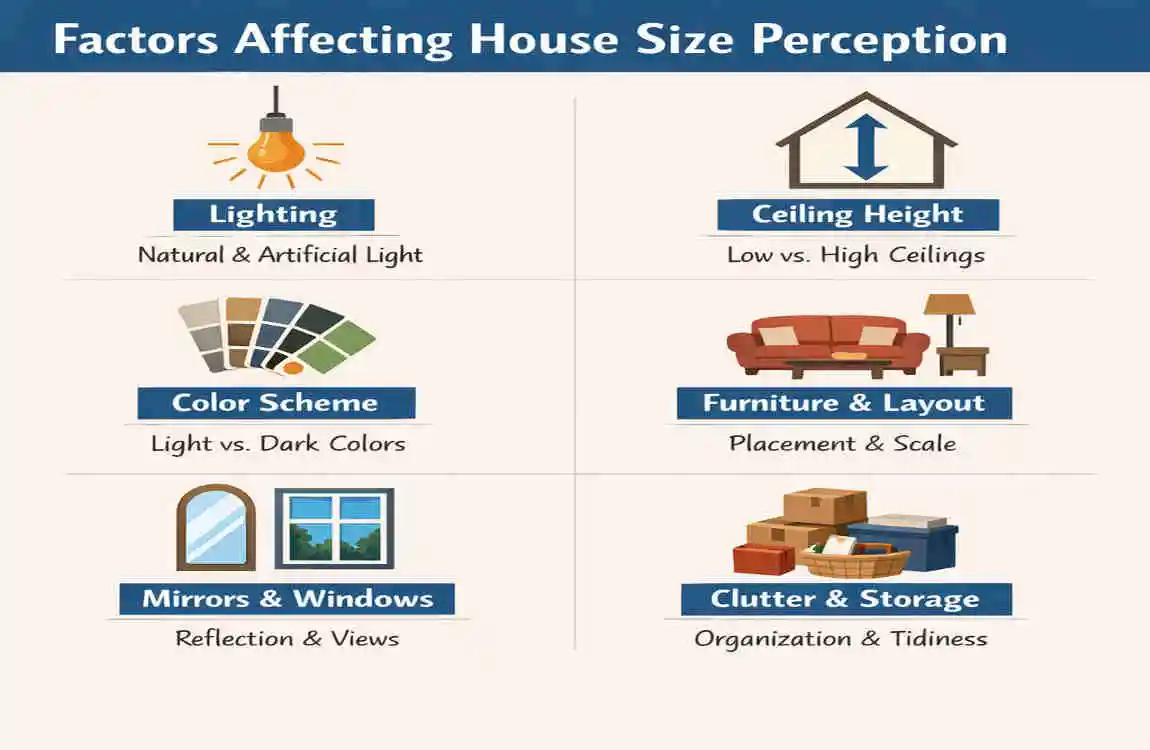
Why does one 2,000 sq ft house feel huge, while another feels cramped? It’s all about design.
Open vs Closed Layouts
This is the biggest factor. An open-plan design removes walls between the kitchen, dining, and living areas. This allows sightlines to travel across the entire width of the house. A 1,500 sq ft open-concept home will often feel larger than a 2,000 sq ft older home that is chopped up into small, separate rooms.
Ceiling Height and Volume
Square footage measures the floor, but humans perceive volume (cubic footage).
- 8-foot ceilings: Standard. Feels cosy but can feel low in large rooms.
- 9-foot to 12-foot ceilings: Adds massive “airiness.” A small room with a high ceiling feels much larger and more luxurious.
- Vaulted Ceilings: These don’t add square footage, but they dramatically change the answer to “how big is a square foot house” in your mind.
Windows and Light
Natural light expands space. A small room with floor-to-ceiling windows connects the interior to the outdoors, tricking the eye into thinking the room continues outside.
Location Context
Perception is relative. If you live in a dense urban centre like Tokyo or New York City, a 1,000 sq ft apartment is a luxury. If you live in rural Texas, where land is cheap, that same 1,000 sq ft might feel incredibly restrictive.
Personal Needs vs Numbers
Finally, size is about lifestyle.
- Empty Nesters: 3,000 sq ft feels like a burden (too much cleaning).
- Young Families: 1,200 sq ft feels like a pressure cooker (toys everywhere). The “right” size is the one that fits your current stage of life.
Costs of Different Square Foot Houses
We touched on this, but let’s break down the money.
Build Costs
If you are building new, you will often be quoted a “price per square foot.”
- National Average: Roughly $150 per sq ft for standard finishes.
- Custom/Luxury: Can easily exceed $300-$500 per sq ft.
So, for a standard build:
- 1,500 sq ft x $150 = $225,000
- 2,500 sq ft x $150 = $375,000
- 3,500 sq ft x $150 = $525,000(Note: This excludes the cost of the land).
Ongoing Costs
This is the silent budget killer.
- Property Taxes: Usually assessed based on value, which correlates to size.
- Insurance: Bigger homes cost more to insure.
- Maintenance: Generally, expect to spend 1% of the home’s value annually on maintenance. A bigger, more expensive home means a bigger repair fund.
- Energy: Estimates suggest that for every 1,000 sq ft you add, your utility bills rise by 10-20%.
Resale Value (ROI)
Medium-sized homes (1,500–2,500 sq ft) generally sell the fastest. They appeal to the widest pool of buyers (first-time buyers, families, and downsizers). Massive custom estates often sit on the market longer because the pool of buyers who can afford them (and want to maintain them) is smaller.
Is Bigger Always Better?
For decades, the American motto was “supersize it.” But the narrative regarding “how big is a square foot house” is changing.
Balancing Space and Lifestyle
Many buyers are realising that a massive house can be a massive anchor. It requires time to clean, money to heat, and effort to maintain. A smaller, more efficient home (1,800-2,200 sq ft) often frees up budget for travel, hobbies, and experiences.
The Sustainability Trend
Smaller footprints mean a smaller carbon footprint. It takes fewer resources to build and less energy to run a modest home. For the eco-conscious buyer in 2026, efficiency is the new luxury.
FAQ: Common Questions About House Sizes
Here are the most common questions people ask when trying to figure out how big a square-foot house is.
How big is a 2000 square feet house?
A 2,000-square-foot house is considered a medium-to-large-sized home. It typically accommodates 3 to 4 bedrooms, 2.5 bathrooms, a spacious living area, and a dining room. It is spacious enough for a family of four to live comfortably without being on top of each other.
What does the average square feet of a house include?
The square footage usually only includes the livable, finished interior. It typically excludes the garage, unfinished basement, attic, porches, and patios.
How big is a square foot house in meters?
To convert, multiply the square footage by 0.0929.
- 1,000 sq ft = 92.9 sq meters.
- 2,000 sq ft = 185.8 sq meters.
What is the smallest livable square feet house size?
While “tiny homes” can be as small as 100 to 400 sq ft, most building codes require a dwelling to be at least 120 to 150 sq ft for one person, with specific dimensions for habitable rooms. Practically speaking, 400-600 sq ft is the minimum for comfortable long-term living for a single person.
How many square feet per person is ideal?
The general rule of thumb for modern comfort is 600 to 800 square feet per person. This allows for private bedrooms and shared living spaces that don’t feel cramped.
How big is a square-foot house vs a lot size?
This is the “lot coverage” ratio. In suburbs, the house footprint might take up 20-30% of the lot. In cities, it could be 50% or more. Always check zoning laws if you plan to expand.
What does a 1500 square feet house room breakdown look like?
A 1,500 sq ft home usually features:
- 3 Bedrooms
- 2 Bathrooms
- Kitchen and Dining Area
- Living Room: It is a very efficient layout that minimises hallways to maximise usable space.