
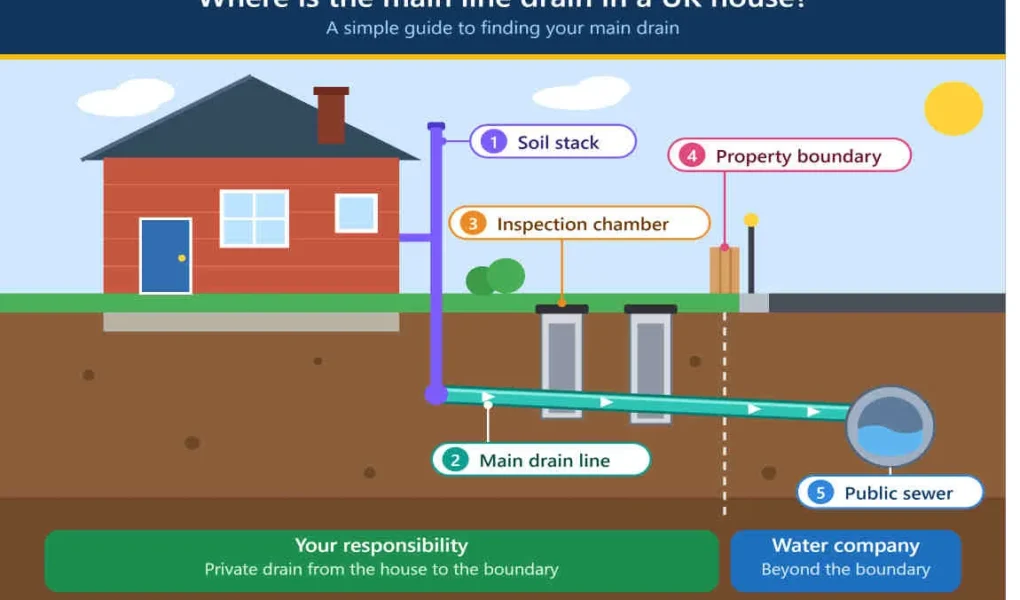
Understanding where the main line drain is located in a UK house can make plumbing problems much easier to identify and manage. The main drain carries wastewater from toilets, sinks, showers, and other fixtures away from your property and into the public sewer system. However, its exact location can vary depending on the house layout, age, and drainage design.
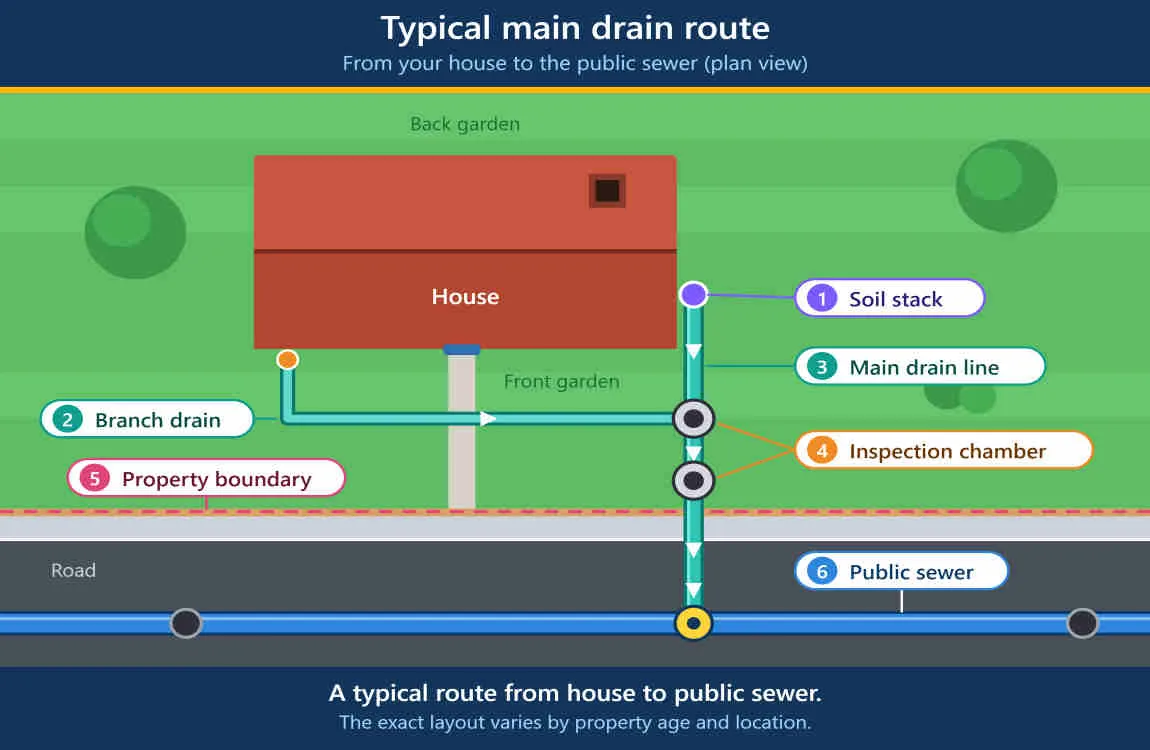
What exactly is the “main line drain”?
“Main line drain” is a plumber’s phrase for the principal underground pipe that carries wastewater from your home to the sewer. Every toilet, kitchen sink, bath and shower connects to it, directly or through the soil stack. In official terms, a drain serves one property, while a sewer serves more than one. Swindon Borough Council explains that a drain is a single pipe serving one premises, whereas a sewer is a pipe serving multiple properties.
Where is the main drain usually located?
There is no single spot, but UK houses follow predictable patterns. Start your search in these places, in this order.
Directly outside the soil stack
Find the large (usually 100 mm) vertical pipe on the outside wall, often at the back of the house. Below it, the pipe turns underground. That is the start of your main drain.
The nearest inspection chamber or manhole
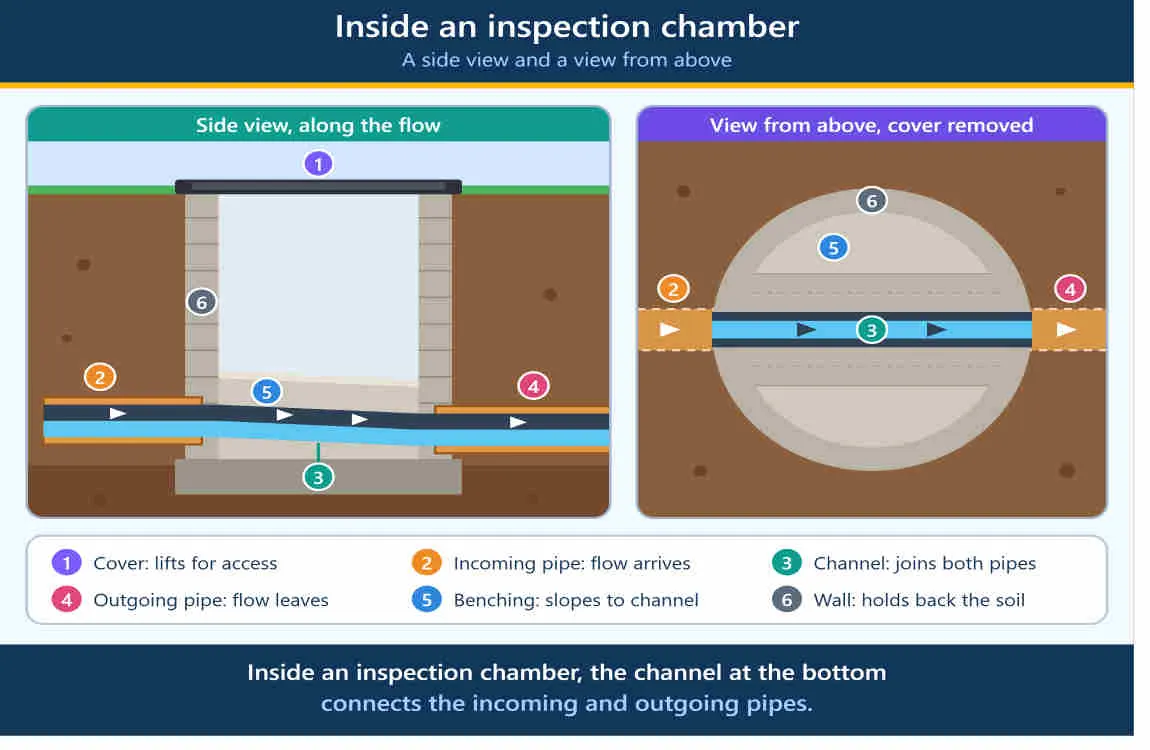
Look for a square, round or rectangular cover set into the ground, in paving, a driveway, a lawn or a flower bed. Modern homes often have plastic chambers, while older ones may have brick chambers with heavy cast-iron covers. Chambers are placed where pipes change direction, join, or need access for rodding and cleaning. The Government’s building guidance, Approved Document H, covers foul water drainage, pipe sizes, protection of pipes, manholes and inspection chambers.
The front garden or driveway
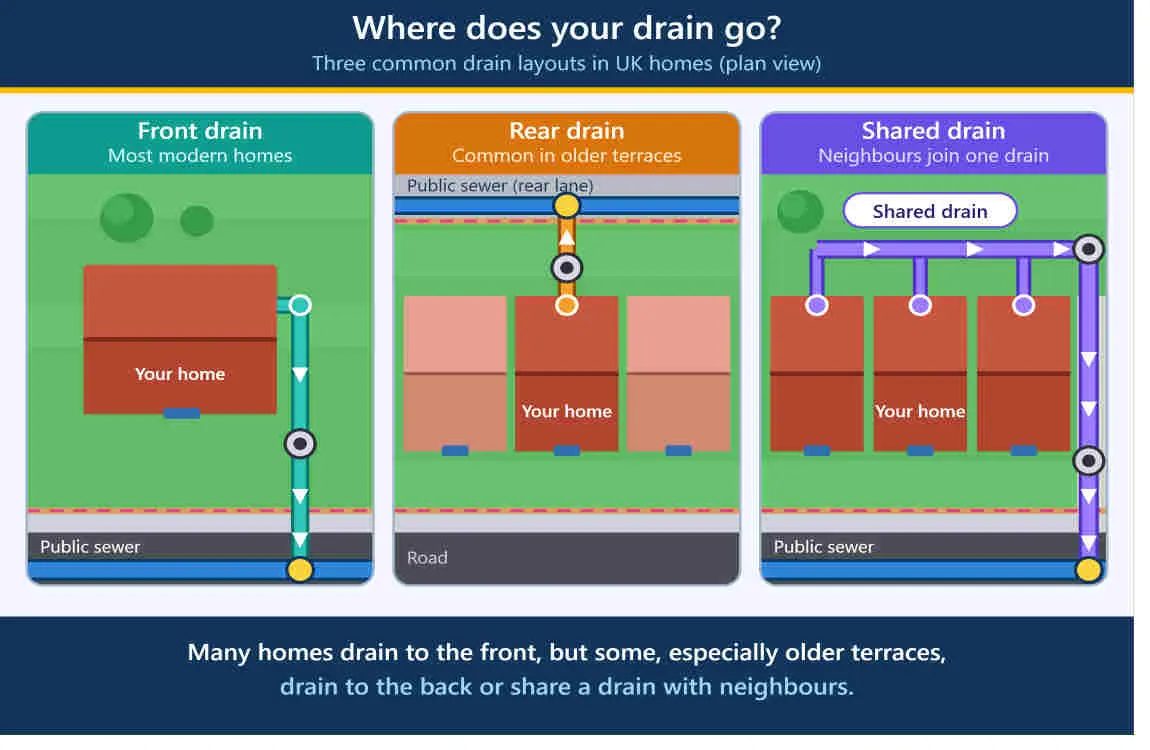
Because the public sewer normally runs beneath the road, most houses drain towards the front. Check along the path between the soil stack and the pavement.
The back garden (older and terraced homes)
Many Victorian and inter-war terraces have a drain that runs along the back of the row, shared by several houses. If your chamber is out the back, there is a good chance it is a shared sewer rather than a private drain.
Inside or under the property
In some older houses, and in homes that have been extended, the drain can run under the building. If you are planning an extension, check this early, because building over or near drains needs approval. Property guidance publication Homebuilding & Renovating notes that building control approval can be required where work is within one metre of a boundary or affects the drain’s structure.
Drain, lateral drain or public sewer? Who is responsible?
This is where most homeowners get caught out. Since 1 October 2011, much of the responsibility moved from homeowners to water companies. Thames Water states that it became responsible for private sewers and drains from that date, while homeowners are still responsible for the pipes between their property and the transferred sewer or lateral drain.
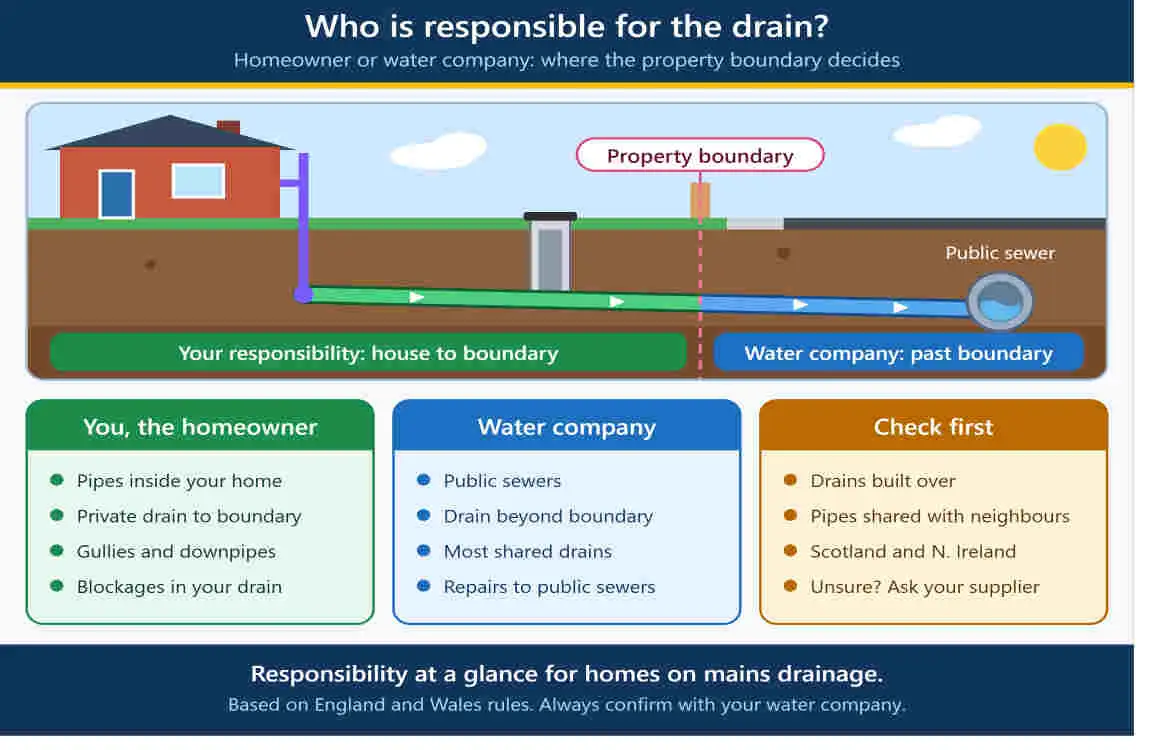
In plain terms:
- Your drain: a pipe that serves only your property. The council guidance from Swindon says the owner is responsible up to the property boundary.
- Lateral drain: the section of your drain that runs outside your boundary to the sewer. Reigate & Banstead Borough Council describes lateral drains as pipes serving a property that connect to a public sewer while lying under public or private land. These are normally the water company’s job.
- Shared sewer: where pipes from several homes meet. Since the 2011 transfer, these are generally the water company’s responsibility too.
- Not everything transferred: some pipes remain with the owner, and in unclear cases a lateral drain and a private drain can be hard to tell apart, so an investigation may be needed.
Not sure which company looks after your area? Use the Water UK Find Your Supplier tool and enter your postcode. The regulator, Ofwat, also confirms that your bill names the company providing your water and sewerage services.
How to find your main drain step by step
- Start at the soil stack. Stand where the large vertical plumbing pipe meets the ground. The drain begins just below.
- Hunt for covers. Check paths, driveways, patios, borders and under old plant pots. Covers are sometimes buried under soil or turf, so a slim probe or a metal detector can help.
- Trace the line. Drains are laid in a fairly straight line with a downward fall, usually heading for the road. Draw a rough sketch of every cover you find.
- Check your paperwork. Your solicitor’s searches, building plans or a homebuyer survey may show the route. The water company’s public sewer records can also confirm whether a pipe near you is public. Reigate & Banstead notes its council holds a copy of the public sewer map supplied by Thames Water, so it is worth asking your own council or water company.
- Book a CCTV drain survey. A camera survey is the most reliable way to map the pipe, spot cracks or root ingress, and confirm which sections are yours.
What you will see inside an inspection chamber
If you lift a cover (only if it is safe and you are able to, as covers are heavy and drains can contain harmful gases), you will usually find a channel with the flow running through it. A clean channel with moving water means the line is clear. Standing water, or a chamber that is full, means a blockage downstream.
Signs your main drain has a problem
- Several toilets, sinks or showers draining slowly at once
- Gurgling noises from toilets or plugholes
- Foul smells in the garden or near a manhole
- Wet patches or sunken ground along the drain route
- Sewage backing up in the lowest drain or shower on the ground floor
If only your property is affected, the blockage is likely in your own drain. Swindon Borough Council advises that if more than one property is affected, you should contact the water company. Neighbours with the same problem is a strong clue that the fault is in a shared sewer.
Common causes of main drain blockages
- Fat, oil and grease poured down the sink
- Wet wipes (even those labelled “flushable”), nappies and sanitary products
- Tree roots entering joints in older clay pipes
- Collapsed or displaced pipework
- Pipes with too little fall, or sagging sections
Anything other than toilet paper and human waste should go in the bin, not the toilet.
When to call a professional
Call a qualified drainage engineer if you cannot find your drain, if rodding does not clear a clean blockage, or if you suspect a collapse. For anything beyond your boundary, or if neighbours are affected, contact your water company first, as lateral drains and sewers are usually theirs to deal with. If you are buying a house, a pre-purchase CCTV survey can save you from an expensive surprise.
Frequently asked questions
Where is the main drain in a semi-detached or terraced house?
Often at the back, running along the rear of the row, or to the front towards the road. It may be shared with neighbours, which usually makes it a sewer for the water company to maintain.
How deep is a main drain in the UK?
Depth varies with the age of the property and the ground. Shallow drains are common in modern developments, while older runs can be deeper. A CCTV survey or the chamber depth will give you the real figure for your house.
Is the main drain the homeowner’s responsibility?
Only the section serving your home alone, up to your boundary. Beyond that, and for shared pipes, the water company is generally responsible, subject to the exceptions covered above.
Do all UK houses have a manhole in the garden?
Most do, but not all. Some homes have a rodding eye or a chamber inside a garage or under an extension. A drain survey will confirm what is there.
Can I build over my main drain?
Possibly, but you will need approval. Building near or over drains is controlled by Part H of the Building Regulations, so speak to building control and your water company before any extension work.
Final thoughts
So, where is the main line drain in a UK house? Start at the soil stack, look for inspection chambers in the front or rear garden, and follow the straight run towards the road. Once you know where it is, you will know who to call when something goes wrong, and you will be much better prepared for extensions, repairs or house purchases.