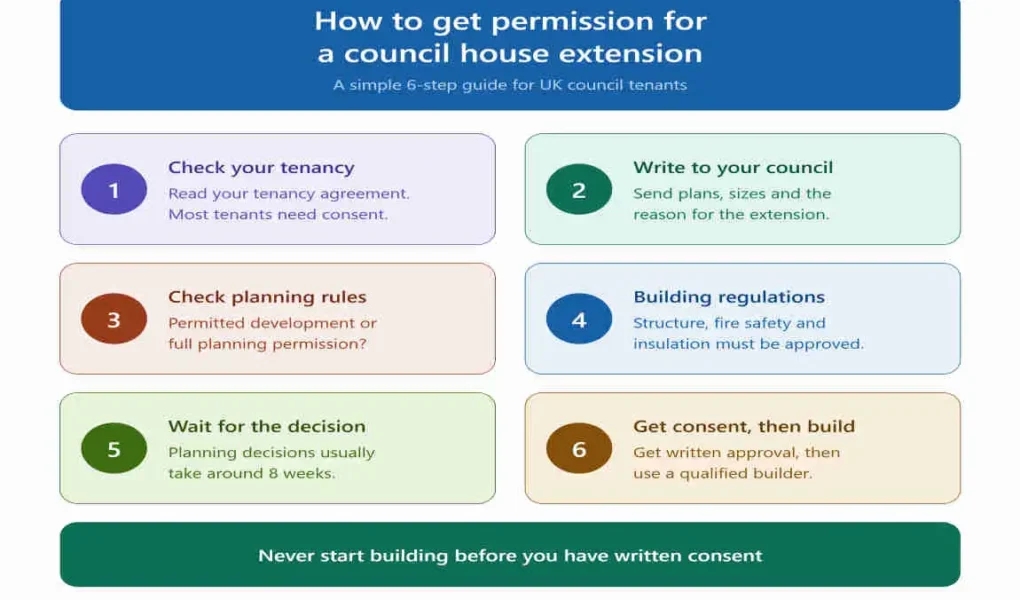
Yes, you may be able to, but you must get your council’s written consent before any work starts. Secure council tenants have a legal right to ask, and the council cannot unreasonably say no. Depending on the size and location of the extension, you may also need planning permission and building regulations approval. Some councils openly say they will not approve extensions, so always check your own council’s policy first.
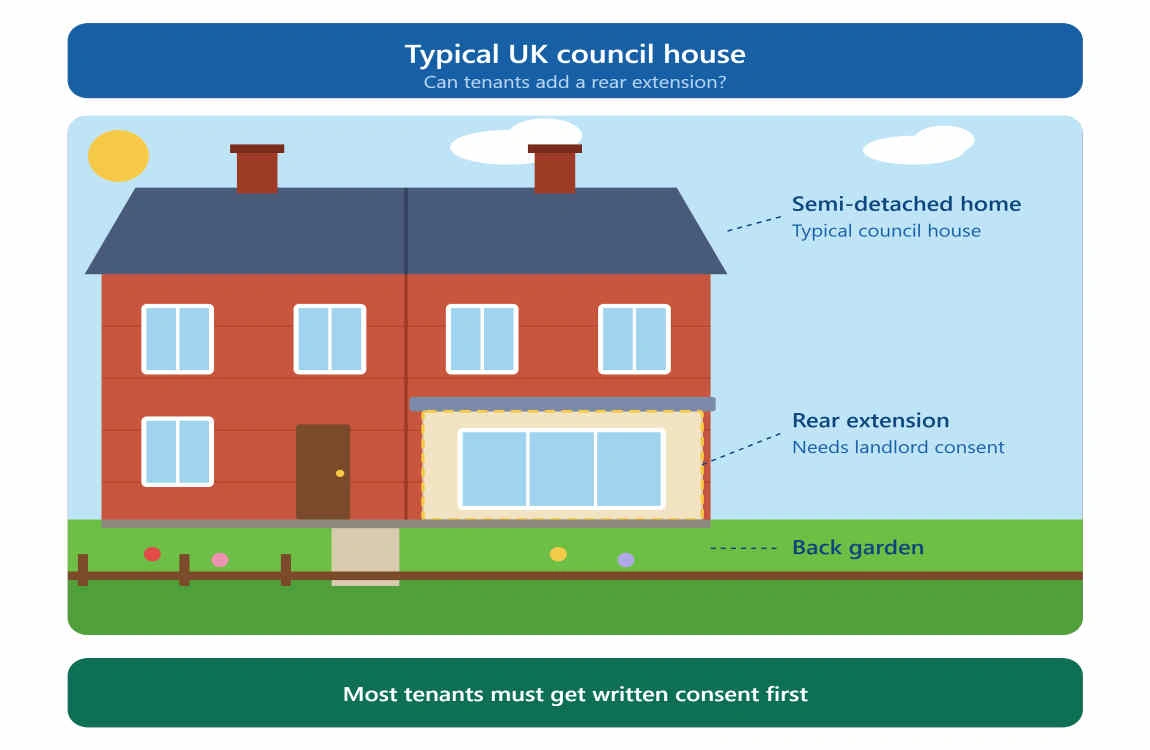
Why do council tenants need permission to extend?
The council owns the building extension, not you. Under the Housing Act 1985, it is a term of every secure tenancy that you will not make an “improvement” without your landlord’s written consent. The Act defines an improvement broadly as any alteration to, or addition to, the home. A new room built onto the back of the house clearly counts.
Councils also have practical reasons for caring. They need to make sure work is carried out safely, professionally and in line with the law, and that it does not harm neighbouring homes or leave the council with future repair bills.
Is your tenancy type important?
Yes. The legal right to ask for consent (and the rule that it cannot be unreasonably withheld) applies to secure tenants. Introductory, starter or other non-secure tenancies can have stricter terms, and some councils do not allow those tenants to alter the property at all. Check your tenancy agreement or ask your housing officer which type you hold before spending money on drawings.
Will my council actually say yes to an extension?
This is where the answer varies most. Councils set their own policies, and extensions cost are often the hardest alteration to get approved. For example, Barking and Dagenham Council lists extensions and loft conversions among the things it will not give permission for. Other councils consider requests case by case and ask for detailed plans first.
Homes in conservation areas or listed buildings are also harder. One London council notes that permission may be harder to obtain in a conservation area or for a listed building.
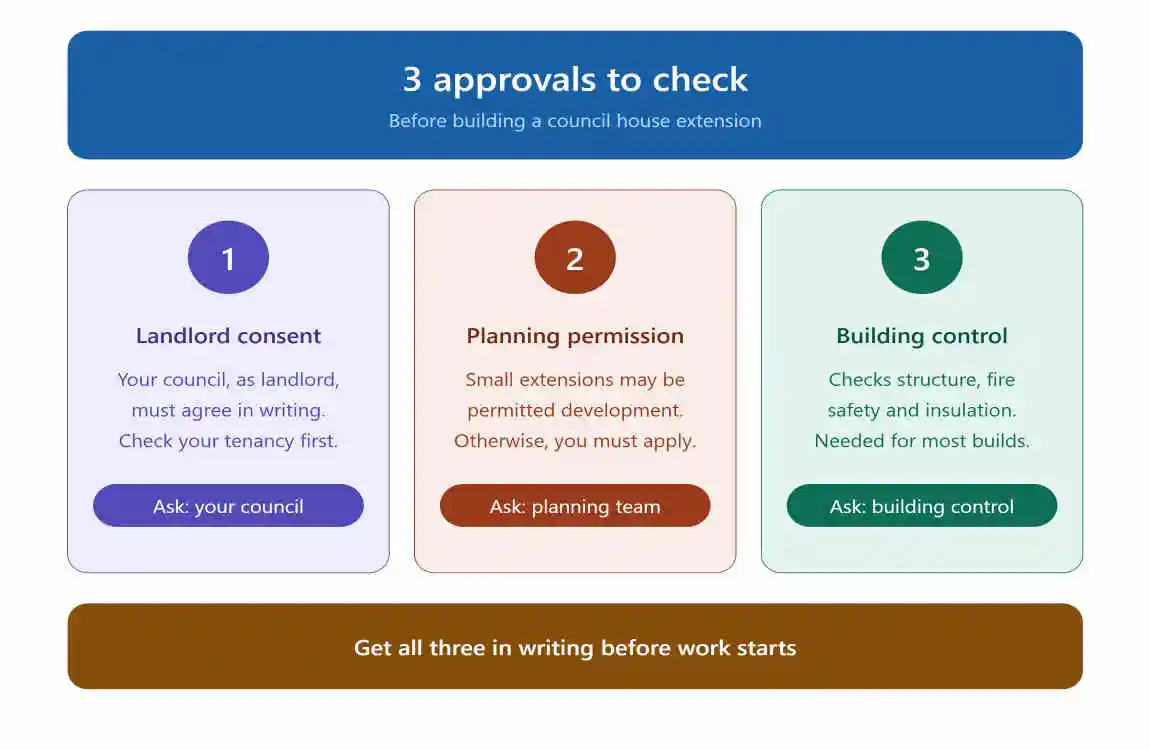
The 3 permissions you may need
| Approval | Who gives it | What it covers | Always needed? |
|---|---|---|---|
| 1. Landlord’s written consent | Your council housing team | Your right to alter the property you rent | Yes, for any extension |
| 2. Planning permission (or permitted development) | Local planning authority | Size, appearance and impact on neighbours | Not always |
| 3. Building regulations approval | Council building control or an approved inspector | Structural safety, fire, insulation, electrics | Most extensions |
The Planning Portal explains that most extensions need building regulations approval, and that planning permission and building regulations are separate applications. Getting one does not give you the other.
How to get permission for a council house extension: step by step
Read your tenancy agreement and your council’s policy
Search your council’s website for “tenant alterations” or “home improvements”. Many councils publish a policy that lists what they will and will not approve. This can save you weeks.
Talk to your housing officer informally
Before paying for drawings, ask whether an extension is even possible on your property type. A short email or phone call can tell you whether you are wasting your time.
Prepare a detailed written request
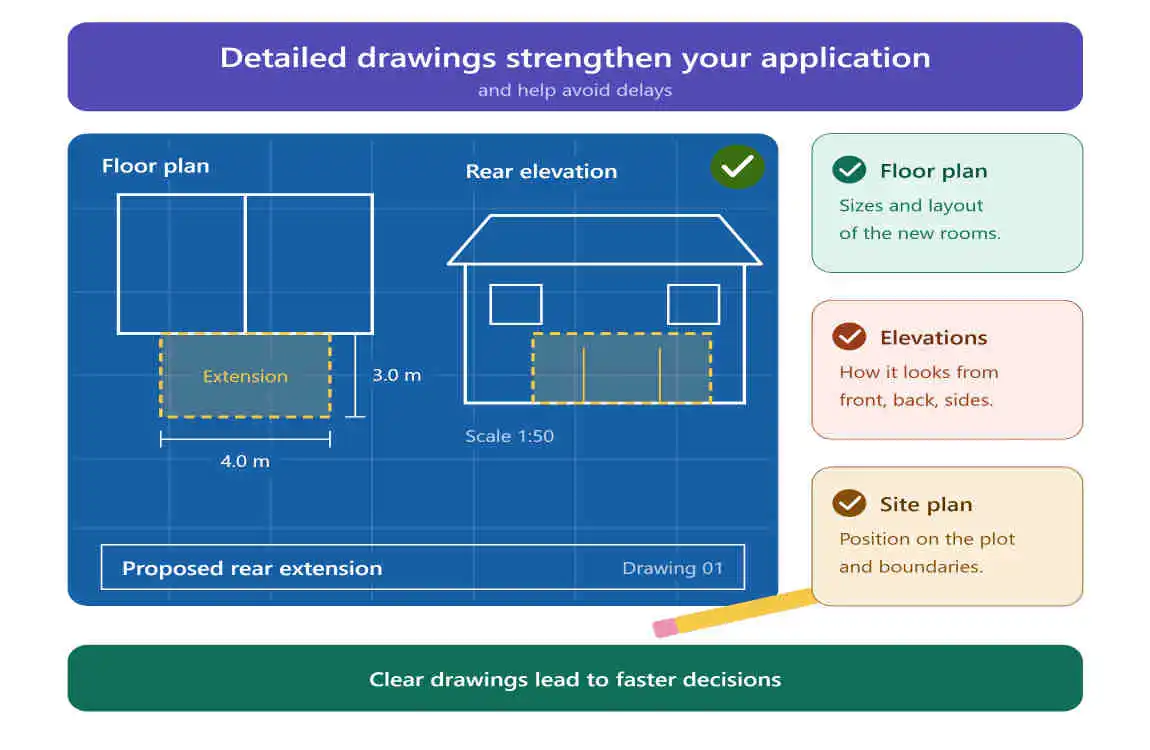
Councils usually want it in writing. Ashford Borough Council, for example, says applications to extend must include detailed drawings and photographs or they will be rejected for lack of information. A strong request typically includes:
- Scaled floor plans and elevations of the extension
- Photos of the current house and garden
- The materials you plan to use
- Who will do the work, and proof of their insurance
- When you want to start and how long it will take
Check whether you need planning permission
Use the Planning Portal’s interactive guides or ask your local planning authority. If you are unsure, many councils offer a pre-application or householder enquiry service. More on the size limits below.
Apply for building regulations approval
Your extension must meet building standards even when planning home design permission is not required. Your council’s building control team or a private approved inspector can handle this.
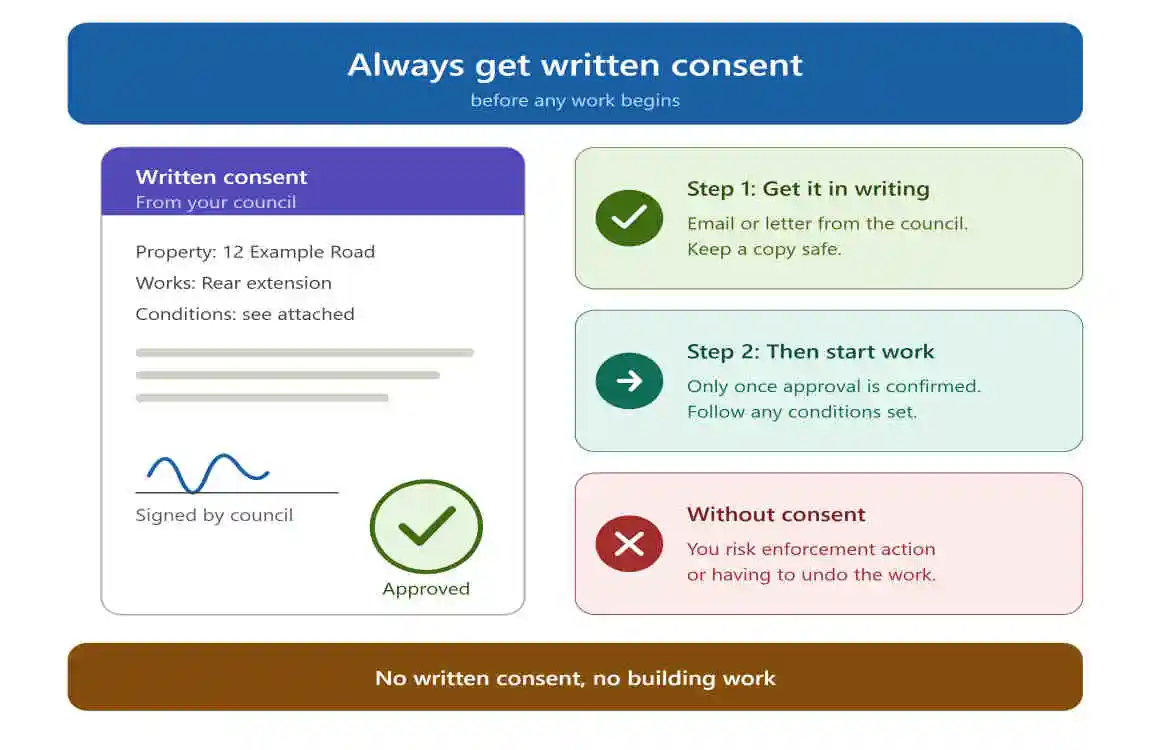
Wait for written consent before you start
Do not book builders or break ground until you have the council’s approval in writing. A verbal “that should be fine” is not enough.
Do you need planning permission for a council house extension?
Often a single-storey rear extension to a house can be built under permitted development, which means no full planning application. These rights attach to the property type and location, not to who owns it, but they come with conditions. In summary (always confirm with the Planning Portal or your local planning authority):
- The standard limit for a single-storey rear extension is roughly 3 metres for terraced and semi-detached houses and 4 metres for detached houses, with no notification needed, according to North Somerset Council’s guidance.
- Larger single-storey rear extensions of up to 6 metres (terraced or semi-detached) or 8 metres (detached) are possible through the prior approval process on the Planning Portal, and the architects’ body RIBA confirmed these larger limits were made permanent in England in 2019.
- These rights do not apply to flats or to houses in conservation areas.
- Where an extension is within 2 metres of a boundary, the eaves height is limited to 3 metres, and the extension cannot sit in front of the principal elevation.
Important: if you live in a flat or maisonette, permitted development for house extensions does not apply, so you will almost certainly need a full planning application as well as landlord consent.
What if your neighbour shares a wall with you?
Building on or near a shared boundary can trigger the Party Wall etc. Act 1996. The UK government publishes official guidance on the Party Wall Act. Talk to your neighbours early. It also helps your council application.
Can the council refuse, and what can you do if it does?
For secure tenants, the law protects you from unreasonable refusals. Under the Housing Act 1985:
- Consent must not be unreasonably withheld, and if it is, it is treated as given.
- If a dispute arises, it is for the landlord to show that refusing was not unreasonable, and a refusal must come with a written statement of reasons.
- If the landlord neither agrees nor refuses within a reasonable time, consent is treated as having been withheld.
- A landlord may attach conditions, but an unreasonable condition counts as an unreasonable refusal.
Reasonable grounds for refusal often include structural risk, loss of garden space, harm to neighbours, or future maintenance problems. If you disagree, ask for the reasons in writing, use the council’s complaints procedure, and consider free advice from a housing charity or a solicitor. This is general information, not legal advice.
Who pays and who maintains it?
Almost always you. Harrow Council states that you must apply for and pay for any planning permission or building control, are responsible for maintaining the alteration, and that housing officers may inspect before, during and after the work.
The main exception is disability adaptations. If you or someone in your household has a disability, ask the council about an assessment. Haringey Council explains that approved adaptations are carried out at no extra cost to the tenant.
You may also be able to claim compensation for approved improvements when your tenancy ends. Winchester City Council notes that secure tenants may be entitled to compensation for improvements at the end of the tenancy. Ask your council about its rules before you start.
What happens if you build without permission?
Do not risk it. One council states plainly that making changes before permission is granted breaches your tenancy conditions. Others add that tenants must declare past unauthorised work and that the council may inspect to check for damage and building standards.
The Housing Act does allow consent to be given after the action it relates to, but that is the landlord’s choice, not your right, and you may be asked to put things right at your own cost.
Alternatives if your council says no
- Smaller alterations: internal changes or a storage outbuilding may be easier to approve. Always ask first.
- Overcrowding or medical need: speak to your housing team about a transfer or an adaptation assessment.
- Mutual exchange: swapping with a tenant who has a larger home can solve space problems without building.
Frequently asked questions
Can I put an extension on my council house?
Possibly. Secure tenants in England and Wales need written landlord consent, which cannot be unreasonably withheld. Some councils will not approve extensions, and you may also need planning permission and building regulations approval.
Do I need planning permission to extend a council house?
Not always. Many single-storey rear extensions to houses fall under permitted development, but flats, conservation areas and larger projects have different rules. Planning permission is separate from your landlord’s consent.
What happens if I extend my council house without permission?
You breach your tenancy conditions, which could put your tenancy at risk. The council may require you to remove the work or fix it at your expense.
Can a council refuse an extension?
Yes, but for secure tenants the refusal must be reasonable, must be explained in writing, and the landlord must be able to justify it.
Who pays for a council house extension?
Normally the tenant, who also maintains it afterwards. Disability adaptations may be funded by the council after an assessment.
Final thoughts
An extension on a council house is not impossible, but it is rarely quick. Check your tenancy type, read your council’s policy, speak to your housing officer, prepare detailed plans, and secure all three approvals before a single brick is laid. Done properly, you protect both your home and your tenancy.