Dreaming of your custom home but wondering, “How long does it take to build a house?” You are certainly not alone in asking this. It is the very first question that crosses the minds of ambitious future homeowners. You likely have a vision board filled with stunning kitchens, cozy living spaces, and beautiful backyard patios. But right between that dream and your move-in day sits the reality of construction schedules, budgets, and potential delays.
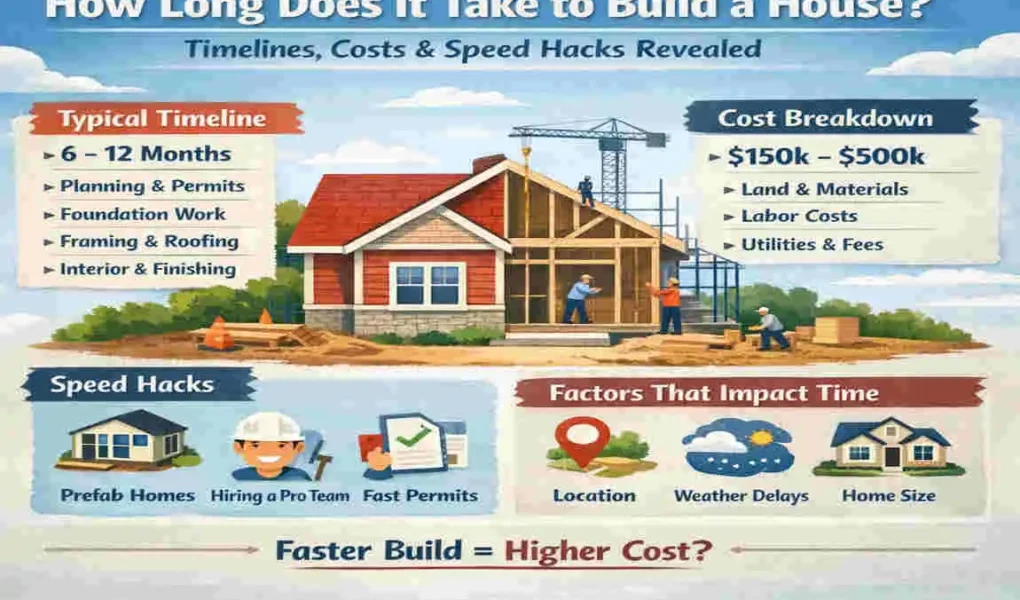
Let us start with the straightforward facts. According to recent U.S. Census data, the national average timeline to build a new construction home sits right around 9 to 10 months. However, this is just a baseline average. Depending on what you are building and where you are building it, your actual journey could look very different.
The financial side of things is just as important as the timeline. In the current 2026 market, you can expect building costs to range anywhere from $150 to $400 per square foot, heavily dependent on your material choices and region. But here is the good news: time is money. By understanding the timeline intimately, you can employ clever building hacks to slash your overall construction time by up to 30%, keeping more money in your pocket.
The Average House Construction Timeline Breakdown
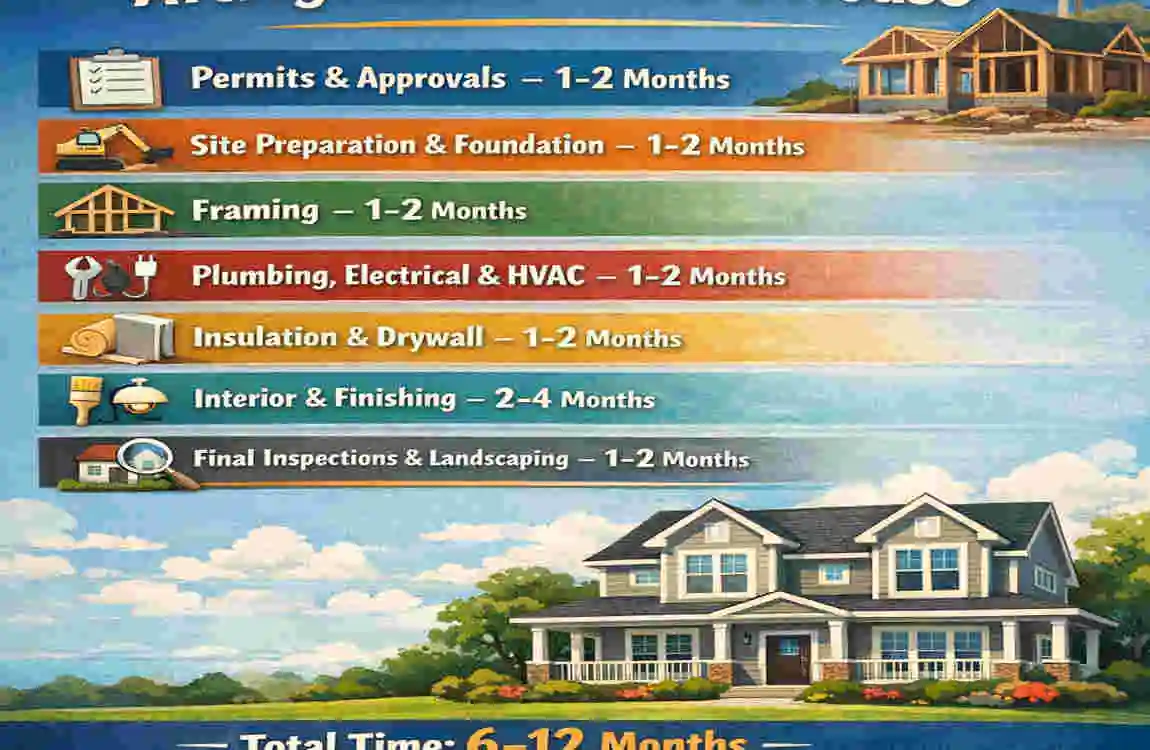
When you ask, “How long does it take to build a house?” you have to look at the big picture. The total time from the exciting moment you purchase your plot of land to the day you finally unpack your boxes can range anywhere from 10 to 36 months. This grand total includes the crucial pre-construction phases that many people forget to account for.
Let us break down this massive undertaking into easily understandable segments.
Phase-by-Phase Timeline
Construction Stage: Average Duration, Key Tasks and Milestones
Planning & Land 3 – 6 months: Site selection, land purchase, securing financing, initial budget creation.
Design & Permits 2 – 4 months: Drawing blueprints, hiring architects, waiting for local city approvals.
Foundation 1 – 4 weeks: Excavation, pouring concrete, allowing proper curing time.
Framing & Exterior 1 – 3 months: Erecting the structure, adding the roof, installing windows, and doors.
Interior & Finishing 2 – 4 months: Plumbing, electrical work, drywall, painting, installing cabinets, and flooring.
Inspections & Handover 2 – 4 weeks: Final walk-throughs, city inspections, fixing minor defects, and getting the keys.
Planning and Land Acquisition (3-6 Months)
This is where your journey begins. Before a single shovel hits the dirt, you need a place to build. Finding the perfect lot takes time. You need to test the soil, ensure the land is suitable for building, and most importantly, secure your construction financing. Banks take their time verifying your details, so patience here is essential.
Design and Permits (2-4 Months)
Once you have the land and the loan, you need the blueprints. Working with an architect or a designer to perfectly map out your dream home is a collaborative, back-and-forth process. Once the design is locked in, you hand those plans over to your local government. Waiting for building permits is notoriously slow, but it is a legal necessity you cannot skip.
The Foundation (1-4 Weeks)
Finally, the physical work begins! Heavy machinery will arrive to clear your land, dig the trenches, and pour the concrete foundation. The actual pouring happens fast, but concrete needs time to “cure” or harden completely before it can support the heavy weight of a house.
Framing and the Exterior (1-3 Months)
This is the most exciting phase for homeowners because your house suddenly looks like a house! Carpenters will construct the wooden skeleton of your home. They will put up the wall frames, add the roof trusses, and wrap the exterior in protective materials to make it weatherproof.
Interior Work and Finishing (2-4 Months)
While the outside might look finished, the inside is just getting started. This is the longest and most complex phase. Plumbers and electricians run wires and pipes through the open walls. Then comes the insulation, the drywall, the painting, and the installation of all your beautiful finishes like hardwood floors, custom kitchen cabinets, and sparkling countertops.
Final Inspections and Handover (2-4 Weeks)
You are at the finish line! But before you move in, a local inspector must verify that everything is safe and built to code. You will also do a final walk-through with your builder to catch any tiny mistakes, like a scratched floor or a loose doorknob. Once everything is perfect, you get the keys!
Production Homes vs. Custom Homes
It is vital to understand that the type of home you choose drastically impacts your timeline. Production homes—which are built by large-scale developers using pre-selected floor plans in established neighborhoods—usually take only 4 to 8 months of active construction.
On the flip side, custom homes are completely unique and built from scratch. Because every single detail is tailored to your specific desires, custom homes typically take 10 to 16 months to build.
Regional Differences Matter
Where you build plays a massive role in your timeline. For example, building a standard home in the American Midwest generally averages about 9 months. However, if we look at a different global context, building a custom home in Lahore, Pakistan, typically takes between 12 and 18 months. This extended timeline is often due to a combination of dense urban permit regulations, unique local labor dynamics, and seasonal weather patterns.
Major Factors Affecting Your Build Time
If you want an accurate answer to “how long does it take to build a house,” you have to look at the variables. In the construction world, unexpected delays can easily add 20% to 50% more time to your schedule. Here are the top influencers that dictate your home’s speed.
The Size and Complexity of Your Home
Simply put, a massive mansion takes longer to build than a cozy cottage. A straightforward, 2000-square-foot single-story home with a simple roofline might only take 6 to 9 months to finish. Conversely, a sprawling, multi-story custom home with intricate architectural details, vaulted ceilings, and custom-ordered materials will easily stretch past the 12-month mark. Complexity is the enemy of speed.
Location and Extreme Weather Conditions
Mother Nature does not care about your move-in date. If you are building in a region with heavy snowfall, like the northern United States, your builder cannot pour a concrete foundation into frozen ground.
Similarly, if we look at international builds, the intense monsoon seasons in Lahore can completely halt outdoor construction, easily delaying a project by 1 to 2 months. Furthermore, building in a crowded, urban environment often means navigating stricter noise ordinances, difficult material deliveries, and slower permit approvals compared to building in a quiet rural area.
Labor and Supply Chain Realities
The construction industry is heavily dependent on people and parts. If there is a shortage of skilled electricians in your city, your project pauses. Post-2025, the global market experienced significant labor and material shortages that, on average, added about 12% more time to national build schedules. If your special-order Italian marble takes six months to arrive on a cargo ship, your kitchen cannot be finished until it gets there.
Homeowner Decisions and Change Orders
This is the one factor you can actually control! Every time you change your mind mid-build—perhaps deciding you want a bigger window in the living room or a different type of roofing—it creates a “change order.”
Change orders force builders to stop, return materials, order new ones, and sometimes literally tear down work they have already completed. Indecision and frequent changes can easily extend your timeline by 1 to 3 extra months.
Financing and Permitting Hurdles
Money and bureaucracy are infamous for slowing things down. Getting your construction loan approved and waiting for city planners to stamp your permits can eat up 1 to 4 months before construction even begins. Furthermore, if you run out of money mid-build because of budget overruns, the work will stop entirely until you secure more funding.
Pro Tip for Faster Building: Always get your construction loans pre-approved early, and build a 15% emergency buffer into your budget to avoid any financial halts.
Build Time Costs: A Financial Breakdown
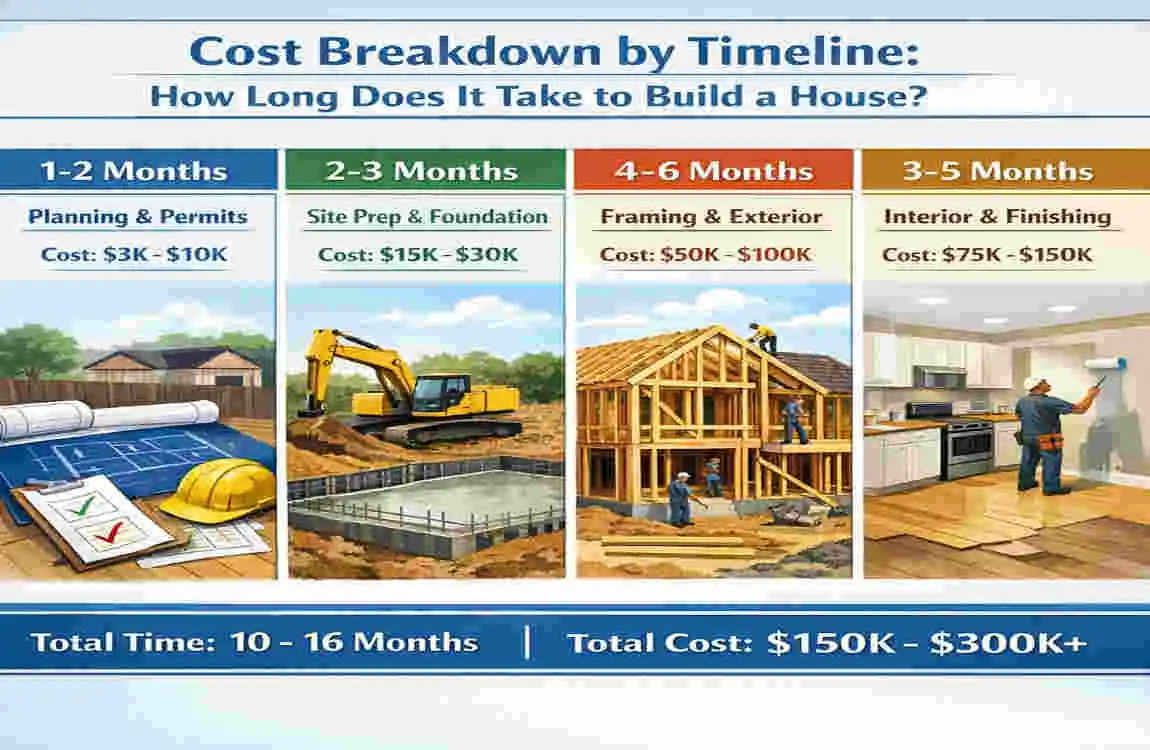
There is a very old saying in the building industry: time is money. When you stretch out your house construction timeline, you aren’t just losing patience; you are losing cash.
Faster builds can actually save you 10% to 20% on labor costs and holding costs. “Holding costs” include the rent you are paying for your current living situation, combined with the interest you are paying on your construction loan before you even move in. For an average $300,000 U.S. home, those monthly fees add up incredibly fast.
Let us look at how different timelines impact the total cost of building a standard 2000-square-foot home in the 2026 market.
Timeline vs. Cost Scenario Table
Timeline Scenario, Estimated Total Cost (2000 sq ft), Top Savings Tips
Standard Build (10 months) $400,000 – $600,000 Buy everyday materials in bulk to lock in current prices.
Fast-Track Build (6 months) $450,000 – $650,000 Utilize prefabricated elements to reduce expensive hourly onsite labor.
Delayed Build (18 months) $500,000 – $800,000+ Invest in early weatherproofing to protect the unfinished structure from damage.
Budgeting by Construction Stage
To understand where your money goes during these months, it helps to break down the budget by stage. Typically, laying your foundation takes up about 10% of your total budget (roughly $40,000 for a standard build). However, the interior finishing phase consumes a massive 30% (around $120,000) because you are paying for delicate, detailed labor and expensive items like appliances, tiles, and fixtures.
The 2026 Inflation Reality
It is also vital to factor in current economic realities. In 2026, general construction costs have naturally shifted upward by about 5% to 10% compared to 2025. This inflation means that locking in your builder and materials as quickly as possible is more crucial than ever to protect your wallet.
7 Speed Hacks to Accelerate Your Home Building
If the idea of waiting a year or more for your new home makes you anxious, we have great news. You do not have to settle for the standard timeline. By making smart, strategic choices early on, you can effectively shave 2 to 6 months off your schedule.
Here are seven actionable ways to speed up home building without sacrificing quality.
Embrace Modular and Prefabricated Homes
If you want the absolute fastest route to a new home, modular construction is the answer. Instead of building the house piece by piece in the rain and dirt, large sections of your home are built inside a climate-controlled factory. These finished sections are then trucked to your land and assembled like giant puzzle pieces. This method is incredibly efficient and can result in a total build time of just 4 to 6 months.
Utilize Pre-Designed Floor Plans
Custom architectural blueprints are beautiful, but they take months to draw, revise, and approve. You can completely skip this 2-month design phase by purchasing high-quality, pre-designed templates from a builder. You still get a beautiful home, but you get to start building almost immediately.
Master the Art of Parallel Tasks
Amateur builders do everything in a straight line: step one, then step two, then step three. Professional builders overlap tasks to save time. For instance, while you are waiting for the city to approve your final building permits, your crew can be simultaneously clearing the lot, grading the soil, and setting up temporary power on the site.
Hire Highly Experienced Local Crews
Your build is only as fast as the people swinging the hammers. Hiring vetted, highly experienced builders who deeply understand the local landscape is a game-changer. For example, using a reputable local Lahore builder who already knows the specific city inspectors and regional supply chains can reduce on-site errors and delays by up to 25%.
Leverage Modern Tech Tools
Construction has gone digital. Ask your builder if they use BIM (Building Information Modeling) software. This technology creates a highly detailed, 3D digital version of your home before physical construction starts. It allows builders to spot plumbing or electrical clashes on a computer screen rather than discovering them inside your physical walls, successfully shaving 10% to 20% off the total timeline.
Buy Your Materials in Bulk Early
Supply chain delays are a builder’s worst nightmare. Do not wait until the framing is done to order your windows. Order your windows, doors, roofing materials, and large appliances in bulk right at the start of the project. Storing them in a secure unit nearby ensures that when your crew is ready for them, the materials are already waiting.
Time Your Start with the Off-Season
Weather delays are preventable if you plan your calendar wisely. If you are in a snowy region, aim to have your foundation poured and the house framed with a roof before winter hits, allowing interior work to happen warmly indoors. If you are building in South Asia, time your foundation work to completely avoid the monsoon rains, easily gaining a full month of uninterrupted progress.
A Speed Hack Case Study
Consider a recent real estate project in the Twin Cities. A family wanted a semi-custom home but could not afford to wait a year. By opting for a high-end prefabricated framing package and pre-ordering all their interior finishes on day one, their local builder completed the entire project in just 8 months—months ahead of the regional average!
Common Construction Delays & How to Avoid Them
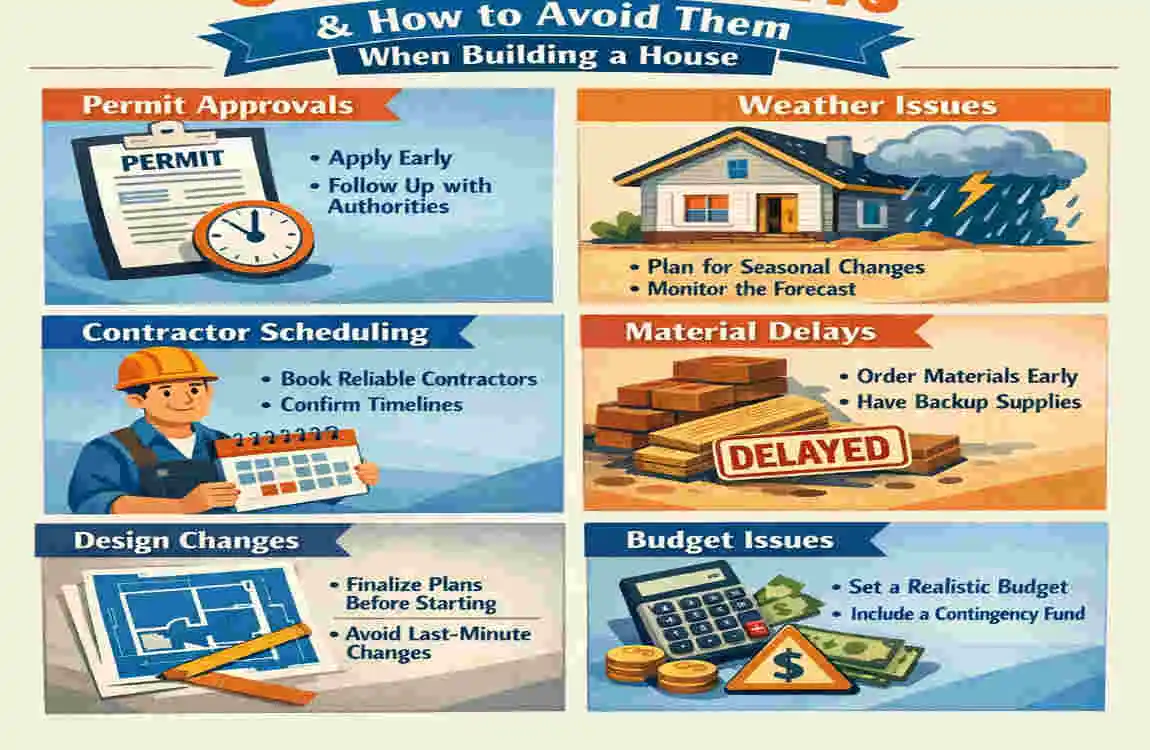
Even with the best speed hacks, the road to a new house is rarely perfectly smooth. It is completely normal to encounter a few bumps along the way. In fact, national data shows an average 12% timeline creep between the years 2019 and 2024.
The key to a stress-free build is knowing what these common pitfalls are and having a plan to avoid them.
The Permit Bottleneck
The Problem: Waiting for government bureaucracy is arguably the most frustrating delay. A backlogged city planning office can hold your blueprints hostage for months. The Solution: Always buffer an extra 3 months into your mental timeline for permits. If you are building in a heavily regulated urban area, spend the extra money to hire a local “permit expediter”—a professional whose sole job is to navigate city hall and push your paperwork through faster.
Unpredictable Weather
The Problem: You cannot pour concrete in a blizzard, and you cannot install a roof during a torrential downpour. Severe weather can force your crew to sit at home for days or weeks. The Solution: While you cannot control the sky, you can utilize indoor prefabricated materials to minimize the time your home is exposed to the elements. Additionally, ensure your builder has robust weatherproofing protocols, like heavy-duty tarps and commercial site pumps, ready to go.
The “Change Order” Trap
The Problem: As the house comes together, you might suddenly decide the primary bathroom needs to be larger, or the kitchen needs an extra window. These late-stage changes completely derail the schedule. The Solution: Lock in every single design decision before construction begins. Treat your approved blueprints as sacred. If you must make a change, understand that it will cost you both money and valuable time.
Failed city Inspections
The Problem: Your framing is done, but the city inspector finds a structural flaw and fails the inspection. Work must stop, the flaw must be fixed, and a new inspection must be booked. The Solution: Hire builders who have a stellar reputation for quality control. Furthermore, have your builder schedule the city inspectors proactively, weeks in advance, so you are not left waiting at the back of the line when a phase is finished.
Real-World Building Case Studies
To truly understand the answer to “how long does it take to build a house,” it helps to look at real-world examples. Timelines change drastically based on the specific circumstances of the project. Let us look at three very different scenarios.
The Standard U.S. Average Build
Take the story of the Smith family in the American Midwest. They purchased a standard, pre-designed floor plan from a local contractor. Because they made no major changes and experienced standard summer weather, their project mirrored the national statistics perfectly. From the day the permits cleared to the day they moved their furniture in, the total contractor-built timeline was exactly 9.1 months.
The Custom Lahore Villa
Now, let us look at a more complex, regional example. A family decided to build a stunning, entirely custom 3-story luxury villa in Lahore. This hypothetical project (based strongly on regional construction data) required deep foundation work, imported luxury marble, and intricate custom woodwork. Factoring in the time needed for complex urban permits and a brief pause during the heavy monsoon season, this breathtaking custom home took 14 months to complete. It required patience, but the final, unique result was well worth the wait.
The Prefab Speed Record
Finally, consider a young couple prioritizing speed and environmental sustainability. They purchased a modern piece of land and opted for a high-tech modular home. The entire structure was built inside a factory over 12 weeks while their local crew prepared the foundation. Once the home modules were delivered on trucks, the on-site assembly and interior buttoning-up took just a few weeks. Start to finish, their speed-success story resulted in a move-in-ready home in an astonishing 5 months.
Frequently Asked Questions (FAQs)
How long does it take to build a house in Lahore specifically?
For a standard construction project in Lahore, you should generally expect a timeline of 10 to 16 months. This accounts for local building techniques, standard bureaucratic permitting times, and the potential for seasonal weather delays like the summer monsoons.
What is the average cost per square foot right now?
In the 2026 market, the national average for new home construction ranges from $150 to $300 per square foot. Keep in mind that this is a baseline. If you choose luxury finishes, custom cabinetry, and high-end smart home technology, that number can easily climb above $400 per square foot.
Can I live on-site in an RV or trailer during the build?
While it sounds like a great way to save on rent, living on-site is rarely permitted. Most local zoning laws strictly prohibit living on an active construction site due to safety and sanitation hazards. It is highly recommended that you plan for short-term rental accommodations well away from the dust and heavy machinery.
What is the absolute fastest method to build a house?
Without a doubt, the fastest method available today is modular or prefabricated construction. By building the home in a factory simultaneously with the land preparation, you can cut the total construction time down to just 3 to 6 months.