Have you ever wondered how many square feet a 3-car garage is? If you’re planning to build a new home or add a garage to your existing property, this question is probably at the top of your mind. A 3-car garage has become increasingly popular in modern homes, and for good reason.
Today’s families often have multiple vehicles, and the need for extra storage space continues to grow. Whether you’re storing seasonal decorations, sports equipment, or creating a workshop area, a 3-car garage offers the flexibility that many homeowners crave. But before you start planning, it’s crucial to understand precisely how much space you’re working with.
Knowing the square footage of a 3-car garage matters for several reasons. If you’re a homeowner, you need to ensure the garage fits your property and meets local building codes. As a potential buyer, understanding garage dimensions helps you evaluate whether a home meets your needs. And if you’re a builder or contractor, accurate measurements are essential for project planning and cost estimation.
What Defines a 3-Car Garage?
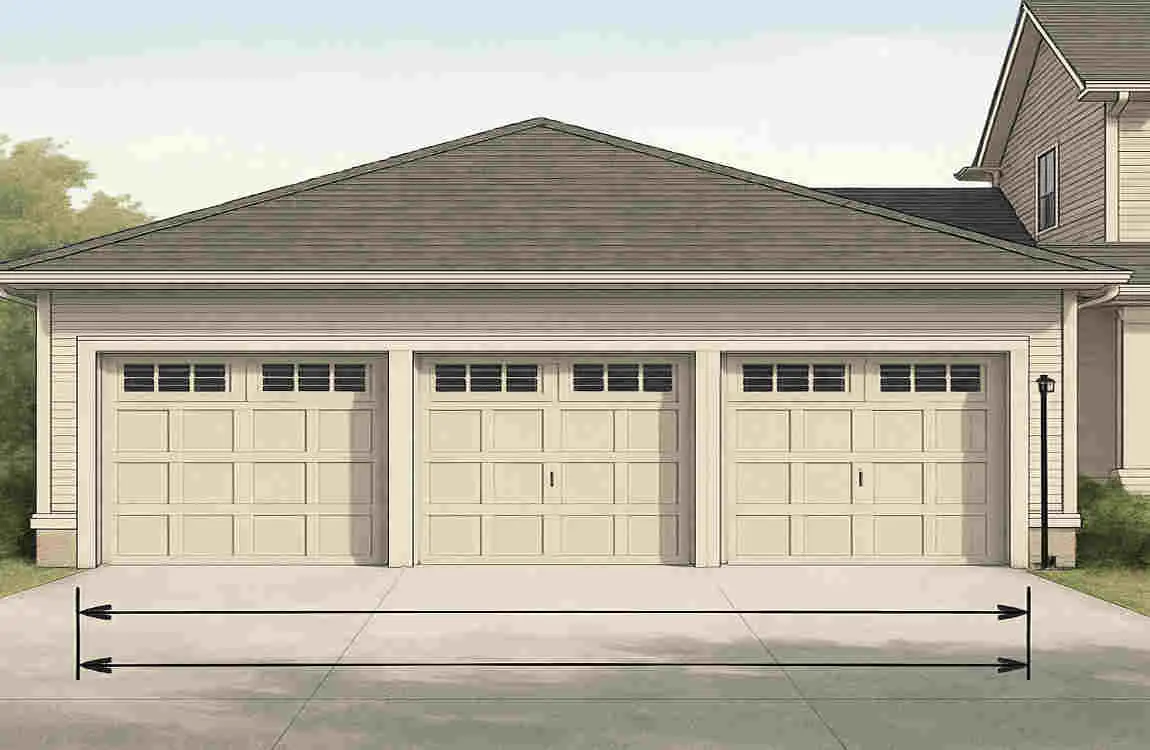
When we talk about a 3-car garage, we’re not just discussing a space that fits three vehicles. The definition goes much deeper than that, and understanding these nuances will help you make better decisions for your home.
A 3-car garage typically comes in several configurations. The most common is the side-by-side layout, where all three parking spaces are arranged in a row. This design provides easy access to all vehicles and is ideal for families who frequently use their cars. Another popular option is the tandem configuration, where one or two vehicles park behind others. This setup works well for narrower lots but requires more planning for daily use.
Some homeowners opt for combination layouts that blend both approaches. For instance, you might have two cars side-by-side with a third space positioned at an angle or perpendicular to the others. This creative arrangement can maximise available space while maintaining functionality.
Beyond parking vehicles, modern 3-car garages serve multiple purposes. Many families use the extra space for storage solutions, keeping everything from holiday decorations to camping gear organised and accessible. Others transform part of their garage into a workshop area for woodworking, auto repairs, or crafting hobbies.
The garage layout significantly affects the total square footage. A standard side-by-side configuration typically requires more width but less depth. Meanwhile, tandem designs need greater depth but can work with less width. These variations mean that two 3-car garages can have the same parking capacity but very different square footage measurements.
Understanding these definitions helps answer the question of how many square feet a 3-car garage is more accurately, as the answer depends on your specific needs and chosen configuration.
Standard Dimensions and Square Footage of a 3-Car Garage
Now let’s get to the heart of the matter: how many square feet is a 3-car garage? The answer varies based on several factors; however, we can provide you with typical measurements to help you plan effectively.
Typical Width Measurements
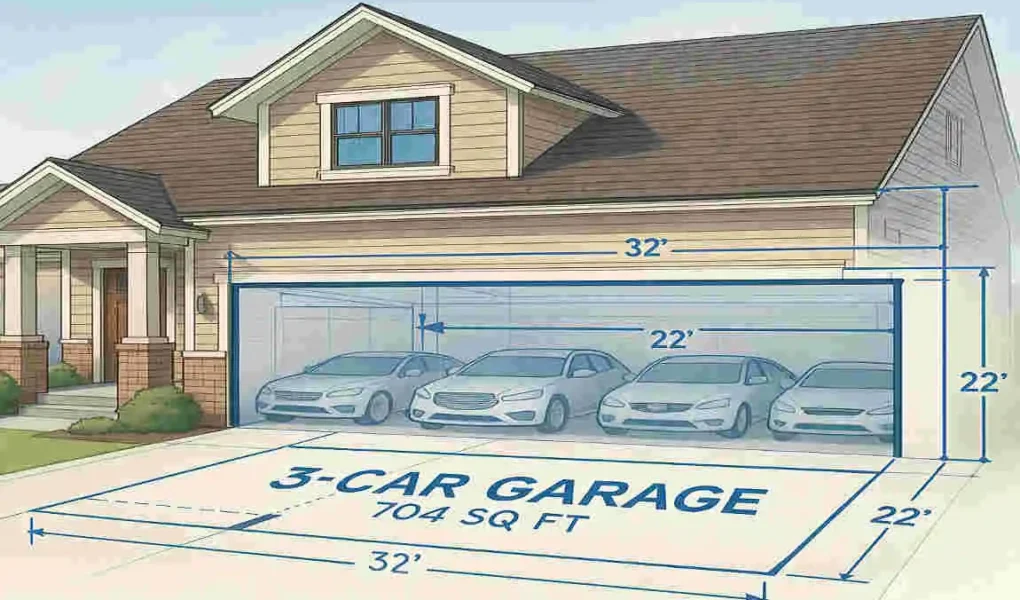
The width of a 3-car garage usually ranges from 30 to 36 feet. This measurement accounts for three parking spaces, each requiring approximately 10 to 12 feet of width. The wider dimensions provide more comfortable spacing between vehicles and easier door opening.
You may also read (how can i manually open my roller house garage door).
For those who own larger vehicles like trucks or SUVs, opting for the wider end of this range makes sense. The extra space prevents door dings and allows for easier manoeuvring when parking.
Standard Depth Dimensions
The depth of a 3-car garage typically measures between 20 and 24 feet. This provides adequate space for most vehicles while leaving room for storage at the front or back of the garage. Some homeowners prefer deeper garages, extending to 30 feet or more, especially if they plan to include a workshop area.
Height Considerations
While height doesn’t affect square footage, it’s worth noting that standard garage heights range from 8 to 10 feet. Higher ceilings allow for overhead storage solutions and can accommodate lifted trucks or roof-mounted cargo carriers.
Calculating Square Footage
Let’s break down the math with some real examples:
Configuration Width Depth Square Footage
Minimum Size 30 ft 20 ft 600 sq ft
Average Size 32 ft 22 ft 704 sq ft
Comfortable Size 36 ft 24 ft 864 sq ft
Spacious Size 40 ft 30 ft 1,200 sq ft
Example calculation: A garage measuring 32 feet wide by 22 feet deep equals 704 square feet (32 × 22 = 704).
Different Configuration Options
The square footage can vary significantly based on your chosen configuration:
Side-by-Side Configuration: This is the most straightforward layout. With three cars parked next to each other, you’ll need approximately 30-36 feet of width. This configuration typically results in a total space of 600 to 900 square feet.
Tandem Configuration: This design measures approximately 20 feet wide by 40 feet deep, accommodating two cars in tandem, with one positioned alongside the other. Despite the different shape, the total square footage (800 sq ft) remains similar.
L-Shaped Configuration: Some homeowners choose an L-shaped design that wraps around the house corner. This might measure 24 feet on each side, creating approximately 576 square feet in the central area, plus additional space in the extension.
Variations and Customisation
Remember that these are standard measurements. Your specific needs require adjustments. For instance:
- Motorcycle enthusiasts might allocate one bay for multiple bikes
- Boat owners need extra depth for trailer storage
- Workshop users require additional width for tool storage and workbenches
Understanding these dimensions helps you answer confidently when someone asks, “How many square feet is a three-car garage?” The typical answer ranges from 600 to 900 square feet, but your specific needs will determine the ideal size for your situation.
Factors That Influence the Size of a 3-Car Garage
When determining how many square feet a 3-car garage is for your specific situation, several factors come into play. Understanding these elements will help you make informed decisions about the size and layout of your garage.
Vehicle Sizes and Types
The types of vehicles you own significantly impact the required garage dimensions. Compact cars need less space than full-size trucks or SUVs. Consider these typical vehicle dimensions:
- Compact cars: 14-16 feet long, 5-6 feet wide
- Mid-size sedans: 16-18 feet long, 6-7 feet wide
- SUVs and trucks: 18-22 feet long, 6-8 feet wide
If your family owns larger vehicles, you’ll need to adjust your garage dimensions accordingly. A household with three compact cars might be comfortable with a 600-square-foot garage, while a family with trucks and SUVs could need 900 square feet or more.
Extra Storage and Workspace Requirements
Many homeowners use their garage for more than just parking. If you plan to include storage areas or a workshop space, you’ll need additional square footage. Consider these common additions:
Storage needs might include shelving units along the walls, overhead storage systems, or dedicated areas for lawn equipment. Each of these requires planning and affects your total square footage calculations.
Workshop areas typically need at least 8-10 feet of additional depth or width. This space accommodates workbenches, tool storage, and room to move around projects comfortably.
Local Building Codes and Regulations
Your local municipality plays a crucial role in determining garage dimensions. Building codes often specify:
- Minimum and maximum garage sizes
- Required setbacks from property lines
- Height restrictions
- Fire safety requirements between the garage and the living spaces
These regulations can significantly impact your garage’s final square footage. Some areas require specific distances between the garage and property boundaries, which might limit your expansion options. Always check with your local building department before finalising plans.
Architectural Style and Design Preferences
Your home’s architectural style influences garage design and size. A colonial-style home might feature a detached garage with traditional proportions, while a modern design could incorporate an oversized attached garage as a prominent architectural element.
Personal preferences also matter. Some homeowners prioritise a larger garage even if it means a smaller yard, while others prefer minimal garage space to maximise outdoor living areas. Your lifestyle and priorities should guide these decisions.
The combination of these factors ultimately determines how many square feet your 3-car garage will encompass. By carefully considering each element, you can design a garage that perfectly balances your needs with your property’s constraints.
How the Square Footage of a 3-Car Garage Affects Your Home’s Value
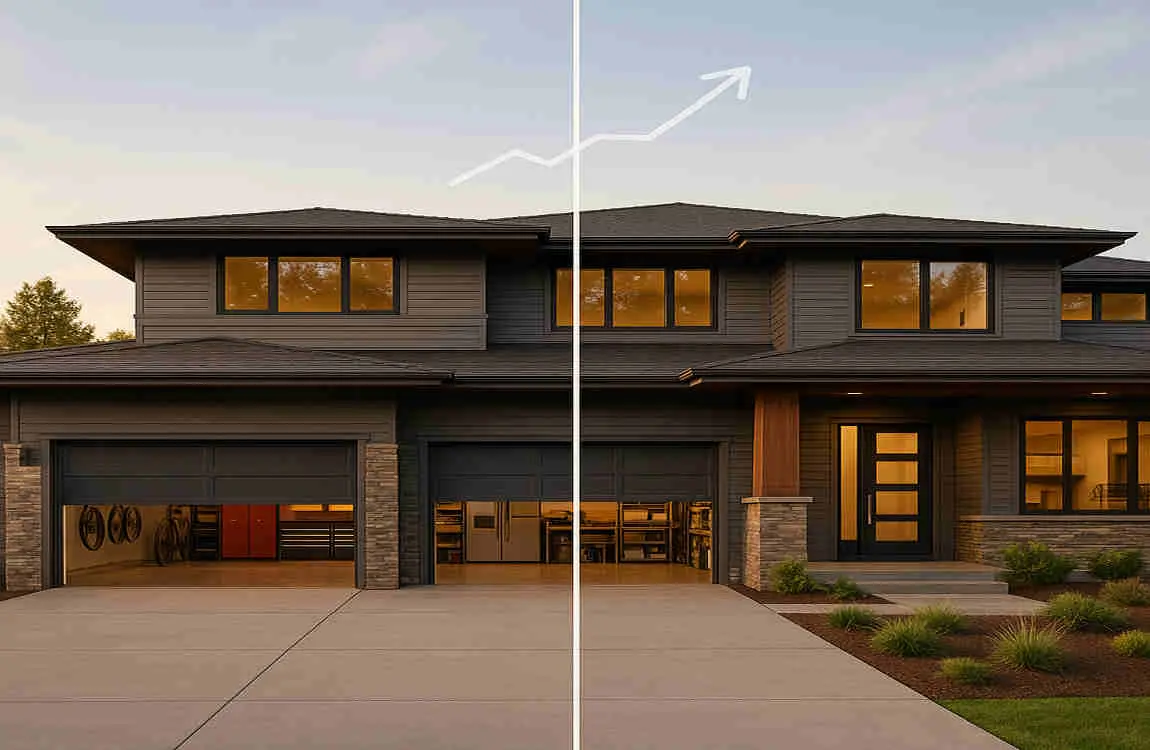
Understanding how many square feet a 3-car garage is becomes even more critical when you consider its impact on your home’s value. The relationship between garage size and property value is significant and multifaceted.
The Value-Add Equation
Real estate professionals consistently report that a 3-car garage can increase home value by 5-10% compared to similar homes with 2-car garages. This percentage translates to substantial dollar amounts in many markets. For a $400,000 home, a well-designed 3-car garage could add $20,000 to $40,000 in value.
The square footage of your garage directly correlates with this value increase. A spacious 900-square-foot garage typically adds more value than a cramped 600-square-foot version. Buyers perceive larger garages as more versatile and functional, making them willing to pay premium prices.
Current Real Estate Market Trends
Today’s homebuyers prioritise garage space more than ever. Recent surveys show that 85% of buyers consider garage size a crucial factor in their purchasing decision. This trend is particularly pronounced in suburban and rural areas, where families often own multiple vehicles.
The demand for 3-car garages has grown steadily over the past decade. Real estate agents report that homes with 3-car garages sell faster and often receive multiple offers. In competitive markets, the presence of a 3-car garage can be the deciding factor between similar properties.
Property Tax Considerations
While a larger garage can increase a home’s value, it also affects property taxes. The additional square footage gets factored into your home’s assessed value. However, the tax increase is usually modest compared to the value gained.
For example, if your 3-car garage adds 800 square feet to your home and your area assesses at $150 per square foot, that’s $120,000 in assessed value. With a typical tax rate of 1.2%, you’d pay an additional $1,440 annually in property taxes. Most homeowners find this increase reasonable, given the benefits of increased functionality and resale value.
Insurance and Appraisal Impacts
Your homeowner’s insurance premiums will likely increase with a larger garage. Insurance companies consider the replacement cost of the structure, so more square footage means higher coverage limits. However, a well-built garage can also qualify for discounts if it includes safety features like fire-resistant materials or security systems.
During the appraisal process, appraisers carefully measure and evaluate garage space. They consider:
- Total square footage
- Quality of construction
- Functionality and access
- Comparison to neighbourhood standards
A professionally built 3-car garage that matches your home’s architecture and meets local standards will appraise at full value. Conversely, a poorly designed or constructed garage might not add the expected value, regardless of size.
Understanding these value implications helps justify the investment in an appropriately sized 3-car garage. The square footage you choose today will impact your home’s marketability and value for years to come.
Cost Implications of Adding a 3-Car Garage
When planning your garage project, understanding the financial aspects is crucial. Let’s explore how the square footage of a 3-car garage translates into real costs and what factors influence your final budget.
Average Cost Per Square Foot
The cost to build a 3-car garage varies significantly based on location, materials, and complexity. Here’s what you can expect:
Basic construction typically runs between $20 $40 per square foot. For a standard 800-square-foot garage, this translates to $16,000 to $32,000. This price includes foundation, framing, roofing, and basic finishing.
Mid-range construction with better materials and finishes costs $40 to $60 per square foot. An 800-square-foot garage at this level would cost $32,000 to $48,000. This tier includes insulation, windows, and quality garage doors.
High-end construction can exceed $60 per square foot, mainly if you include premium features like heated floors, custom storage systems, or architectural details. These garages can cost $48,000 or more for 800 square feet.
Attached vs. Detached Garage Costs
The decision between attached and detached significantly impacts your budget:
Attached garages generally cost less because they share a wall with your home. You save on:
- One exterior wall construction
- Simplified electrical and plumbing connections
- Reduced site preparation
Detached garages require complete four-wall construction and independent utility connections. However, they offer more flexibility in placement and design. Expect to pay 10-15% more for a detached garage of the duplicate square footage.
Material and Labour Factors
Several elements influence your garage construction costs:
Foundation type makes a big difference. A simple slab foundation costs less than a full basement or crawl space. For an 800-square-foot garage, foundation costs range from $4,000 to $8,000.
Roofing materials vary widely in price. Asphalt shingles are the most economical, while metal or tile roofing can double or triple the cost. Your choice here can add $3,000 to $10,000 to the project.
Garage doors for a 3-car garage represent a significant expense. Basic doors might cost $2,000 total, while insulated, custom doors can exceed $6,000.
Return on Investment Considerations
Understanding the ROI helps justify your garage investment:
- Most 3-car garages return 65-80% of their cost in increased home value
- Well-designed garages in high-demand areas can return up to 85%
- The functionality value often exceeds the monetary ROI
Example ROI calculation: If you spend $40,000 on an 800-square-foot garage and it adds $30,000 to your home value, that’s a 75% immediate return. Plus, you gain years of practical use before selling.
Cost-Saving Strategies
To maximise value while managing costs:
- Plan carefully to avoid expensive changes during construction
- Consider phased construction – build the shell now, finish the interior later
- Compare multiple contractors , but don’t automatically choose the lowest bid
- Buy materials during sales or consider slightly used items like doors
- Do some work yourself if you have the skills, such as painting or basic electrical work
Remember that while a larger garage costs more initially, the price per square foot often decreases as size increases. Building a 900-square-foot garage might only cost 10-15% more than a 700-square-foot one, making the larger option more cost-effective per square foot.
Design Tips and Ideas to Maximise a 3-Car Garage Space
Now that you understand how many square feet a 3-car garage is, let’s explore how to make the most of that space. Innovative design can transform your garage from a simple parking area into a multifunctional space that enhances your daily life.
Efficient Space Planning
Start with a clear layout plan. Measure your vehicles and map out their positions, leaving at least 3 feet between cars and 2 feet of clearance around each vehicle. This ensures comfortable access and prevents door dings.
Consider creating zones within your garage:
- Parking zone: The primary area for vehicles
- Storage zone: Dedicated space for seasonal items and equipment
- Work zone: Area for projects, repairs, or hobbies
- Transition zone: Space near entry doors for everyday items
Smart Storage Solutions
Maximise your garage’s square footage with these storage ideas:
Wall-mounted systems keep floors clear while providing easy access. Install:
- Slatwall panels for flexible organisation
- Heavy-duty shelving for boxes and bins
- Pegboards for tools and equipment
- Bike hooks to store bicycles vertically
Overhead storage utilises ceiling space effectively. Consider:
- Ceiling-mounted platforms for seasonal decorations
- Pulley systems for kayaks or ladders
- Overhead bins for rarely used items
Built-in cabinets offer clean, organised storage. Position them strategically:
- Alongside walls to maintain vehicle clearance
- In corners to maximise otherwise wasted space
- Above workbenches for tool storage
Lighting and Ventilation Strategies
Proper lighting transforms your garage’s functionality:
- Install LED shop lights for bright, energy-efficient illumination
- Add task lighting above workbenches
- Consider motion-sensor lights for convenience
- Include windows or skylights for natural light
Good ventilation keeps your garage comfortable:
- Install exhaust fans to remove fumes and heat
- Add vents near the floor and ceiling for air circulation
- Consider a mini-split system for climate control
- Ensure proper ventilation for any workshop areas
Architectural Harmony
Your garage should complement your home’s style:
Match exterior finishes to your house:
- Use the same siding material and colour
- Coordinate roofing materials and style
- Select garage doors that enhance curb appeal
- Add architectural details like windows or decorative hardware
Create visual interest without overwhelming:
- Break up large door expanses with windows
- Add exterior lighting for safety and aesthetics
- Consider different door styles for each bay
- Include landscaping to soften the garage’s appearance
Maximizing Functionality
Transform your 3-car garage into more than just parking:
Create a workshop area by:
- Installing a sturdy workbench along one wall
- Adding electrical outlets for power tools
- Including proper ventilation for paint or chemical use
- Designating tool storage nearby
Design flexible spaces that adapt to changing needs:
- Use modular storage systems that you can reconfigure
- Install fold-down workbenches for occasional use
- Create mobile storage carts for easy reorganisation
- Leave some open floor space for future needs
By implementing these design strategies, you’ll maximise every square foot of your 3-car garage. The key is planning for both current needs and future possibilities, ensuring your garage remains functional and valuable for years to come.
You may also read (how do you properly seal a home garage floor).