You wake up in a sun-drenched bedroom. You step out of bed, and with a simple voice command, the motorized blinds glide up to reveal a stunning, unobstructed view of nature through floor-to-ceiling glass walls. The boundary between the cozy indoors and the wild outdoors seems to vanish entirely. Your home feels less like a walled fortress and more like a living, breathing part of the landscape.
This is not a scene from a sci-fi movie. This is the reality of modern living, and it perfectly captures the magic we are going to explore today.
If you have ever caught yourself staring at a breathtaking, sleek new home and wondered, what is contemporary architecture, you are exactly in the right place. Simply put, it is a dynamic, ever-evolving style of building. It emphasizes ultimate simplicity, incredibly clean lines, wide-open spaces, and a deep, respectful harmony with nature.
It is a design philosophy that took the bold ideas of mid-20th-century modernism and upgraded them for today’s innovative, tech-driven world. People absolutely love it. In fact, recent 2025 Zillow trends report a massive 40% growth in contemporary home builds. Homeowners are craving spaces that feel fresh, functional, and deeply connected to the environment.
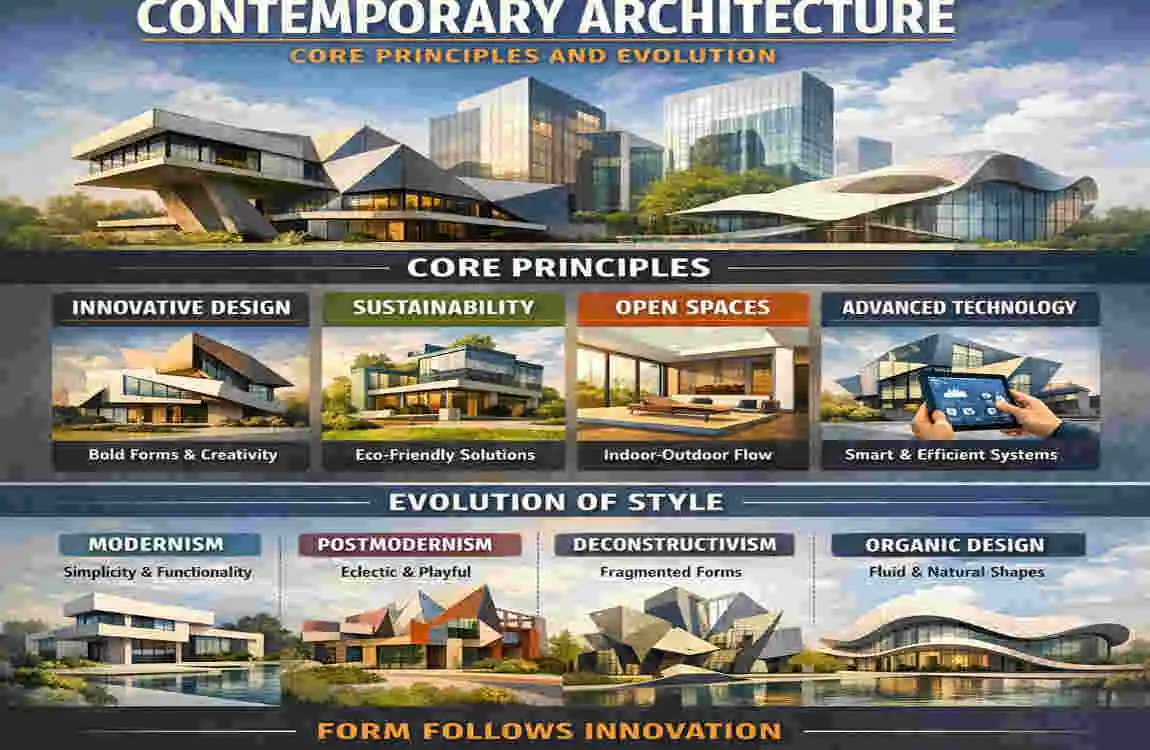
Defining Contemporary Architecture: Core Principles and Evolution
What Is Contemporary Architecture Exactly?
When people ask, what is contemporary architecture, they often confuse it with modern architecture. Let’s clear that up right away. Modern architecture refers to a very specific time period—mostly the early to mid-20th century. It is a fixed style, much like the Victorian or Colonial styles.
Contemporary architecture, on the other hand, is the architecture of right now. It is the style of the present moment, generally referring to buildings designed from the 2000s onward. It is not tied to one strict set of rules. Instead, it is highly adaptable, heavily prioritizing functionality, beautiful minimalism, and a willingness to break traditional boundaries.
To help you spot a contemporary home in your neighborhood, look for these core principles:
- Clean lines and geometric forms: You will not find fussy, ornate details or complex carvings here. You will see crisp, straight lines, bold sweeping curves, and striking geometric shapes.
- Massive windows for natural light: Contemporary designers treat natural light as a primary building material. Expect walls made entirely of glass and strategically placed skylights that flood the home with sunshine.
- Open floor plans: Say goodbye to dark, separated, tiny rooms. Contemporary homes flow freely from the kitchen to the dining area to the living room, creating a massive, shared space.
- Sustainable, eco-friendly materials: Today’s architects care deeply about the planet. They frequently use recycled steel, reclaimed warm woods, low-VOC (volatile organic compound) paints, and sustainably sourced concrete.
Historical Evolution from Modernism to Today
To truly understand where we are, we have to look at where we came from. The timeline of today’s architecture has fascinating roots.
It started in the 1920s with the German Bauhaus movement. These pioneers believed that the function of a building should dictate its form. They stripped away unnecessary decorations and focused on pure utility.
Then came the 1950s International Style, which brought us those sleek, glass-and-steel skyscrapers you see in major cities. Fast forward to the 21st century, and things have absolutely exploded. The invention of digital tools, like BIM (Building Information Modeling) software, allows architects to design gravity-defying shapes that were impossible to draw by hand.
Today, our buildings are influenced by massive global shifts. Globalization brings different cultural styles together. Climate change forces us to build smarter, greener buildings. And technology, like giant 3D printers, is literally changing how we lay down bricks and mortar.
To make the differences perfectly clear, let’s look at a quick comparison table:
FeatureTraditional ArchitectureModern Architecture (Mid-Century)Contemporary Architecture (Today)
Time Period Pre-20th Century 1920s – 1960s 2000s – Present Day
Roof Style Pitched, gabled, or shingled Mostly flat or gently sloped Asymmetrical, flat, or green (living) roofs
Windows Small, symmetrical, paned Large, unpaned, ribbon windows Massive floor-to-ceiling glass, smart glass
Floor Plan Closed, distinct, separate rooms Open, but often rectangular Completely fluid, highly adaptable spaces
Eco-Focus Very low to none Minimal Extremely high (Net-zero, sustainable)
Key Characteristics of Contemporary House Design
Now that we know the history, let’s talk about how this looks in the real world. If you are thinking about upgrading your current house or building a new one, these are the features you want to pay attention to.
Signature Features in Homes
Contemporary house design is all about making a bold statement while remaining incredibly comfortable. Here are the signature features you will see in top-tier homes today:
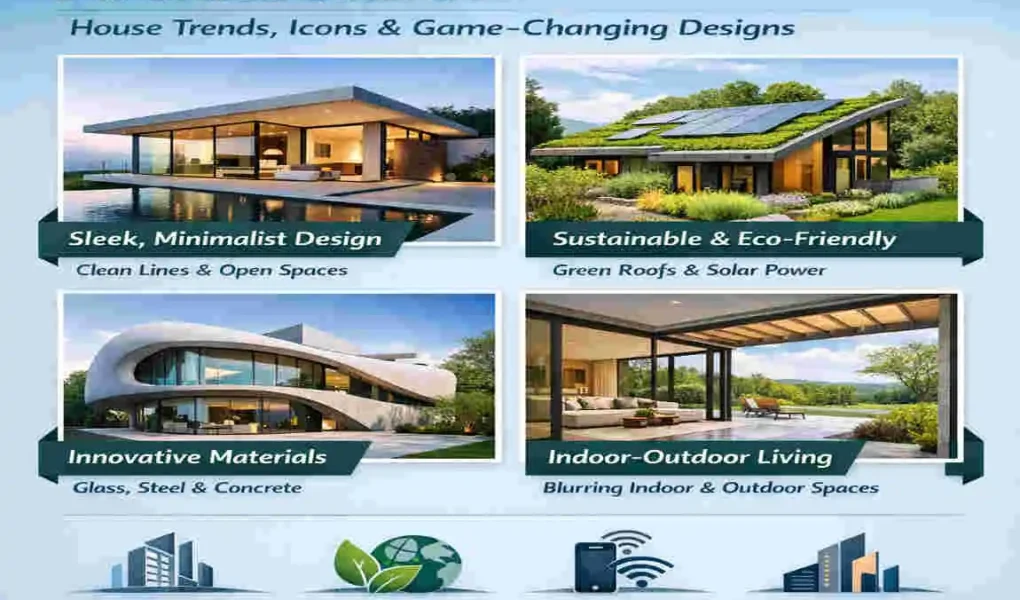
- Asymmetrical roofs and flat designs: Forget the standard triangle roof. Contemporary homes often feature flat roofs, or roofs that slope in unexpected, dramatic directions. This creates a striking silhouette against the sky.
- Integration of indoor-outdoor living: This is a huge one. Architects use massive sliding glass walls or folding accordion doors. When you open them, your living room literally spills out onto the patio, doubling your entertainment space.
- Smart tech integration: A contemporary home is a smart home. We are talking about voice-activated ambient lighting, energy-efficient HVAC systems that learn your schedule, and security systems you monitor from your phone.
- Fascinating material mixes: Contemporary designers love contrast. They will mix cold, industrial materials like poured concrete and glass with incredibly warm, organic materials like rich cedar wood and corten steel (a special steel that rusts beautifully to a rich orange-brown color to protect itself).
Floor Plans and Spatial Innovations
The way a house flows is just as important as how it looks from the curb. The floor plans of contemporary homes are spatial masterpieces.
One common layout is the modernized, single-story ranch. But these aren’t your grandparents’ ranches. They often feature cantilevered sections—rooms that jut out in mid-air without visible supports below them, looking like they are floating.
Another popular option is the multi-level loft. These spaces feature soaring, double-height ceilings in the main living area, with a second-floor bedroom or office looking down over the space from a glass balcony.
Imagine a 2,500 square foot contemporary home plan. You walk through a massive pivoting front door. Immediately, your eyes are drawn past the floating staircase, right through the glass back wall, and out to the pool. There are no walls blocking your view.
Here is a pro tip for you: These open layouts and strategic window placements are not just for looks. By capturing natural breezes and sunlight, these designs can actually reduce your energy costs by up to 30%, according to a recent 2025 ENERGY STAR report. You save money while living in a stunning piece of art.
Top Contemporary Architecture Trends for 2026 Homes
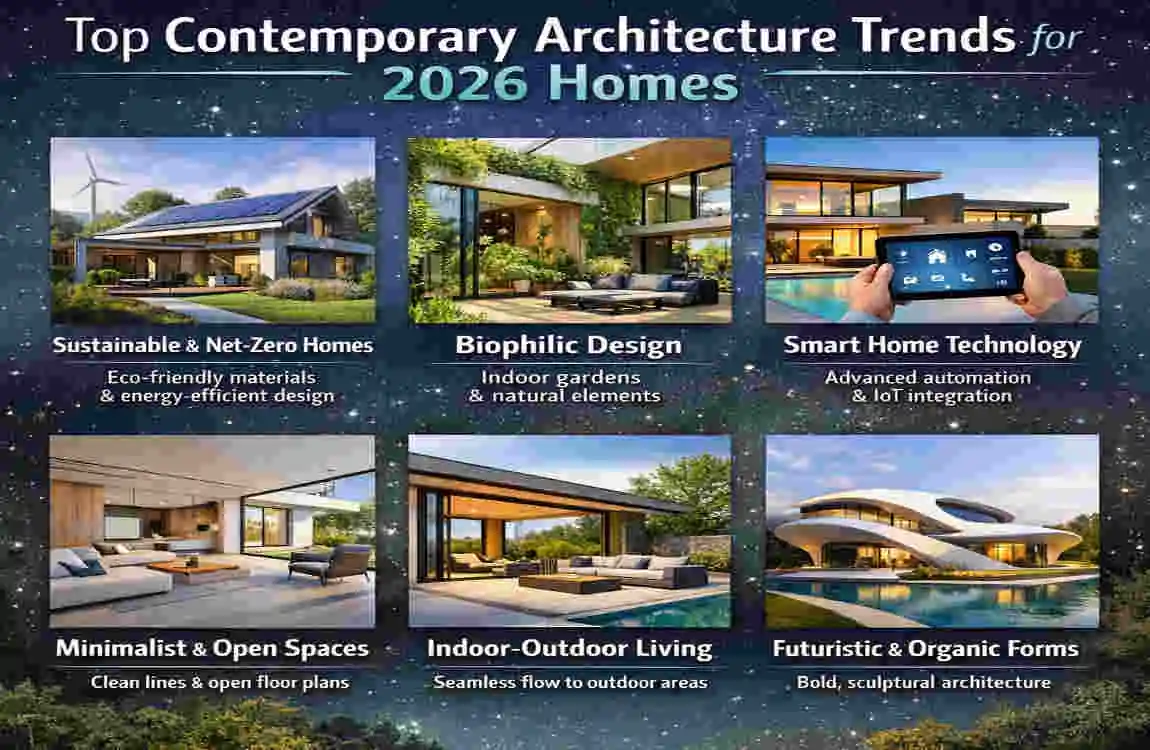
The world of design never stands still. If you want to stay ahead of the curve, you need to know what is coming next. As we look at the contemporary house trends for 2026, the focus is entirely on health, sustainability, and clever building methods.
Emerging Trends Shaping the Future
Here are the top five trends that are dominating architectural blueprints right now:
- Biophilic design: This is more than just putting a spider plant in the corner. Biophilic design means weaving nature directly into the building. Think massive living walls covered in lush moss and ferns, indoor water features, and green roofs that provide insulation while giving local birds a place to rest.
- Modular and prefab construction: Building a house from scratch is expensive and takes forever. The solution? Modular homes. Parts of the house are built in a climate-controlled factory with laser precision, then shipped to your lot and assembled like giant LEGO blocks. It is incredibly fast and highly affordable.
- Net-zero energy homes: With rising energy costs, homes that produce as much power as they consume are the ultimate goal. This involves seamless solar panel integration (sometimes solar tiles that look just like regular roofing), heavy-duty insulation, and geothermal heating.
- Adaptive reuse: Instead of tearing down old, beautiful buildings, architects are saving them. We are seeing incredible projects where abandoned brick warehouses, old churches, and even shipping containers are being transformed into ultra-luxurious, contemporary lofts.
- Wellness-focused spaces: Our homes are our sanctuaries. New designs feature circadian lighting systems that change color temperature throughout the day to match the sun, helping you sleep better. They also include hospital-grade air purification systems built right into the walls.
Trend Spotlight: Sustainable Minimalism
Let’s zoom in on one specific trend that is taking over: sustainable minimalism. The idea is simple. You build only what you need, you make it beautiful, and you ensure it doesn’t harm the earth.
Take the “Passive House” standard, for example. These homes are sealed so tightly and insulated so well that they barely need a furnace or an air conditioner.
Let’s look at a real-world case study. In the rapidly growing eco-developments on the outskirts of Lahore, architects are blending contemporary design with local climate needs. By using thick, insulated concrete walls, deeply shaded windows to block the fierce summer sun, and strategic cross-ventilation, these modern villas are incredibly cool inside. Homeowners in these Lahore eco-villages are seeing their cooling bills plummet, proving that great design solves real-world problems.
Iconic Contemporary Architecture: Buildings That Inspire
Sometimes, to truly appreciate what is contemporary architecture, you need to look at the giants. You need to look at the buildings that make tourists stop in their tracks and pull out their cameras. These global icons spark our aspiration and push the boundaries of what is physically possible.
Must-Know Masterpieces
Let’s take a quick world tour of some architectural masterpieces you must know about.
- The Oculus by Santiago Calatrava (New York City): If you visit lower Manhattan, you cannot miss this. Serving as a transportation hub, it looks like a giant, glowing white dove being released from a child’s hands. Its sweeping, asymmetrical white ribs let natural light pour down into the underground train stations. It is a powerful symbol of renewal and hope.
- Burj Khalifa by Adrian Smith (Dubai): You cannot talk about contemporary marvels without mentioning the tallest building on earth. Piercing the clouds at over 2,700 feet, this needle-like structure is a masterclass in modern engineering. It proves that extreme verticality can meet ultimate luxury seamlessly.
- Apple Park by Norman Foster (Cupertino, California): Often called the “spaceship,” Apple’s headquarters is a perfect massive circle of curved glass. It blends seamlessly into the rolling California hills and is powered entirely by renewable energy. It represents the ultimate fusion of sleek technology and natural landscapes.
- The Stahl House, Case Study House #22 (Los Angeles): While slightly older, it is the godfather of contemporary residential design. Perched dangerously on a cliff high above Los Angeles, its massive glass walls offer a 270-degree view of the city lights below. It completely erased the line between indoors and outdoors.
Celebrity Homes in Contemporary Style
We cannot ignore the influence of pop culture. When celebrities build homes, the masses take notes, and those features eventually trickle down to everyday housing markets.
Take Elon Musk, for example. Before selling his real estate portfolio, he lived in ultra-sleek, minimalist compounds. He even famously lived in a tiny, $50,000 prefab contemporary box house in Texas, proving that extreme wealth does not always mean extreme excess.
Then you have stars like Zendaya, who purchased a stunning, sleek pad in Los Angeles. Her home features warm woods, massive walls of glass, and a quiet, zen-like minimalism.
Why do these celebrity homes matter to you? Because they influence mass-market trends. When a celebrity shows off their new floating staircase or their biophilic living wall on Instagram, builders take notice. Within a few years, those exact features become affordable options at your local home improvement center.
Game-Changing Designs Revolutionizing the Industry
We have looked at the present, but what about the future? The field of contemporary architecture is currently undergoing a massive technological revolution. Forward-thinking architects are using tools that sound like they belong in a science fiction novel.
Pioneering Projects and Tech
If you want to know where home building is going, keep your eyes on these incredible innovations:
- 3D-Printed Homes: This is not a drill. Companies like ICON are literally printing entire neighborhoods. They use a massive machine that squeezes out layers of specialized concrete, much like a baker frosting a cake. They recently built an entire village of gorgeous, contemporary homes in Texas. It reduces construction waste to nearly zero and can print the walls of a house in a matter of days.
- Parametric Designs via AI: The late, great architect Zaha Hadid pioneered this. By using advanced artificial intelligence and complex algorithms, computers can design buildings that mimic the fluid, curved shapes found in nature. The AI calculates exactly how the wind will hit the building and how the sun will light the rooms, creating mind-bending, futuristic structures.
- Floating Homes for Climate Resilience: As sea levels rise, architects in places like the Netherlands are designing amphibious houses. These are gorgeous contemporary homes built on buoyant foundations. If a flood comes, the house detaches from the ground and floats safely upward, sliding up massive steel poles to stay anchored. It is a brilliant, beautiful way to adapt to climate change.
Future-Proofing Your Home: Implementation Tips
You might be reading this and thinking, “This all sounds amazing, but how do I get a piece of this action without building a billion-dollar spaceship?”
You do not need to start from scratch. You can future-proof your current home by embracing these principles. Start with the basics. Strip away heavy drapes and let the light in. Paint your walls crisp, clean whites or warm, earthy tones.
If you have a budget, consider a contemporary facelift. A starting budget of around $50,000 can do wonders. You can replace your standard windows with expansive, black-framed glass. You can knock down a non-load-bearing wall to create that coveted open floor plan. You could update your exterior siding to incorporate rich wood accents against dark, moody paint.
Whether you are in a quiet suburb or looking to upgrade a property, smart investments in contemporary design always pay off. Be sure to research local costs carefully before you start swinging a sledgehammer!
Why Choose Contemporary Architecture? Benefits and Challenges
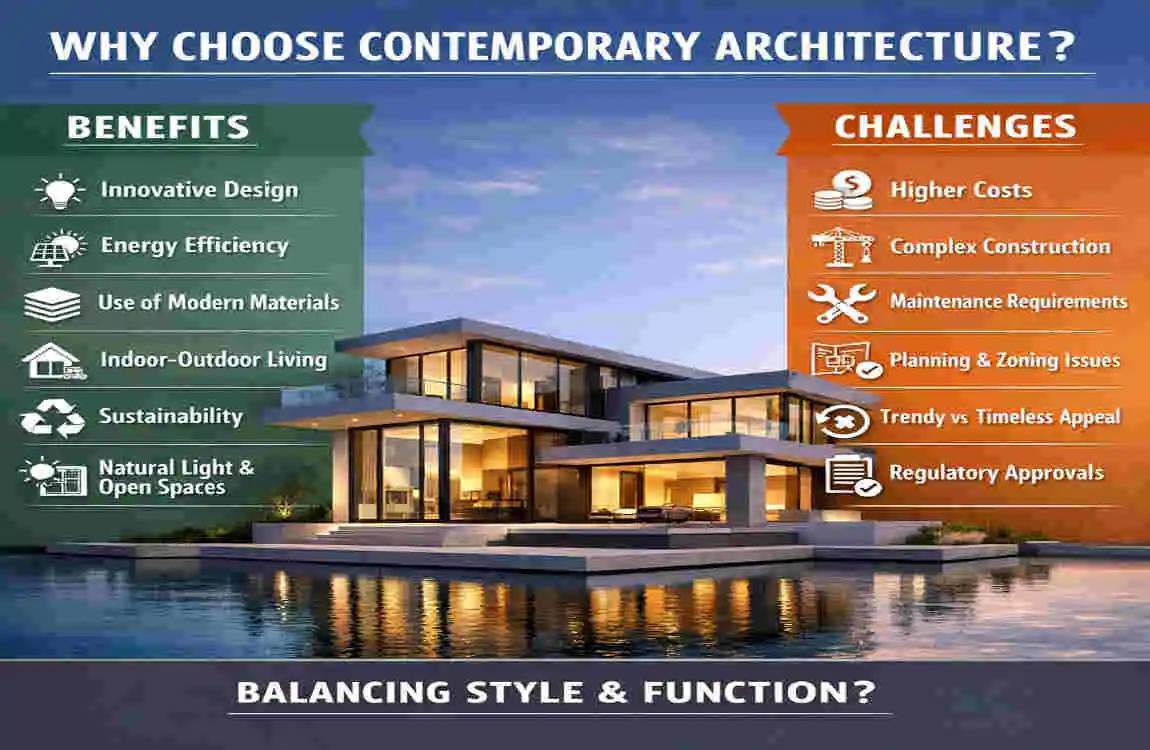
Before you commit to transforming your home into a sleek, glass-walled paradise, it is important to look at the whole picture. Like anything in life, contemporary architecture has its incredible highs and its specific challenges.
Let’s break down the pros and cons so you can make an informed decision.
The Benefits (Why You Will Love It):
- Massive Energy Savings: Because these homes prioritize natural light and utilize cutting-edge insulation and solar tech, your monthly utility bills will drop significantly.
- Major Resale Value Boost: People want modern, clean spaces. According to recent data from Redfin, homes with contemporary updates often sell for a 15-20% premium compared to dated homes in the same neighborhood.
- Timeless, Peaceful Appeal: Because the design relies on simplicity and nature rather than trendy patterns, a well-designed contemporary home will look just as good in twenty years as it does today. The lack of clutter actively promotes mental peace.
The Challenges (What to Watch Out For):
- Higher Upfront Costs: Buying massive sheets of structural glass and high-end eco-materials is not cheap. The initial build or renovation will likely cost more than a standard, traditional build.
- Maintenance of Glass Elements: Let’s be brutally honest. If you have floor-to-ceiling windows, you are going to see fingerprints, dog nose smudges, and water spots. You will need a good window cleaner on speed dial.
- Privacy Concerns: Living in a glass house is beautiful, but if you have close neighbors, you will need to invest heavily in smart blinds or strategic landscaping to keep prying eyes out.
If you are an urban professional living in a bustling, growing city like Lahore, seeking a modern villa that offers a quiet escape from the noise, the pros far outweigh the cons. A contemporary home gives you a personal, tranquil oasis in the middle of a chaotic world.
Frequently Asked Questions
What is contemporary architecture vs. modern architecture? As discussed, modern architecture refers to a specific historical period (roughly the 1920s to the 1960s) known for strict, functional designs. Contemporary architecture means the architecture of “today.” It borrows from modernism but is much more fluid, utilizing today’s eco-friendly materials and digital design tools.
Are contemporary homes cold and unwelcoming? This is a huge misconception! While older minimalist designs could feel sterile, today’s contemporary homes are incredibly warm. Architects achieve this by mixing cold materials like concrete with very warm materials like natural cedar wood, soft textiles, and abundant indoor greenery.
Is it expensive to build a contemporary house? It certainly can be, primarily due to the cost of large-scale glass, custom steel structures, and advanced smart-home technology. However, the long-term energy savings from sustainable features and the massive boost to your property value often offset the higher initial price tag.
Can I make my traditional house look contemporary? Absolutely. You do not need to bulldoze your house. You can modernize it by painting the exterior in high-contrast colors (like stark white with black trim), updating old windows to large, un-paned glass, removing heavy window treatments, and knocking down interior walls to create a flowing, open floor plan.
Why are flat roofs so common in this style? Flat or low-sloped roofs are popular because they perfectly match the geometric, clean-line aesthetic of the style. Furthermore, they are highly functional. A flat roof provides the perfect unseen platform for large solar panel arrays, or they can be structurally reinforced to host a beautiful rooftop garden or an outdoor living room.