
Imagine this scenario: You pride yourself on keeping your home spotless. You vacuum religiously, your hardwood floors gleam, and there isn’t a pile of clutter in sight. You sit down on your sofa to relax after a long day, and suddenly, you feel a sharp, undeniable itch on your ankle. You look down, and there it is—a tiny, dark speck that vanishes the moment you try to touch it.
Here is the hard truth: Even the cleanest houses are not flea-proof. Cleanliness has very little to do with how a flea infestation begins, though it can help control it. A single flea hitchhiking on your pet (or even your pant leg) can spiral into a full-blown crisis faster than most homeowners realize.
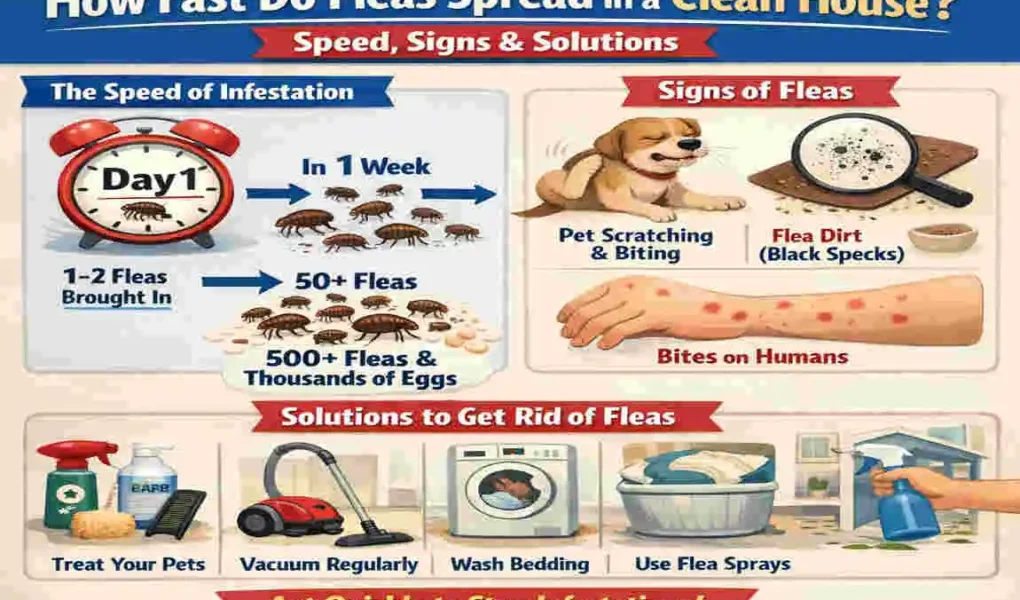
If you are asking, how fast do fleas spread in the house, the answer is alarming. In ideal conditions, a minor annoyance can turn into a home-wide infestation in as little as two weeks. A single female flea is a reproductive machine, capable of laying up to 50 eggs per day. That means, within a week, one flea could have created a generation of 350 successors hiding in your carpets, cracks, and bedding.
Flea Biology Basics: Know Your Enemy
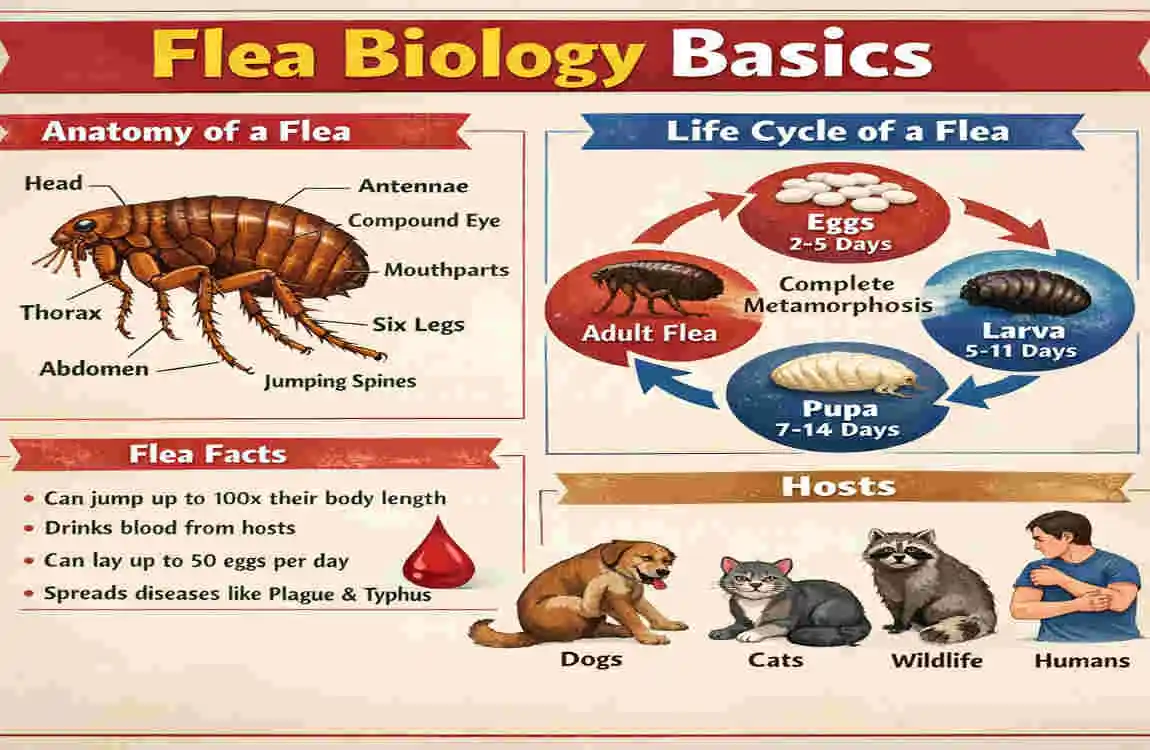
To understand the speed of an infestation, you have to understand the biology behind it. You cannot fight what you don’t understand. The reason fleas persist so stubbornly is their complex, four-stage lifecycle. Most people only see the adults, but they represent a tiny fraction—often as little as 5%—of the total flea population in your home. The other 95% are lurking in stages you can’t easily see.
The Stages of the Flea Lifecycle
The transformation from egg to biting adult can take anywhere from 2 weeks to several months, depending on the temperature and humidity of your home.
The Egg (The Invisible Spreaders)
This is where the numbers get scary. A female flea starts feeding almost immediately upon landing on a host and begins laying eggs within 24 to 48 hours. She can lay 50 eggs a day. These eggs are not sticky; they are dry and smooth, resembling grains of salt. As your pet moves around the house—jumping off the couch, shaking in the hallway, or sleeping in your bed—these eggs fall off like tiny salt shakers, seeding every room in your house.
The Larva (The Hidden Scavengers)
Once the eggs hatch (usually in 2 to 14 days), the larvae form. These look like microscopic, translucent worms. They avoid light and burrow deep into carpet fibers, floor cracks, and upholstery. They feed on “flea dirt” (which is actually dried blood excreted by adult fleas) and other organic debris. Because they hide deep in fibers, light vacuuming often misses them.
The Pupa (The Armored Tank)
This is the stage that frustrates homeowners the most. The larva spins a sticky, silk-like cocoon around itself, becoming a pupa. This cocoon is incredibly durable. It is sticky, so it gathers dust and debris, camouflaging itself perfectly as a piece of dirt. Inside this armor, the flea is protected from most insecticides. Even scarier? They can stay dormant in this stage for months, waiting for a signal that a host is nearby.
The Adult (The Biting Machine)
Once the adult emerges, its only goal is to find blood and reproduce. They can jump 12 to 18 inches horizontally—equivalent to a human jumping over a skyscraper. Once they find a host, they rarely leave it voluntarily.
Why Clean Houses Are Vulnerable
You might be wondering, “Why my house?” Fleas do not thrive on dirt; they thrive on warmth and humidity. A modern, climate-controlled home kept at 70°F is a tropical paradise for a flea. Your clean carpets provide shelter for larvae, and your sanitized bedding provides warmth. The “dirt” in your house is irrelevant to them as long as there is a blood host (your pet or you) to feed the adults.
How Fast Do Fleas Spread in the House?
This is the core question. The speed of infestation depends on environmental factors, but inside a typical home, it happens with frightening efficiency. Let’s break down the timeline of an infestation to see how fast fleas spread in the house, specifically.
The Infestation Timeline
Stage of Infestation: Timeframe: What is Happening? Spread Potential
The Breach Hour 0: A single flea enters via a pet or clothing. 1 Adult
The Setup: 24 – 48 Hours. The flea feeds and begins laying eggs. 20-50 Eggs scattered
The Hatch 2 – 14 Days Eggs hatch into larvae in carpets/bedding. Hundreds of Larvae
The Emergence 2 – 4 Weeks. The first new generation of adults emerges. 100+ Biting Adults
Full Infestation 1 Month+ Multiple generations overlap. Thousands of stages
The Math of Infestation
Let’s do the math. If you have just five female fleas enter your home (a very conservative number if your dog visited a park):
- Day 1: 5 fleas x 50 eggs = 250 eggs hidden in your home.
- Day 2: Another 250 eggs. Total = 500 eggs.
- Day 7: You now have roughly 1,750 eggs developing in your carpets, before you have even noticed the first scratch on your dog.
By the time you see fleas jumping, you are usually seeing the second generation. This means the infestation has already been building silently for weeks.
Factors That Speed Up the Spread
While the lifecycle is naturally fast, certain conditions act like a turbo button for flea reproduction:
- Temperature: Fleas love temperatures between 70°F and 85°F. This is the standard temperature for most households, allowing fleas to breed year-round indoors, even when it is freezing outside.
- Humidity: They require humidity over 50% for the eggs to hatch effectively. In humid climates or seasons, the spread is exponential.
- Multiple Pets: If you have a cat and a dog, the spread velocity doubles. Cats are often better at grooming and hiding fleas, acting as silent carriers that seed the house while the dog gets the blame.
- Movement: The more your pet moves through the house, the faster the spread. One flea on a dog can infest a 3-room house in 10 days simply by the dog walking from the bedroom to the living room and shaking off eggs.
Signs of Spreading Fleas: Catching Them Early
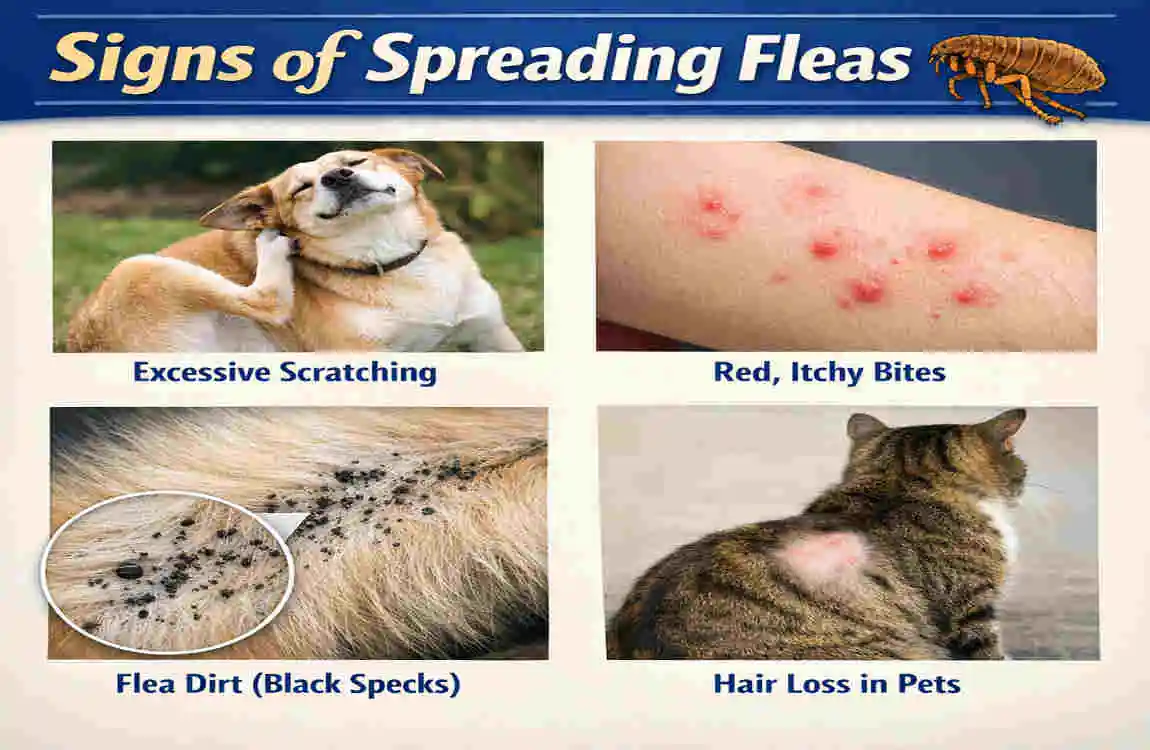
Because how fast fleas spread in the house is measured in days, catching the signs early is critical. Do not wait until you are covered in bites. You need to be a detective in your own home.
The “Salt and Pepper” Sign
Check your pet’s bedding or where they sleep most often. If you see tiny white grains (eggs) mixed with tiny black specks (flea dirt), you have an active infestation. The black specks are dried blood.
- The Water Test: If you aren’t sure if a black speck is dirt or flea poop, place it on a wet paper towel. If it dissolves into a rusty red or brown smear, it is flea dirt (digested blood).
The Ankle Itch
Fleas tend to live in carpets and floorboards. When humans walk by, newly emerged adults trigger their jump reflex. Because they can jump about a foot high, they typically land on their ankles and lower legs. If you notice sudden, small, red, itchy bumps around your socks, the floor is likely infested.
Pet Behavior Changes
Your pets are your first line of defense. Look for:
- Suddenly, frantic biting at the base of the tail or inner thighs.
- Restlessness or inability to get comfortable.
- “Flea Allergic Dermatitis”: Some pets are highly allergic to flea saliva. A single bite can cause hair loss, scabs, and severe redness.
The White Sock Test
This is a simple, proactive way to test for spread. Put on a pair of knee-high white socks and shuffle your feet across the carpet in suspect rooms (the living room and bedrooms). Walk slowly. The vibration and heat simulate a host. If you have fleas, they will jump onto the socks. The dark fleas will be instantly visible against the white fabric.
Why Clean Houses Get Infested
It is a massive source of frustration: “I clean every weekend! How did this happen?”
We need to bust the myth that fleas are a sign of a dirty home. Fleas are parasites; they are biological hitchhikers. They do not care if your floors are Italian marble or old shag carpet; they only care that there is a warm body nearby.
Common Entry Points
Your home is a fortress, but the drawbridge is often down.
- Visitors: A friend bringing their dog over for a playdate can introduce fleas.
- You: Yes, you. If you go hiking or walk through tall grass, a flea can jump onto your shoe or pant cuff and ride into your living room.
- Wildlife: Raccoons, opossums, and stray cats wandering through your yard drop flea eggs. You or your pet then tracks those hatched fleas inside.
- The Vet or Groomer: Ironically, places where animals congregate are hotspots for flea transmission.
The Cleanliness Paradox: In a messy house, people might expect bugs. In a clean house, people let their guard down. They might not use preventative medicine because they think their environment protects them. This false sense of security allows the infestation to take root unnoticed, accelerating the spread of fleas in the house because no one is looking for them.
Immediate Solutions: Stopping the Spread
You have confirmed the fleas are there. Now you need to go to war. Speed is your ally here. You cannot treat just the pet or just the house; you must treat everything simultaneously.
The Great Vacuuming (Daily)
Vacuuming is your most powerful mechanical weapon. It does two things: it sucks up adults, eggs, and larvae, and the vibration/heat encourages pupae to hatch prematurely (so you can suck them up, too).
- Focus Areas: Don’t just do the center of the room. Use the crevice tool on baseboards, under furniture, and in sofa cushions.
- The Bag Rule: If you use a canister vacuum, empty it into a trash bag outside immediately. If you leave the dust in the vacuum, the fleas will crawl back out.
The Hot Wash
Gather every piece of fabric that your pet has touched. Bedding, throw blankets, pillow covers, and even your own bed sheets.
- Wash them in water that is at least 140°F. This heat is necessary to kill all stages of the lifecycle.
- Dry on the highest heat setting.
Treat the Host (The Pet)
You must stop the food source. Consult your veterinarian for the best immediate-kill product.
- Oral Medications: These work fast, often killing adult fleas on the pet within 4 hours.
- Topical Drops: These provide lasting protection.
- Flea Combs: For immediate relief, use a flea comb dipped in soapy water to physically remove fleas from your pet’s coat.
Environmental Treatments
For the house, you may need to use insect growth regulators (IGRs).
- Sprays vs. Foggers: Directed sprays are generally better than “flea bombs” (foggers). Foggers essentially throw pesticide into the air, which lands on surfaces but fails to penetrate deep into carpet fibers or under furniture where larvae hide.
- Natural Aids: Diatomaceous Earth (Food Grade): This powder works by physically dehydrating fleas. Sprinkle it on carpets, let it sit for 24-48 hours, then vacuum. It cuts the flea’s exoskeleton.
- Salt: Finely ground salt also acts as a dehydration agent for eggs and larvae.
DIY Timeline: If you are diligent, you can usually knock back an infestation in 2 to 4 weeks. However, you will likely see “pop-up” fleas for weeks after treatment as the protected pupae hatch. This is normal—keep vacuuming!
Long-Term Prevention Strategies

Once the battle is won, you must secure the perimeter to ensure you never have to ask “how fast do fleas spread in the house” again.
Year-Round Prevention
The biggest mistake pet owners make is stopping flea prevention in the winter. As we discussed, your house is warm enough for fleas year-round. Keep your pets on a monthly preventative prescribed by your vet (chews or drops) 12 months a year. This turns your pet into a “dead end” for fleas.
Yard Defense
Your yard is the waiting room for fleas.
- Keep grass short: Fleas hate direct sunlight. Short grass exposes them to UV rays and heat, which kills them.
- Remove debris: Piles of leaves or wood are perfect hiding spots for flea-carrying rodents.
- Nematodes: Consider using beneficial nematodes in your garden. These are microscopic worms that eat flea larvae in the soil but are harmless to pets and plants.
Home Maintenance
Seal cracks in floors and baseboards where larvae can hide. If you have a serious recurring problem, consider replacing carpets with hard flooring, which is much less hospitable to flea reproduction.
When to Call the Professionals
Sometimes, despite your best efforts, the infestation wins. If you have been vacuuming and treating for more than two weeks and are still seeing the population increase, it is time to call in the cavalry.
Professional exterminators have access to stronger chemicals and, more importantly, Insect Growth Regulators (IGRs) that disrupt the life cycle more effectively than store-bought products. They can spray underneath furniture and into crevices you might miss.
- Cost: Expect to pay between $200 and $500, depending on the size of your home.
- Success Rate: Professional treatments usually have a success rate of over 95%, often coming with a guarantee that they will return if the fleas do.
FAQs
Q: How fast do fleas spread in the house without pets? A: While slower, it is possible. If you move into a home that previously had pets, dormant pupae can wake up months later. Also, rats or mice in your walls can bring fleas in. Without a host, they won’t reproduce effectively, but they can bite you for weeks before dying off.
Q: Can fleas spread in the winter? A: Absolutely. While they die outdoors in freezing temps, your heated home is a perfect sanctuary. Winter infestations are actually very common because people stop using preventative medicine.
Q: Do flea bombs actually work? A: Rarely on their own. They kill the adults in the open but often miss the larvae deep in the carpet and the pupae in their cocoons. They can also leave toxic residue on your countertops. Directed treatment (sprays + vacuuming) is superior.
Q: Can fleas live on humans? A: Generally, no. They will bite humans for a blood meal, but they cannot survive or reproduce on human skin as they do in animal fur. We aren’t hairy enough to hide them.