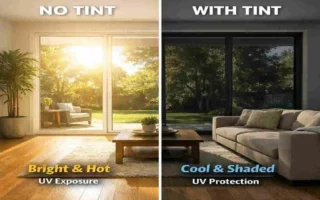
Are you tired of opening your electricity bill in the middle of summer and feeling your jaw drop? As we navigate through 2026, home improvement trends are shifting heavily toward energy efficiency, and for a very good reason. Rising energy costs are hitting homeowners hard. If you are looking for a smart, effective way to keep your home cool without running your air conditioner into the ground, you are in the right place. Did you know that applying the right protective film to your glass can slash your cooling bills by up to 30%? It is an incredible upgrade that pays for itself over time.
It is the first thing every homeowner wants to know. To give you a quick preview, the average homeowner in 2026 spends between $316 and $941 on a standard residential tinting project. However, prices can fluctuate based on the size of your home, the specific materials you choose, and where you live. Beyond financial savings, tinting offers significant benefits, such as blocking harmful UV rays, increasing your family’s daytime privacy, and eliminating that annoying glare on your television screen.
| Category | Average Cost Range | Notes/Details |
|---|---|---|
| Per Square Foot | $6–$15 | Includes materials + labor; standard homes avg. $8–$12. |
| Per Window (6 sq ft) | $30–$114 | Smaller panes cheaper; skylights up to $19/sq ft. |
| Small Home (10 windows) | $500–$1,000 | 1,000–1,500 sq ft total glass. |
| Medium Home (15–20 windows) | $800–$2,000 | Most common; adds $612 avg. project. |
| Large Home (25+ windows) | $2,000–$5,000+ | Multi-story or custom shapes extra 20–30%. |
Average House Window Tinting Costs
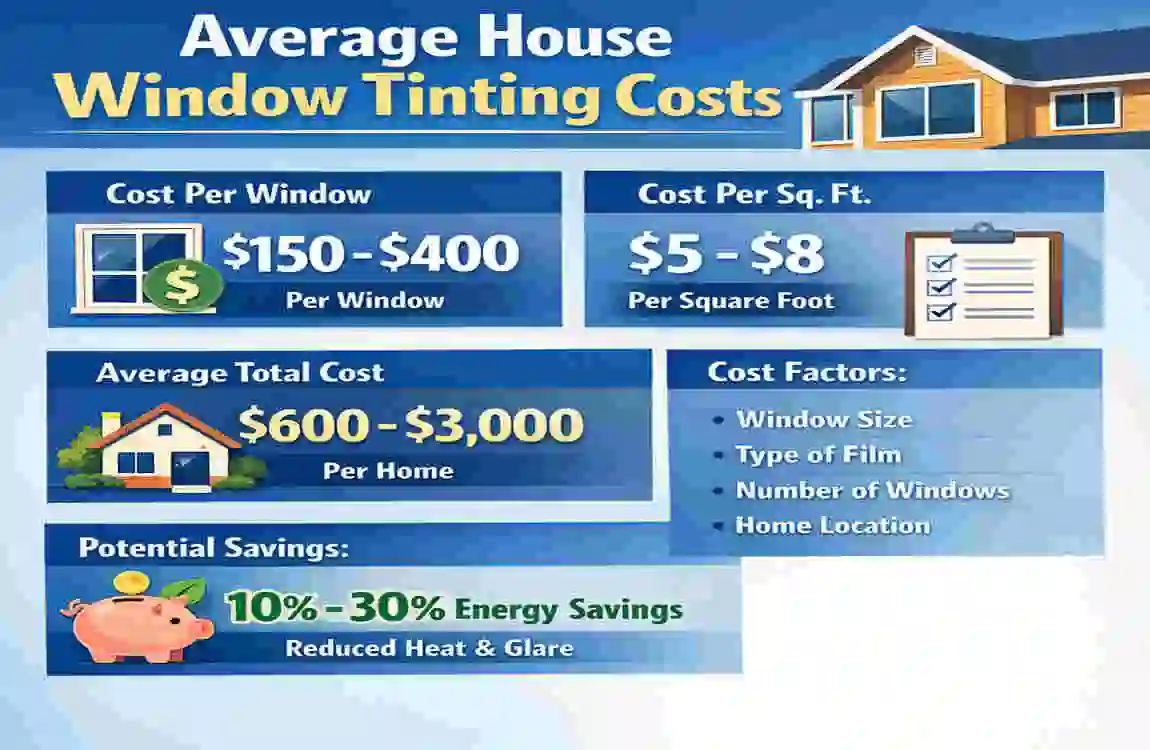
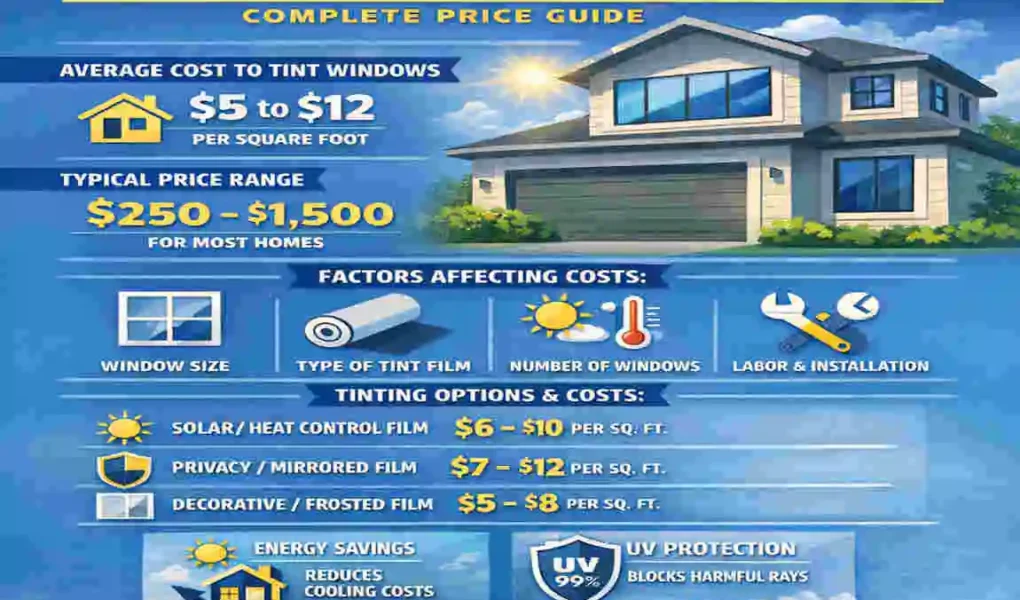
When you start budgeting for this project, it helps to review national averages. In 2026, the general cost to tint home windows ranges from $6 to $15 per square foot, fully installed. If you have an average-sized home with about 10 to 20 windows, you can expect your total project to land somewhere between $500 and $1,200.
Of course, the total residential window tinting prices will scale up or down depending on the exact footprint of your property. Let’s break down what you might expect to pay based on the size of your house:
- Small Homes (approx. 1,000 sq ft): If you live in a cozy bungalow or a smaller townhome, you have fewer windows to cover. You will likely spend between $300 and $800 for a full installation.
- Medium Homes (approx. 1,500 to 2,500 sq ft): For a standard three-bedroom suburban house, the window count increases. Expect to budget between $800 and $2,000 to protect the entire house fully.
- Large Homes (approx. 3,000+ sq ft): If you have a sprawling estate, custom architecture, or a home with massive sunrooms, your costs will reflect that luxury. Large projects typically run from $2,000 up to $5,000 or more.
The Cost Per Window
Sometimes it is easier to think about the project one room at a time. If we break the house window tinting cost down to a per-pane basis, you are looking at roughly $30 to $114 per standard window. A standard residential window is usually around 6 square feet. If you want to tint the two windows in your home office to stop the afternoon sun from blinding you, you might only spend a hundred bucks!
DIY vs. Professional Installation
You might be wondering if you can tackle this job yourself over the weekend. If you go the Do-It-Yourself (DIY) route, the window film cost per sq ft drops significantly to just $2 to $5 for the raw materials.
However, applying film to glass is an incredibly tedious process. It requires immense patience, a perfectly dust-free environment, and a steady hand. If you make a mistake, you will end up with ugly air bubbles, hard creases, and peeling corners. Hiring a professional is an investment in peace of mind. A seasoned installer knows how to adapt their style and approach to each unique assignment and glass type [[9]].
Regional Price Variations
Where you live plays a major role in the final bill. High-cost-of-living areas naturally carry higher labor rates. To give you a clear picture, here is a look at how prices vary across different regions, adjusted for 2026 inflation, including our special local estimates:
- US National Average: $6 – $15 per sq ft
- Major Urban Cities (New York, LA): $10 – $18 per sq ft
- Rural US Areas: $5 – $10 per sq ft
As you can see, local labor rates drastically alter the final price tag.
Cost Factors Affecting House Window Tinting
So, why does your neighbor pay $800 while you get quoted $1,200? The final price tag for your home tint installation depends on several specific cost factors. Let’s explore the primary variables that installers use to calculate your quote.
Window Count and Size
This is the most obvious factor. More glass means more material and more time. However, it is not just the sheer number of windows; the size and shape matter immensely. Standard double-hung windows are quick and easy to treat. On the other hand, massive, floor-to-ceiling picture windows require oversized rolls of specialty film and usually take two technicians to install safely. Tinting a large picture window alone can cost between $400 and $1,200.
Home Layout and Accessibility
How hard is it for the technician to physically reach your windows? If you live in a single-story home where every window is accessible from the ground, your labor costs stay low.
But if you have a stunning two-story home with gorgeous skylights on a vaulted ceiling, the installers will need to bring in tall ladders, scaffolding, and safety harnesses. This added danger and time usually results in a 20% to 30% increase in labor costs. The harder the glass is to reach, the more you will pay.
Removal of Old Tinting
Are you upgrading an old, bubbling, purple-looking film installed decades ago by a previous owner? Before the new film can go on, the old film must be completely removed. Removing old adhesive from glass without scratching the pane is a meticulous, time-consuming chore. Technicians have to use razor blades, heat guns, and harsh chemical solvents. You can expect to pay an additional $1 to $3 per square foot for the removal process.
Quick Reference: Cost Factors Table
To make this simple, here is a breakdown of how different factors impact your final quote:
FactorCost ImpactExample
Window Size & Shape +$5 – $10 / sq ft Skylights and custom arches cost up to $19/sq ft because they require custom cutting.
Home Stories +15% – 25% labor A 2-story house incurs a surcharge due to scaffolding and ladder requirements.
Geographic Location Varies 10% – 20% Hiring a company in a bustling urban city costs more than in a quiet rural town.
Old Film Removal +$1–$ 3/sq ft Labor-intensive scraping of baked-on adhesive increases on-site hours.
When an expert plans your installation, they evaluate all these structural elements to provide a customized, accurate quote, ensuring they understand the brief and the exact content of the job required.
Types of Window Tinting for Houses
Not all window films are created equal. The technology you choose will significantly influence both the performance and the cost of your project. Let’s compare the most popular residential window films available on the market today so you can choose the perfect fit for your family.
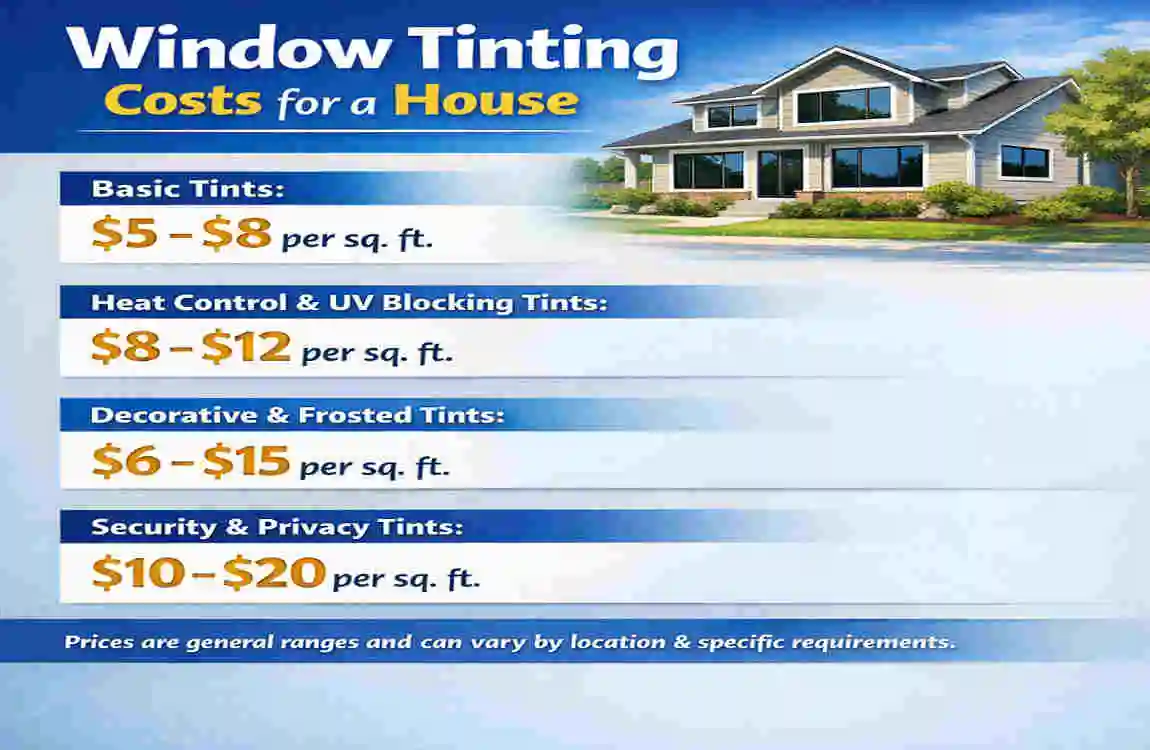
Non-Reflective Film (Dyed Film)
If you are on a strict budget and your primary goal is to darken a room and gain a little daytime privacy, non-reflective dyed film is your best bet. This film absorbs the sun’s heat rather than reflecting it away.
- Cost: $6 to $7 per square foot.
- The Verdict: It is fantastic for budget homes, but it doesn’t reject heat nearly as well as advanced films.
Ceramic Window Film
Welcome to the gold standard of 2026 window tinting. Ceramic films use microscopic nano-particles to block out heat and UV rays. The best part? They do not look dark or reflective. You can apply a nearly clear ceramic film to your windows and still reject up to 80% of the sun’s infrared heat.
- Cost: $7 to $12 per square foot.
- The Verdict: While it costs slightly more upfront, it is the absolute best choice for massive energy savings and keeping your home bright and airy.
security and Safety Film
Do you live in an area prone to severe storms, hurricanes, or, unfortunately, high crime? Security film is much thicker than standard tint. While it won’t prevent glass from breaking if a burglar hits it with a brick, it will hold the shattered glass firmly in place in the frame, making it incredibly difficult for an intruder to enter your home.
- Cost: $8 to $15 per square foot.
- The Verdict: Essential for first-floor windows in high-crime neighborhoods or areas with extreme weather.
Frosted and Decorative Film
Sometimes you need privacy without losing natural light. Frosted films mimic the look of expensive sandblasted glass. You will commonly see these applied to bathroom windows, glass shower doors, or glass panels on front entry doors.
- Cost: $6 to $13 per square foot.
- The Verdict: Perfect for bathrooms and interior glass partitions where you want style and complete privacy day and night.
Smart Film (PDLC Technology)
If you are upgrading a luxury home and want the ultimate “wow” factor, you need smart film. By hooking this film up to a small electrical current, you can use a remote control or a smartphone app to instantly switch the glass from completely transparent to completely frosted opaque in less than a second.
- Cost: $20 to $45 per square foot.
- The Verdict: Very expensive, but provides unbeatable futuristic luxury and on-demand privacy.
Quick Comparison Table: Which Film is Right for You?
TypeCost / Sq FtKey BenefitsBest For Houses
Non-Reflective $6 – $7 Basic UV protection & glare reduction—budget-conscious homes.
Ceramic $7 – $12 Blocks 50–80% of heat while staying clear. Maximizing energy savings.
Security $8 – $15 Prevents glass from shattering inwards—high-crime or storm areas.
Frosted $6 – $13 24/7 privacy while letting light in. Bathrooms and front doors.
Smart Film $20–$45 Remote-control instant privacy. High-end luxury homes.
Labor and Installation Costs
Let’s talk about the people doing the hard work. When you hire a professional company, a significant portion of your bill goes directly to labor. In the US, professional installation labor typically costs between $3 and $8 per square foot. For an average project, you can expect the labor alone to account for roughly $612 of the total bill.
Professionals use a blended approach to completing the job, combining specialized chemical slip-solutions with high-quality squeegees to ensure the installation is cost-effective while maintaining strict professional standards [[6]].
The Step-by-Step Installation Process
So, what exactly are you paying these professionals to do? It is a multi-day, highly detailed process.
- The Site Visit: The team arrives to meticulously measure every pane of glass and verify the type of window frame.
- The Deep Clean: This is the most important step. Installers use special non-ammonia cleaners and specialized scrapers to remove invisible sap, paint specks, and dust from the glass. Even a single dog hair will look massive under a sheet of tint.
- The Application: The technician sprays a soapy slip-solution onto the glass, lays the precision-cut film onto the pane, and meticulously squeegees the water out from behind the film.
- The Curing Time: Once they leave, the windows will look slightly cloudy or bubbly. Don’t panic! It takes about 2 to 4 days for the remaining moisture to evaporate completely. Once cured, the finish is flawless.
Why Hire Certified Professionals?
It is tempting to save money, but hiring certified pros offers significant benefits. First, they guarantee a bubble-free, perfectly aligned finish. Second, and most importantly, professional installers offer extensive warranties. Many top-tier films come with a lifetime warranty against peeling, cracking, and turning purple—but only if installed by an authorized dealer. A good installer will identify potential issues with your glass before they start, much like a skilled editor identifies grammar and spelling errors to deliver a flawless final piece.
Savings and ROI from House Window Tinting
Let’s shift our perspective. Instead of viewing window tinting as an expense, consider it a high-yield investment. How much money does window tinting save a house? The answer is substantial.
When you apply a high-quality ceramic or reflective film to your home, you dramatically reduce the “greenhouse effect” taking place in your living room. By blocking the solar heat from ever entering the glass, your air conditioning unit doesn’t have to work nearly as hard.
Homeowners typically see a 20% to 30% reduction in their summer energy bills. Depending on your local utility rates, this translates to saving roughly $200 to $500 every single year. Because of these incredible savings, most house window tinting projects completely pay for themselves within a short payback period of just 2 to 5 years. After that, the money you save stays right in your pocket!
Protecting Your Interior Valuables
The financial return on investment (ROI) goes beyond just your electricity bill. The sun’s UV rays are incredibly destructive. Over time, UV radiation bleaches your expensive hardwood floors, fades your luxury Persian rugs, and destroys the upholstery on your couches. By blocking 99.9% of these harmful rays, window film acts like sunscreen for your house, adding years of life to your expensive interior decor.
Tax Credits
Furthermore, governments are actively encouraging homeowners to go green. In many regions throughout 2026, installing energy-efficient window films qualifies you for specific home improvement tax credits. Be sure to ask your tax professional how you can write off a portion of your installation costs!
A Quick Case Study
Consider a family living in a standard 1,500 sq ft suburban home facing the harsh western afternoon sun. They spent $1,100 installing ceramic tint on their hottest windows. By letting their AC unit rest, their summer power bills dropped by $100 a month. Over a four-month summer season, they saved $400 annually. In less than 3 years, the project paid for itself entirely! Creating this kind of valuable, relevant solution for your home is exactly what a successful project is all about.
How to Get Accurate Quotes for Your House
Are you ready to find out exactly what your project will cost? Getting an accurate quote is easy if you follow a few simple steps.
Measure Your Square Footage. You don’t need to be perfectly exact, but having a rough estimate helps immensely when calling contractors. Grab a tape measure. Measure the width and the height of the visible glass on a window in inches. Multiply those two numbers together, and then divide by 144. That gives you the square footage of that window. Do this for every window you want tinted and add them up.
Get Three Bids. Never settle for the first price you hear. Call three highly rated local installation companies and request formal estimates based on your measurements. This ensures you are paying a fair market rate and allows you to compare the different brands of film they offer.
Check Reviews and Warranties. The cheapest bid is rarely the best. Read their online reviews. Do they leave a mess? Do their films bubble after a year? Always ask to see their warranty policy in writing before you sign any contract.
Ready to start? If you are in the area, skip the hassle of calling around! Contact us today via our quick online form to get a free, no-obligation quote tailored specifically to your home.
Frequently Asked Questions (FAQs)
We know this is a lot of information to absorb. To help clarify everything, we have gathered the most common questions homeowners ask when researching residential window tinting prices.
How much does window tinting cost for a house?
On average across the nation, you can expect to pay between $6 and $15 per square foot for a professional to install window tint on your house. For a typical home, the total bill generally falls between $500 and $1,200, depending on the house’s size and the Premiumfilm level.
Is house window tinting actually worth it?
Yes, absolutely. Beyond the immediate comfort of reducing harsh glare and blocking sweltering heat, window film offers a strong return on investment. It routinely lowers cooling costs by 30%, making the installation easily pay for itself within 2 to 5 years. It also protects your expensive furniture from sun fading.
Should I DIY my window tint or hire a professional?
While buying a $30 roll of film at a hardware store may seem tempting, we strongly advise against the DIY route. Applying film without causing creases, trapping dust, or creating ugly air bubbles requires specialized tools and years of practice. Hiring a professional guarantees a flawless look and often includes a lifetime warranty.
Will window tinting make my house too dark?
Not unless you want it to! This is a very common misconception. While you can buy dark “limo tint” for your house, most modern homeowners choose high-tech ceramic films. These advanced films reject massive amounts of heat and UV rays while remaining almost completely transparent, keeping your rooms bright and full of natural light.
How long does residential window tint last?
When installed professionally on the interior side of the glass, high-quality residential window films are incredibly durable. You can reasonably expect them to last between 15 and 20 years, and sometimes even longer, before showing any signs of peeling or fading.
Can I clean my tinted windows normally?
You can clean them, but you must change your cleaning products. You should never use harsh chemicals, abrasive sponges, or cleaners containing ammonia (like standard Windex) on tinted windows, as ammonia will eat away at the film. Use a soft microfiber cloth and a mixture of mild baby shampoo and water.
Will window tint ruin my double-pane windows?
It can, if you use the wrong type of film. Double-pane (dual-pane) windows trap gas between two pieces of glass. If you apply a dark, heat-absorbing dyed film to the inside, the glass can overheat, causing the internal seals to blow out or the glass to crack from thermal stress. Always consult a professional who will select a “dual-pane safe” reflective or ceramic film.
Does house tinting provide privacy at night?
Standard solar control films act like mirrors; they reflect light from the side with the most light. During the day, the sun is brighter than in your living room, so outsiders cannot see in. However, at night, when it is dark outside, and your living room lights are turned on, the effect reverses. People outside will be able to see in. If you want 24/7 privacy, you need to install a frosted decorative film.
What is the best window tint for heat reduction?
Nano-ceramic window film is universally considered the best option for rejecting heat. It blocks up to 80% of infrared heat without relying on dark dyes or highly reflective mirrored finishes.
Are there tax credits for house window tinting in 2026?
Yes! In an effort to reduce strain on local power grids, many regions offer energy efficiency tax credits for homeowners who install specific types of solar-blocking window films. Check with your local municipality or a tax advisor to see exactly what rebates you qualify for this year.
How do I remove old, bubbling window tint?
Removing old tint is a messy job. You need to use a razor blade to lift a corner, gently peel the plastic layer off, and then deal with the crusty adhesive left behind. You will need to soak the window in an adhesive remover or soapy water and painstakingly scrape the glass clean with a straight razor.