What Style Is My House? Ultimate Quiz & Guide to Identify Your Architecture
ARCHITECTURE

What Style Is My House? Ultimate Quiz & Guide to Identify Your Architecture

You are definitely not alone. Millions of homeowners stand on their front lawns every year, scratching their heads, trying to figure out if those columns are “Colonial” or “Greek Revival,” or if that low roofline makes their home a “Ranch” or a “Mid-Century Modern.” It’s a common puzzle, but solving it unlocks a world of potential for your property.

Here is a surprising statistic for you: According to industry surveys, roughly 80% of homeowners cannot accurately name their home’s architectural style. That is a huge number of people living in mystery! But why does it matter? Well, knowing your home’s pedigree isn’t just about trivia—it is the secret sauce to smarter renovations, better curb appeal, and preserving the value of your biggest investment.

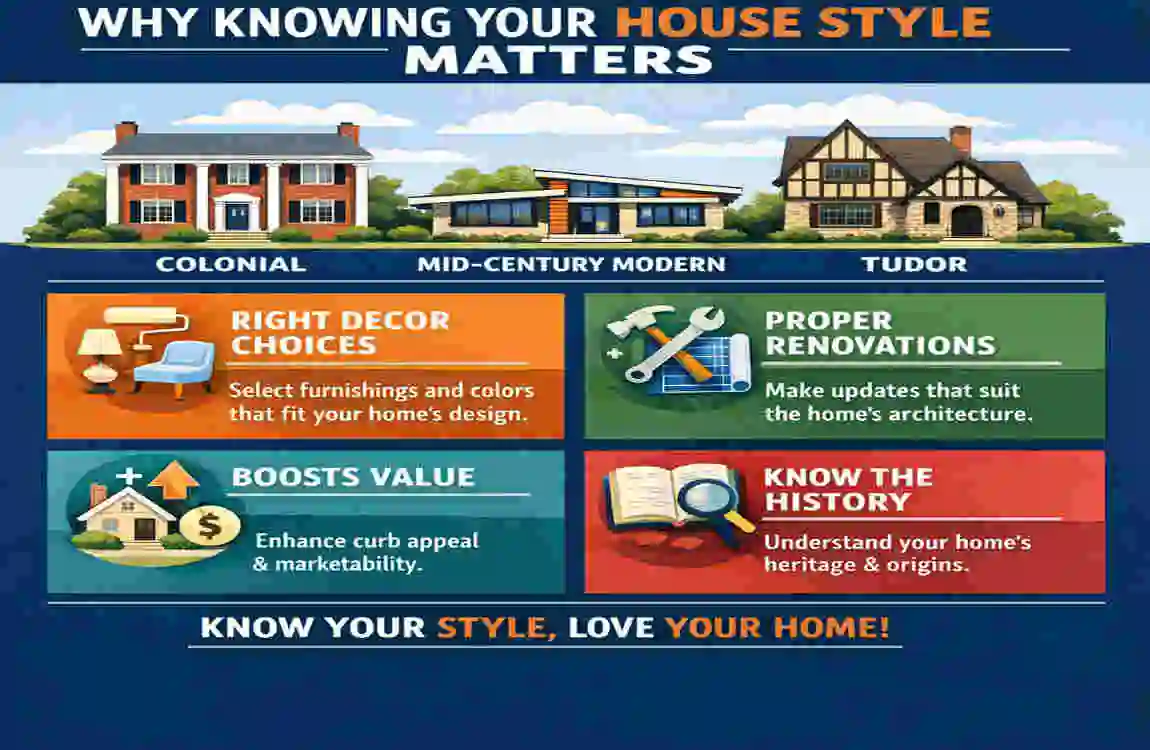
Why Knowing “What Style Is My House” Matters for Homeowners

What Style Is My House? Ultimate Quiz & Guide to Identify Your Architecture

You might be thinking, “Who cares what the label is as long as the roof doesn’t leak?” While a sturdy roof is priority number one, understanding your home’s style influences almost every decision you make regarding maintenance and decoration.

Boosting Curb Appeal and Resale Value

Real estate is all about first impressions. When you understand your architecture, you can make landscaping and paint choices that highlight your home’s best features rather than fighting against them. For example, market data suggests that distinct styles, such as true Craftsman homes, can sell 10% faster when marketed correctly with the right terminology. Buyers love knowing exactly what they are getting.

Smarter Renovation Decisions

This is the big one. We have all seen that house in the neighbourhood—the beautiful Victorian that someone slapped a modern, glass-box addition onto. It looks disjointed and awkward. When you ask, “What style is my house?” you are essentially asking for the renovation rulebook. Knowing your style helps you choose windows, doors, and trim that blend seamlessly, preventing costly aesthetic clashes that hurt property value.

Connecting with History

Every house has a story. Your home might be part of the post-WWII housing boom (hello, Ranch style!) or a callback to the nation’s founding (Colonial Revival). Understanding the history gives you a deeper appreciation for the quirks and charms of your space.

Quick Wins From Identifying Your Style:

  • Paint Colours: You will know exactly which historical palettes work (e.g., earthy tones for Craftsman, pastels for Victorians).
  • Fixture Shopping: You won’t waste money on lighting that looks out of place.
  • Furniture Placement: You will understand the architect’s intended flow.
  • Landscaping: You can match your garden to the home’s era.
  • Resale Marketing: You can write a listing description that attracts specific buyers looking for your style.

The Ultimate “What Style Is My House?” Quiz: Identify Your Architecture in 2 Minutes

Okay, let’s get to the fun part. You want an answer to “What style is my house?” right now.

While I can’t see your house from here, we can narrow it down significantly by looking at the “bones” of the structure. Grab a pen and paper, or keep a mental tally of your answers. Look at the exterior of your home and answer these 10 questions.

The Quiz

Look at your roof. What shape is it?

  • A) Steep, pitched, maybe with some gables (triangles).
  • B) Very low slope, almost flat, or wide overhanging eaves.
  • C) Complex, steep, perhaps a tower or turret, or a Mansard (dual pitch).
  • D) Symmetrical gable (triangle) on the sides.

 Is your house symmetrical? (If you drew a line down the middle, do the sides match?)

  • A) Yes, perfectly symmetrical.
  • B) No, it’s asymmetrical and spread out.
  • C) No, it’s asymmetrical with different shapes and wings.
  • D) Yes, usually very boxy and balanced.

 What do the windows look like?

  • A) Multi-pane, double-hung windows (often with shutters).
  • B) Large picture windows, glass walls, or sliding glass doors.
  • C) Tall, narrow, sometimes arched or with stained glass.
  • D) Small, sometimes with diamond patterns.

What is the primary exterior material (siding)?

  • A) Wood clapboard or brick.
  • B) Wood, stone, or stucco mixture.
  • C) Patterned shingles, fancy, colourful paint, or brick.
  • D) Stucco with timber framing (wood beams).

Do you have a porch?

  • A) Small covered entry or a full porch with columns.
  • B) A patio or courtyard, but not a traditional front porch.
  • C) A large wrap-around porch with detailed woodworking.
  • D) A recessed entry or small stoop.

What about columns?

  • A) Yes, grand columns or simple pillars.
  • B) Minimal or non-existent.
  • C) Yes, turned posts with fancy brackets.
  • D) Heavy timber posts or none.

When was the house likely built?

  • A) 1700s–1900s (or a modern revival of this).
  • B) 1945–1980s.
  • C) 1840s–1910.
  • D) 1900–1940.

How many stories is the house?

  • A) Two or three stories.
  • B) One story (mostly).
  • C) Two or three stories, looming tall.
  • D) One and a half or two stories.

Does the house have a garage?

  • A) Detached or added later.
  • B) Attached, prominent, often facing the street.
  • C) Originally a carriage house (detached).
  • D) Detached.

What is the overall “vibe”?

  • A) Formal, traditional, solid.
  • B) Casual, open, connected to nature.
  • C) Romantic, ornate, detailed.
  • D) Cosy, handcrafted, storybook.

Interpreting Your Results

  • Mostly A’s: You likely have a Colonial Revival, Federal, or Cape Cod. These are the traditional American standards known for symmetry.
  • Mostly B’s: You are living in a Ranch, Mid-Century Modern, or Contemporary home. These prioritise horizontal lines and indoor-outdoor living.
  • Mostly C’s: You have a Victorian, Queen Anne, or Italianate home. It’s all about drama, height, and detail.
  • Mostly D’s: You might be in a Tudor, Craftsman, or Bungalow. These styles emphasise cosy, handcrafted charm.

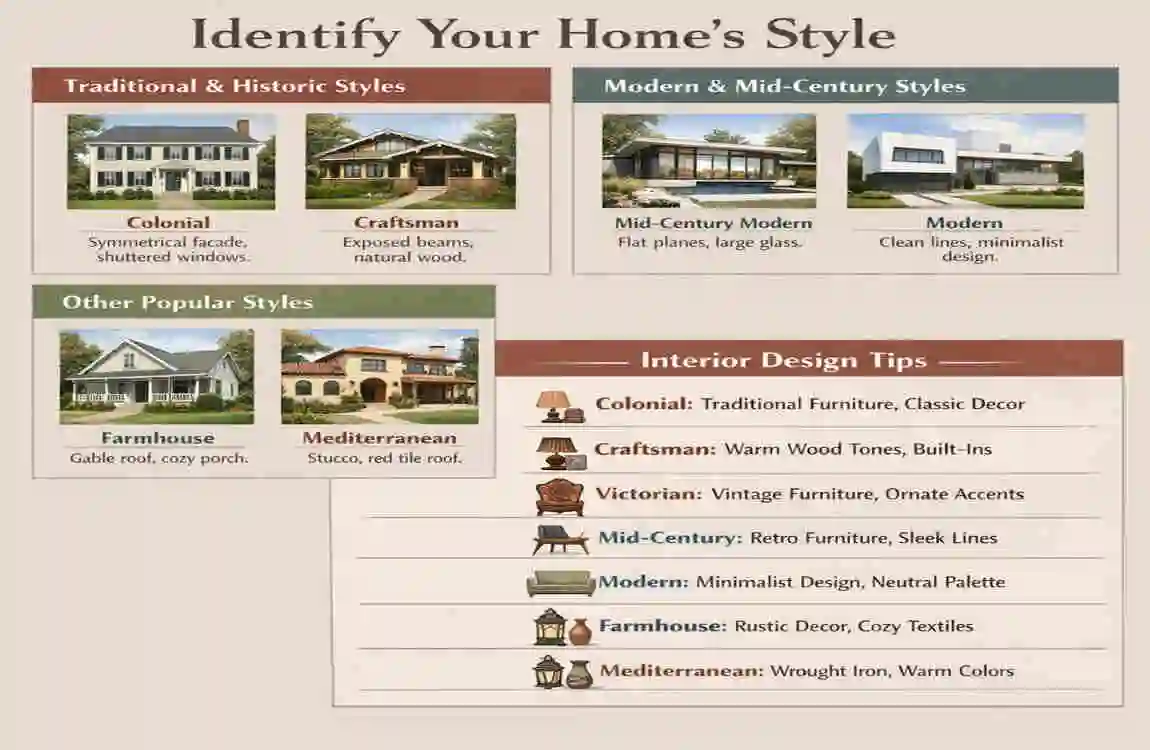
Quick Visual Cheat Sheet: Spot “What Style Is My House?” at a Glance

What Style Is My House? Ultimate Quiz & Guide to Identify Your Architecture


Still unsure? Sometimes a quick visual check is all you need to solve the “What style is my house?” riddle. Use this table to compare your home’s features against the heavy hitters of home design.

Style Roof Shape Windows Signature Feature Common Era

Colonial Gable (Triangle) Double-hung, Symmetrical Centred front door with columns 1600s–1800s (Revivals continuously)

Victorian Steep, irregular, Tall, Arched, Bay Turrets, wrap-around porches, trim 1840s–1900s

Craftsman Low-pitched Gable Wide trim, grouped Tapered columns on deep porch 1905–1930

Tudor Steep, Cross-Gable Tall, narrow, leaded Decorative “half-timbering” 1890s–1940s

Ranch Low, long, Large picture windows , Single-story sprawling layout , 1945–1980s

Mid-Century Flat or Angled Floor-to-ceiling glass Integration with nature/atrium 1945–1965

Cape Cod Steep Gable Dormers on the roof , Central chimney, rectangular 1600s–1950s

Mediterranean Low, tiled Arched Stucco walls, red tile roof 1920s–Present

Pro Tip: Go outside right now and snap a photo of the front of your house. Compare the roofline in your photo to the descriptions above. The roof is often the single biggest giveaway!

Detailed Guide: 12 Popular House Styles to Identify “What Style Is My House?”

If you really want to drill down and say, “I know exactly what style my house is,” we need to look at the specific DNA of these designs. Here is your expert guide to the 12 most common styles you’ll encounter.

Colonial Revival: Symmetrical Elegance

This is one of the most popular home styles in the United States. If your house looks like a child’s drawing of a house—a rectangle box, a door in the middle, windows balanced on either side—it’s probably Colonial. It conveys a sense of formality and tradition.

    • Key Features: Symmetrical facade (what happens on the left happens on the right).
    • Rectangular shape with two or three stories.
    • Brick or wood clapboard siding.
    • Grand entryway with pilasters (flat columns) or a pediment (triangle) over the door.
  • Renovation Tip: Never remove the shutters! Or if you do, replace them with properly sized ones. Colonial homes rely on shutters for visual balance.

Victorian: Ornate and Eclectic

“Victorian” actually refers to an era (the reign of Queen Victoria), not a single architectural style, but, generally, these homes are the “dollhouses” of the block. They are complex, colourful, and asymmetrical. If your house has a lot of personality and perhaps a ghost or two, it fits here.

    • Key Features: Steep, complex rooflines.
    • Decorative trim (gingerbread) along the eaves.
    • Vibrant, multi-colored paint schemes.
    • Bay windows and towers/turrets.
  • How to Spot It: Look up. If the roof has multiple peaks and the trim looks like lace made of wood, you’ve found a Victorian.

Craftsman / Bungalow: Cosy Handcrafted Charm

Born out of the Arts and Crafts movement, this style was a rebellion against the stuffy Victorians. These homes are all about honest materials, hand-workmanship, and cosiness. They are massively popular today for their warm, inviting vibe.

    • Key Features: Low-pitched gable roofs with wide, overhanging eaves.
    • Exposed roof rafters (look under the roof edge).
    • Large front porches supported by thick, tapered columns.
    • Use of stone and wood shingles.
  • Modern Twist: Many modern “farmhouses” borrow heavily from Craftsman designs, specifically the porch structures.

Tudor: Storybook Half-Timbering

Do you feel like you are walking into a fairytale or an English country manor? That’s the Tudor style. They were incredibly fashionable in the 1920s and 30s in affluent suburbs. They are sturdy, masonry-heavy homes.

    • Key Features: Decorative half-timbering (wood strips set into stucco).
    • Steeply pitched roofs with prominent cross-gables.
    • Massive, elaborate chimneys (often on the front).
    • Tall, narrow windows with multiple small panes.
  • Renovation Tip: Avoid painting the brick or stone. The contrast between the masonry and the wood details is what makes this style sing.

Ranch: Single-Story Suburban Icon

If you ask, “What style is my house?” and you live in a subdivision built between 1950 and 1980, the answer is almost certainly Ranch (or “Rambler”). Designed for the automobile age, these homes are wide and low.

    • Key Features: Single-story living (no stairs!).
    • Long, low-pitch roofline.
    • Attached garage.
    • Large picture windows facing the street.
    • Sliding glass doors open to a backyard patio.
  • Why It Works: It’s the ultimate “age-in-place” home because everything is on one level.

Mid-Century Modern: Sleek and Functional

Mid-Century Modern (MCM) is the cool older sibling of the Ranch. While they share a timeline, MCM homes are more experimental. They care about nature, geometry, and breaking the boundary between inside and outside. Think Mad Men style.

    • Key Features: Flat or angled/butterfly roofs.
    • Floor-to-ceiling glass walls.
    • Open floor plans.
    • Elevation changes (split-level).
  • How to Spot It: If your house looks like a geometric sculpture nestled into the landscape, it’s MCM.

Cape Cod: Compact New England Classic

The Cape Cod is the cosy cousin of the Colonial. Originally built to withstand stormy New England weather, it is a simple, sturdy design that is undeniably cute.

    • Key Features: Steep roof with side gables.
    • Usually 1.5 stories (the second floor has knee-walls).
    • Dormer windows protruding from the roof.
    • Central chimney.
    • Little to no exterior ornamentation.
  • Renovation Tip: Adding a shed dormer to the back is a great way to gain space upstairs without ruining the classic front look.

Federal: Refined Early American

Federal style is very similar to Colonial, but more delicate and refined. It was popular in the early years of the United States (1780–1820). It’s basically a Colonial house that went to finishing school.

    • Key Features: Strict symmetry.
    • Fanlight (semi-circle window) over the front door.
    • Palladian windows (three-part windows).
    • Flat, understated surfaces.
  • How to Spot It: Look for the fanlight window above the door. That is the dead giveaway.

Greek Revival: Temple-Like Pillars

In the mid-19th century, Americans were obsessed with democracy and Greece. So, they started building houses that looked like Greek temples. These are grand, imposing homes.

    • Key Features: Gabled front entry with a pediment (triangle roof).
    • Heavy cornice lines (thick trim).
    • Columns! Often tall, white columns supporting a portico.
    • Painted white to mimic marble.
  • Vibe: “I am important and established.”

Italianate: Bracketed Overhangs

This style is tall, narrow, and elegant. It mimics the villas of Italy but was incredibly popular in American towns during the Victorian era.

    • Key Features: Low-pitched or flat roofs.
    • Wide, overhanging eaves with large decorative brackets.
    • Tall, narrow windows, often with curved tops.
    • Cupolas or belvederes (square towers) on top.
  • Spotting Tip: If you see “cornice brackets” (fancy supports under the roof edge) and tall skinny windows, it’s Italianate.

Queen Anne: Asymmetrical Towers

This is what most people picture when they hear “Victorian,” but it is actually a specific sub-style. It is the most elaborate of them all.

    • Key Features: Asymmetrical facade.
    • Round or polygonal towers.
    • Wrap-around porches with spindled detailing.
    • Textured shingles (fish scales) are used as siding.
  • Fun Fact: These were the first homes to really utilise mass-produced wood trim, allowing middle-class families to have “fancy” homes.

Contemporary: Open, Minimalist Lines

Contemporary is tricky because it changes. Currently, it refers to homes built from the 1970s to the present that emphasise eco-friendliness, unique shapes, and natural materials.

    • Key Features: Irregular, asymmetrical facade.
    • Strong geometric shapes.
    • Large windows for natural light.
    • Use of sustainable or industrial materials (metal, bamboo, recycled glass).
    • Minimal ornamentation.

Common Confusions: “What Style Is My House?” Mix-Ups Solved

What Style Is My House? Ultimate Quiz & Guide to Identify Your Architecture

Still scratching your head? Many homes are “mutts”—a mix of styles. Here are the most common mix-ups and how to tell them apart.

  • Colonial vs Cape Cod: Both are symmetrical. The difference is height. A Colonial is a full two stories high. A Cape Cod is 1.5 stories; the roof line starts just above the first-floor windows, and the upstairs rooms have slanted ceilings.
  • Craftsman vs Bungalow: This is a “square vs rectangle” situation. “Bungalow” refers to the size/layout (small, 1-1.5 stories). “Craftsman” refers to the architectural style/decor. You can have a Spanish Bungalow, but most Bungalows in the US are Craftsman style.
  • Modern vs Contemporary: People use these interchangeably, but they are different. “Modern” refers specifically to the Mid-Century Modern era (1940s-60s). “Contemporary” means “what is happening right now.” A house built in 2024 is Contemporary; a house built in 1955 is Modern.
  • Ranch vs Mid-Century Modern: All MCM homes are Ranches (mostly), but not all Ranches are MCM. A standard Ranch is simple and traditional. An MCM Ranch has funky roof angles, glass walls, and a specific “retro” aesthetic.

If your quiz results pointed you toward two different answers, check these distinctions to break the tie!

Regional Variations: “What Style Is My House?” Across the US

Where you live offers a huge clue to the answer. Geography dictates architecture because of climate and available materials.

  • The Northeast: You will see a dominance of Colonial, Cape Cod, and Federal styles. Wood siding is common here.
  • The South: Heat and humidity gave rise to Greek Revival (high ceilings for air circulation) and large porches. You will also see Shotgun houses in places like New Orleans.
  • The West/Southwest: The dry climate favours Spanish Revival, Mission, and Pueblo styles, with stucco walls and clay tile roofs to keep the interiors cool.
  • The Suburbs (Everywhere): The Ranch and the Split-Level conquer the suburbs from California to Pennsylvania.

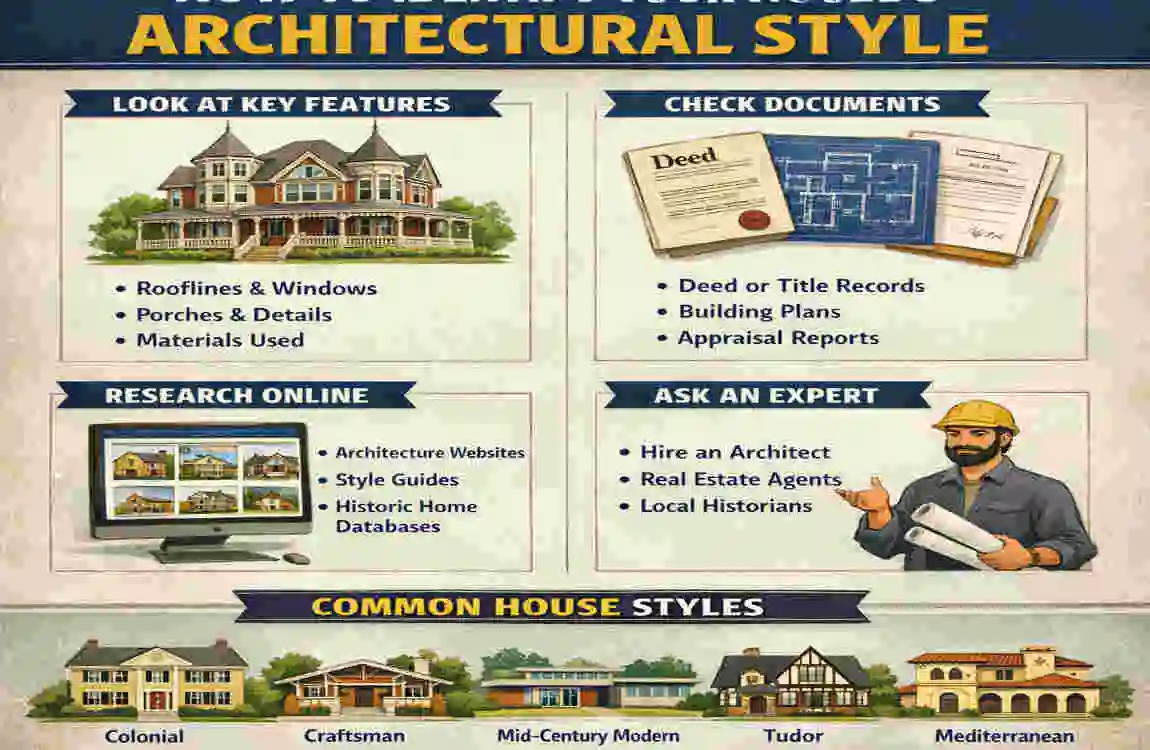
Tools & Next Steps: Confirm “What Style Is My House?” Like a Pro

What Style Is My House? Ultimate Quiz & Guide to Identify Your Architecture

You’ve taken the quiz, checked the cheat sheet, and read the guide. You are 99% sure you know the answer. How do you get to 100%?

  1. Use Technology: Apps like Houzz allow you to browse photos by style. Try searching your suspected style and see if the results match your home.
  2. Read the “Bible”: A Field Guide to American Houses by Virginia McAlester is the definitive book on this subject. If you are a house nerd, you need this book.
  3. Ask a Pro: If you are planning a renovation, hire an architect. You can find local pros on sites like Angi or Houzz who can not only identify the style but also tell you exactly which historical mouldings match it.

Frequently Asked Questions: What Style Is My House?

Q: How do I figure out what style my house is? A: The three easiest ways to identify your home’s style are to look at the roofline (steep vs. flat), the symmetry (balanced vs. asymmetrical), and the materials (brick, stucco, or wood). For example, steep roofs often indicate Victorian or Tudor styles, while low, flat roofs are signatures of Ranch or Mid-Century Modern homes.

Q: Can a house be more than one style? A: Yes, absolutely. This is very common and is often referred to as “Eclectic” or “Transitional.” Many homes built in the early 20th century combined elements, such as a Colonial shape with a Victorian porch. Additionally, if your home has been renovated over the decades, it likely holds a mix of architectural DNA.

Q: What is the difference between “Modern” and “Contemporary”? A: While used interchangeably in conversation, they mean different things in architecture. “Modern” refers to a specific time period (mostly the early to mid-20th century, like Mid-Century Modern). “Contemporary” refers to architecture being built now, in the current moment. Modern is a style; Contemporary is current.

Q: Is there an app to identify house styles? A: While there isn’t one single “Shazam for houses,” you can use Google Lens to snap a photo of your home and see visually similar results. Additionally, real estate apps like Houzz allow you to filter photos by style, which helps you visually match your home’s features to professional listings.

Q: Why is it important to know my house style? A: Knowing your style helps you make smarter renovation decisions. If you add a modern glass extension to a traditional Colonial home, it might clash and lower your property value. Identifying the style ensures you choose the right windows, doors, and landscaping to boost your curb appeal.

Q: What if my house is just a “regular” house? A: If your home doesn’t fit a fancy category, it is likely a “National” or “Folk” style (in the US) or a standard semi-detached/terrace (in the UK). These are vernacular styles built for function over fashion, utilizing local materials and simple layouts to house families efficiently. They are the backbone of the housing market!

You may also like...

Leave a Reply

Your email address will not be published. Required fields are marked *