Imagine stepping out of the blistering heat of midday into a cool, shadowed sanctuary. The air instantly changes. You hear the gentle trickle of a stone fountain, smell the earthy scent of rain on clay tiles, and feel the solid presence of thick, white stucco walls surrounding you. You are standing in the heart of a hacienda—specifically, its courtyard.
It is a style of architecture that feels timeless, romantic, and deeply connected to the land. But it begs a very specific historical question. If you look at a skyscraper, you might point to an architect like Le Corbusier or Frank Lloyd Wright. But when you look at these sprawling ranch homes, the answer isn’t so simple. Who created hacienda-style architecture?
Historical Roots: The Spanish and Moorish Foundations of Hacienda Style
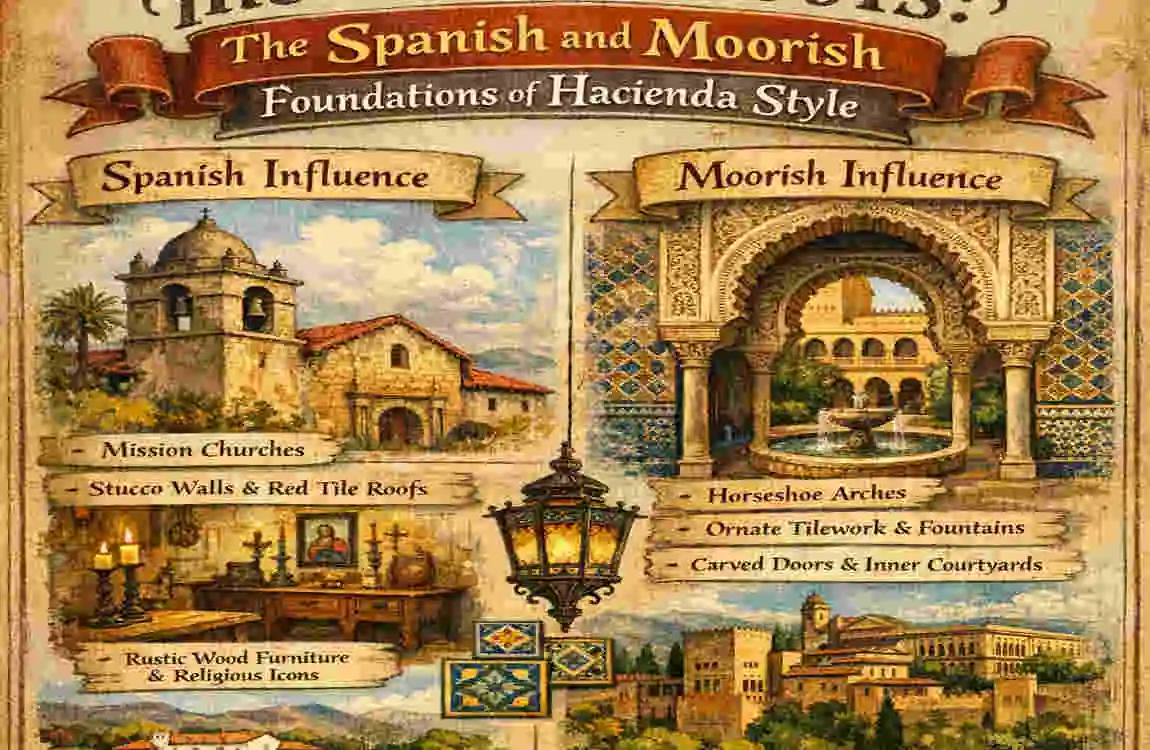
To truly understand who created hacienda-style architecture, we have to travel back in time, long before Spanish ships ever reached the shores of the Americas. The DNA of the hacienda home originated on the other side of the Atlantic Ocean.
The Influence of the Moors
The story begins with the Moors. For nearly 800 years (from the 8th to the 15th century), Islamic rulers dominated the Iberian Peninsula (modern-day Spain and Portugal). They brought with them a sophisticated architectural style born from the hot, arid climates of North Africa and the Middle East.
The Moors understood something crucial about living in the heat: privacy and shade were non-negotiable. They built their homes inward-facing. From the street, a house might look like a fortress with blank walls. But inside? It was a paradise.
The central courtyard, or patio, is the single most defining feature of hacienda architecture. The Moors utilized these open-air centers to capture cool air and circulate it through the surrounding rooms. They adorned them with fountains, not just for beauty, but to cool the air through evaporation—a primitive but effective form of air conditioning.
The Spanish Renaissance Connection
When the Christian Reconquista gradually retook Spain, they didn’t tear down these Moorish innovations. They adopted them.
By the 16th century, Spanish architecture was a melting pot. You had the Roman influence of the atrium, blended with the Moorish courtyard, mixed with the rising trends of the Spanish Renaissance. While there is no single “creator,” we can look to influential figures like Juan de Herrera.
Herrera was one of the architects responsible for the layout of El Escorial, the massive royal palace near Madrid. His work popularized a geometric, unornamented style emphasizing clean lines and functional courtyards. While he didn’t build haciendas in Mexico, the architectural language he helped codify—simple, strong, and centered around the patio—traveled with the colonists across the ocean.
Colonial Birth in Mexico: Where Hacienda Style Architecture Took Shape
The true birth of the “Hacienda” as we know it happened in the New World. Following the conquest of the Aztec Empire by Hernán Cortés in 1521, the Spanish Crown began distributing massive tracts of land to nobles, soldiers, and religious orders. These land grants were called haciendas.
But here is where the plot thickens. The Spanish settlers had a vision of what a house should look like (the styles they knew from Andalusia), but they had to build them in a completely new environment.
The Great Fusion: Spanish Design Meets Indigenous Craft
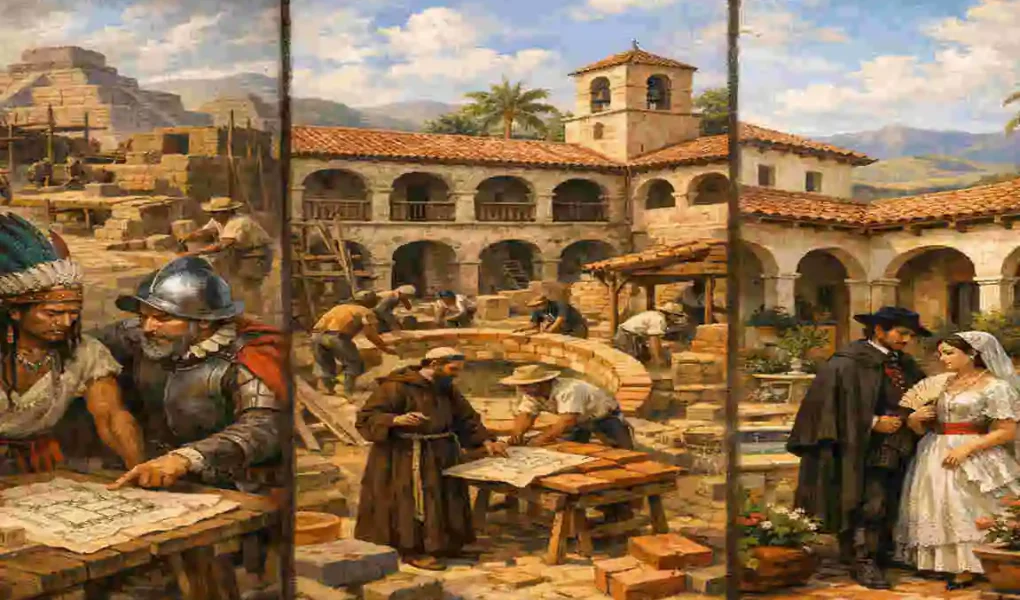
The Spanish colonists are often credited with creating these structures, but they could not have built them alone. The hands that actually built the hacienda homes belonged to the Indigenous people of Mexico—the Aztecs, the Maya, and other local groups.
This led to a fascinating architectural fusion:
- The Blueprint: The Spanish provided the layout. They wanted the central courtyard, the arched walkways (corridors), and the separation of family life from the ranch’s work.
- The Materials: The Indigenous builders used what they knew best. They didn’t have readily available stone quarries in every region of Europe. Instead, they used Adobe.
Adobe is a building material made from earth and organic materials like straw or manure. Indigenous cultures in the Americas had been using it for centuries. It was superior to wood because it had high “thermal mass.” This means the thick walls absorbed the sun’s heat during the day (keeping the inside cool) and slowly released it at night (keeping the inside warm).
The Fortress Home
We also have to remember the context of the time. These early haciendas weren’t just luxury estates; they were isolated outposts on the frontier. They needed to be defensible.
This necessity shaped the architecture. The origins of hacienda-style architecture are deeply rooted in defense.
- The outer walls were thick and high, often lacking large windows facing outward.
- The home turned its back on the world.
- The heavy wooden gates were the only entry point.
If there was unrest or a raid, the hacienda became a fortress. All the livestock and people could be brought into the main courtyard, and the gates could be barred. This practical need for safety cemented the “courtyard-centric” layout that we love today for its aesthetic beauty.
Iconic Prototypes
While we can’t name one architect, we can look at early prototypes that set the standard. The Hacienda de los Morales in Mexico City, established in the mid-16th century, is a prime example. It started as a silkworm farm and evolved into a grand estate.
Religious orders also played a massive role. Franciscan and Dominican friars built mission complexes that functioned exactly like haciendas. They utilized the same courtyard logic for their cloisters. Treatises written by figures such as Fray Diego de Valadés in the 16th century documented these building practices, essentially serving as the rulebook for colonial construction.
Expansion to the American Southwest: Hacienda Influence in the U.S.
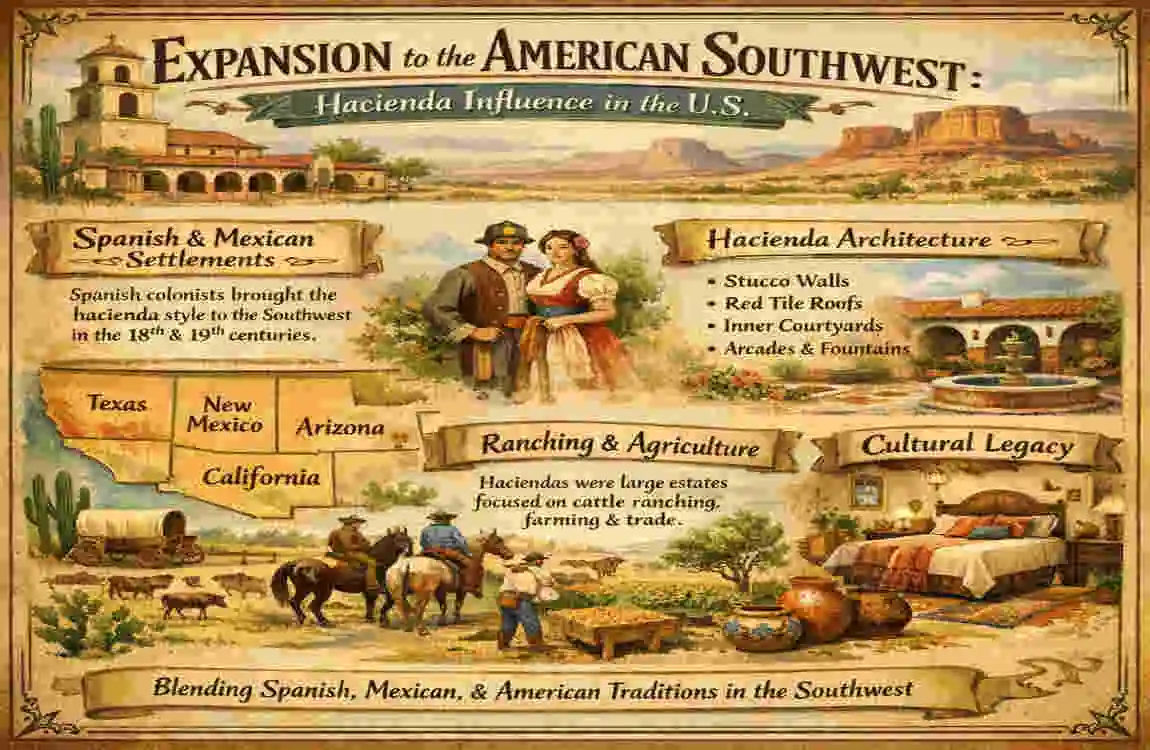
As the Spanish empire expanded northward, so did its architecture. By the 17th and 18th centuries, the hacienda style was moving into what is now Texas, New Mexico, Arizona, and California.
The Mission Trail
The primary vehicle for this expansion was the Mission system. When you look at the origins of hacienda-style architecture in the United States, you have to look at the missions founded by friars like Junípero Serra.
In California, missions like San Juan Capistrano (founded in 1776) showcased the classic hacienda features:
- Red clay roof tiles (shaped, legend has it, over the thighs of the workers).
- Whitewashed adobe walls.
- Deep, shaded arcades.
However, the style had to adapt again. In New Mexico, the Spanish encountered the Pueblo people, who had their own sophisticated multi-story adobe architecture. The Spanish simplified their hacienda designs here. They embraced the “Pueblo” aesthetic—flat roofs (instead of pitched red-tile roofs), exposed timber beams known as vigas, and softer, rounded walls.
The Romanticization of the Style
Interestingly, the “Hacienda Style” we see in American suburbs today isn’t just a direct descendant of the colonial era. A 1920s revival heavily influenced it.
After the Mexican-American War and the Gold Rush, many original adobe structures fell into ruin. But in the early 20th century, architects in California began to romanticize the Spanish past. They looked at the ruins of the missions and the old ranchos and decided to recreate them for modern living.
This “Spanish Colonial Revival” is what cemented the hacienda style in the American imagination. Architects took the rough, practical designs of the colonial frontier and polished them into luxury estates for movie stars and wealthy moguls.
Key Features That Define Iconic Spanish Colonial Courtyard Homes
Now that we have explored the history and identified who created hacienda-style architecture, let’s break down the physical elements. What exactly makes a house a hacienda?
If you are looking to buy a home in this style, or simply want to incorporate these elements into your own design, these are the non-negotiable features.
The Central Courtyard (Patio)
This is the heart of the home. In traditional haciendas, every room in the house opened onto this central space. It wasn’t just a garden; it was an outdoor living room. It provides privacy, security, and a microclimate that is cooler than the outside air.
Thick Adobe Walls with Stucco Finish
Authentic haciendas have walls that look substantial. Originally made of adobe mud bricks, modern versions often use concrete or wood frames finished with stucco. The texture is key—it should look hand-troweled and slightly imperfect. The color is almost always white or a warm earth tone to reflect the sun.
Red Clay Roof Tiles
The low-pitched roof covered in handmade red clay tiles is perhaps the most recognizable silhouette of the style. These tiles are shaped like half-cylinders. They are designed to shed rain quickly and, more importantly, to trap pockets of air that insulate the roof from the beating sun.
Exposed Wood Beams (Vigas)
When you walk inside a hacienda, look up. You should see heavy wooden beams supporting the ceiling. In the original structures, these were structural logs that often poked through the exterior walls. Today, they add warmth and rustic charm to the interior.
Arched Doorways and Arcades
The Romans gave us the arch, the Moors refined it, and the Spanish brought it to the Americas. Hacienda homes feature long outdoor hallways lined with arches. These arcades provide a transition zone between the bright, hot courtyard and the dark, cool interior rooms.
Ironwork and Tile
Details matter. Since wood was sometimes scarce or prone to rot, decorative ironwork became common for window grilles and light fixtures. Additionally, Talavera tile—colorful, hand-painted pottery—is often used to decorate stair risers, fountains, and kitchen backsplashes, adding a splash of vibrancy to the earth-toned palette.
Comparison: Traditional vs. Modern Hacienda Elements
Feature Traditional Colonial Hacienda Modern Hacienda Revival
Primary Material : Sun-dried Adobe Mud Bricks , Stucco over Wood Frame or Concrete
Roofing Handmade Red Clay Barrel Tiles Mass-produced Clay or Concrete Tiles
Floor Plan Enclosed square (fortress-like) Open concept, often L-shaped or U-shaped
Flooring : Stone or packed earth , Saltillo tile, hardwood, or stone
Windows Small, high (for defense/heat) Large picture windows, French doors
Purpose : Self-sufficient ranch/fort , Luxury residential living
Modern Legacy: Hacienda Style in Today’s Home Design and Real Estate
You might be asking, “Is this style still relevant?” The answer is a resounding yes. In fact, hacienda-style architecture is currently enjoying a massive resurgence in the luxury real estate market.
The Adobe Revival
In the modern era, we saw a specific “Adobe Revival” championed by architects like Mary Colter, who designed many of the iconic buildings at the Grand Canyon. She helped prove that these “primitive” designs were actually masterpieces of blending into the landscape.
A Premium on History
Today, in places like Scottsdale, Santa Barbara, Palm Springs, and San Antonio, hacienda-style homes command a premium. According to recent real estate data, homes listed with terms like “Spanish Colonial,” “Hacienda,” or “Courtyard” often see higher engagement.
Why? Because the design solves modern problems.
- Sustainability: The thick walls and courtyard passive cooling are energy-efficient.
- Privacy: In a world of social media and crowded suburbs, the inward-facing design offers a private sanctuary.
- Indoor-Outdoor Living: Modern homeowners crave a connection to nature. The hacienda style, with its many doors opening to the patio, was doing “indoor-outdoor living” centuries before it became a buzzword.
Celebrity Appeal
The style has long been a favorite of the rich and famous. From George Strait’s massive Texas ranch to historical estates in the Hollywood Hills once owned by stars of the Golden Age, the hacienda represents a laid-back, earthy kind of luxury. It says you are grounded, yet sophisticated.
FAQ: Common Questions About Who Created Hacienda Style Architecture
Who created hacienda-style architecture? There is no single creator. It was developed by Spanish colonists in Mexico during the 16th century. They combined architectural styles from Spain (influenced by the Moors/Muslims and Romans) with Indigenous building techniques and materials, such as adobe.
What are the origins of Spanish colonial courtyard homes? The origins trace back to Roman atriums and Moorish courtyards in Spain. When brought to the New World, these designs evolved into the “hacienda,” serving as fortified, self-sufficient ranch estates in the vast, remote lands of colonial Mexico.
Where can I see authentic hacienda homes today? You can find well-preserved examples throughout central Mexico (particularly in states like Yucatán and Jalisco). In the U.S., you can see the direct architectural lineage in the Spanish Missions of California and in the historical districts of Santa Fe, New Mexico, and San Antonio, Texas.
Is hacienda style still popular in real estate? Yes, it is extremely popular, especially in the U.S. Sun Belt (CA, AZ, TX, FL). Modern buyers love the style for its romantic aesthetic, energy efficiency in hot climates, and the privacy it provides through its courtyard layout.
How does hacienda architecture differ from ranch-style? While both are sprawling single-story homes, a true hacienda is defined by an enclosed or semi-enclosed central courtyard and heavy masonry (adobe/stucco) walls. American “Ranch” style homes tend to be open to the backyard and street, lacking the fortress-like enclosure of a hacienda.