Hey there, reader! If you’re dreaming about building your own home in the beautiful state of Virginia, you’re in the right place. Virginia offers a mix of stunning landscapes, from the rolling hills of the Shenandoah Valley to the bustling suburbs near Washington, D.C. But before you grab that hammer, let’s talk about the big question on your mind: how much does it cost to build a house in Virginia? Building a home here can be an exciting adventure, but it comes with its share of financial surprises if you’re not prepared.
We’ll dive into average prices, key factors that influence your budget, and expert insights tailored for 2025. Whether you’re a first-time builder or just curious, stick around—we promise a detailed cost breakdown that helps you make intelligent decisions. By the end, you’ll feel confident tackling your project. Let’s get started!
Overview of Building a House in Virginia

Building a house in Virginia isn’t just about picking a spot and starting construction. It’s a process shaped by the state’s diverse geography, economy, and regulations. Virginia’s housing market is thriving, with new constructions popping up everywhere from urban Richmond to rural farm areas. However, costs can vary significantly, so understanding the basics is crucial.
Imagine designing your dream home with mountain views or easy access to city amenities. That’s the appeal! However, you need to factor in everything from land prices to local building codes. In 2025, with inflation stabilizing and supply chains improving, it’s a decent time to build—but only if you plan wisely.
Current Average Cost Per Square Foot
Let’s cut to the chase: the average cost to build a house in Virginia hovers around $155 per square foot as of 2025. This figure includes basic materials, labor, and some finishes; however, it can increase for custom features. For a standard 2,000-square-foot home, you’re looking at roughly $310,000 just for the build itself—not including land or extras.
Why this number? It’s based on data from sources like Home-Cost.com and local builders. Remember, this is an average; your actual costs could be lower in affordable areas or higher in premium spots. Have you calculated your square footage needs yet? It’s a great starting point!
Comparison to Other States
Virginia stacks up against its neighbors. For instance, building in Maryland might cost you around $180 per square foot, while North Carolina comes in at about $140. What makes Virginia cost-effective? Lower material taxes in some regions, combined with a competitive labor market, keep things reasonable.
Think about it—Virginia’s proximity to major ports means easier access to supplies, reducing shipping costs. Additionally, the state’s moderate climate results in fewer weather-related delays compared to the snowy states in New England. When comparing options, Virginia often emerges as the winner in terms of value. How does this compare to where you live now?
Variability of Costs by Location
Location is everything in Virginia. In Northern Virginia, near cities such as Arlington or Fairfax, expect costs to spike—ranging from $ 200 per square foot and higher due to high demand and strict zoning laws. Rural areas like Southwest Virginia? You might pay as low as $120 per square foot, thanks to cheaper land and fewer regulations.
Urban vs. rural isn’t the only divide. Coastal areas face higher insurance and flood-proofing costs, while mountainous regions deal with tricky terrain. Picture building in Virginia Beach versus Roanoke—the differences add up quickly. Where in Virginia are you eyeing? That choice alone could save or cost you thousands of dollars.
Factors Affecting the Cost to Build a House in Virginia
So, you’ve got the big picture, but what really drives up the bill when asking how much it costs to build a house in Virginia? Several factors play a role, and ignoring them could lead to budget overruns. Let’s break them down one by one, so you can see how they impact your project.
These elements aren’t set in stone—they fluctuate with market trends, your choices, and even the time of year. In 2025, with post-pandemic supply chain improvements, some costs are stabilizing, but others, such as labor, remain volatile. Ready to dive in?
Land Acquisition and Preparation Costs
First up: the land. You can’t build without a solid foundation, right? In Virginia, the average land price is around $23,900 per acre, but that’s just the beginning. Urban plots in Northern Virginia can fetch $ 100,000 or more per acre, while rural spots might sell for $10,000 or less.
Preparation adds more: clearing trees, grading the soil, or installing septic systems could tack on $5,000 to $20,000. Don’t forget surveys and environmental assessments—essential in flood-prone areas. Have you scouted land yet? Factor in these prep costs early to avoid surprises.
Permit and Inspection Fees
Bureaucracy might not be fun, but it’s necessary. Typical building permits in Virginia range from $1,000 to $2,000, depending on your county. Inspections for electrical, plumbing, and structural integrity add another $500 to $1,500.
Why the variation? Places like Fairfax County have more rigorous checks, bumping fees higher. In 2025, digital permitting is speeding up the process, but delays can still occur. Pro tip: Apply early and double-check the requirements to ensure a smooth process.
Labor Market and Wage Rates
Labor is a significant portion of your budget, typically accounting for 40-50% of total costs. In Virginia, carpenters earn about $25-$35 per hour, plumbers $30-$45, and electricians $35-$50. The state’s growing population means skilled workers are in demand, especially in booming areas like Northern Virginia.
Shortages can drive up rates, but hiring local crews saves on travel costs. With 2025’s focus on workforce training, rates might stabilize. Who are you planning to hire? Building relationships with reliable pros pays off.
Material Costs in Virginia
Materials make up another big piece. Lumber for framing? Expect $10,000-$20,000 for a mid-sized home. Roofing materials like asphalt shingles run $5,000-$10,000, while flooring (hardwood or tile) could be $8,000-$15,000. Windows and doors add $5,000 to $12,000, depending on their energy efficiency.
Virginia’s access to East Coast suppliers helps keep prices competitive, but global events can cause price spikes. In 2025, eco-friendly options are trending, potentially leading to long-term savings on energy bills. What materials excite you most?
Design Complexity and Customization
A basic ranch-style home is often less expensive than a custom colonial with all the bells and whistles. Basic builds cost $100-$150 per square foot, mid-range builds cost $150-$200, and luxury builds cost over $250. Custom features, such as smart home technology or gourmet kitchens, can inflate the price.
Complexity means more time and specialized labor. Think about it—do you need that extra bathroom or vaulted ceilings? Balancing dreams with budget is crucial. What’s on your must-have list?
Detailed Cost Breakdown
Now, let’s get granular. This is where we provide the actual cost of building a house in Virginia , using real numbers. We’ll categorize costs, provide averages for 2025, and include examples for different home sizes. Remember, these are estimates—your mileage may vary based on choices.
Breaking it down helps you budget smarter. We’ll cover materials, labor, permits, and extras. Use this as a checklist for your project.
Materials Cost by Category
Materials are the backbone of your build. Framing (the skeleton) averages $15,000 to $25,000 for lumber and steel. Roofing? $6,000-$12,000 for shingles or metal. Insulation keeps things cozy at $2,000-$5,000, while windows and doors seal the deal for $4,000-$10,000.
Don’t overlook finishes: Flooring might cost $7,000-$15,000, and paint/interiors $3,000-$8,000. In Virginia, sourcing locally can cut these by 10-15%. Which category worries you most?
Labor Costs and Hourly Rates
Labor brings it all together. Carpenters charge $25-$40/hour, handling framing and finishes. Roofers: $30-$45/hour for installation. Plumbers and electricians? $35-$55/hour each, ensuring everything works safely.
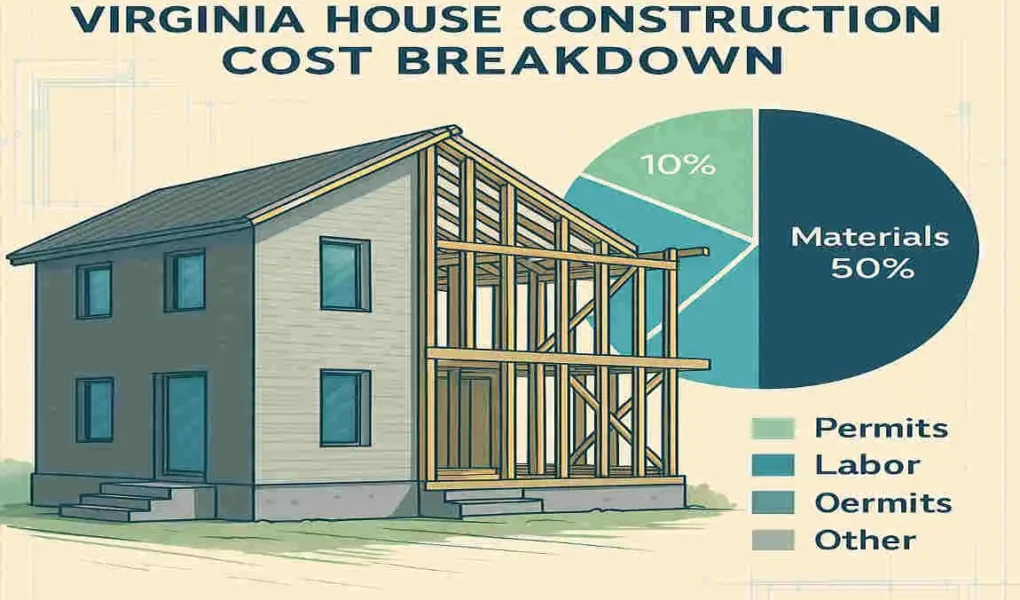
For a complete build, labor accounts for 40-60% of the costs—approximately $100,000-$200,000 for a 2,000 sq. ft. home. Virginia’s union rates in urban areas contribute to this higher figure. Hiring a general contractor? They manage it all for a 10-20% fee.
Permits, Inspections, and Design Fees
Permits: $1,000-$2,000 as mentioned. Inspections add $500-$1,500 per phase. Design fees for architects or engineers? $5,000-$15,000, depending on complexity.
These ensure compliance with Virginia’s building codes, like energy efficiency standards. Skipping them? Fines up to $5,000. Budget for this upfront.
Additional Construction Costs
Extras add up: Utilities hookup (water, electric) $3,000-$10,000. Landscaping: $5,000-$15,000 for grading and plants. Driveway: $4,000-$8,000 in concrete or asphalt. Painting: $3,000-$7,000 inside and out.
Forgotten items like appliances or HVAC? $10,000-$20,000 more. In Virginia’s varied climate, weatherproofing is key.
Examples of Average Total Costs
For a 1,500 sq. ft. home: Around $232,500 at $155/sq. Ft., plus $50,000 for land/prep—total ~$282,500.
A 2,000 sq. ft. mid-range: $310,000 build + $60,000 extras = ~$370,000.
Luxury 3,000 sq. ft.: $600,000+ with custom features.
Here’s a quick table to visualize:
Home Size (sq. ft.)Basic Cost ($/sq ft.)Total Build Cost With Land & Extras
1,500 $155 $232,500 $282,500+
2,000 $155 $310,000 $370,000+
3,000 $200 (mid-range) $600,000 $700,000+
These are 2025 estimates; adjust for your specific area.
Cost Comparison: Building vs Buying in Virginia
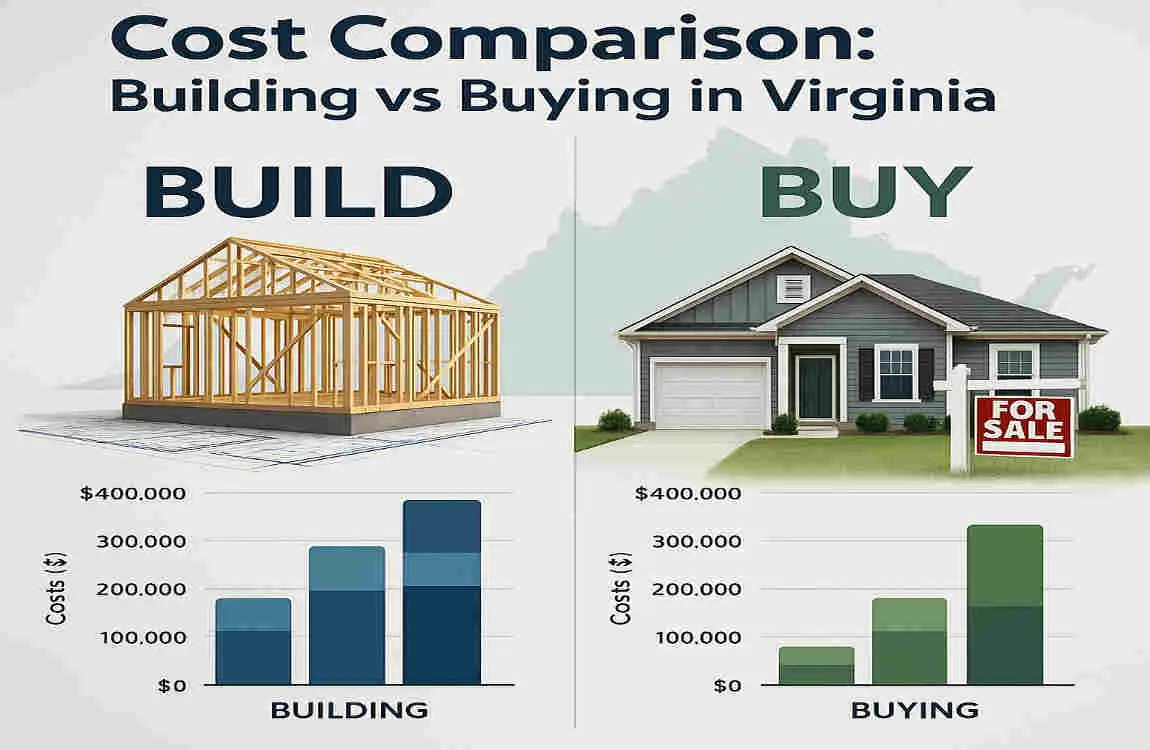
Deciding between building new or buying existing? It’s a common dilemma when considering the cost of building a house in Virginia. Building lets you customize, but buying is quicker. Let’s compare.
In 2025, Virginia’s median home price is approximately $400,000, often for older properties that require updates. Building could cost less per square foot for new efficiency.
Why Building Might Save Money
New builds incorporate energy-saving tech, potentially slashing utility bills by 20-30%—no renovation surprises like hidden mold. Additionally, you avoid realtor fees (typically 5-6% on buying).
In the long term, building in growing areas like Hampton Roads enhances resale value. Is customization worth the extra effort for you?
Timeframe Considerations
Building takes 9-12 months, from permits to move-in. Buying? 1-2 months, including closing. Construction house delays (weather, shortages) can extend this.
In fast-paced 2025 markets, buying might mean bidding wars. Building gives control but requires patience. What’s your timeline?
Market Trends in 2025
Inflation is easing, but material costs are up 5-10% from 2024. Home prices in Northern Virginia are rising due to the influx of tech jobs. Construction loans are more accessible with lower interest rates.
Trends favor sustainable builds, offering tax incentives. Keep an eye on these— they could tip the scales.
Expert Tips to Save on Virginia House Construction
Who doesn’t love saving money? Experts in Virginia’s construction scene share ways to trim costs without cutting corners. These tips come from builders like those at Birchwood bulid Homes and Karma Construction Group.
Let’s list a few key ones:
- Opt for modular construction: Pre-built sections assembled on-site can save 10-20% on labor.
- Buy in bulk: Source materials directly for discounts, especially lumber.
- Energy-efficient choices, such as LED lighting and insulation, are eligible for rebates, which reduces long-term costs.
More advice? Schedule during the off-season (winter) to avoid peak labor rates. Manage your project timeline to prevent delays—each week lost adds $ 1,000 or more in holding costs.
Choosing Cost-Effective Materials
Go for durable yet affordable options like vinyl siding over brick ($5,000 savings). Use composite decking instead of wood. Quality doesn’t mean luxury—focus on ROI.
In Virginia, local quarries offer cheap stone. What materials fit your style and budget?
Scheduling and Labor Management
Hire a project manager to coordinate trades, minimizing overtime (extra 50% pay). Start early in the year to beat summer rushes.
Avoid weekends—stick to weekdays for better rates. Good planning keeps everyone efficient.
Proper Planning and Permit Acquisition
Research county fees—some like Loudoun have lower ones. Use online tools for quick permits.
Consult pros early to spot issues. This avoids costly reworks.
Regional Considerations for Cost-Saving
Build in counties like Augusta for lower land taxes. Rural spots have fewer HOA fees.
Check incentives in opportunity zones for tax breaks. Location shopping pays off!
Common Mistakes to Avoid When Estimating Virginia Home Construction Costs
Even seasoned builders slip up. When estimating the cost of building a house in Virginia, avoid these pitfalls to stay on budget.
Underestimating land prep? That $10,000 surprise hurts. Ignoring permits leads to shutdowns and fines.
Not factoring inflation? Material prices rose 8% last year—plan for 5% in 2025.
Over-customizing? That fancy atrium might put a dent in your budget. Stick to essentials first.
Here’s a bullet list of more:
- Forgetting contingency funds (10-15% buffer).
- Skipping soil tests leads to foundation issues.
- Hiring the cheapest contractor—quality matters.
Learn from these, and your build will go smoother. What’s one mistake you’ve heard about?