You are winding down after a long, exhausting day. You are finally relaxing in your cozy bed, perhaps reading a good book or scrolling through your phone by the soft light of your bedside lamp. Suddenly, out of the corner of your eye, you spot movement. You look closer and discover tiny, hard-shelled beetles crawling across your nightstand, scaling your baseboards, or worse, making their way across your bedsheets.
If this has happened to you, you are far from alone. Weevils are incredibly common household invaders. While most people associate them purely with the kitchen, these tiny pests are highly opportunistic. They are naturally drawn to grains and dry foods, but they also seek out specific fabrics and moist areas. It is surprisingly easy for them to thrive in bedrooms. They often wander in through open windows, sneak through unsealed cracks in the walls, or hitch a ride on infested items like luggage, thrifted clothing, or even a late-night snack bowl left on a desk.
When you find yourself facing this nightmare, your immediate thought is likely, “How to get rid of weevils in my house bedroom?” You want them gone, and you want them gone right now. But because this is the room where you sleep, breathe, and relax, you may want to avoid dousing the area in harsh, toxic chemical bug sprays.
Why Natural Remedies Work Fast

When you search for how to get rid of weevils in your bedroom, you might be tempted to run to the hardware store and buy the strongest chemical fogger available. However, natural remedies are often the superior choice for indoor, lived-in spaces.
First and foremost, natural remedies prioritize the safety of your family and your pets. You spend roughly eight hours a day breathing heavily in your bedroom. You do not want to coat your mattress, your clothing, or your floor in synthetic neurotoxins that leave behind a lingering chemical residue.
Secondly, natural remedies actually work incredibly fast, often providing overnight action. Instead of relying on slow-acting poisons, natural methods use direct physical disruption. Elements like desiccants work by instantly sticking to the bug and dehydrating it, while intense natural repellents overwhelm their senses and force them to flee immediately.
Compared to chemical sprays that just coat the room, natural options like pure essential oils and acidic sprays kill pests on contact without leaving a dangerous residue behind. They are highly eco-friendly, cheap, and usually utilize ingredients you already have in your kitchen cabinets.
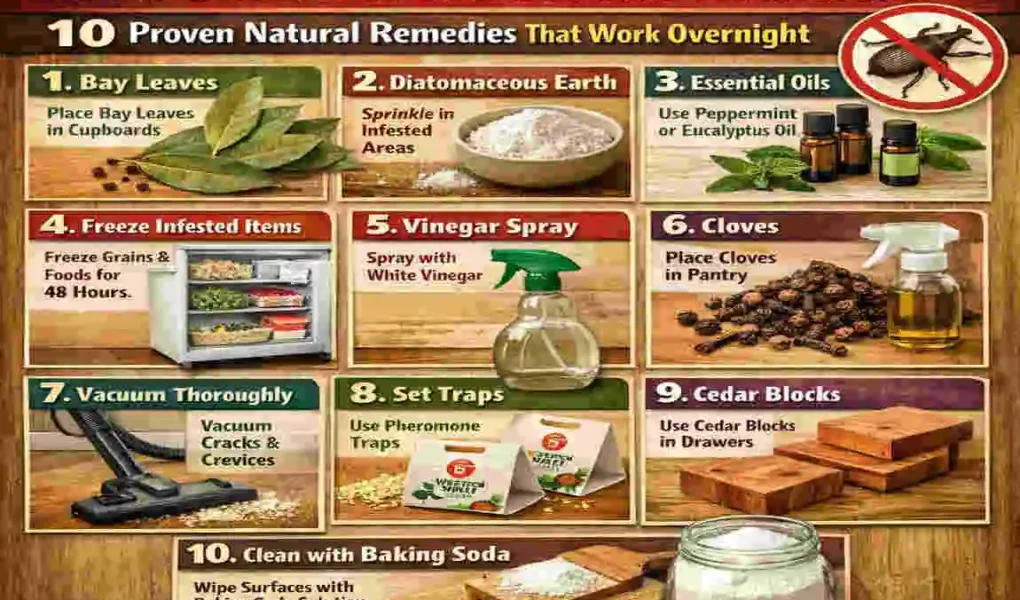
Here is a quick preview of the 10 natural remedies we will be diving into:
- Diatomaceous Earth
- Bay Leaves
- Cloves and Garlic
- White Vinegar
- Neem Oil
- Citrus Peels
- Black Peppercorns
- Sticky Traps
- Freezing
- Essential Oils
10 Proven Natural Remedies
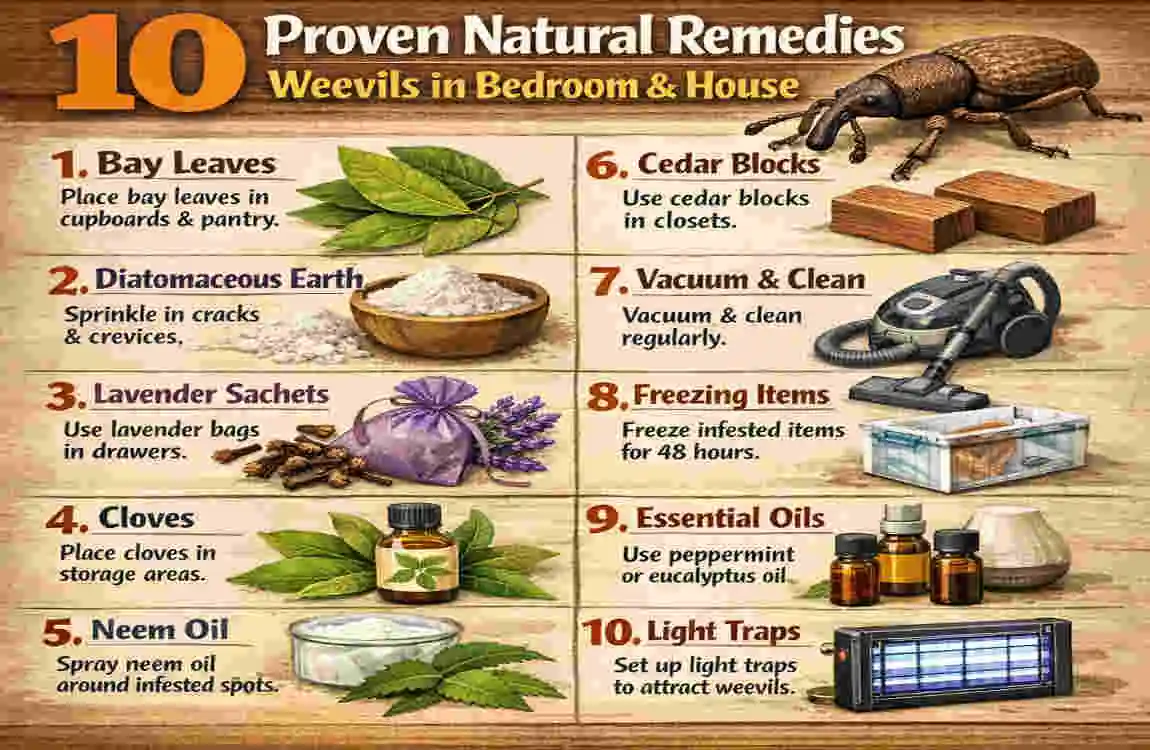
Are you ready to take back your bedroom? Here is your comprehensive, step-by-step guide to the best natural remedies for eliminating weevils quickly and safely.
Diatomaceous Earth Traps
Diatomaceous Earth, frequently referred to as DE, is arguably the most effective natural insect killer on the planet. It is a fine white powder made from the crushed, fossilized remains of microscopic aquatic organisms called diatoms.
While it feels like soft baby powder to human hands, to a weevil, it is like walking through a field of razor-sharp broken glass. The microscopic jagged edges of the DE pierce the hard, waxy exoskeleton of the insect. Once that protective shell is scratched, the highly absorbent powder draws out all the moisture from the bug’s body. This dehydrates weevils in just a few short hours, making it an incredible overnight solution for a weevil infestation in the bedroom.
How to Use DE:
- Purchase food-grade DE: Ensure you only buy the “food-grade” version, not the pool-grade version, as food-grade is completely safe for humans and pets.
- Clean the area: Sweep or vacuum your bedroom floor, paying special attention to the corners and baseboards.
- Apply a thin dusting: Using a powder duster or a makeup brush, apply a very light, nearly invisible layer of the powder along the perimeter of your room, under your bed, and on closet shelves.
- Leave it overnight: Let the powder sit undisturbed while you sleep. The nocturnal weevils will walk through it.
- Vacuum it up: In the morning, or after a few days, vacuum up the powder and the dead bugs.
Bay Leaves Repellent
If you want to know how to get rid of weevils in my house bedroom without having to clean up dead bugs in the morning, repellents are your best friend. Bay leaves are a legendary pantry pest deterrent, and they work just as beautifully in your sleeping quarters.
The secret behind this remedy lies in a natural compound found in the leaves called eucalyptol. While we humans might associate the smell of bay leaves with a delicious, slow-cooked stew, weevils absolutely despise the bitter, pungent odor of eucalyptol. It acts as an instant sensory overload, making your bedroom completely intolerable to them. Because the scent permeates the air in small, enclosed spaces quickly, it effectively repels them instantly.
How to Use Bay Leaves:
- Source fresh or dried leaves: Both work well, though fresh bay leaves have a slightly stronger scent profile.
- Target the hot spots: Place whole leaves directly into your dresser drawers, tucking them beneath stacks of clothing.
- Secure the perimeter: Slide a few leaves underneath your bed frame, place them on your window sills, and leave a couple in the corners of your closet.
- Replace regularly: Swap the leaves out every few months when they lose their pungent aroma.
Cloves and Garlic Sachets
Following the same logic as the bay leaves, you can create a powerful olfactory barrier using ingredients straight from your spice rack. Cloves and garlic both contain intense, naturally occurring sulfur compounds and essential oils that insects cannot tolerate.
When you combine the sharp, spicy scent of cloves with the heavy, pungent odor of garlic, you create an environment that forces weevils to turn around and leave. Scattering these scents in enclosed spaces like closets or under heavy furniture drives them out overnight, preventing them from settling in and laying eggs.
How to Create Sachets:
- Gather your supplies: You will need whole cloves, a few cloves of fresh, unpeeled garlic, and some breathable fabric like cheesecloth or thin cotton scraps.
- Assemble the bags: Place a small handful of whole cloves and one slightly crushed garlic clove into the center of the fabric.
- Tie them up: Bundle the fabric together and tie it tightly with a piece of string or a rubber band.
- Distribute the sachets: Toss these little bags into the back corners of your closet, inside your shoes, or behind your bedroom door.
White Vinegar Spray
White vinegar is the undisputed champion of natural household cleaning, but it is also a highly effective, fast-acting pest control agent. When you are looking to eliminate weevils fast, naturally, reaching for the vinegar bottle is a brilliant move.
White vinegar contains acetic acid. This acidity is strong enough to eat through the delicate membranes of soft-bodied larvae and heavily disrupt adult weevils on contact. Furthermore, vinegar acts as a brilliant masking agent. It wipes away the invisible pheromone trails that weevils leave behind to communicate with each other. By wiping down surfaces, you kill the bugs on contact and confuse the remaining bugs, making it incredibly safe and effective for bedroom use.
How to Use Vinegar Spray:
- Create the mixture: In a clean spray bottle, mix equal parts distilled white vinegar and tap water.
- Add a boost (optional): Add a few drops of dish soap to help the liquid stick to the bugs better.
- Target the bugs: If you see active weevils crawling on your nightstand or floor, spray them directly.
- Wipe down surfaces: Spray the mixture onto a microfiber cloth and thoroughly wipe down your baseboards, window ledges, and hard furniture.
- Let it dry: Allow the surfaces to air dry. The sharp vinegar smell will dissipate completely within about thirty minutes.
Neem Oil Solution
Neem oil is a pressed oil derived from the fruits and seeds of the neem tree. It has been used for centuries in agricultural pest control, and it is a powerhouse when it comes to tackling a stubborn indoor bug problem.
Unlike contact killers that poison the bug, neem oil works by targeting the insect’s hormonal system. When a weevil ingests or comes into contact with neem oil, it forgets to eat, forgets to mate, and stops laying eggs. It disrupts their entire breeding cycle fast. This means that even if the adult bug doesn’t die the very first night, the infestation stops growing immediately, leading to a rapid population crash.
How to Use Neem Oil:
- Buy pure neem oil: Look for 100% cold-pressed neem oil at your local garden center or online.
- Emulsify the oil: Because oil and water do not mix, you must emulsify it. Mix one teaspoon of neem oil with half a teaspoon of liquid dish soap in a bowl.
- Mix with water: Pour this soapy oil mixture into a spray bottle filled with a quart of warm water. Shake vigorously.
- Spray the cracks: Spray this solution directly into the unsealed cracks in your walls, along your baseboards, and anywhere you suspect bugs are hiding.
Citrus Peels Barrier
If you want a remedy that makes your bedroom smell like a spa while actively fighting off pests, look no further than your fruit bowl. The peels of oranges, lemons, grapefruits, and limes are packed with a natural chemical compound called limonene.
Limonene is toxic to many insects, including weevils. It breaks down their respiratory systems and acts as a massive sensory deterrent. By using the oils found naturally in the skins of citrus fruits, you can easily build a protective, invisible barrier around your most important furniture. It repels effectively and leaves your room smelling wonderfully fresh.
How to Use Citrus Peels:
- Peel your fruit: Eat a delicious citrus fruit and save all the peels.
- Express the oils: Bend the peels backward slightly until you see the microscopic mist of oil spray out from the pores of the skin.
- Rub the surfaces: Vigorously rub the outside of the peel directly onto the legs of your bed frame, along your window sills, and on the edges of your wooden furniture.
- Leave the peels: You can also chop the leftover peels into small pieces and leave them in a small decorative dish on your nightstand to act as a localized repellent.
Black Peppercorns
Sometimes, the simplest solutions are the most effective. Just as black pepper makes you sneeze and causes your eyes to water, it acts as a severe respiratory irritant to tiny bugs.
Weevils breathe through tiny holes in the sides of their bodies called spiracles. When they encounter the sharp, irritating dust and scent of black peppercorns, it burns their respiratory system. This intense discomfort forces a quick exodus. They will immediately turn around and run in the opposite direction to find clean air, making pepper a fantastic barrier method for doorways and bedroom entry points.
How to Use Peppercorns:
- Crush the pepper: While whole peppercorns work reasonably well, slightly crushed peppercorns release far more irritating oils. Place a handful of black peppercorns in a zip-top bag and smash them gently with a rolling pin or the back of a pan.
- Sprinkle the perimeter: Sprinkle these crushed peppercorns heavily into the dark corners of your bedroom.
- Target the entryways: Line the threshold of your bedroom door and the tracks of your windows with the pepper.
- Sweep and replace: After a week, sweep or vacuum up the old pepper and lay down a fresh batch if needed.
Sticky Traps with Light
If you have a moderate to severe infestation, you should actively draw the bugs out of their hiding spots to capture them. Because weevils are often nocturnal and are naturally drawn to light sources in a dark room, you can use their own instincts against them.
Setting up a sticky trap with a dedicated light source serves as an irresistible beacon. The bugs leave their safe harbor in the walls or under the bed, march toward the glowing light, and walk directly onto an incredibly sticky glue board. This night setup in the bedroom attracts and captures the pests silently while you sleep, allowing you to wake up to a bug-free floor.
How to Use Sticky Traps:
- Buy or make traps: You can purchase non-toxic yellow sticky insect traps at any hardware store. Alternatively, you can coat a piece of bright yellow cardboard with a thick layer of petroleum jelly.
- Set the stage: Place the sticky traps flat on the floor in the center of your bedroom or near the area where you see the most activity.
- Add the light: Place a small, battery-operated LED push-light or a small desk lamp directly over or next to the sticky trap.
- Turn off the main lights: Turn off every other light in the bedroom so the trap is the only light source available.
- Check in the morning: Wake up, inspect the trap, and throw away the captured bugs.
Freezing Infested Items
Sometimes, the weevils aren’t just roaming your floor; they have taken up residence in specific items. If you carried the bugs in via a favorite sweater, a decorative pillow, a stuffed animal, or a stack of old books, you need to treat the item directly.
Extreme temperatures are fatal to bugs at all life stages. While heat can ruin delicate fabrics and warp books, freezing is generally safe for most household items. When you plunge an item into sub-zero temperatures, the water inside the insect’s cells expands and bursts, causing instant death. Bagging and freezing these items overnight reliably kills the adult weevils, the crawling larvae, and the unhatched eggs.
How to Freeze Items:
- Identify the infested item: Locate the specific sweater, blanket, or toy that harbors the bugs.
- Seal it up: Place the item inside a heavy-duty, airtight plastic freezer bag. Squeeze out as much air as possible and seal it tightly. This prevents condensation from ruining your item.
- Freeze overnight: Place the sealed bag into the coldest part of your freezer. Leave it there for a minimum of 24 hours (48 hours is even better for thick items).
- Thaw and wash: Remove the bag, let it come to room temperature, and then immediately wash the fabric item in the washing machine to remove the dead bugs.
Essential Oils (Peppermint and Citronella)
Our final natural remedy is the most pleasant for you and the most devastating for the bugs. Highly concentrated essential oils are incredibly powerful tools in natural pest management.
Oils like peppermint and citronella contain potent aromatic compounds (like menthol). To a tiny insect, these intense smells are completely overwhelming. They mask the pheromones the bugs use to navigate, irritate their respiratory systems, and overwhelm their senses for rapid results. A room infused with peppermint is a room that a weevil will desperately try to escape.
How to Use Essential Oils:
- Choose your oil: Peppermint, citronella, tea tree, and eucalyptus are the most effective against beetles.
- Diffuse the scent: Fill a bedroom oil diffuser with water, add 10 to 15 drops of your chosen essential oil, and run it for a few hours before bed to saturate the air.
- Create a contact wipe: Mix 20 drops of peppermint oil with a cup of water in a spray bottle. Shake vigorously.
- Wipe the entry points: Spray this mixture onto a cloth and wipe down the frames of your doors, the edges of your windows, and the legs of your bed.
Pro Tip: Essential oils are highly toxic to cats and dogs if ingested or absorbed through the skin. If you have pets that sleep in your bedroom, stick to pet-safe alternatives like diatomaceous earth or bay leaves, and skip the diffuser.
Quick Reference Guide: Remedy Comparison
To help you choose the best option for your specific situation, here is a quick breakdown of our top recommended strategies.
Remedy Key Ingredient Bedroom Application Time Effectiveness
Diatomaceous Earth Fossilized algae (silica) 1-2 hours to dehydrate High – Excellent for killing bugs
Bay Leaves Eucalyptol compounds Overnight repellent High – Excellent for prevention
Vinegar Spray Acetic acid Immediate on contact Medium – Good for active spotting
Sticky Traps, Glue, and light attraction. Overnight capture. Medium – Good for monitoring
Essential Oils Menthol / Citronellol Immediate sensory overload High – Excellent aromatic barrier
Step-by-Step Action plan
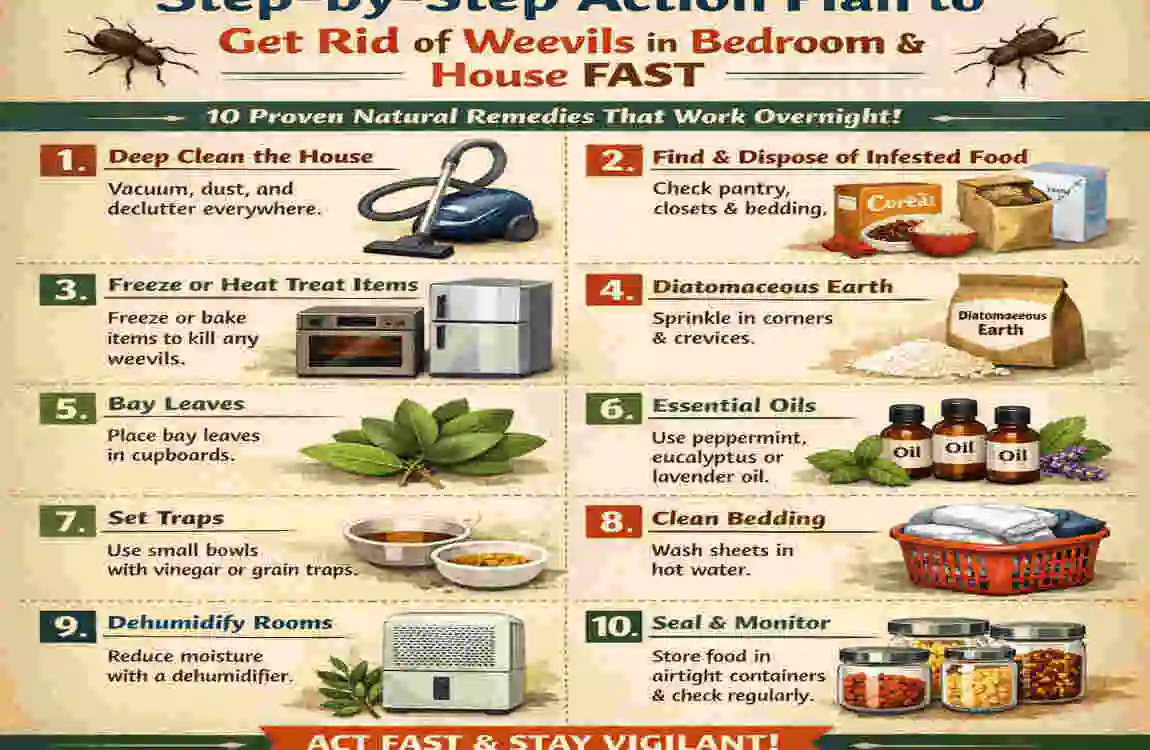
Reading about these remedies is great, but taking immediate action is how you reclaim your bedroom. If you are wondering how to get rid of weevils in my house bedroom right this second, follow this foolproof, 24-hour rapid action plan.
Step : Inspect and vacuum thoroughly. Start by stripping your bed and moving your furniture away from the walls. Grab your vacuum cleaner and use the hose attachment to thoroughly suck up everything along the baseboards, deep inside the closet, and under the bed. The vacuum will instantly remove the majority of adult bugs, eggs, and food crumbs they might be eating. Immediately empty the vacuum canister into an outside trash can.
Step : Discard infested items. If you find a cardboard storage box, a specific piece of old clothing, or a hidden late-night snack wrapper that is crawling with bugs, do not try to save it. Seal it in a garbage bag and remove it from your house immediately.
Step : Apply the top 3 remedies combo. Do not rely on just one method. Combine them for maximum impact. Apply a dusting of Diatomaceous Earth (DE) along the baseboards to kill crawlers. Tuck bay leaves into your drawers to protect your clothes. Finally, wipe down your nightstands and window sills with the vinegar spray to kill stragglers.
Step : Seal entry points. Grab a tube of silicone caulk and seal any visible cracks around your window frames or gaps between your baseboards and the floor. By cutting off their highways, you stop new bugs from entering.
Timeline: If you execute this plan vigorously, you will see a massive reduction in bugs within hours and total control in under 24 hours.
Prevention Tips Long-Term
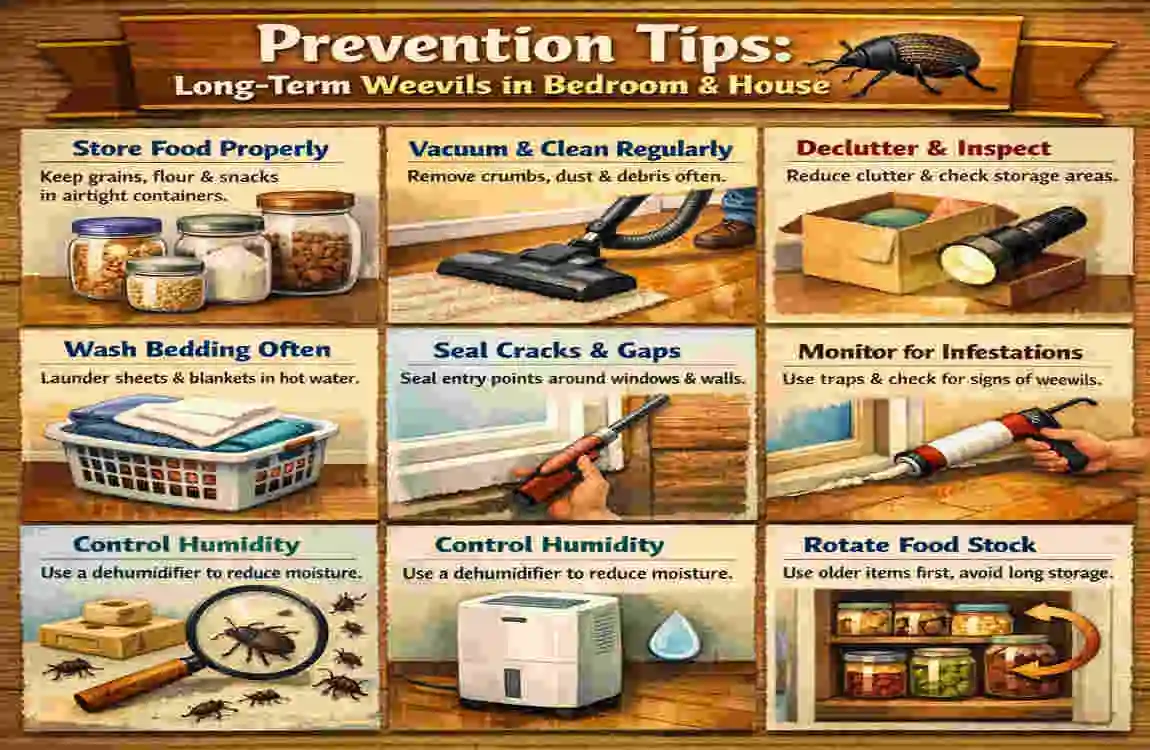
Getting rid of the bugs is only half the battle; keeping them out forever is the ultimate goal. To ensure you never have to deal with a weevil infestation in the bedroom again, you need to adopt a few simple, long-term habits.
First, rethink your bedroom snacks. If you absolutely must keep snacks in your room, never leave them in open cardboard boxes or plastic bags. Always store food items in airtight glass or thick plastic containers. If they cannot smell the food, they will not come looking for it.
Second, make repellents part of your monthly routine. Once a month, swap out the bay leaves in your drawers and wipe down your baseboards with peppermint oil or vinegar. Maintaining that invisible scent barrier keeps your room constantly unappealing to pests.
Third, maintain absolute dryness. Weevils need water to survive. If your bedroom is naturally humid, or if it sits adjacent to a steamy bathroom, invest in a small room dehumidifier. Keeping the humidity below 50% makes the room incredibly uncomfortable for insects.
Finally, for bedroom-specific care, check your window screens for tiny tears and launder your heavy blankets and curtains seasonally to remove any dust or hidden eggs.
FAQs
How to get rid of weevils in my house bedroom overnight? The absolute fastest overnight method is to use a combination approach. First, lightly dust food-grade Diatomaceous Earth (DE) along the baseboards and under the bed to dehydrate and kill the bugs while you sleep. Next, place fresh bay leaves inside your drawers and closet. The DE kills the bugs on the floor, while the bay leaves act as a powerful scent repellent to keep them out of your clothes.
Are weevils harmful to humans or pets? You will be relieved to know that weevils are strictly a nuisance pest. They do not possess stingers, they do not bite humans or animals, and they do not carry harmful diseases or pathogens. While finding them in your bedroom is certainly gross and stressful, they pose absolutely no physical danger to your health.
Should I use natural or chemical treatments? Natural remedies are vastly superior for bedrooms. Chemical sprays leave behind toxic residues on the floors where you walk barefoot and the air you breathe while sleeping. Natural methods like DE, vinegar, and essential oils are safer for your respiratory system, completely safe for children and pets, and often act much faster by instantly repelling the bugs rather than waiting for them to ingest a poison.