We have all seen the movies. The architect is usually portrayed as a visionary genius, wearing a black turtleneck, pointing at a futuristic model of a skyscraper, and living in a stunning loft that they designed themselves. It looks glamorous, sophisticated, and incredibly high-paying. But does Hollywood match reality?
The truth is a little more nuanced. According to recent data from the U.S. Bureau of Labor Statistics and global industry reports, the field is growing, but it is not without its hurdles. Architecture offers a unique blend of creative fulfillment and technical challenge that few other professions can match. It is a career where you can literally leave a physical mark on the world. However, it also demands serious grit, long hours, and a thick skin.
Daily Life as an Architect: Is It Right for You?
To understand if this is a good career, you first need to understand what the job actually entails. If you think it is just sitting at a drafting table sketching dream homes all day, you might be in for a surprise. So, what does an architect actually do?
Core Responsibilities
At its heart, architecture is about problem-solving. An architect is responsible for planning and designing buildings and structures. But “designing” isn’t just about aesthetics.
You have to ensure that every structure is safe, functional, and economical. You act as the conductor of an orchestra. You aren’t just drawing lines; you are coordinating with structural engineers to make sure the building stands up, mechanical engineers to make sure the AC works, and construction managers to ensure it can actually be built.
Furthermore, a huge part of the job involves navigating bureaucracy. You must ensure every design complies with local zoning laws, fire regulations, and building codes. If you miss a detail here, the building doesn’t get built.
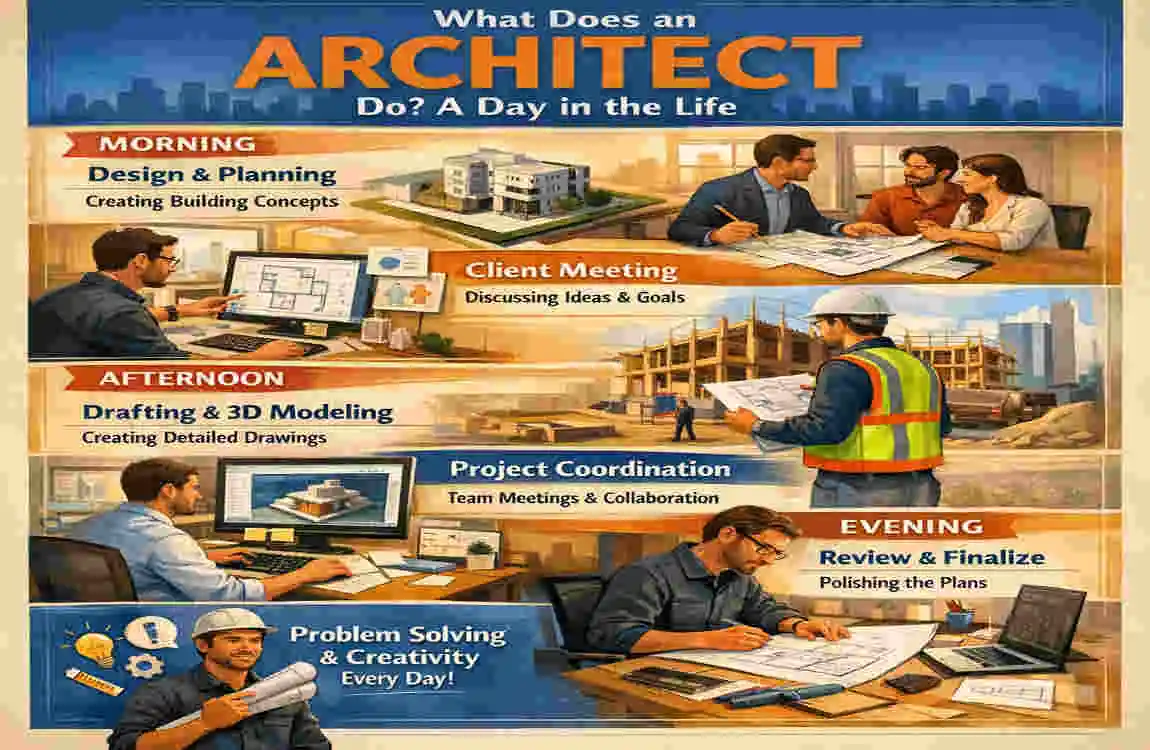
A Typical Day in the Life
Let’s break down what a standard Tuesday might look like for a mid-level architect.
- The Morning (Concept and Coordination): The day often starts with coffee and emails—lots of emails. You might spend the first few hours in CAD (Computer-Aided Design) or Revit, tweaking a 3D model based on client feedback. This is the “flow state” work where you get to be creative, solving how to fit a staircase into a tight lobby or choosing materials for a façade.
- The Afternoon (Meetings and Management): After lunch, the headphones come off. You might head into a conference room (or a Zoom call) for a client presentation. This is where your communication skills are tested. You have to sell your ideas and explain why a certain design choice is necessary. Later, you might coordinate with a vendor to source specific tiles or glass.
- The Evening (Site Visits): Sometimes, you leave the office entirely. You put on a hard hat and boots to visit a construction site. Here, you check that the contractor is following the drawings. You answer questions from the builders, resolve unexpected issues (like a pipe appearing where it shouldn’t), and ensure the quality aligns with the vision.
Specializations within the Field
One of the great things about this career is that you aren’t stuck doing one thing. The field is vast.
- Residential Architects: These professionals work with homeowners to design custom houses or renovations. It is a very personal and emotional work.
- Commercial Architects: They focus on office buildings, hotels, and shopping centers. These projects are larger, take longer, and involve bigger teams.
- Sustainable/Green Architects: This is a booming sector. These specialists focus on eco-friendly design, energy efficiency, and the reduction of construction’s carbon footprint.
Education and Skills Needed for an Architecture Career
If the daily life sounds appealing, the next question is: How do you get there? Architecture has a high barrier to entry. It is not a career you can “pick up” over a weekend course. It requires formal education, rigorous testing, and years of practice.
The Degree Path
To become a licensed architect, you generally need a professional degree accredited by the National Architectural Accrediting Board (NAAB) in the United States (or equivalent bodies globally).
You typically have two main routes:
- Bachelor of Architecture (B.Arch): This is a 5-year, intensive undergraduate degree. It is the fastest route for high school graduates.
- Master of Architecture (M.Arch): If you already have a 4-year degree in a different field, you can do a 2-to-3-year Master’s program to get accredited.
Architecture school is famous for its “studio culture.” This involves spending long nights in the design studio, building models, and presenting your work for public critique by professors and peers. It is grueling, but it bonds you with your classmates for life.
Licensing and Internships
Graduating is only step one. You cannot legally call yourself an “Architect” just because you have a degree. You must get licensed.
- The AXP (Architectural Experience Program): You must log roughly 3,740 hours of work experience under a licensed architect. This used to be called an “internship,” but it is really a junior job. You gain experience in everything from practice management to construction evaluation.
- The ARE (Architectural Registration Exam): the final boss. It is a multi-part exam that tests your knowledge on everything from structural systems to contract law. It is difficult, and many people take months or years to pass all divisions.
Essential Skills for Success
To survive this education and career path, you need a specific toolkit.
- Creativity and Vision: You need the ability to visualize spaces that don’t exist yet.
- Technical Proficiency: You must master complex software like AutoCAD, Revit, Rhino, and Adobe Creative Suite.
- Math and Physics: You don’t need to be a mathematician, but you need a solid grasp of geometry, algebra, and physics to understand structural loads.
- Communication: You can be the best designer in the world, but if you cannot explain your idea to a client, it will never get built.
The Cost of Entry
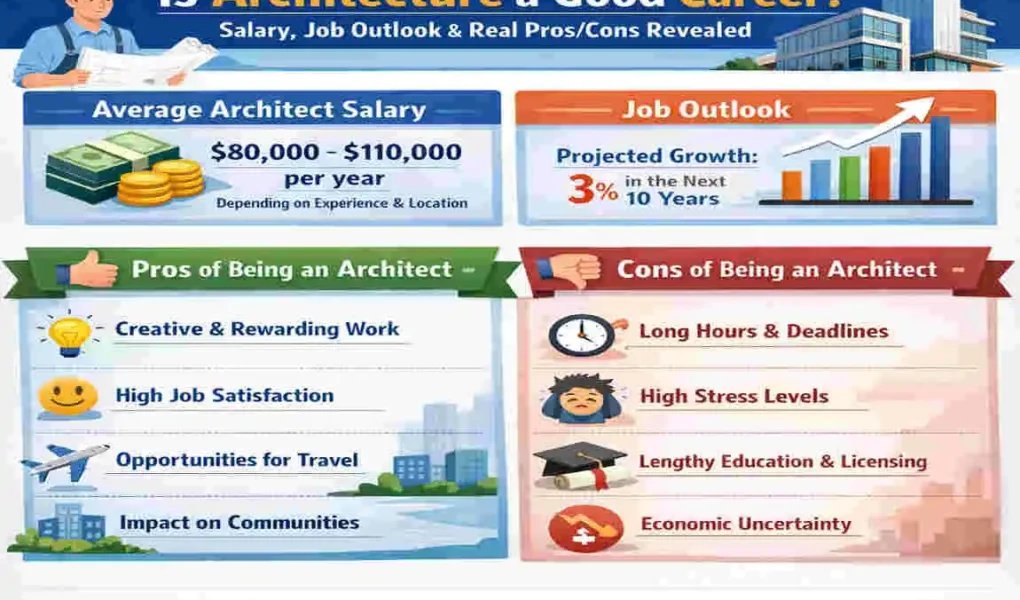
We have to be real about the finances. Architecture school is expensive. The materials for models (laser cutting, 3D printing, wood, glue) add up, on top of tuition. The average architecture student in the U.S. graduates with significant debt, often exceeding $100,000. Unlike medical school, where high debt is met with an immediate high salary, architecture salaries take longer to ramp up, which is something to consider seriously.
Architecture Salary Breakdown 2026: Entry to Expert
Let’s talk money. This is usually the biggest point of contention when asking, “Is architecture a good career?” The short answer is: You can make a very good living, but you probably won’t be a billionaire unless you become a “Starchitect” or own a large firm.
Entry-Level Expectations
Fresh out of school, you are usually titled a “Junior Architect” or “Architectural Designer.” In the United States, the average starting salary ranges from $50,000 to $70,000.
This can be a shock for graduates who spent five years in a rigorous program, especially when compared to their friends in Tech or Finance who might start at six figures. However, remember that you are still in the training phase (AXP) of your career.
Mid-Career and Senior Growth
The good news is that the salary trajectory is steady. As you gain licensure and experience, your value skyrockets.
- Project Architects (Mid-Career): Once you are licensed and have 5-10 years of experience, salaries typically range from $80,000 to $120,000.
- Senior Architects/Principals: If you move into management or become a partner in a firm, salaries often exceed $150,000 and can go much higher with profit sharing.
Location, Location, Location
Where you work matters immensely; an architect in New York city or San Francisco might earn $130,000, while someone with the same experience in the Midwest might earn $90,000. However, the cost of living in those coastal cities often eats up the difference.
Global Perspective: Pakistan and Beyond
Architecture is a global career, and salaries vary wildly by region. For readers looking at the market in South Asia, specifically Pakistan, the numbers look different, but purchasing power parity remains relevant.
- Entry-Level in Pakistan: Fresh graduates often start at PKR 60,000-100,000 per month (approx. PKR 1.2M annually).
- Senior Level: Experienced architects leading projects in cities like Lahore or Karachi can earn PKR 3M to 4M+ annually.
- Middle East: Many architects from South Asia move to the UAE or Saudi Arabia, where tax-free salaries can be significantly higher, often comparable to Western wages.
Bonuses and Perks
Base salary isn’t everything. Many firms offer year-end bonuses based on the firm’s profitability. Since the pandemic, there has also been a massive shift toward remote work flexibility, which is a non-monetary perk that saves you commuting time and money.
Salary Comparison Table:
Experience Level U.S. Average Salary Pakistan Average (PKR)
Entry (0-3 yrs) $60,000 1.2M
Mid (4-10 yrs) $95,000 2.5M
Senior (10+ yrs) $140,000 4M+
Architecture Job Outlook 2026: Is Demand Rising?
You don’t want to enter a dying field. Fortunately, architecture is far from dying, but it is evolving.
The Growth Stats
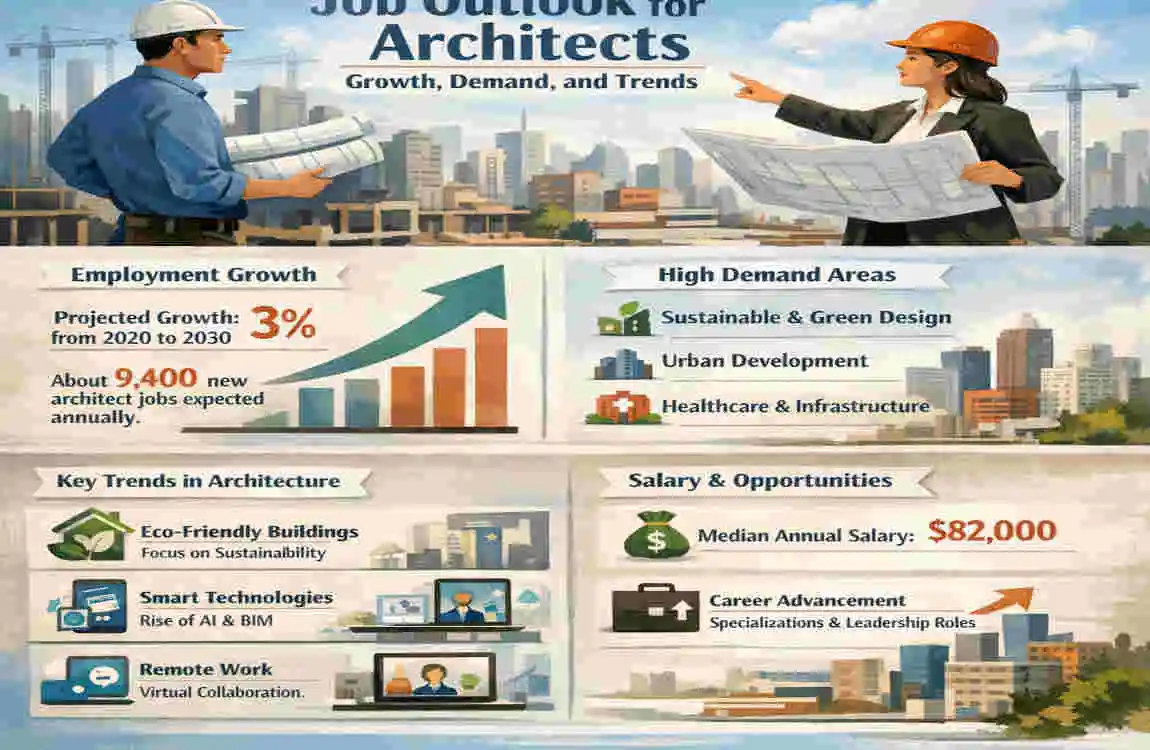
According to the U.S. Bureau of Labor Statistics and other economic forecasters, the employment of architects is projected to grow 5% from now through 2032. This is considered “faster than average” compared to all occupations.
This translates to about 10,000 job openings per year. This growth is driven by the need to replace workers who retire or transfer to different occupations, as well as the fundamental need for housing and commercial space.
Hot Trends Boosting Demand
Several factors are actively increasing the need for architects:
- Sustainable Design: Climate change is forcing the construction industry to adapt. There is a massive demand for architects who know how to design “Net Zero” buildings and obtain LEED certifications.
- Urban Revitalization: Cities are running out of empty land. There is a huge push for “adaptive reuse”—turning old factories or warehouses into cool apartments or offices. This is complex work that requires skilled architects.
- Aging Population: As the baby boomer generation ages, demand for healthcare facilities, senior living communities, and accessible home designs is surging.
The AI Challenge
We cannot ignore the elephant in the room: Artificial Intelligence. Will AI replace architects?
The consensus for 2026 is no. AI tools are becoming powerful assistants. They can generate floor plan variations or rendering images in seconds. However, AI cannot navigate complex building codes, handle difficult client emotions, or troubleshoot construction site errors. Instead of replacing architects, AI is making them more efficient, removing the boring drafting work and leaving more time for design.
Pros of a Career in Architecture
Why do people stay in this profession if the schooling is long and the starting pay is average? Because the rewards can be profound.
Creative Freedom and Expression
There are very few jobs where you get to use both sides of your brain so intensely. You are an artist and an engineer. You get to take a blank sheet of paper and turn it into a place where people live, work, and make memories. That act of creation is incredibly addictive and fulfilling.
High Impact on Society
Doctors save lives, but architects shape the way lives are lived. A well-designed hospital helps patients heal faster. A well-designed school helps children learn better. A well-designed home brings families together. The work you do has a tangible, lasting impact on human behavior and happiness.
Tangible Legacy
Most office jobs result in spreadsheets or reports that are forgotten in a year. An architect’s work stands for decades, perhaps centuries. You can drive past a building with your children and say, “I designed that.” That sense of legacy is a huge ego boost and a source of pride.
Dynamic Work Environment
If you hate doing the same thing every day, architecture is a great option. One day you are sketching, the next you are selecting marble samples, the next you are wearing boots in the mud at a job site. You work with a variety of people: construction workers, city officials, millionaire developers, and artists.
Prestige
Let’s be honest—it sounds cool. “I’m an architect” commands respect in social circles. It is viewed as an intellectual and sophisticated profession.
Architecture Career Cons: Overhyped or Overworked?
To make an informed decision, you need to look at the dark side of the moon. Here are the challenges that cause burnout in the industry.
Long Hours and Burnout
This is the most common complaint. Architecture culture, from university onward, often glorifies “all-nighters.” When a deadline is approaching for a competition or a client meeting, the 40-hour workweek goes out the window. 50, 60, or even 70-hour weeks can happen. This can lead to severe burnout if you don’t set boundaries.
High Stress Levels
You are responsible for millions of dollars of someone else’s money. If you make a mistake in the drawings, it can cost a fortune to fix on the construction site. You also have to manage clients who constantly change their minds, contractors who cut corners, and city officials who deny permits. The pressure is real.
The Slow Start
As mentioned in the salary section, the return on investment takes time. You spend 5-7 years in school, then 3 years as an intern, all while making modest money. It takes about a decade of dedication before you really feel established and well-compensated.
Vulnerability to Recessions
Construction is often the first thing to stop when the economy crashes. During the 2008 financial crisis, many architects lost their jobs. While the industry is more stable now, it is still cyclically linked to the real estate market.
Subjective Criticism
You have to develop a thick skin. You will pour your heart into a design, only for a client to say they hate it, or for a contractor to say it is impossible to build. Learning not to take design critique personally is a Survival skill.
Summary of Trade-offs:
Pros Cons
Creative Expression Intense Deadlines
Solid Salary Growth (Eventually) Years to License
Societal Impact Client Drama
Prestige Recession Sensitivity
Is Architecture a Good Career for You?
So, having weighed the data, the money, and the lifestyle, is this the path for you? It is not for everyone.
Who Thrives in Architecture?
- The Visual Thinker: You have always been the kid who drew in the margins of your notebook or played with LEGOs way past the “appropriate” age.
- The Detail-Oriented: You notice things others don’t—the way light hits a wall, the alignment of tiles, the texture of a handrail.
- The Perseverer: You are willing to delay gratification. You understand that mastery takes time, and you are willing to put in the work to get there.
- The Diplomat: You can handle conflict and navigate between different personalities (clients vs. builders).
Who Should Avoid It?
- The Quick Cash Seeker: If you want to make $100k right out of college, look at software engineering or investment banking.
- The 9-to-5 Purist: If you want a job where you can completely switch off your brain at 5:00 PM every single day, the deadline-driven nature of architecture might struggle to fit that lifestyle.
Alternatives to Consider
If you love the idea of architecture but the licensing path or salary scares you, consider these adjacent careers:
- Civil Engineering: More math-heavy, generally higher starting pay, and focused on infrastructure (bridges, roads).
- Urban Planning: Focuses on the big picture of cities and zoning rather than individual buildings.
- Construction Management: You are on-site, making the building happen. It is high stress, but it often pays better than design.
- 3D Visualization Artist: If you love digital modeling and rendering, you can do this exclusively for gaming, movies, or real estate marketing.
FAQ: Is Architecture a Good Career?
Is architecture a good career for the future?
Yes. With a projected 5% job growth through 2032 and a booming focus on sustainable “green” building, the demand for skilled architects is steady. While technology is changing the field, the need for human creativity and problem-solving isn’t going away.
Do architects get paid well?
Eventually, yes. Starting salaries can be modest (around $50k-$60k), which frustrates some graduates. However, once you are licensed and have 5-10 years of experience, salaries often jump to $90k-$130k+, offering a comfortable upper-middle-class lifestyle.
Do I need to be good at math to be an architect?
You need to be competent, but you don’t need to be a mathematician. You need a strong grasp of geometry, algebra, and physics concepts to understand how a building stands up. However, you won’t be doing complex calculus by hand every day; computers handle the heavy calculations.
Is being an architect stressful?
It can be. The industry is known for tight deadlines and “crunch time” before project submissions. Dealing with client changes and construction budgets can also be high-pressure. However, many find the satisfaction of seeing their designs built makes the stress worth it.
Do I need to be an amazing artist to study architecture?
Not necessarily. While sketching helps you communicate ideas quickly, modern architecture relies heavily on 3D modeling software (like Revit and Rhino). Being able to visualize space in your head is more important than being able to draw a perfect portrait by hand.
Will AI replace architects?
Likely no. AI is becoming a powerful tool that helps architects design faster and generate options instantly. However, AI cannot negotiate with clients, navigate complex local zoning laws, or ensure a building is legally safe for habitation. Architects will use AI, not be replaced by it.