If you have looked at the traditional real estate market lately, you have probably felt a mix of shock and frustration. With median home prices in the U.S. rising every year, the dream of owning a piece of property can feel like it is slipping away for many hardworking people. You are definitely not alone in feeling this way. This financial pressure is exactly why so many potential buyers are pivoting their search toward a more attainable solution: manufactured housing.
By the time you finish reading, you will understand that while a mobile home typically ranges between $80,000 and $200,000, where you live and what you put inside it can swing that price by as much as 50%. Let’s get into the specifics so you can plan your future with confidence.
What Is a Mobile Home? Quick Primer
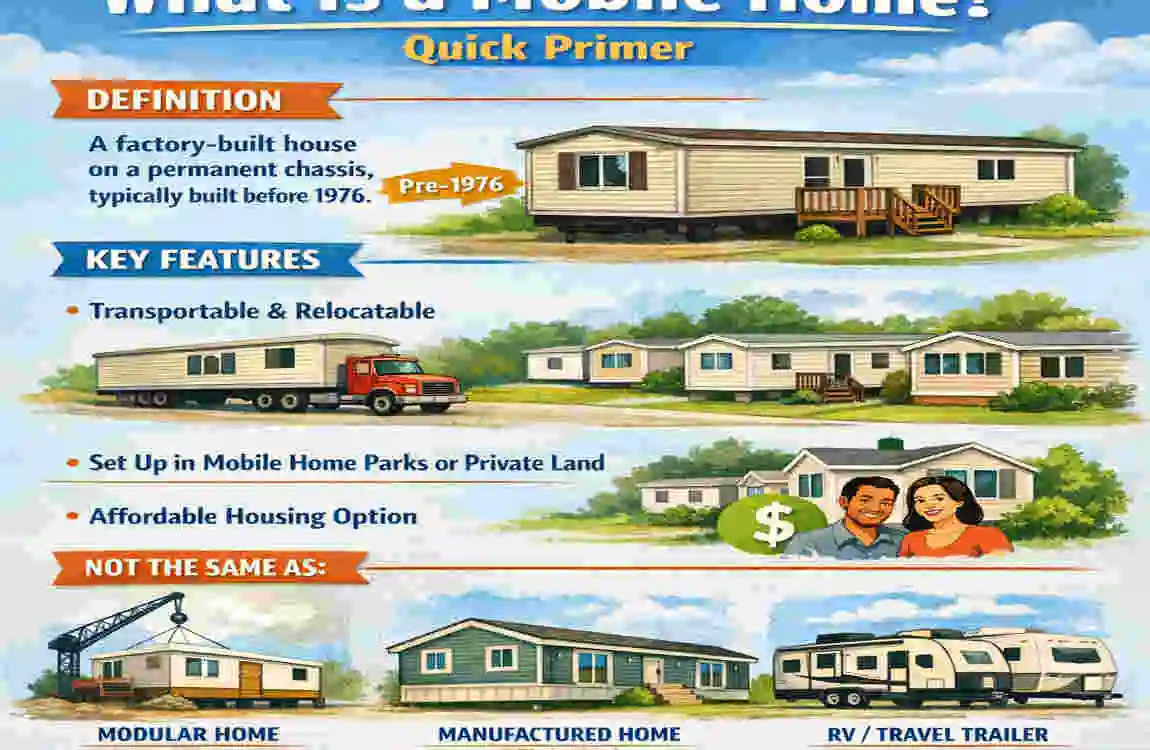
Before we start crunching numbers, let’s make sure we are all speaking the same language. While we often use the term “mobile home” in casual conversation, the industry term is “manufactured home.”
Here is the distinction: technically, “mobile homes” refers to units built before 15 June 1976. Anything built after that date falls under the jurisdiction of the U.S. Department of Housing and Urban Development (HUD). Why does this matter to your wallet? Post-1976 homes are built to the HUD Code, which mandates strict standards for thermal protection, plumbing, electrical systems, and structural integrity.
The manufactured homes of 2026 are nothing like the stereotypes of the past. Today, these structures are highly energy-efficient, often customizable, and built in climate-controlled factories, eliminating delays caused by bad weather.
National Average Costs: Baseline for 2026
When budgeting for a new home, it helps to start with the big picture. In 2026, the gap between site-built home prices and manufactured home prices remains wide, making manufactured housing the clear winner for affordability. However, prices have ticked up slightly due to labor shortages and higher costs for raw materials such as lumber and steel.
Below is a breakdown of the national averages you can expect to see when walking onto a dealership lot today. Keep in mind, these are base prices for the structure itself, usually not including land or extensive site preparation.
Key Stats Table: 2026 Average Prices
Category Average Cost Typical Price Range
Single-Wide (500–1,200 sq ft) $80,000 $50,000 – $120,000
Double-Wide (1,200–2,200 sq ft) $150,000 $100,000 – $250,000
Triple-Wide (2,000+ sq ft) $200,000+ $180,000 – $350,000
Used Mobile Home (Post-2010) $65,000 $30,000 – $90,000
What Influences These Averages?
You might look at that table and wonder why the range is so wide. Why does one single-wide cost $50,000 while another costs $120,000?
- Materials and Finishes: A base model might come with vinyl walls and laminate countertops. The higher end of that range gets you drywall (which looks like a traditional home) and granite or quartz counters.
- Labor Inflation: In 2026, skilled labor is at a Premium. The cost of employing factory workers, drivers, and setup crews has increased, which is reflected in the sticker price.
- Regional Supply: If you live near a manufacturing hub (like in the South), your costs are lower because the home doesn’t have to travel as far. If you are in the Pacific Northwest, you are paying for that long-haul transport.
According to recent census data and industry reports from ManufacturedHomes.com, while the average price has risen about 4% since 2024, it is still roughly half the cost per square foot of a traditional home.
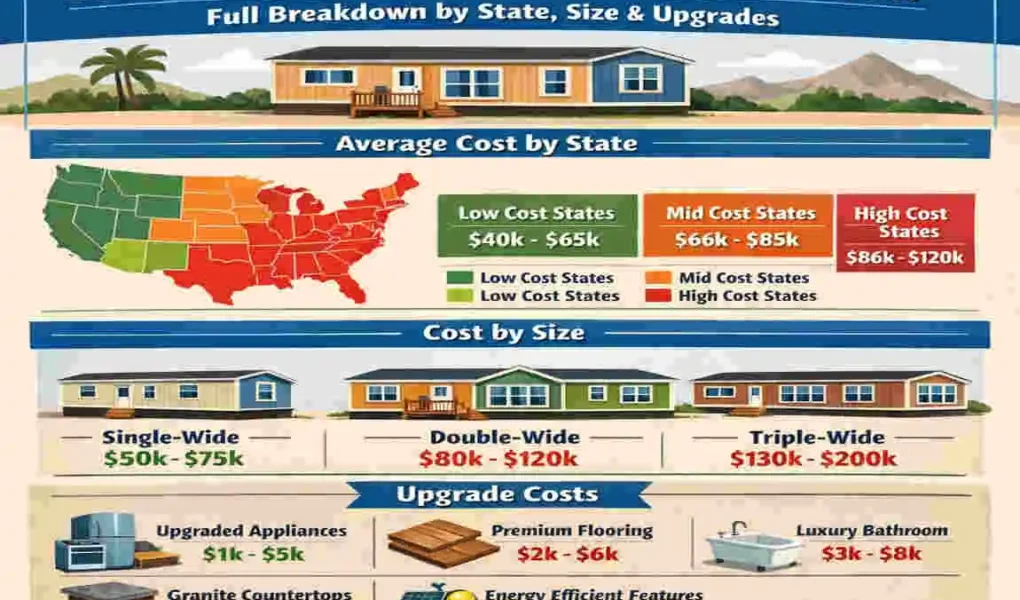
Mobile Home Costs by Size: Single-Wide, Double-Wide & More
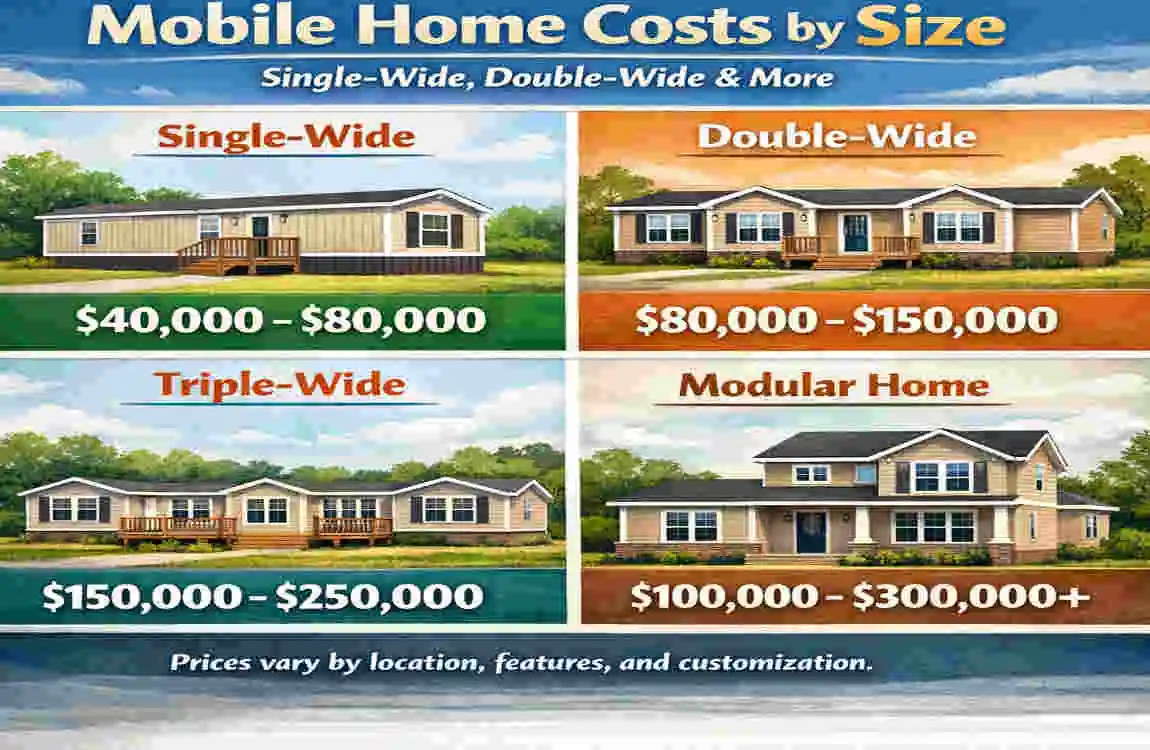
Size is the biggest lever you can pull when determining the cost of your home. The terminology here—single, double, triple—refers to how many sections the home is built in. Each section is transported separately on a semi-truck and joined together at your property.
Single-Wide Mobile Homes
Average Cost: $50,000 – $120,000
A single-wide is exactly what it sounds like: a long, narrow unit that is delivered in one piece. Typically, these are roughly 14 to 18 feet wide and up to 90 feet long.
- The Pros: They are the most affordable entry point into homeownership. They fit easily on smaller plots of land or in dense mobile home parks.
- The Cons: The layout is linear (“shotgun style”), so you often have to walk through one room to reach another. Hallways are narrow.
- The Sweet Spot: A popular 2026 configuration is a 16×80 model (1,280 sq ft). You can often find these for around $90,000, offering 3 bedrooms and 2 bathrooms. This is an incredible value for a small family or a couple looking to downsize.
Double-Wide Mobile Homes
Average Cost: $100,000 – $250,000
This is the gold standard for most families. A double-wide is shipped in two separate sections and joined on-site. The result is a home that looks and feels much more like a traditional ranch-style house.
- The Experience: Because the width is doubled (usually 20 to 32 feet wide), you get open floor plans. You can have a kitchen island, a large living room, and a dining area that aren’t all squeezed into a single line.
- Price Factors: The cost jumps here not just because of materials, but because of setup. Joining the two halves requires a specialized crew to ensure the roofline is sealed and the floor is level.
- Comparison: If you search “double wide mobile home cost” vs. “site-built cost,” you will see that a 2,000 sq ft double-wide might cost $160,000, whereas a site-built home of the same size could easily run $400,000.
Triple-Wide and Larger Options
Average Cost: $180,000 – $350,000+
If you are looking for luxury, this is it. Triple-wides (and occasionally quadruple-wides) can exceed 3,000 square feet. These homes often feature architectural details such as dormers, steeper roof pitches, and wraparound porches.
- When to Choose This: These are best for buyers who own a large plot of private land and want a “forever home” without the hassle of construction crews in their backyard for six months.
- Pro Tip: As the home gets bigger, the cost per square foot actually drops. While the total tag is higher, you get more “house” for every dollar spent than with a single-wide.
State-by-State Breakdown: Where Prices Vary Most
This is the most critical section of this guide. You cannot simply take the national average and assume it applies to you. Local regulations, transportation costs, and demand heavily dictate the cost of a mobile home.
Below is a snapshot of price fluctuations across key states in 2026.
Top 10 States by Average Cost Breakdown
State Avg Single-Wide Avg Double-Wide Key Cost Factor
California $150,000 $280,000 Strict environmental/fire codes & high land costs
Texas $70,000 $140,000 Manufacturing hub & low transport fees
Florida $90,000 $170,000 Wind Zone III (Hurricane) upgrades required
Arizona $85,000 $160,000 High demand for retirement communities
New York $110,000 $210,000 Heavy zoning regulations & taxes
Ohio $75,000 $145,000 Central location helps keep shipping moderate
North Carolina $78,000 $150,000 High volume of dealers keeps pricing competitive
Washington $130,000 $240,000 Labor costs & energy efficiency mandates
Michigan $80,000 $155,000 Cold-weather insulation packages add cost
Alabama $65,000 $130,000 proximity to many factories
High-Cost States: The Coastal Premium (CA, FL, NY)
If you are asking “how much does a mobile home cost in California,” prepare for sticker shock. In states like California and Washington, you aren’t just paying for the house. You are paying for compliance. California has rigorous energy standards and wildfire-resistant exterior requirements (WUI codes). This can add $20,000 to $40,000 to a home’s base price.
In Florida, the issue is wind. The state is divided into Wind Zones. If you live on the coast (Zone III), your home must be built to withstand high-velocity hurricanes. This requires stronger wall studs, specialized roof straps, and impact-resistant windows.
Low-Cost States: The Southern Advantage (TX, AL, MS)
Conversely, the South is the heartland of manufactured housing. States like Texas, Alabama, and Mississippi have a high concentration of factories.
Because the home doesn’t have to sit on a truck for 800 miles to get to you, you save thousands on delivery. Furthermore, land is generally cheaper, and zoning laws are more permissive, meaning you have fewer administrative hoops (and fees) to jump through. A nice double-wide that costs $170k in Florida costs only $140k in Texas.
The Midwest & Other Regions
The Midwest offers a balanced middle ground. In states like Ohio and Michigan, the focus is on thermal protection. You will pay a bit more for “2×6 sidewalls” (allows for thicker insulation), and heavy-duty roof loads to handle snow, but overall prices remain very competitive compared to traditional housing.
Breaking Down Additional Costs Beyond the Sticker Price
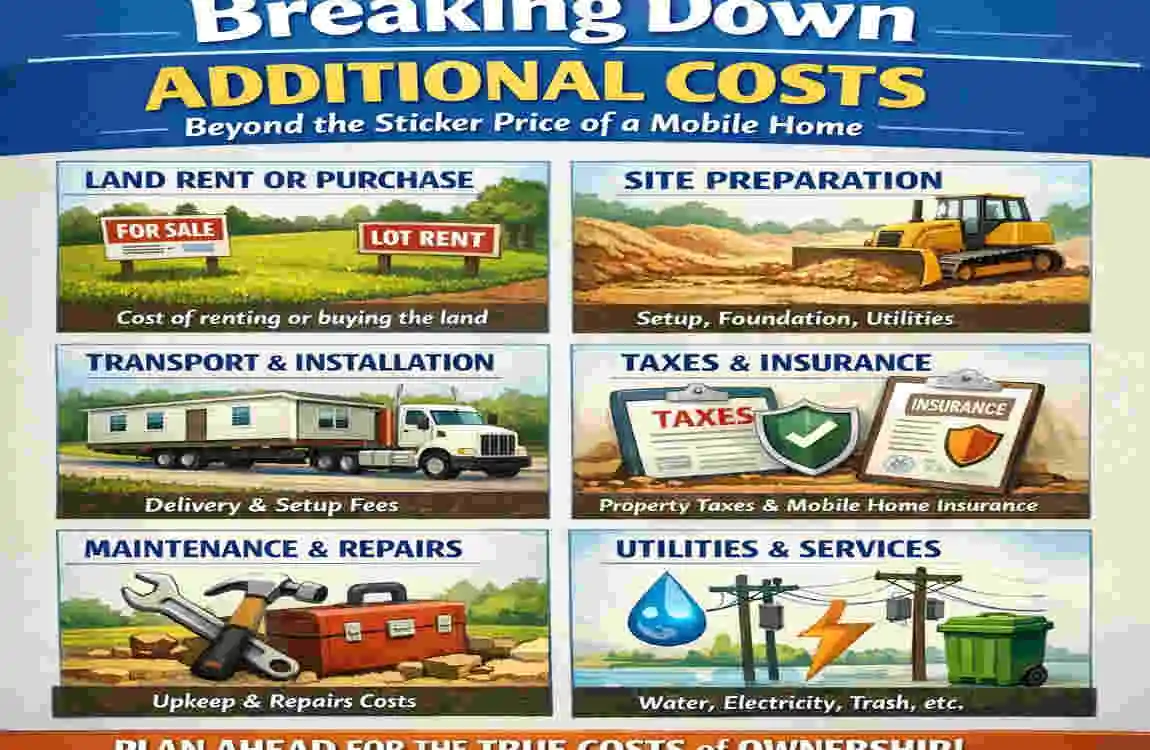
If you take nothing else away from this article, let it be this: The sticker price is not the final price.
Many first-time buyers get their financing approved for the exact cost of the home, only to realize they are $30,000 short of the setup costs. Here is the realistic breakdown of the “hidden” costs you need to budget for.
Land and Lot Setup
You have two choices: buy land or rent a lot.
- Buying Land: This varies wildly. A rural acre in Arkansas costs $5,000, while a plot in Oregon costs $100,000.
- Renting a Lot: If you move into a “land-lease community” (mobile home park), you will pay a monthly lot rent. In 2026, this averages $300 to $800 per month, depending on amenities (pools, clubhouses, etc.).
Delivery, Setup & Foundation
Unless the dealer explicitly says “delivery included” (which usually only covers the first 50-100 miles), you are paying for transport.
- Transport: Costs average $5 to $10 per mile.
- The Foundation: You cannot just park the home on grass. You need a concrete slab, a pier-and-beam system, or a crawl space. A basic slab for a double-wide runs $5,000 to $10,000.
- The “Set”: This includes blocking, leveling, anchoring (tie-downs), and putting on the skirting (the vinyl or brick that covers the gap at the bottom). Budget $5,000 to $15,000 for this labor.
Utilities: The “Hookup”
If you are on raw land, you need power, water, and sewage.
- Septic Tank: $5,000 – $10,000.
- Well Drilling: $4,000 – $12,000.
- Electric Pole/Meter: $2,000 – $5,000.
- Permits, impact fees, and inspections can easily add another $2,000.
Total “Add-On” Reality Check: It is safe to assume you will spend 20% to 40% of the home’s base price on getting it ready to live in.
Popular Upgrades and Their Costs
One of the best parts of buying a new manufactured home is customization. You aren’t stuck with what the previous owner liked. However, upgrades add up fast. Which ones are worth it?
Upgrade Cost Range Value Add / ROI
Energy Star Package (Insulation, Windows) $5,000 – $8,000 Essential. Saves 20-30% on monthly utility bills.
Drywall Throughout (vs. Vinyl walls) $5,000 – $10,000 Makes the home look “site-built.” Huge boost for resale value.
Upgraded Kitchen (Cabinets/Counters) $3,000 – $8,000 High livability factor.
Steeper Roof Pitch (Architectural Shingles) $2,000 – $5,000 Improves curb appeal and shedding of snow/rain.
Decks and Porches: $5,000 – $15,000. Expands living space.
The ROI of Upgrades
If you are on a tight budget, prioritize the structure over the cosmetics. You can always upgrade your countertops or carpets later. You cannot easily change the thickness of your walls or the insulation in your roof once the home is built.
Spending the extra $6,000 on the “Energy Star” or “Northern Insulation” package will pay for itself in lower electric bills within 5 to 7 years.
Hidden Costs & Long-Term Ownership Expenses
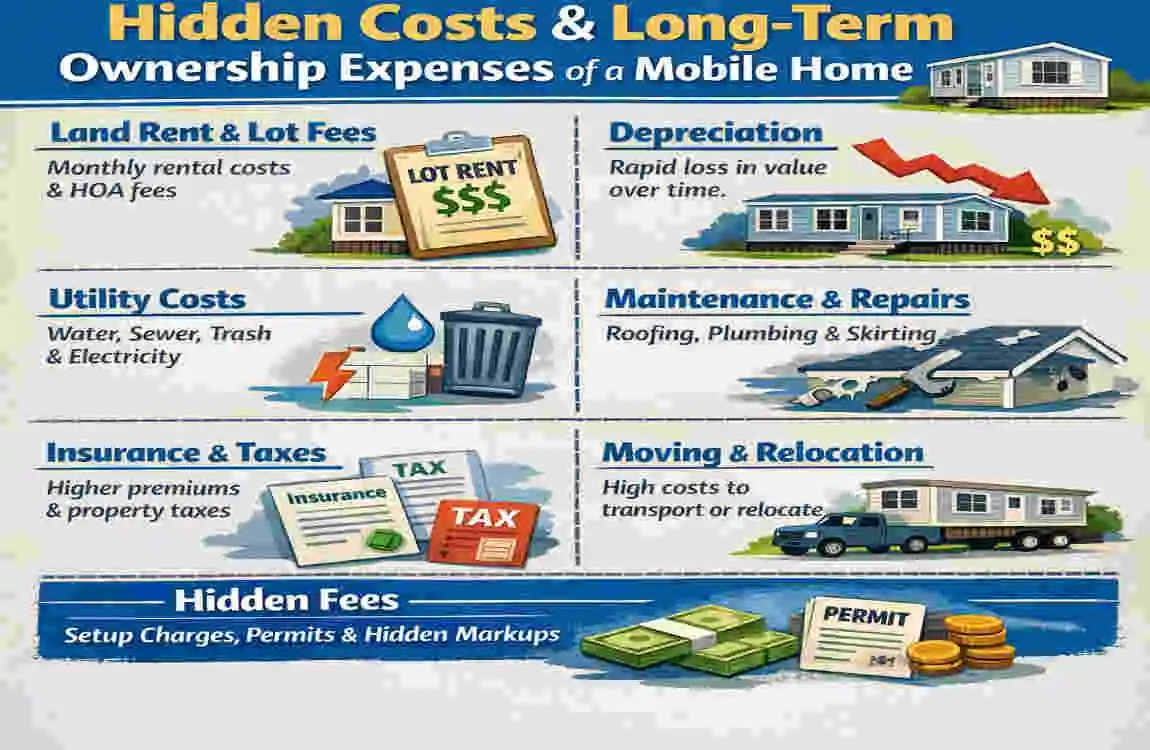
Owning a home is a marathon, not a sprint. Once you are moved in, there are ongoing costs specific to mobile homes.
Maintenance: Like any home, things break. However, mobile homes have specific needs. You need to check your skirting regularly to ensure rodents aren’t getting under the house. You also need to check your leveling every few years. If the ground settles, your doors might stop closing properly. Re-leveling a home costs about $500 – $1,000.
Financing Interest Rates: This is a big one. If you buy the home and the land together, you can often get a traditional mortgage with standard rates. However, if you buy only the home (and rent the land), you will likely get a Chattel Loan. In 2026, interest rates on chattel loans are typically 2% to 5% higher than standard mortgage rates because the bank views the home as personal property (like a car) rather than real estate.
Insurance: Mobile home insurance is specialized. Costs range from $800 to $2,000 annually, but can be significantly higher in tornado alleys or hurricane zones.
Is a Mobile Home Right for You? Pros, Cons & Financing
So, now that you know the costs, is it the right move?
The Pros:
- Unbeatable Affordability: You can own a brand-new, 3-bedroom home for under $150k. That is unheard of in the traditional market.
- Speed: You can move in within weeks or months, not years.
- Modern Comfort: New models are safe, stylish, and energy-efficient.
The Cons:
- Depreciation: Without land, the home itself generally depreciates over time.
- Stigma: While fading, some people still view manufactured housing negatively.
- Financing Hurdles: Fewer lenders deal with chattel loans.
A Note on Financing
If you have a credit score above 580, you have options.
- FHA Title I Loans: Specifically for manufactured homes (even without land).
- VA Loans: excellent options for veterans.
- USDA Loans: If you buy land in a rural area, this can be a zero-down option.
FAQs: Answering “How Much Does a Mobile Home Cost?”
How much does a mobile home cost in Texas compared to California? Texas is significantly cheaper. A double-wide in Texas averages around $140,000, while the same home in California could cost $280,000 due to stricter regulations and higher labor costs.
Which is cheaper: a Single-Wide or a Double-Wide? A single-wide is cheaper, averaging $80,000, compared with $150,000 for a double-wide. However, double-wides offer better cost-per-square-foot value.
Do mobile homes increase in value? Generally, the structure depreciates like a car. However, if you own the land underneath and the home is permanently affixed to a foundation, the total property value can appreciate just like traditional real estate.
What are the cheapest states to buy a mobile home? The cheapest states are typically in the South and Midwest, specifically Alabama, Texas, Mississippi, and Ohio, due to low land costs and proximity to factories.
Can I customize a mobile home? Absolutely. In 2026, factories allow you to move walls, upgrade finishes, add fireplaces, and even change the roofline, though these changes will increase the base price.