Imagine you’re touring a beautiful Florida home, expecting it to have three bedrooms because that’s what the listing said. But when you look closer, only two rooms truly qualify as bedrooms under Florida law. This situation is more common than you might think — and it can make a big difference if you’re buying, selling, or renovating a home.
Why does this matter? Bedrooms heavily influence a home’s value. Adding an extra bedroom can increase home prices by 10-20%, and incorrect bedroom counts can hurt appraisals, cause issues with insurance, and even lead to legal troubles when listing your property.
Florida Bedroom Code Basics
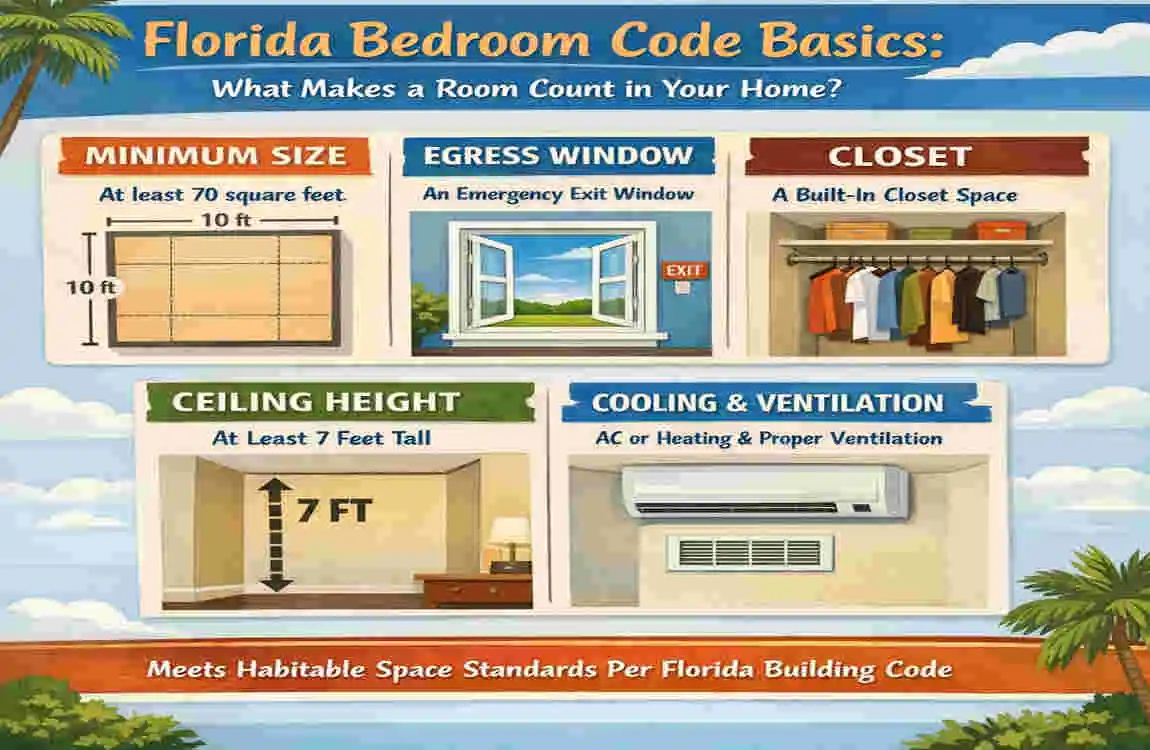
The Florida Building Code (FBC) is the legal framework that defines and regulates bedrooms in the state. According to Section 200 of the FBC, a bedroom is specifically defined as “a room that can be used for sleeping,” but not every room where someone sleeps qualifies as a bedroom.
There are strict qualifiers to meet, including size, ventilation, egress, and location within the home. The code distinguishes between site-built homes and manufactured homes, which have different standards based on their construction methods.
Why Does the Florida Bedroom Code Matter?
- Appraisals: Homes appraised with fewer bedrooms often receive lower valuations.
- Insurance: Insurance companies may refuse coverage or raise premiums if the bedroom count doesn’t meet code.
- Real estate listings: MLS platforms require accurate bedroom counts to maintain transparency and avoid disputes.
The Florida Bedroom Definition Workgroup, active since 2008, has worked on refining these rules to keep homes safe, functional, and marketable.
Understanding the code means you won’t be caught off guard during inspections or sales. You’ll know exactly what rooms count — and which don’t.
Minimum Size Requirements
One of the easiest ways to tell if a room can be officially called a bedroom in Florida is by its size.
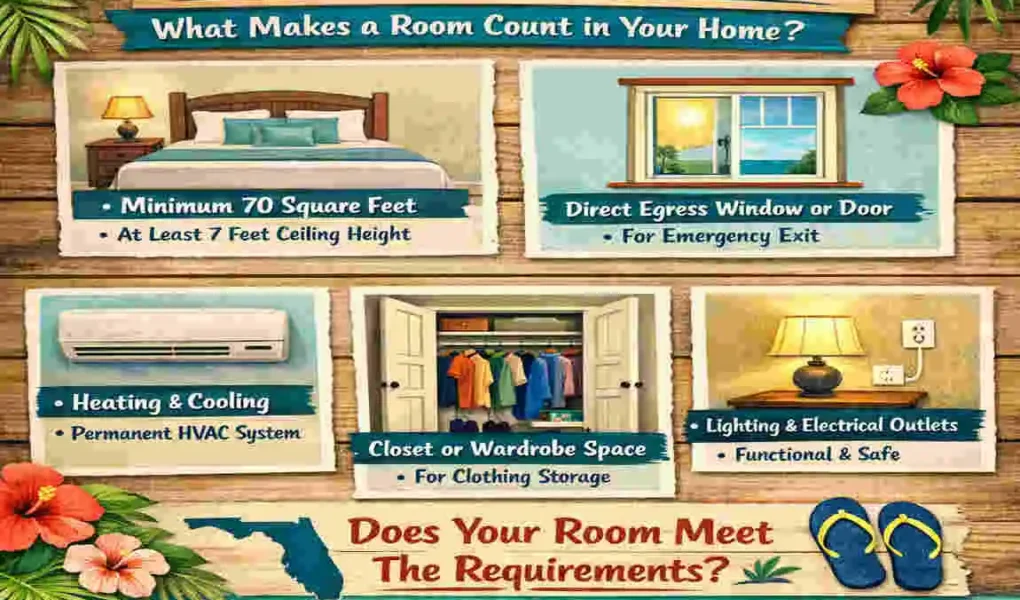
- For site-built homes, the minimum floor area is 70 square feet, with at least one dimension measuring 7 feet or more.
- For manufactured homes, the minimum is smaller — 50 square feet — since construction standards differ.
These minimums ensure the room is large enough to serve as a functional sleeping space.
How Does This Compare With Other Rooms?
For comparison, the code defines a habitable room, such as a living room or kitchen, as requiring at least 120 square feet, which shows that bedrooms are allowed to be cozier but still practical.
Here’s a quick look:
Home TypeMinimum Floor AreaMinimum Dimension
Site-Built 70 sq ft 7 ft
Manufactured 50 sq ft N/A
If a room doesn’t meet these standards, it can’t legally be called a bedroom, even if it’s used for sleeping.
Exterior Wall Location Rule
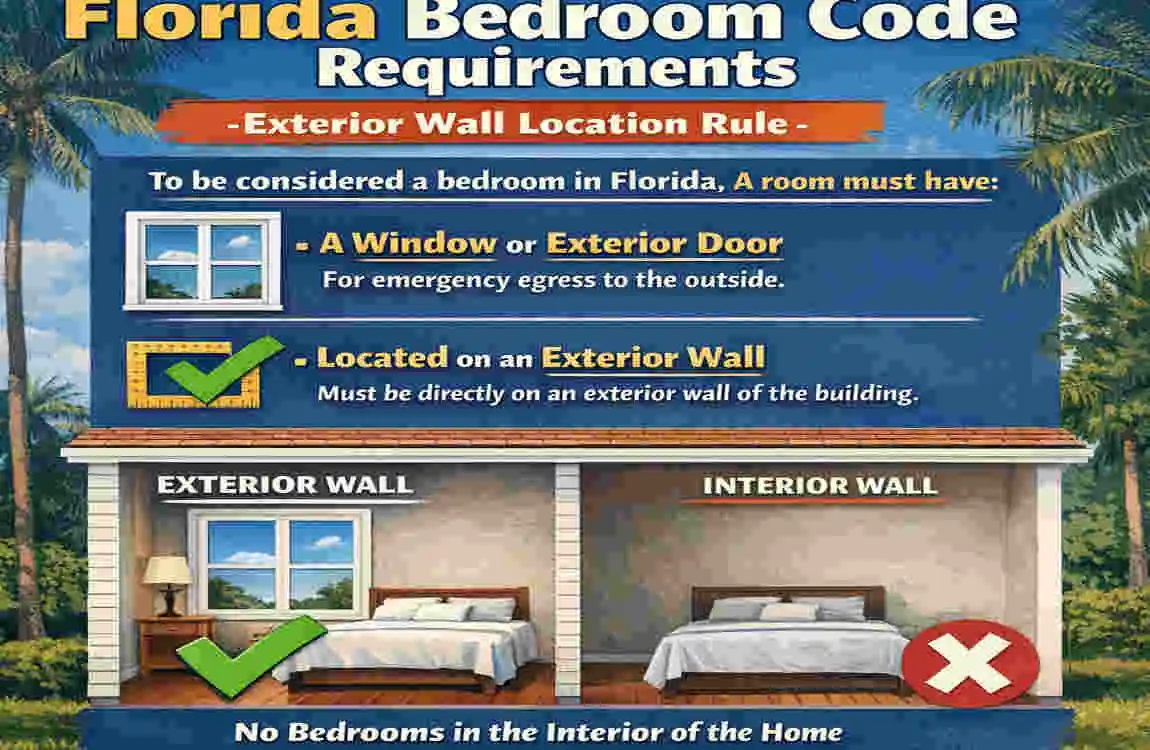
A key element in bedroom qualification is that the room must be located along an exterior wall of the home.
Why?
- Natural light: Bedrooms require windows for daylight.
- Ventilation: Fresh air flow is essential for health and safety.
Interior rooms without exterior walls, such as some bonus rooms or interior offices, cannot qualify as bedrooms under Florida code.
This rule ensures that bedrooms provide safe, livable conditions—not just enclosed spaces.
Closet and Door Essentials
Does a bedroom need a closet in Florida? The answer is yes — but it doesn’t have to be a walk-in closet.
The Florida Building Code requires bedrooms to have:
- A closable door for privacy.
- A closet or a designated space that can function as one.
This is to ensure the room is intended solely for sleeping and storing personal belongings.
Myth-Busting: Closets and Bedrooms
- Myth: Any room with a door counts as a bedroom.
- Fact: It must also have a closet or space for one.
- Myth: The closet must be walk-in size.
- Fact: A small reach-in closet suffices.
For example, an office without a closet doesn’t qualify as a bedroom, even if it has a door and a window.
Emergency Egress Requirements
Safety is a top priority in Florida bedroom rules, and this is why emergency escape and rescue openings are mandatory.
What does this mean?
- Each bedroom must have a window or door that provides a safe way to escape in case of fire or emergency.
- The window must have a minimum opening size of 20 inches wide by 24 inches high.
- The sill height can be no more than 44 inches above the floor.
Ground Floor vs. Upper Floors
- On the ground floor, windows must open directly to the outside.
- For upper floors, balconies or fire escapes may serve as emergency exits, but windows still need to meet size criteria.
Common Violations
- Basements without proper egress windows.
- Windows are too small or blocked by security bars.
- Rooms relying only on doors that don’t lead directly outside.
These violations are red flags for appraisers and inspectors.
Conditioned Space Standards
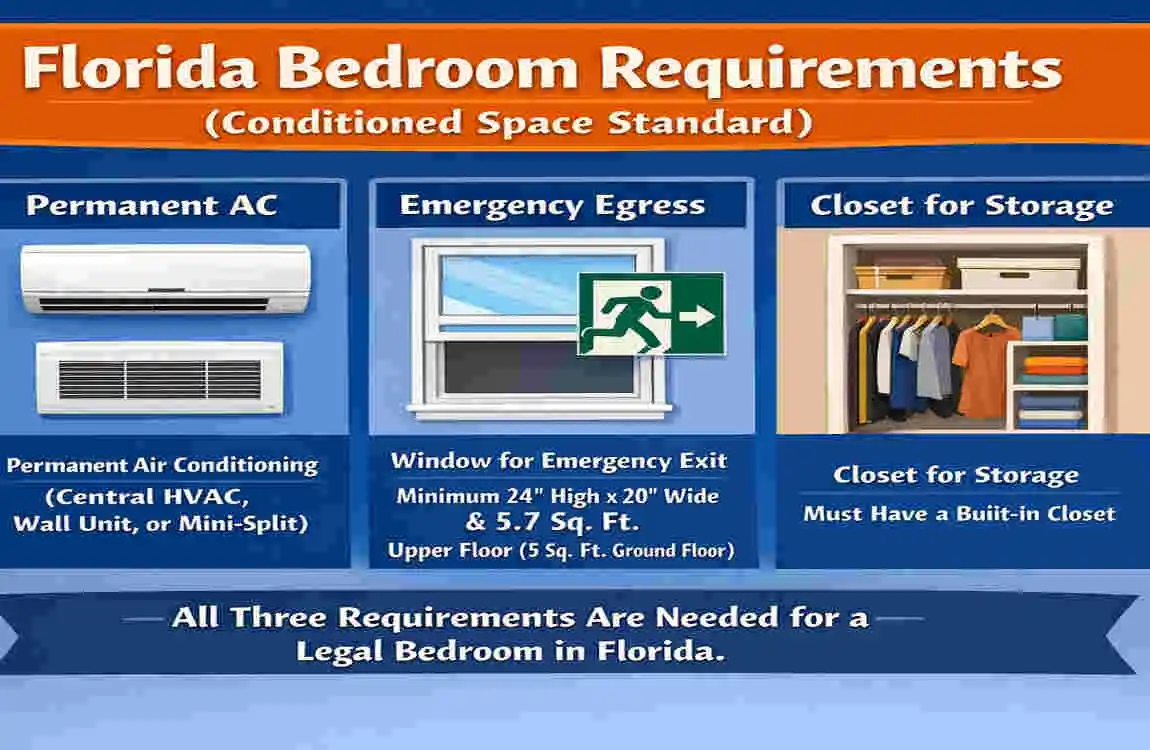
Another requirement is that bedrooms must be conditioned spaces.
This means:
- The room must be heated and cooled.
- Heating systems should maintain a minimum temperature of 68°F.
This rule ensures comfort and compliance with Florida’s energy codes.
Unconditioned spaces, such as unfinished attics or garages, don’t count as bedrooms even if they meet size and egress requirements.
Non-Qualifying Room Scenarios
Not every room with a door is a bedroom. Some common non-qualifying rooms include:
- Hallways or pass-through rooms: Must not be used as access to other bedrooms.
- Offices or media rooms: Without proper egress or closets.
- Sunrooms that are too small or lack conditioned air.
These rooms often get mistaken for bedrooms, but don’t meet the full criteria.
Site-Built vs. Manufactured Homes
Florida distinguishes between site-built and manufactured homes when it comes to bedroom rules.
Feature Site-Built Manufactured
Minimum Size 70 sq ft 50 sq ft
HUD Standards Not applicable Must meet HUD
Manufactured homes are built to federal HUD standards, which can differ slightly from the Florida Building Code applied to site-built homes.
Impact on Home Appraisals
The bedroom count directly affects home appraisals.
- Appraisers strictly follow the Florida bedroom code.
- Overstating the number of bedrooms can lead to lower appraisals or outright rejection.
- Buyers who need a specific number of bedrooms (e.g., families) may be disappointed if rooms don’t qualify.
Example: A family looking for a 3-bedroom home may find a listing with 3 rooms labeled as bedrooms, but one fails the code. This mismatch can derail the sale or reduce the home’s value.
MLS Listing Best Practices
When listing your home:
- Use terms like “bonus room” or “den” for rooms that don’t qualify as bedrooms.
- Disclose any atypical features clearly.
- Avoid risking your agent’s or seller’s reputation by incorrectly labeling rooms.
This transparency builds trust with buyers and agents.
Renovation Tips to Qualify a Room
Want to turn a non-bedroom into a legal bedroom? Here’s how:
- Add a closet that meets minimum dimensions.
- Install an egress window that meets the required size and height.
- Ensure the room is at least 70 sq ft with a minimum 7-foot dimension.
- Confirm the room is along an exterior wall and has a door that can be closed.
- Upgrade heating/cooling to meet conditioned space standards.
Renovation Costs
Expect to pay between $5,000 and $15,000 per room, depending on window installation and HVAC work.
Florida vs. National Codes
Florida’s bedroom rules are generally stricter than the national International Residential Code (IRC).
RequirementFloridaIRC
Closet Required Optional
Egress Window Min 20″ x 24″ Similar standards
This means Florida homeowners must pay closer attention to closets and egress openings than homeowners in many other states.
Common Myths Debunked
- Myth: Any 70 sq ft room counts as a bedroom.
- Fact: It must meet size, closet, door, egress, and wall location rules.
- Myth: No window is needed on upper floors.
- Fact: Egress windows or equivalent emergency exits are always required.
Knowing these myths helps you avoid costly mistakes.
Case Studies: Florida Homes
Consider two Florida homes:
- Home A: Listed as a 3-bedroom, but one room lacked an egress window. Appraisal reduced the value by 8%.
- Home B: Renovated a den by adding a closet and window, increasing the bedroom count to 3. The sale price increased by 15%.
These real examples show the tangible impact of bedroom code compliance.
FAQs
Q: What are the requirements for a room to be a bedroom in Florida?
A: Minimum 70 sq ft (site-built), exterior wall with window, closable door, closet, emergency egress, and conditioned space.
Q: Does a bedroom need a closet in Florida?
A: Yes, a closet or designated storage space is required.
Q3: What size must a bedroom window be in Florida?
A: Minimum 20 inches wide by 24 inches high, with no more than 44 inches above the floor.
Q: Can an interior room count as a bedroom?
A: No, bedrooms must be on an exterior wall.
Q: Are attic bedrooms allowed in Florida?
A: Yes, if they meet all code requirements, including egress and size.
Q: How does Florida code define a manufactured home bedroom?
A: Minimum 50 sq ft, must meet HUD standards, including egress.
Q: Can closets be removed and still call a room a bedroom?
A: No, closets are mandatory.
Q: Does the door have to be solid?
A: It must be closable but not necessarily solid.
Q: Are basement bedrooms allowed?
A: Yes, if they have proper egress windows.
Q: How does non-compliance affect home sales?
A: It can lower appraisal, cause financing issues, or delay sales.