
We’ve all been there. You’re standing in your kitchen, looking out at the garden, and feeling like the walls of your house are slowly closing in on you. Maybe you have a teenager who needs their own space, an elderly relative coming to stay, or perhaps you crave a guest room that doesn’t involve inflating a mattress on the living room floor.
As you gaze out the window, your eyes land on the humble garden shed. It’s sitting there, mostly housing spiders and a rusty lawnmower. Suddenly, a lightbulb goes on. You think, “Can I turn my shed into a house bedroom UK?” It’s the perfect solution: it’s cheaper than an extension, less disruptive than a loft conversion, and the structure is already there.
Turning a garden structure into a habitable living space is one of the most heavily regulated home improvement projects in the UK. It is absolutely possible, but it requires more than just a lick of paint and a heater. In this guide, we are going to walk you through everything—from the rigid planning laws and building regulations to the costs and construction realities.
Legal Basics: The Difference Between a Shed and a Bedroom
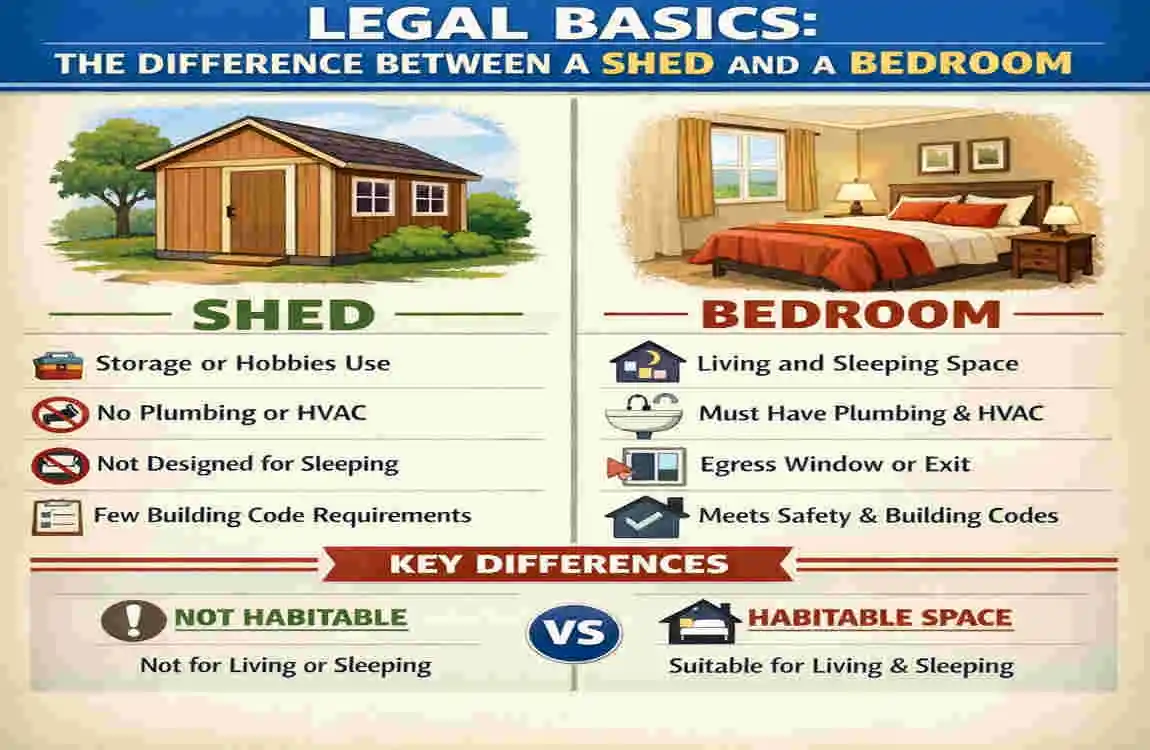
First things first, let’s strip away the jargon. To you, it’s a shed. To the local council, it’s an “outbuilding.” But the moment you decide someone is going to sleep in it, the council stops viewing it as a shed and starts viewing it as a dwelling or habitable accommodation.
This is the most critical distinction you need to understand.
The “Incidental” vs. “Ancillary” Rule
Under the Town and Country Planning Act, garden buildings are usually treated as “incidental” uses. This means the building is used for things that support your enjoyment of the house but aren’t primary living activities. Think of things like:
- Storing tools (a classic shed).
- A home gym.
- A garden office.
- A hobby room or man cave.
You usually don’t need planning permission for these because no one lives there.
However, a bedroom falls under “ancillary” use—or in some cases, a completely separate dwelling. Sleeping is considered a primary living activity. As soon as you install a bed and intend for someone to sleep there regularly, the building’s legal status changes.
The “Duck Test”
Planning officers often use a logic similar to the “duck test” (if it looks like a duck and quacks like a duck…). If your shed has a bed, a shower, and a toilet, and is used for sleeping, it is a house.
If you are putting a sofa bed in a garden office for the occasional nap, you might get away with it. But if you are asking, “Can I turn my shed into a house bedroom UK” for a permanent resident, the answer is that it is viewed as creating a new room for the main house, or even a self-contained home.
Regional Variations
It is also worth noting that while the general principles apply across the UK, there are slight variations in how councils interpret these rules in England, Scotland, and Wales. For example, Scottish building warrants can be quite strict regarding insulation in detached buildings. Always check your specific local authority’s stance.
Planning Permission Guide: Do You Need It?
Many homeowners assume that because they can build a garden office under Permitted Development Rights (PDR), they can also build a bedroom. This is a common and expensive misconception.
Why Permitted Development Usually Fails for Bedrooms
Permitted Development allows you to build outbuildings without a full planning application, provided they meet specific criteria (like being under 2.5m tall and not taking up more than 50% of the garden).
However, the rules specifically state that the outbuilding must be for incidental use. As we discussed above, a bedroom is not incidental. Therefore, converting a shed to a bedroom technically falls outside of Permitted Development rights.
If you want to use a shed as a bedroom, you generally need to apply for Planning Permission.
The Application Process
Don’t panic—applying for planning permission isn’t impossible. It just requires paperwork. You will need to submit:
- Site Plans: Showing the shed’s location relative to the house and boundaries.
- Elevations: Drawings of what the shed looks like.
- Floor Plans: Show the layout (bedrooms, en-suite, etc.).
- Design and Access Statement: Explaining how the building fits the area.
You will likely be engaging with your local authority portal. The process usually takes about 8 to 10 weeks.
Criteria for Approval
When the planning officer looks at your application, they are checking for a few key things:
- Visual Impact: Does it look like a nice garden room, or a shanty town shack?
- Privacy: Will your windows overlook the neighbor’s garden?
- Use: Are you trying to create a separate house to rent out (Airbnb)? If so, that is a whole different (and much harder) application called creating a “separate dwelling.” You want to aim for an “annexe” attached to the main house.
Summary of Constraints
To help you visualize where you stand, here is a quick breakdown of the rules:
Requirement Permitted Development Limit Full Permission Needed If…
Height: Maximum 2.5m (if within 2m of boundary). The roof exceeds 2.5m, or the building is in a conservation area.
Usage: Gyms, Offices, Storage. Used as a bedroom, bathroom, or kitchen (Self-contained living).
Footprint Max 50% of total garden area. You want to cover more than half your garden.
Location: Behind the front building line. You want to build it in the front garden (facing the road).
Intention: Incidental to the main house. It creates a separate address or rental unit.
Building Regulations Essentials: It’s Not Just About Planning
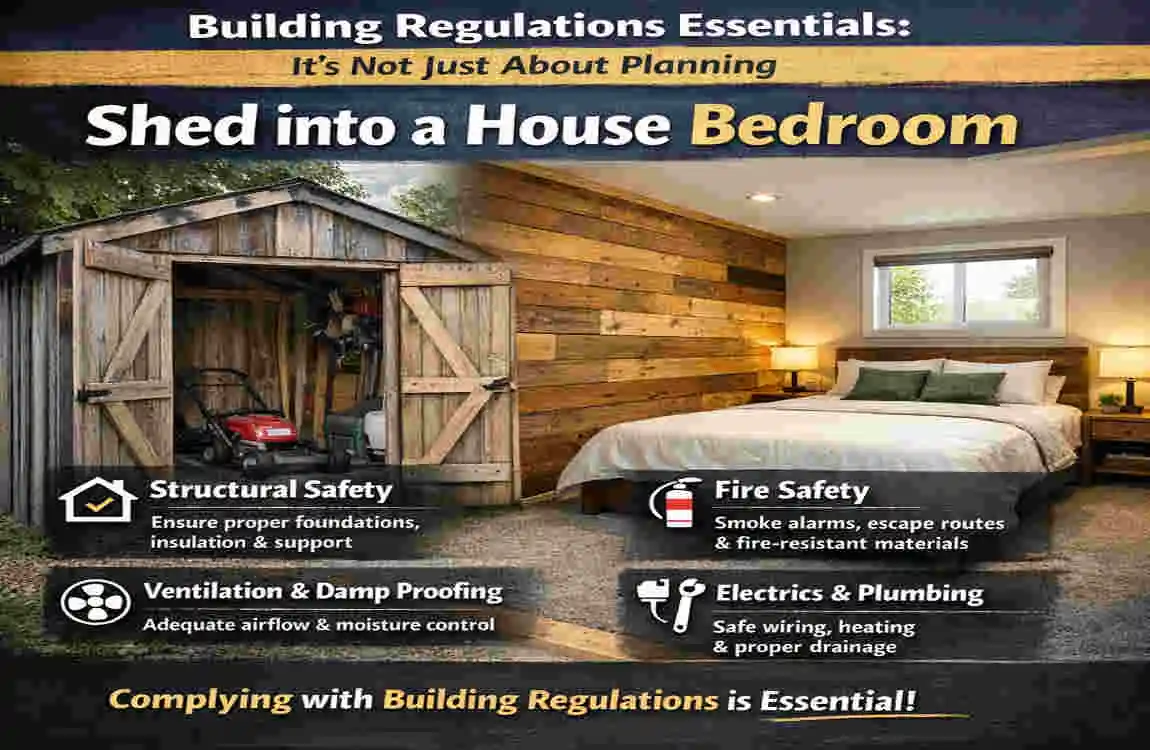
Okay, let’s assume the council says “Yes, you can have a bedroom.” You aren’t finished yet. In fact, this is where the real work begins.
Even if you didn’t need planning permission (which is rare), you must still comply with the Building Regulations.
Building Regulations are intended to ensure that structures are safe, warm, and dry for humans to inhabit. A typical garden shed bought from a hardware store does not meet these standards.
Structure
Your shed cannot just sit on a few paving slabs. If people are sleeping in it, it needs substantial foundations to prevent subsidence. The timber frame needs to be structural grade, capable of holding the weight of a proper roof (and snow load in winter).
Fire Safety
This is non-negotiable.
- Escape Routes: The bedroom must have a window big enough to escape through in a fire.
- Smoke Alarms: It must be hardwired with smoke detection.
- Materials: The walls need to be fire-resistant, especially if the shed is close to a boundary fence. You don’t want a fire in your shed spreading to the neighbor’s house.
Energy Efficiency (Insulation)
This is the biggest hurdle for converting existing sheds. To meet Part L regulations, the walls, floor, and roof must be heavily insulated.
- The Problem: A standard shed has thin walls. By the time you add the required 100mm+ of insulation and plasterboard, you lose a massive amount of internal floor space.
- The Solution: Most people find it better to knock down the old shed and build a new, insulated timber-frame structure from scratch.
Electrical Safety
You cannot just run an extension cord from the kitchen window across the lawn. That is illegal and dangerous.
- You need a dedicated armoured underground cable.
- A certified electrician must install it.
- You need a separate consumer unit (fuse box) in the shed or a dedicated circuit from the main house.
Ventilation
Humans breathe out moisture. Without proper ventilation (trickle vents in windows and extractors in bathrooms), your lovely new bedroom will be covered in black mould within weeks.
Costs and Budget Breakdown
You might be thinking, “This sounds expensive.” You are right to be cautious. While it is cheaper than a brick extension, it is not “cheap.”
If you are looking for a high-quality, legal, and comfortable year-round conversion, you need to budget realistically.
The “Cheap” Myth
You might see sheds online for £500. Do not be fooled. Turning that into a bedroom costs significantly more. A basic conversion of a high-quality existing structure might start at £5,000, but a full build-from-scratch garden bedroom usually lands between £15,000 and £30,000.
Where Does the Money Go?
Here is a realistic look at where your cash will be spent:
Cost Item: Low-End Estimate, High-End Estimate, Notes
Planning & Design £200 £1,500 Includes council fees and architectural drawings.
Foundations £800 £2,500 Concrete slab or ground screws.
Insulation & Drywall £2,000 £5,000 Celotex/Kingspan and plastering.
Electrics & Plumbing £1,500 £5,000 Running trenching, armoured cables, and waste pipes.
Windows & Doors £1,000 £4,000 Double glazing is mandatory for heat retention.
Flooring & Decor £500 £2,000 Laminate, paint, skirting.
Professional vs. DIY
Can you save money by doing it yourself? Yes, but be careful.
- DIY: You can do the insulation, painting, and general carpentry.
- Pro Only: You must hire certified pros for electrics (Part P) and gas/water. If you don’t, you won’t get the Building Control completion certificate, and you will struggle to sell your house later.
Step-by-Step Conversion Process
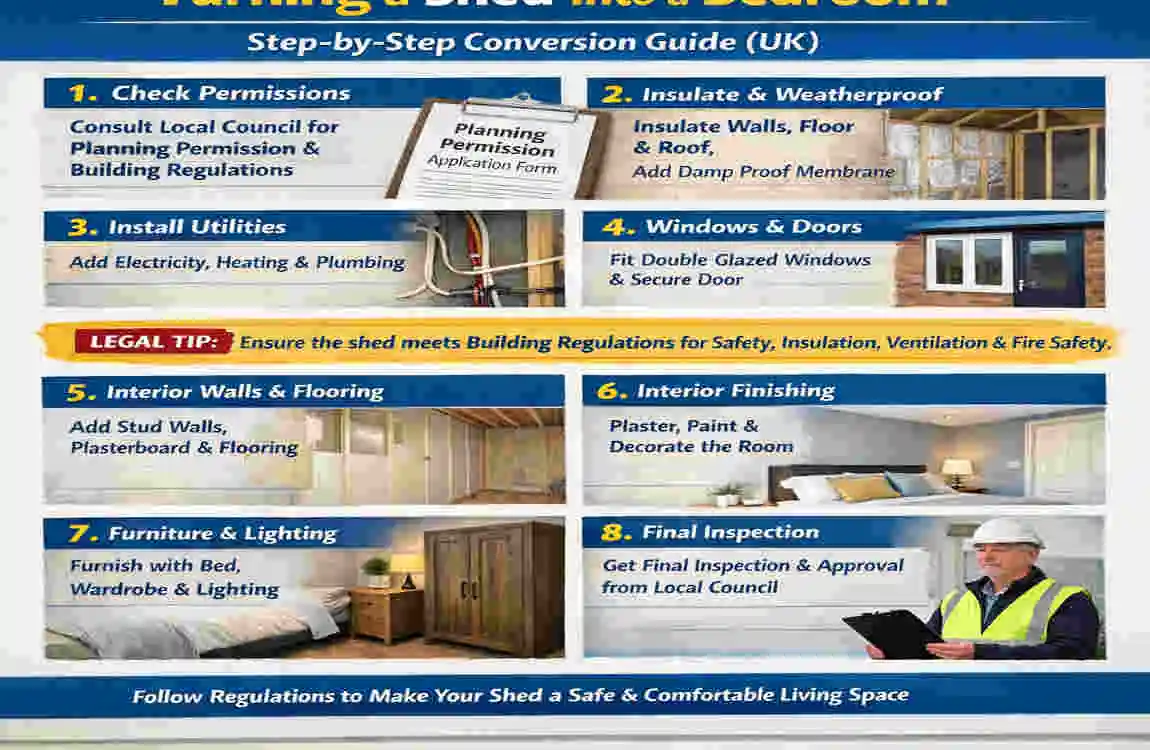
So, you have the budget and the patience. How do you actually do it? Here is a simplified roadmap to answering “Can I turn my shed into a house bedroom UK?” with a resounding “Yes.”
Assess Feasibility
Look at your current shed. Poke the wood with a screwdriver. Is it rotting? Is the roof sagging? If the structure is weak, tear it down. It is often cheaper to build a new frame than to reinforce a rotten one. Also, check access—can you get materials into the garden?
Apply for Permissions
Before you buy a single plank of wood, draw up your plans and submit them to the council. Apply for both Planning Permission and Building Control approval. Do not start work until you have the green light.
Foundations and Services
Once approved, lay a proper concrete base or use ground screws. At this stage, dig the trenches for your electricity and water pipes. It is much easier to do this before the walls go up.
The Structure (The Shell)
Build the timber frame. Wrap it in a breathable membrane (Tyvek) to stop damp. Install your double-glazed windows and doors. Ensure the roof is watertight with EPDM rubber or high-quality felt.
Insulation and First Fix
Fit your insulation (rigid foam boards are best for space-saving). This goes on the floor, walls, and ceiling. Then, have the electrician run the wires (“first fix”).
Internal Finish
Plasterboard the walls—plaster (skim) them. Lay the flooring. Install sockets and lights (“second fix”). Paint and decorate.
Final Sign-Off
Call the Building Control officer back. They will inspect the work to ensure it meets regulations. Once they are happy, they issue a Completion Certificate. Keep this document safe!
Common Pitfalls and Risks
I want you to succeed, so I need to warn you about the traps homeowners fall into.
The “It’s Just a Sleepover” Trap
Some people try to bypass the law by claiming the shed is an “office,” but then they put a sofa bed in it.
- The Risk: If a neighbor complains (and they will, if they see lights on late at night), the council can investigate. If they find evidence of permanent sleeping (wardrobes, bedding), they can issue an Enforcement Notice.
- The Consequence: You might be forced to tear down the building or strip out all the residential features. Fines can reach up to £20,000 if you ignore the notice.
Insurance Nightmares
If you have a family member sleeping in a shed that hasn’t been signed off by Building Control, your home insurance is likely void. If there is a fire, the insurance company will refuse to pay out because the structure wasn’t deemed “habitable.”
Damp and Cold
The UK is wet. If you skimp on the damp-proof course (DPC) or vapour barriers, the room will smell musty within months. A damp bedroom is a health hazard, especially for elderly relatives or children.
Real UK Case Studies
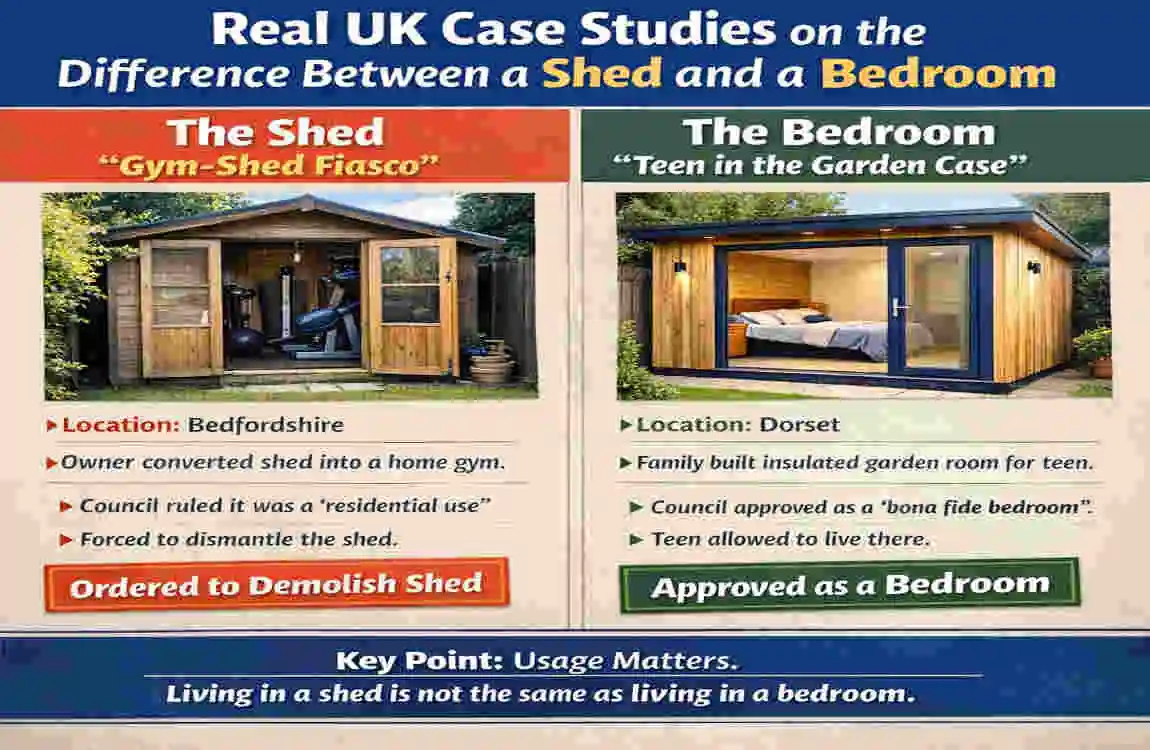
It helps to look at what others have done to understand the reality.
The Success Story: The Student “Pod”
One homeowner in Bristol converted a large garden workshop into a bedroom for their university-aged son.
- Strategy: They applied for planning permission for an “ancillary annexe.”
- Result: Approved. They used a professional company to build a prefab insulated garden room. It added about £30,000 to the property’s value.
The Cautionary Tale: The DIY Disaster
A homeowner in London insulated a standard B&Q shed with bubble wrap and ran an extension cord for a heater.
- Issue: The neighbor reported them. The council inspected and found it was a fire hazard with no escape route.
- Result: They were ordered to remove the bed and electrics immediately. Money wasted: £2,000.
Advice from Architects
Most professionals agree: Don’t try to convert a cheap shed. Think of it as “building a timber-framed house in the garden.” The mindset shift ensures you focus on quality and legality.
Alternatives to Full Conversion
If this all sounds like too much hassle, or if your budget is tight, there are alternatives.
Garden “Day Room.”
Build a high-quality garden office (under permitted development) with a comfortable sofa. It can’t be a permanent bedroom, but it gives you that extra breakout space during the day, freeing up space in the main house.
Glamping Pods / Shepherd Huts
Sometimes these fall under different rules if they are movable structures; if you sleep in them permanently, planning permission is still usually required. However, they come pre-built and insulated.
Loft Conversion
If the garden route is blocked by planning rules, look up. Converting a loft is often easier in terms of planning permission (falling under Permitted Development more often), even if the structural costs are higher.
Frequently Asked Questions (FAQs)
Q: Can I turn my shed into a house bedroom in the UK without permission?A: Generally, no. Using an outbuilding for sleeping constitutes a “change of use” from incidental to ancillary (or separate dwelling), which requires planning permission.
Q: How long does approval take?A: Once you submit your valid application, the local authority usually decides within 8 to 13 weeks.
Q: Does a garden bedroom add value to my house?A: Yes, significantly—provided it has a Building Control Completion Certificate. If it’s just a shed with a bed and no paperwork, it adds very little value and can actually scare off buyers.
Q: Can I put a toilet in my shed without planning permission? A: It’s a grey area. A toilet suggests “habitability.” Furthermore, connecting a toilet to the main sewage drains requires Building Regulations approval and notifying the local water board.