How much a 2-bedroom house is in your absolute dream location? You are certainly not alone. Whether you are a first-time homebuyer looking to stop paying rent, a retiree wanting to downsize, or an investor seeking a profitable rental property, a two-bedroom home hits the perfect sweet spot. It offers enough space for comfort without the overwhelming maintenance of a massive estate.
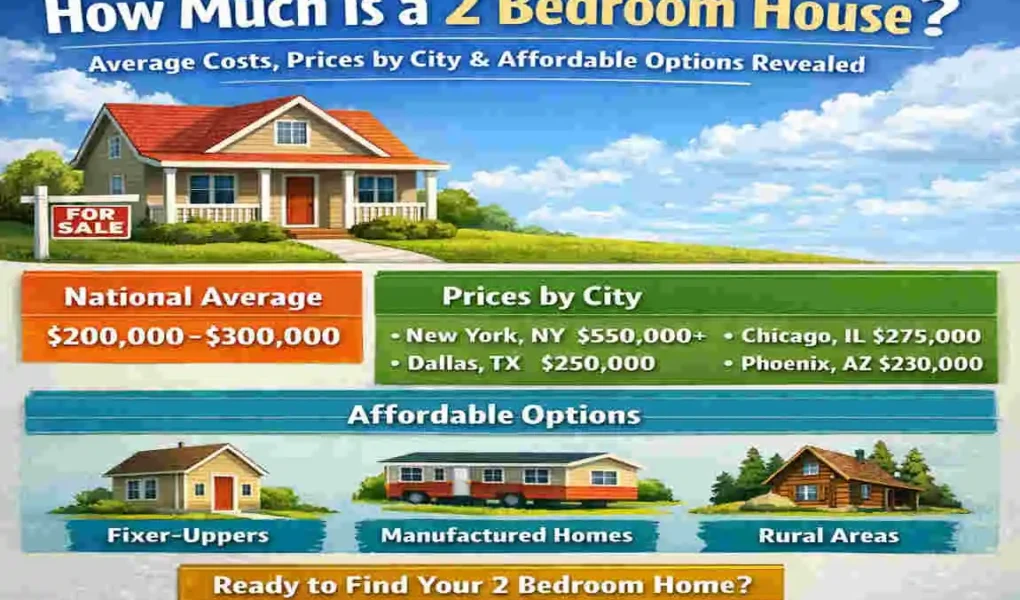
As we navigate through the real estate market of 2026, prices have shifted, trends have evolved, and new opportunities have emerged. Nationally, across the United States, you will generally find the average price hovering between $250,000 and $350,000. However, that single number barely scratches the surface of the whole story.
National Average Costs: A Coast-to-Coast Look
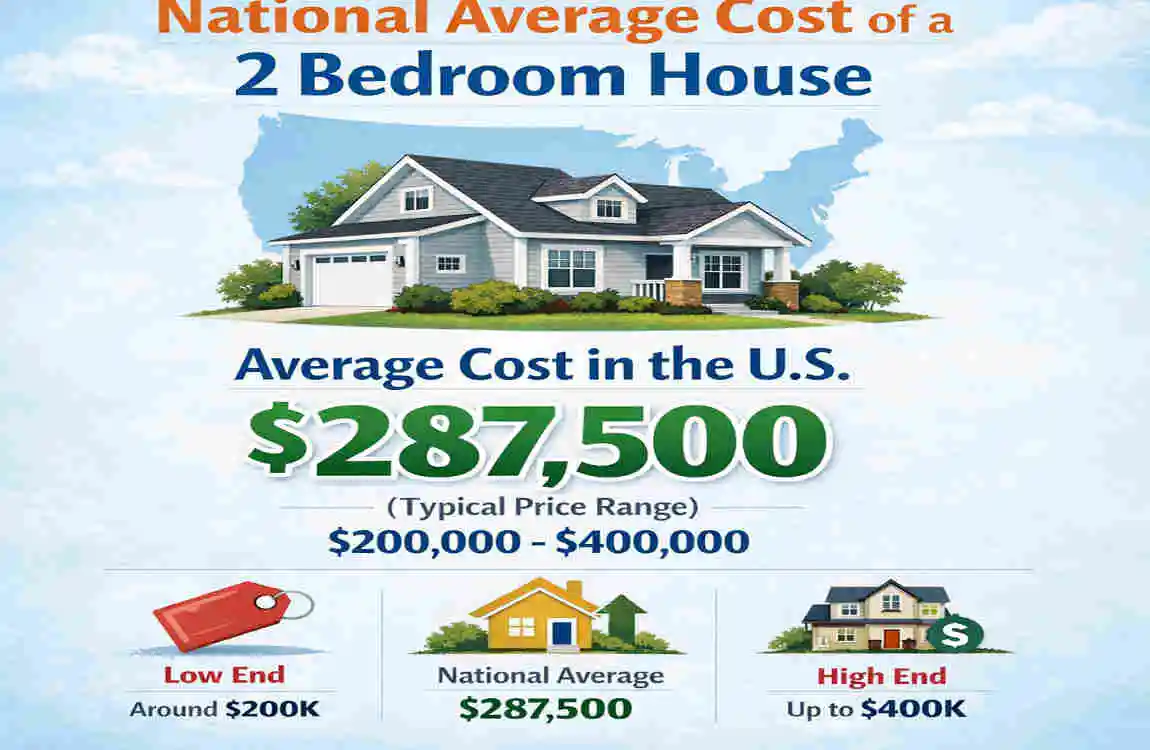
When you ask, “How much is a 2-bedroom house?” the most honest answer is always going to be: it depends on where you stand. The United States is a massive, diverse landscape, and its real estate market reflects that diversity.
If we look at the national baselines for a standard two-bedroom home—typically ranging between 800 and 1,200 square feet—we see extreme variations. In the heartland of the Midwest, you can still find charming, move-in-ready properties for $120,000 to $180,000. Conversely, if you want to wake up to the ocean breeze on the coastal metros of California or the bustling energy of the Northeast, you should expect to pay $400,000 and well above.
Understanding the Space
A two-bedroom house is unique. It is often the entry point for homeownership. At 800 to 1,200 square feet, these homes are highly efficient. You get a primary bedroom, a secondary room (perfect for a guest, a child, or a remote-work office), a cozy living area, a kitchen, and usually one to one-and-a-half bathrooms.
New Construction vs. Resale Homes
Another major factor in these national averages is the age of the home. Brand-new constructions will always command a Premium. Builders are using modern, energy-efficient materials, open-concept floor plans, and smart-home technology. A new build will push your cost toward the higher end of the regional average.
On the flip side, resale homes—especially those built in the mid-to-late 20th century—offer character and affordability. While they might need a fresh coat of paint or a bathroom update, they represent some of the best values in the 2026 housing market.
2026 Regional Price Breakdown
To give you a clearer picture, let us look at the average costs broken down by major U.S. regions.
Region Average 2BR Price Example Cities & Notes
Northeast $600,000+ Boston ($580k+), NYC (Highly competitive, older stock)
Midwest $220,000 – $350,000 Chicago, Minneapolis (Excellent value for space)
South $200,000 – $350,000 Atlanta, Dallas (Fast-growing, expanding suburbs)
West $400,000 – $600,000+ Los Angeles, San Francisco ($600k+ base, Premium coastal)
The Global Perspective: Focus
While U.S. markets are fascinating, we know many of our readers and investors are looking globally, specifically at the booming markets in South Asia. For our audience focused, , the context shifts entirely.
If you are looking for similar specifications—a modern, well-built two-bedroom home in a desirable neighborhood—you are looking at an average price range of PKR 2 to 5 crore. This price point offers distinct advantages and different architectural styles, which we will dive into deeply later in this article.
Key Factors Affecting Prices: What Drives the Market?
You might look at two houses that are exactly the same size, with the exact same layout, and wonder why one costs $150,000 and the other costs $500,000. Real estate is a complex ecosystem. Let us explore the primary drivers that manipulate these numbers.
Location, Location, Location (The 50% Impact)
It is the oldest cliché in real estate, but it remains incredibly true in 2026. The physical location of a home dictates up to 50% of its total impact on price.
A two-bedroom home sitting in a highly rated school district, within walking distance of chic coffee shops, and offering a brief commute to a major downtown hub will always cost a Premium. You are not just buying the bricks and mortar; you are buying the neighborhood, the convenience, and the community lifestyle.
Age and Overall Condition
The physical state of the house plays a massive role in its valuation. A “turnkey” property—meaning you can turn the key in the door, walk in, and not have to do a single repair—will cost significantly more.
Conversely, a “fixer-upper” will drop the asking price dramatically. Buyers must ask themselves if they have the time, energy, and liquid cash to handle renovations. While buying an older home saves you upfront money, a cracked foundation or an aging roof can quickly erase those savings.
Square Footage and Layout Efficiency
Not all two-bedroom houses are created equal. A sprawling 1,400-square-foot home with large, vaulted ceilings will naturally cost more than a compact 800-square-foot bungalow.
Furthermore, the layout matters. In 2026, buyers strongly prefer open-concept living. If a home has a cramped, closed-off kitchen, it might sit on the market longer and sell for less than a slightly smaller home with a bright, flowing layout.
Value-Adding Amenities
The little extras add up quickly. Does the house have a dedicated, attached garage? In snowy climates or dense cities, a garage can add 10% to 15% to the total property value.
What about outdoor space? A fenced-in backyard, a modernized deck, or a finished basement can push a standard two-bedroom home into a much higher pricing tier.
Market Trends: The 2026 Inventory Shortage
As we move through 2026, a significant driver of high prices is the ongoing inventory shortage. Simply put, there are more people who want to buy two-bedroom homes than there are two-bedroom homes available for sale.
Many baby boomers are choosing to “age in place” rather than sell, and millennial and Gen-Z buyers are fiercely competing for starter homes. This high demand and low supply naturally force prices upward.
Inflation and Interest Rates
You cannot talk about house prices without talking about the economy. Inflation impacts the cost of building materials (lumber, concrete, copper), making new homes more expensive to construct.
Additionally, mortgage interest rates dictate your monthly buying power. When interest rates are high, buyers can afford less house, which sometimes forces sellers to lower their asking prices. When rates drop, buyer frenzy returns, and prices skyrocket.
Energy-Efficient Upgrades
In today’s eco-conscious world, green homes are highly prized. Houses equipped with solar panels, high-efficiency HVAC systems, dual-pane argon-gas windows, and smart thermostats command higher upfront prices.
However, buyers are willing to pay this Premium because these upgrades can save homeowners up to 20% on long-term utility costs.
Prices by Major U.S. Cities: An Urban Breakdown
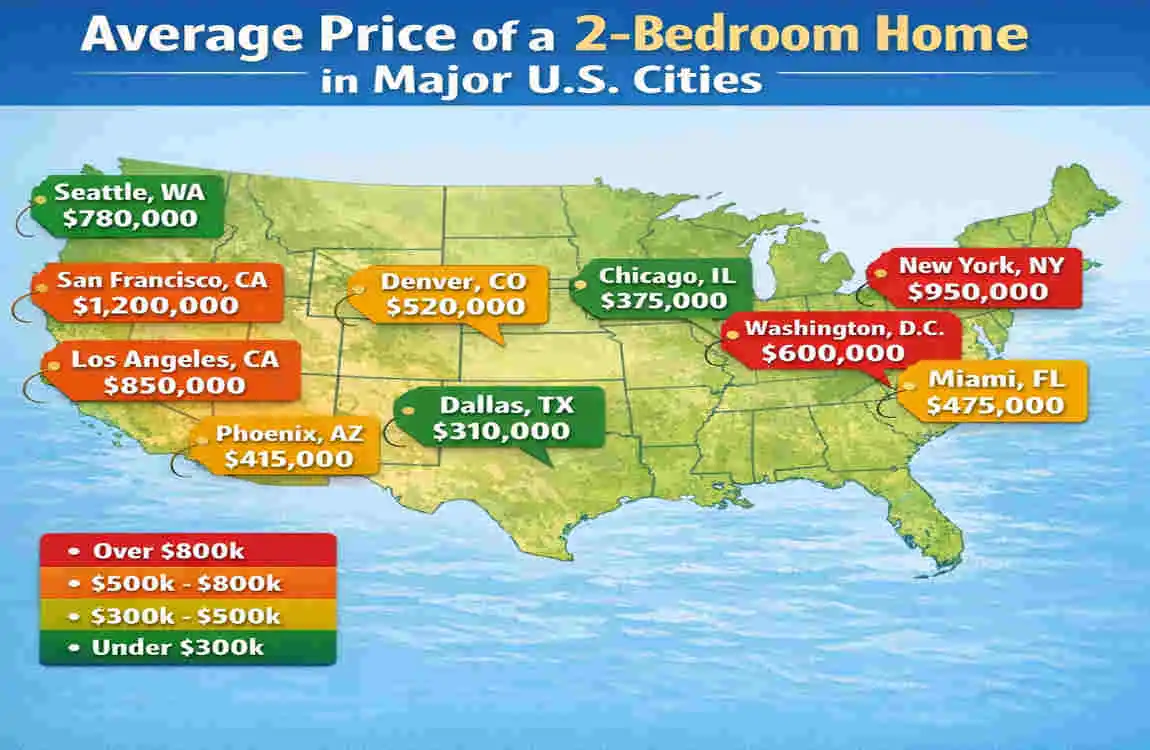
To truly grasp how much a 2-bedroom house is, we must zoom in on specific cities. The urban landscape in the U.S. varies wildly in affordability. Let us take a detailed look at the 2026 median prices across some of the nation’s most popular metropolitan hubs.
City Average 2BR Price Rent Equivalent Important Market Notes
Boston, MA $580,000+ $2,700/mo Historic charm, extremely high demand. Look to suburbs like Lynn for deals under $500k.
New York city, NY $600,000+ $3,500+/mo Very limited supply of detached homes. Most 2BRs are condos or co-ops.
Chicago, IL $250,000 $1,800/mo The affordable Midwest hub. Excellent cultural amenities without coastal prices.
Dallas, TX $300,000 $2,000/mo A rapidly growing Southern market. Massive suburban expansion provides good inventory.
Los Angeles, CA $550,000+ $2,800/mo The coastal Premium is real. High land values make standard homes very expensive.
The Northeast: Boston and New York city
If you are looking at the Northeast, prepare your wallet. Boston maintains a median price of over $580,000 for a two-bedroom property. The city is landlocked by water and surrounding towns, meaning new construction is rare. However, if you look just outside the city to affordable suburbs like Revere or Lynn, you can find beautiful beachfront-adjacent properties for under $500,000.
New York city is an entirely different beast. Finding a detached, single-family two-bedroom home for $600,000 is like finding a needle in a haystack. Most buyers in this price range are looking at condominiums or co-ops, which come with their own set of monthly maintenance fees.
The Midwest: The Chicago Advantage
If you want world-class dining, incredible architecture, and a bustling job market without going broke, Chicago is your answer. At an average of $250,000 for a two-bedroom home, it stands out as the most affordable major hub in the country. With rent equivalents hovering around $1,800 a month, buying a home in Chicago is often much cheaper than renting over a five-year period.
The South: Dallas and Sunbelt Growth
The great migration to the Sunbelt continues in 2026. Dallas, Texas, offers an incredible balance of job opportunities and housing affordability. For around $300,000, buyers can secure relatively modern two-bedroom homes, often with central air conditioning and generous yard space. The lack of state income tax in Texas also makes it highly attractive to young professionals.
The West Coast: The Los Angeles Premium
Sunshine and mild winters come at a steep cost. In Los Angeles, $550,000 is often considered a starting point for a two-bedroom home, and in desirable neighborhoods, that number easily doubles. The rent equivalent is a staggering $2,800 or more. Because of the “coastal Premium,” buyers here often have to compromise on square footage or commute times to find something within their budget.
Affordable 2 Bedroom Options: Buying Smart
If the big city prices are making you sweat, take a deep breath. You do not have to be a millionaire to own a piece of real estate. There are plenty of creative, highly affordable ways to secure a two-bedroom home if you know where to look and are willing to think outside the traditional box.
Prefabricated and Modular Homes
Welcome to the future of housing. A prefab 2-bedroom house offers modern design at a fraction of the cost of traditional, “stick-built” homes. Because these homes are built in climate-controlled factories, there are no weather delays, and material waste is minimized.
This efficiency translates directly to your wallet. Prefab and modular homes are typically 10% to 20% cheaper than standard homes. You can easily find stylish, brand-new prefab two-bedroom homes starting around $100,000 (not including the cost of the land).
Rural and Small-Town Living
The remote work revolution is still going strong in 2026. If you do not need to commute to a downtown office every day, why pay city prices?
Moving just one or two hours outside of a major metropolitan area can slash your housing costs in half. In many rural areas and charming small towns across the Midwest and Southern United States, it is incredibly common to find lovely two-bedroom homes for under $150,000. You get fresh air, more land, and a much smaller mortgage.
The Power of the Fixer-Upper
If you are handy with a hammer—or willing to learn—a fixer-upper is a fantastic way to build instant equity. You might purchase an outdated two-bedroom home for a base price of $120,000.
If you invest another $30,000 in smart renovations (like modernizing the kitchen, updating the bathroom, and adding fresh paint and flooring), the home’s value might jump to $200,000. You have effectively created wealth just by putting in a little “sweat equity.”
Alternative Housing Lists
Consider these other budget-friendly avenues to homeownership:
- Tiny Homes: While smaller than standard houses, double-wide tiny homes or park-model RVs offer two distinct sleeping areas for under $80,000.
- Duplexes: Buy a two-unit building, live in one two-bedroom unit, and rent out the other. The rental income can often pay for your entire mortgage!
- Government Programs: Look into FHA (Federal Housing Administration) loans, which require as little as 3.5% down, or USDA loans, which offer zero-down-payment options for homes in designated rural areas.
Buying Tips & Hidden Costs: Protect Your Investment
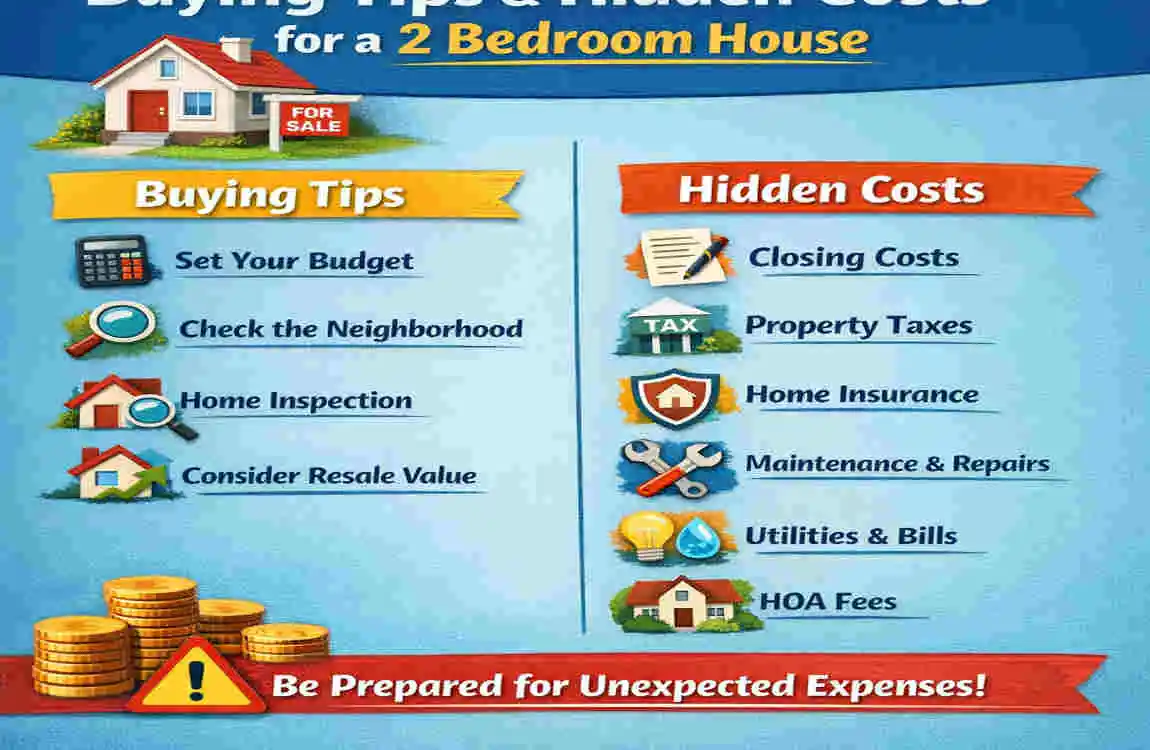
Finding the answer to “how much is a 2-bedroom house” is only the first step. The list price you see on a real estate website is never the final amount you pay. Buying a home involves a complex web of transactions, and failing to budget for the “hidden costs” can turn a dream purchase into a financial nightmare. Let us walk through the essential tips to ensure you are fully prepared.
Prepare for the Hidden Costs
When you are drawing up your budget, you must account for closing costs. These are the fees charged by lenders, title companies, and local governments to process the sale.
- Closing Costs: Always budget an extra 1% to 3% of the total purchase price for closing costs. On a $300,000 home, that is an extra $3,000 to $9,000 you must have in cash on closing day.
- Inspections and Appraisals: Never skip the home inspection. Paying $400 to $600 for a professional to check the roof, foundation, plumbing, and electrical systems can save you tens of thousands of dollars in surprise repairs. Lenders will also require an appraisal (around $500) to ensure the house is actually worth the money they are lending you.
- Property Taxes and Insurance: Your monthly payment isn’t just your mortgage. It includes property taxes and homeowners’ insurance. In states with high property taxes, this can add hundreds of dollars to your monthly bill.
Smart Financing Strategies
Cash is king, but most of us need a mortgage. While there are excellent low-down-payment programs available, aiming for a 20% down payment is still the gold standard in 2026.
Why? Putting down 20% proves to the lender that you are a safe bet, which typically secures you a lower interest rate. More importantly, it eliminates Private Mortgage Insurance (PMI)—a pesky monthly fee lenders charge you to protect themselves if you default on the loan. Avoiding PMI can save you hundreds of dollars every single month.
Master the Art of Negotiation
Do not just accept the asking price unquestioningly—the real estate market ebbs and flows. In a “buyer’s market” (where there are more homes for sale than people buying), you possess the power.
Work with a skilled real estate agent to analyze comparable recent sales in the neighborhood. If a house has been sitting on the market for over 45 days, you can confidently offer 5% to 10% below the asking price. You can also negotiate for the seller to pay your closing costs or to leave behind valuable appliances.
If you want to know exactly what you can afford right now, do not guess. Use our free affordability calculator to map out your specific financial scenario!
Frequently Asked Questions (FAQs)
Still have questions about purchasing your next property? Let us address some of the most common inquiries we receive from eager homebuyers.
How much is a 2-bedroom house in my specific city? Prices vary drastically depending on your geographical location. As a quick reference, expect to pay around $250,000 in affordable Midwest hubs like Chicago, roughly $300,000 in Southern cities like Dallas, and well over $550,000 in coastal metros like Los Angeles and Boston. Be sure to reference our detailed city table above for rent equivalents and market notes!
Are prefab homes actually worth the investment? Absolutely. In 2026, prefab and modular homes are a phenomenal investment. They are not the flimsy structures of the past; they are highly durable, energy-efficient, and beautifully designed. Most importantly, you can expect 10% to 20% in overall savings compared to traditional on-site construction.
What is the absolute cheapest 2-bedroom option available? If budget is your primary concern, your best bet is looking at rural areas in the Midwest or the Southern United States. In these less densely populated regions, you can frequently find modest, older two-bedroom homes for around $100,000. Pairing a cheap rural home with a USDA zero-down loan is the most affordable path to homeownership today.
What are the specific property prices for a 2-bedroom house? For buyers, the market offers robust options. A standard, modern two-bedroom home (approximately 120 square yards or 5 Marla) in a prime, secure area will average between PKR 2 to 5 crore. The exact price heavily depends on the specific housing society, the quality of interior finishes, and proximity to major commercial zones.