
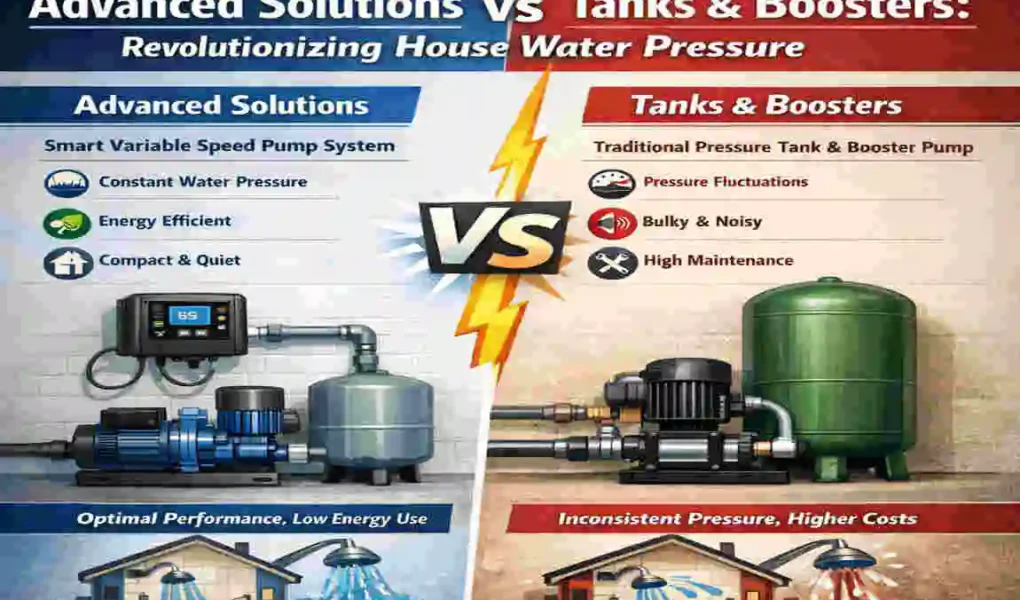
Imagine this: You have just returned home after a long, exhausting day at work. The year is 2026, and the sweltering peak summer heat of absolutely unforgiving. All you want is a powerful, refreshing shower to wash away the stress of the day. You step into your beautifully tiled, modern bathroom, turn the sleek faucet handle, and, instead of a rushing waterfall, you are greeted by a weak, frustrating, sputtering trickle. It is incredibly annoying, right?
If you are dealing with inconsistent flow, you are certainly not alone. Throughout the world, and especially in rapidly developing urban neighborhoods, struggling with weak water flow is a daily headache. But here is the good news: you do not have to live like this anymore. In 2026, the ongoing debate of advanced solutions vs tanks and boosters is entirely transforming household water pressure for the better.
| Feature | Pressure Tanks | Water Boosters | Advanced Solutions |
|---|---|---|---|
| House Pressure Boost | Basic storage | On-demand pump | Smart, variable speed |
| Energy Use | Low (passive) | High (constant run) | 40% less efficient |
| Cost (5 Years) | $800 total | $1,500 total | $1,200 (ROI fast) |
| Noise Level | Silent | Loud | Whisper-quiet |
| Lifespan | 5-7 years | 3-5 years | 10+ years |
| Best For | Small homes | Multi-floor | Modern smart houses |
Understanding Traditional House Water Pressure Systems
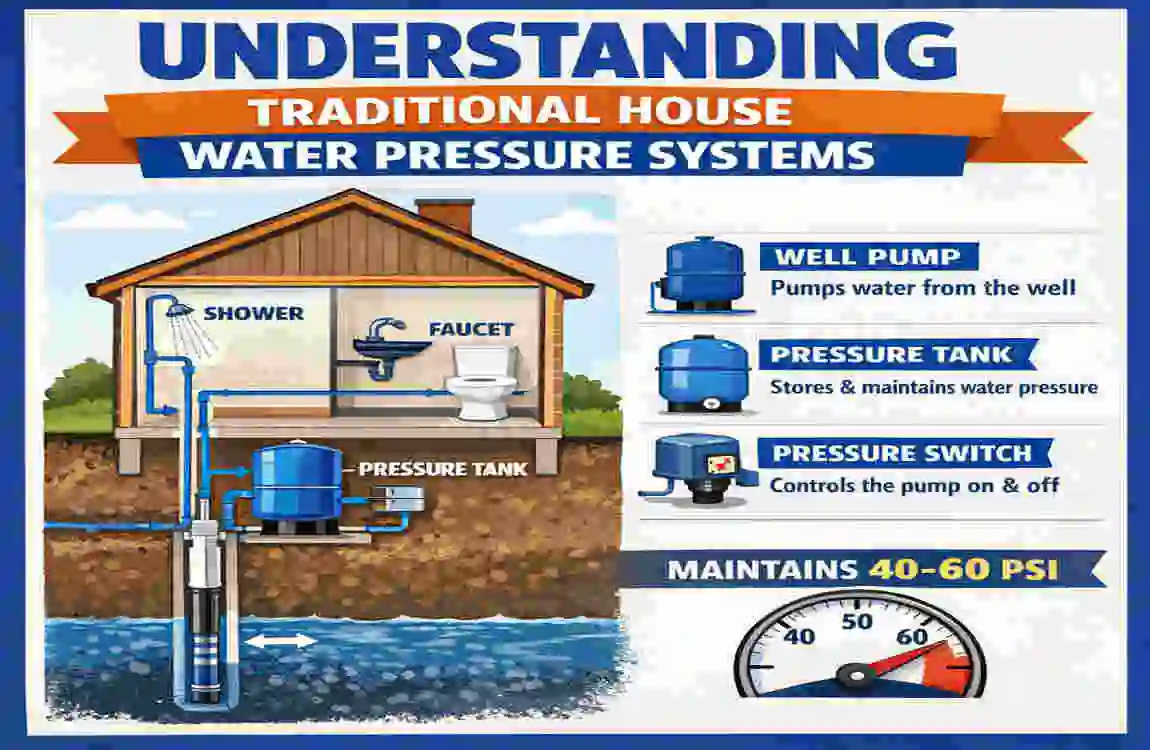
To truly appreciate the incredible leaps in modern plumbing technology, we first need to step back and look at older methods. For decades, builders and plumbers relied heavily on a few standard tricks to get water from the main municipal line up to your second-story showerhead. Let us break down these traditional systems and see why they are slowly becoming obsolete.
What Are Pressure Tanks for Homes?
If you have ever explored the utility closet or the roof of an older home, you have likely seen a pressure tank. But what exactly are pressure tank house systems? In the simplest terms, a pressure tank is a large, heavy metal or fiberglass cylinder that physically stores pressurized water.
Inside this tank, there is usually a large rubber bladder. As a basic pump forces water into the tank, it compresses the air trapped inside the bladder. This compressed air acts like a giant, invisible spring. When you open a tap in your kitchen, that compressed air pushes the water out of the tank and through your pipes.
The Pros: These systems have been around for a very long time, which means they come with a relatively affordable initial installation cost. Because the mechanics are quite basic, finding a local plumber who understands how to perform simple maintenance on them is incredibly easy.
The Cons: However, these tanks have significant limitations. They have a strictly limited holding capacity. If you have a high-demand household—perhaps someone is running the washing machine downstairs while two others are showering upstairs—the tank empties too quickly. The pressure instantly drops, and you are left shivering under a weak drizzle. Furthermore, the rubber bladders in these tanks frequently stretch, tear, and fail, leading to costly and annoying replacements. In many urban homes, these heavy tanks dominate the rooftops, exposed to the blistering sun, which only accelerates their deterioration.
Water Boosters: The Go-To Solution for Low Pressure
When a passive tank isn’t enough, plumbers often resort to a more aggressive solution: a water booster. Water boosters for home use are essentially motorized electrical pumps that physically suck water from your main supply and forcefully push it through your plumbing network.
The Pros: For many years, booster pumps have served as the standard, quick-fix solution for multi-story houses that suffer from chronically low municipal flow. If you need water forced up to a third-floor bathroom, a powerful booster pump will undoubtedly get it there.
The Cons: Despite their raw power, traditional boosters are heavily flawed. First and foremost, they are incredibly noisy. When a traditional booster kicks on, it usually starts with a loud, aggressive clunk, followed by a vibrating hum that can literally shake your home’s walls. If someone flushes a toilet at 2:00 AM, the entire house wakes up to the sound of the pump roaring to life.
Secondly, these older pumps are energy hogs. They operate on a simple “on/off” switch. Whenever they run, they run at 100% maximum power, whether you are just filling a small glass of water or a massive bathtub. This constant, full-throttle operation leads to high electricity bills and frequent motor burnouts. This perfectly explains why traditional tanks and boosters dominate the market today but struggle immensely compared to the refined elegance of advanced solutions.
What Are Advanced Solutions for House Water Pressure?
As a professional content writer, you must create readable, engaging, and informative pieces that help your website or blog grow in popularity and search engine visibility. To do that effectively here, I need to ensure you understand exactly what “advanced” means in the context of 2026 home architecture. We are no longer talking about crude, noisy motors. We are talking about highly intelligent, self-regulating machines that think for themselves.
Core Technologies Behind Advanced Systems
The brilliant secret behind advanced water pressure systems lies in a revolutionary technology known as the Variable Frequency Drive (VFD), combined with smart IoT (Internet of Things) sensors.
Let me use a simple analogy. Imagine driving a car. A traditional booster pump is like a driver who knows only two speeds: completely stopped or the gas pedal pressed flat to the floor. It is a jerky, loud, and inefficient way to drive. A variable-speed pump, on the other hand, acts like a skilled driver, gently easing on the accelerator.
Smart sensors inside the pipes continuously monitor your home’s water demand in real time. If you turn on a single bathroom faucet to brush your teeth, the smart pump only spins to 5% capacity—just enough for a perfect, gentle stream. If someone else jumps in the shower, the pump seamlessly and silently ramps up to 40% capacity.
As we progress through the 2026 home improvement trends, we are even seeing AI-driven pressure optimization. These intelligent systems actually learn your family’s daily routines. They know you take a shower at 7:00 AM every weekday, and they proactively optimize the system to ensure a flawless experience, while drastically cutting wasted electricity.
Top Advanced Solutions vs Tanks and Boosters: Key Players
When looking at the top-tier equipment available today, a few major global brands have completely cornered the market on smart water delivery.
- Grundfos SCALA Series: This brand is essentially the luxury sports car of the plumbing world. Their smart pumps are incredibly compact, whisper-quiet, and feature a fully water-cooled motor.
- DAB E.sybox: This is an incredibly popular, beautifully designed Italian system. It looks more like a sleek computer server than a water pump. It features a digital screen, built-in wireless connectivity, and aggressive soundproofing.
- Stuart Turner: Known for immense durability, these models integrate beautifully with smart home ecosystems like Google Home and Amazon Alexa.
While traditional systems are bulky and ugly, these modern units are sleek, compact, and designed to be neatly tucked away in a small utility cabinet.
Head-to-Head Comparison: Advanced Solutions vs Tanks and Boosters
Content Writers excel at weaving words into engaging narratives that inform, entertain, and inspire readers. But I also know that sometimes, you want the hard data laid out clearly in front of you. When deciding on a major home upgrade, you need to see exactly how these options stack up. Let us look at the ultimate showdown of advanced solutions vs tanks and boosters.
Feature: Traditional Pressure Tanks, Standard Water Boosters, Modern Advanced Solutions
Energy Efficiency Low (relies heavily on the main pump cycling) Medium (constantly runs at 100% full power) Extremely High (Variable speed yields 30-50% savings)
Cost (Initial / Annual) Low / $200 average Medium / $400 average Medium-High / $150 average
System Reliability 5-7 years (bladders frequently rupture) , 3-5 years (motors burn out from hard starts) , 10+ years (soft-start motors heavily reduce wear)
Noise Level Silent (passive storage) Very High (loud clunking and vibrating) Whisper-quiet (water-cooled, soundproofed)
Smart Features None Basic (simple pressure switch) App-controlled, AI-learning, leak detection
Performance in Real Houses
Let us talk about what happens in the real world. Imagine a standard two-story house with four bathrooms. In a traditional setup, if the washing machine is running downstairs, the water pressure in the upstairs shower drops to a miserable drip. The standard booster pump frantically tries to keep up, turning on and off in rapid, noisy bursts, causing the shower water temperature to fluctuate wildly from cold to scalding hot.
With an advanced solution, performance is flawlessly smooth. The variable speed drive instantly detects the pressure drop when the washing machine turns on. In a fraction of a second, the pump speeds up to compensate. The person in the upstairs shower experiences absolutely no change in pressure or temperature. It delivers a constant, luxurious stream of water, regardless of how many taps are opened simultaneously.
Cost Breakdown Over 5 Years
Advanced smart pumps indeed cost more to purchase than basic, old-fashioned motors. However, the long-term Return on Investment (ROI) is staggering.
Because traditional boosters run at full power every single time you open a tap, they consume a massive amount of electricity. Over five years, a standard booster can easily rack up hundreds of dollars in unnecessary electricity costs. Conversely, a smart variable-speed pump uses only the exact amount of electricity required for the specific task at hand. By saving 30% to 50% on pumping costs every single month, the advanced system literally pays for itself in savings within the first two to three years.
Installation and Maintenance
The ability to proofread and edit their own work is even more important than dealing with others’ writing. In the same way, the ability of a smart water pump to digitally monitor and adjust its own performance is vastly superior to manually maintaining an old system.
Traditional tanks require constant manual maintenance. You have to routinely check the air pressure with a gauge, drain the tank to prevent waterlogging, and physically replace the rubber bladders when they inevitably tear.
Advanced systems, however, are practically maintenance-free. They feature digital readouts that alert you instantly via a smartphone app if there is a problem, such as a micro-leak in your plumbing. Installation is also surprisingly straightforward for a licensed professional; these all-in-one units do not require massive external tanks or complicated pipe manifolds, making them a neat, tidy addition to your home.
Benefits of Switching to Advanced Solutions for Your House
By now, you can clearly see the mechanical superiority of these new technologies. But how does this actually translate into tangible benefits for your daily life? The impacts of moving to 2026 water solutions reach far beyond just a better shower experience.
Energy Efficiency and Loadshedding Resilience
In many parts of the world, particularly in countries, communities frequently experience planned power outages. When the grid goes down, homes switch to backup UPS batteries or residential solar panels.
This is where traditional boosters completely fail. A standard booster pump requires a massive, aggressive surge of electricity to kickstart its motor. This huge power draw can easily overload and trip standard home UPS systems. However, an advanced variable-speed pump features a “soft start” mechanism. It gently draws power, slowly ramping up its speed without causing any electrical spikes. This means you can comfortably run your entire home’s water pressure system on a basic solar setup or a standard battery inverter without blowing a fuse.
Incredible Water Savings
While we all want high pressure, we also have a moral obligation to conserve water amid growing global shortages. Advanced solutions brilliantly balance luxury with conservation. Because these systems deliver a steady, consistent flow rather than aggressive, unmanaged blasts of water, you experience far less splashing and waste at the sink. Furthermore, the intelligent leak detection features built into these smart pumps will immediately shut off the water supply and send an alert to your phone if a pipe bursts while you are away at work, saving thousands of gallons of precious water.
Boosting Your Home’s Value
If you are looking to sell your property in the future, modern home buyers are highly educated and demanding. They are actively looking for fully integrated smart homes. Having a bulky, rusty pressure tank on the roof instantly ages a property. Upgrading to a sleek, silent, app-controlled water-delivery system is a major selling point that aligns perfectly with modern, high-end architectural trends.
Eco-Friendliness
Reducing your carbon footprint is no longer just a trend; it is a necessity. By cutting your water-pumping energy consumption in half, you are directly reducing demand on fossil-fuel power plants. These advanced pumps are built with highly recyclable materials and do not rely on the toxic oils and lubricants required by older, industrial-style pumps.
A Real-World Case Study: The Transformation
Consider the completely realistic case of Ali, a homeowner in the upscale DHA neighborhood. For years, his family suffered through weak showers and high electricity bills caused by a failing roof tank and a noisy ground-floor booster. The pump was so loud it woke the children up at night.
Ali finally decided to invest in an advanced Grundfos variable-speed smart pump. The transformation was immediate. The pump was installed discreetly under the stairs. Now, even during peak summer hours, all three of his home’s bathrooms can run simultaneously with perfect, unwavering pressure. Best of all? His monthly energy bill dropped significantly, and his solar inverter handled the gentle electrical load flawlessly during the afternoon loadshedding hours.
How to Choose and install the Right System
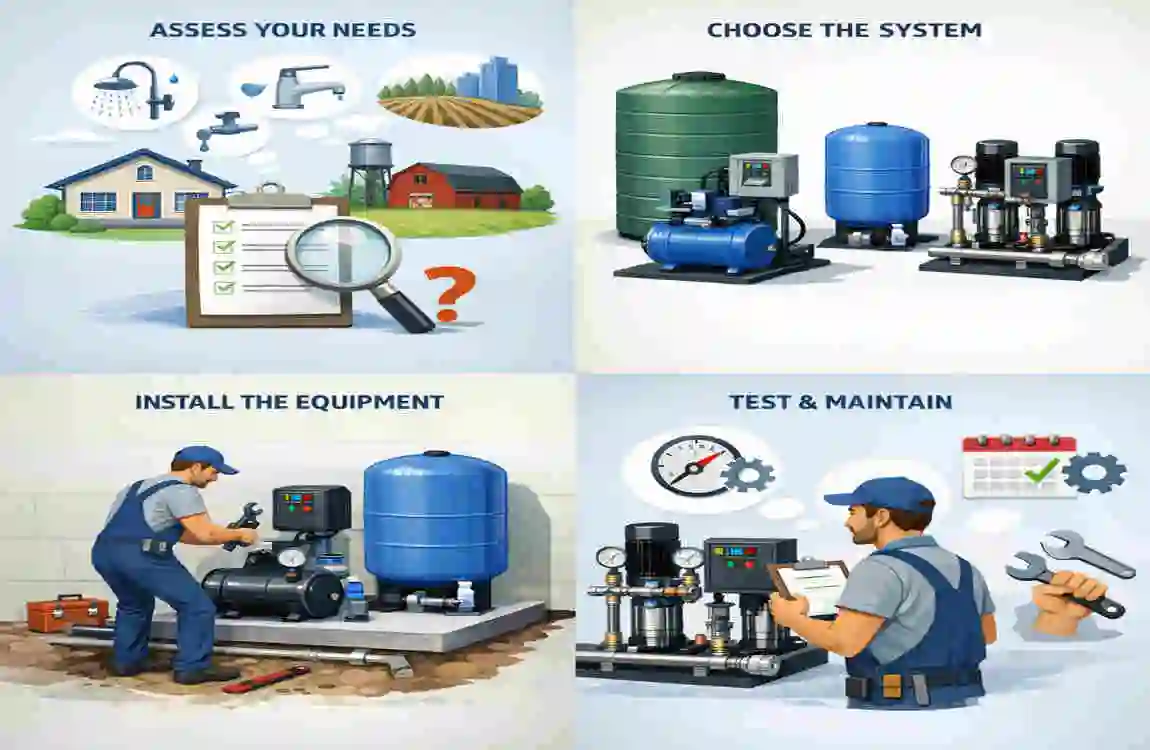
Are you convinced yet? If you are ready to leap, you cannot simply walk into a hardware store and grab the first shiny box you see on the shelf. Choosing the right equipment requires careful planning.
Assessing Your House’s Needs
Every home is unique, and you need to size your system to match your specific daily demands properly. Here is a quick checklist to help you assess your requirements:
- Count Your Fixtures: Walk through your house and count every single tap, showerhead, toilet, washing machine, and dishwasher.
- Calculate Peak Demand: Consider the busiest time of day at your home. How many of those fixtures are realistically running at the same time?
- Check the Pipe Size: The diameter of your home’s main plumbing pipes (usually 1/2 or 3/4 inch) determines the maximum volume of water your home can handle.
- Consider the Floors: Pushing water horizontally across a single-story home requires much less power than pushing water vertically up to a three-story rooftop terrace.
Step-by-Step Installation Guide
While I always highly recommend hiring a certified, professional plumber to ensure your warranties remain fully valid, understanding the installation process helps you manage the project effectively. Here is exactly how a professional upgrade goes down:
- Safety First: The main municipal water supply valve is completely shut off, and the main electrical breaker powering the old pump is flipped to the off position.
- Drain the Lines: The plumber opens the lowest tap in the house to completely drain all standing water from the existing pipes.
- Remove the Old Gear: The heavy, rusty traditional pressure tank and the noisy old booster motor are safely disconnected and removed from the property.
- Prepare the Base: A clean, vibration-absorbing rubber mat is placed down to ensure the new smart pump operates as quietly as possible.
- Connect the Plumbing: Using high-quality, flexible stainless-steel braided hoses, the plumber connects the main water intake to the pump, and the pump’s output line to the home’s main distribution pipe.
- Prime the Pump: Before turning on the power, the pump housing is manually filled with water. This prevents the motor from running dry and burning out on its first start.
- Electrical and App Integration: The unit is plugged into a dedicated, surge-protected outlet. Finally, the homeowner downloads the companion smartphone app, pairs it with the pump via Wi-Fi, and sets their desired water pressure (e.g., a perfect 3.5 bar).
Top Recommendations
If you are currently shopping the market, here is how the landscape looks for your wallet:
- The Budget Pick: Entry-level variable speed models from reliable regional brands offer basic constant-pressure features without the expensive WiFi connectivity.
- The Mid-Range Champion: The DAB smart pump series offers incredible, whisper-quiet performance and aggressive space-saving designs, perfect for urban apartments.
- The Premium Luxury Pick: Top-tier Grundfos models offer full AI-learning, instant leak detection, and flawless smart-home integration for the ultimate peace of mind.
Common Myths and FAQs
Whenever a revolutionary new technology disrupts an old industry, myths and rumors inevitably follow. Let us take a moment to debunk some of the most stubborn misconceptions.
“Tanks and boosters are significantly cheaper in the long term.” This is categorically false. While a traditional setup might save you $100 or $200 on the initial installation day, the hidden costs will bleed your wallet dry over the next five years. When you factor in the massive, ongoing electricity waste of a motor running at 100% capacity, plus the cost of plumbers coming out to replace torn rubber bladders and burnt-out pressure switches, the older systems are vastly more expensive to own over a decade.
Advanced smart solutions are massive overkill for small houses. This is a fundamental misunderstanding of the technology. Advanced systems are incredibly beneficial for small homes, specifically because they take up a fraction of the physical space. You do not need a dedicated utility room; these sleek units can fit under a kitchen sink. Furthermore, a small house still benefits from silent operation and lower electrical bills.
Frequently Asked Questions
What exactly are advanced solutions vs tanks and boosters? Traditional tanks use compressed air, and boosters use brute-force, single-speed motors to push water. Advanced solutions utilize brilliant Variable Frequency Drives (VFDs) and smart digital sensors to gently speed up or slow down exactly as needed, providing perfectly constant water pressure without wasting energy.
Are these smart systems the best choice for multi-story houses? Absolutely. Pushing water up three or four stories requires immense power. An advanced smart pump will monitor the pressure drop on the top floor and seamlessly ramp up its speed to deliver a flawless shower experience upstairs without bursting the pipes on the ground floor.
How much does it truly cost to upgrade house water pressure? In 2026, upgrading to a mid-range smart pressure system generally costs between $500 and $800, including professional installation. While this is an upfront investment, the massive energy savings and total elimination of maintenance costs make it a highly financially sound decision.