
Did you know that discovering non-compliant smoke alarms delays nearly 25% of house sales in Queensland right at the finish line? Imagine this scenario: you have finally found the perfect buyer for your property. You have negotiated a fantastic price, the contract is signed, and you are already packing your boxes. Then the building and pest inspection takes place. The inspector flags that your home does not meet the strict fire safety laws. Suddenly, your buyer gets cold feet, the bank delays financing, and your fast, stress-free sale grinds to a halt.
If you want to avoid this nightmare scenario, understanding everything about smoke alarms when selling a house in Queensland, QLD, is absolutely critical. Fire safety is not just a minor detail in the Sunshine State; it is a major legal requirement, closely monitored by the Queensland Fire and Emergency Services (QFES). The laws have changed dramatically over the last few years, and what passed as “safe” a decade ago will completely fail an inspection today.
You need to know exactly what is required to pass your inspections on the very first try. This complete 2026 compliance checklist is designed specifically for home sellers like you. We will break down the complex legal jargon into simple, everyday language so you can prepare your home with total confidence.
Why Smoke Alarms Matter When Selling a House in QLD
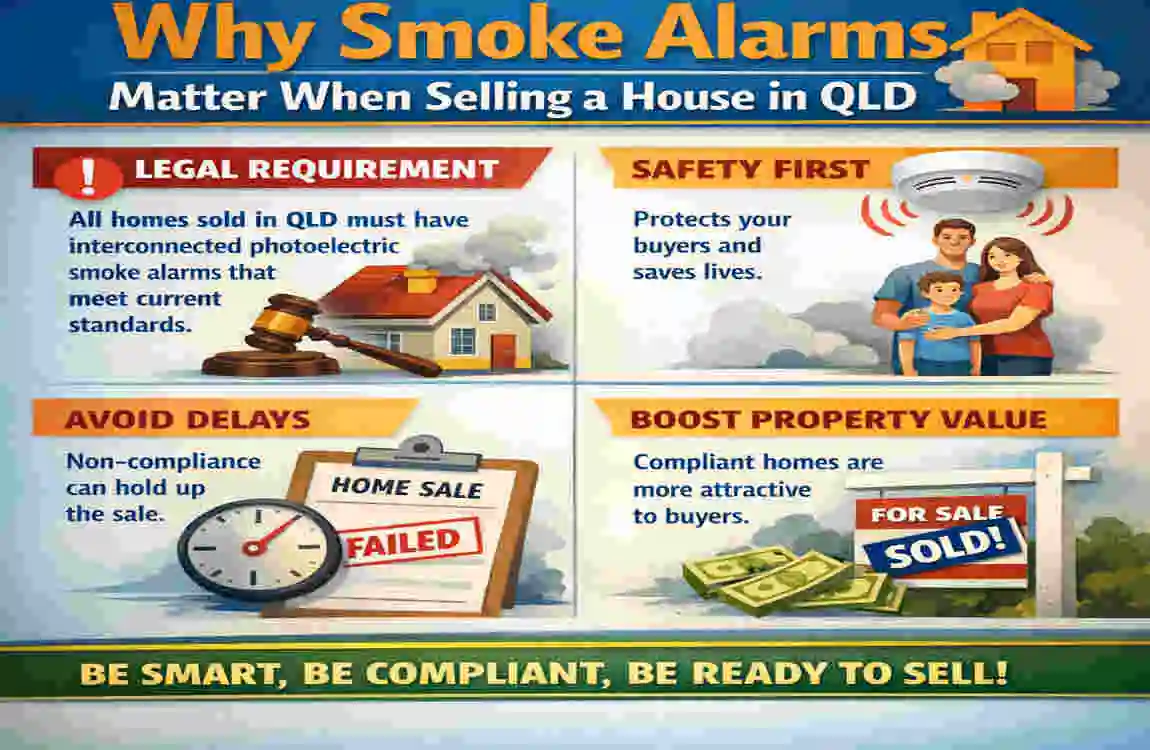
When you put your home on the market, you already have a million things to worry about. You are painting walls, fixing leaky taps, and keeping the house spotless for weekend open homes. It is incredibly easy to look at the little white plastic circles on your ceiling and assume they are fine. But ignoring them is a massive mistake.
Here is exactly why staying on top of your fire safety requirements is non-negotiable for Queensland sellers today.
The QLD-Specific Risks of Non-Compliance
First and foremost, the financial penalties for ignoring these laws are incredibly severe. If you fail to comply with the updated legislation, you face massive fines that can quickly exceed $15,000. But the fines are actually the least of your worries when you are trying to sell a property.
The real danger lies in your sales contract. Standard Queensland real estate contracts explicitly require the seller to declare the compliance status of their fire safety systems. If you tick the “compliant” box, but the buyer’s building inspector discovers outdated alarms, you are officially in breach of your contract. This gives the buyer tremendous legal leverage. They can demand a significant price reduction, force you to fix the issue immediately at your own expense, or worse, completely walk away from the sale without penalty.
2026 Updates to Smoke Alarm Laws
Queensland currently has the strictest fire safety legislation in all of Australia. The rollout of these laws has happened in phases, but as of 2026, the expectations are crystal clear for all property owners.
The biggest update you need to know about is the strict mandate for interconnected photoelectric smoke alarms. You can no longer rely on standalone units that only beep in one room. Today, if a fire starts in the kitchen, the main bedroom alarm must sound simultaneously.
Furthermore, the state has initiated a strict phase-out of any unit that is older than 10 years. Even if your old alarm still beeps when you press the test button, it is legally considered dead after a decade. You must replace it to comply with the new smoke alarm requirements for selling a house in Queensland.
The Impact on Sale Speed and Property Price
On the flip side, having a fully compliant home offers massive benefits. Homes that easily pass their building and fire safety inspections sell up to 20% faster than those that get bogged down in renegotiations.
When buyers see that you have recently installed high-quality, interconnected systems, it sends a powerful psychological message. It tells them that you are a responsible homeowner who takes care of the property. This builds deep trust. Compliant homes move swiftly from the “under contract” phase straight to the “unconditional” phase, getting your money into your bank account much faster.
Current QLD Smoke Alarm Regulations for Home Sellers
Before you can fix your home, you need to understand the rules of the game. The Queensland government does not just care that you have alarms; they care deeply about the type, placement, and power source of those alarms.
Let us break down the current smoke alarm requirements for selling a house in QLD into easy-to-understand segments.
Photoelectric vs. Ionization Alarms
If you go to a hardware store, you will generally see two types of fire sensors: ionization and photoelectric.
Older homes usually feature ionization alarms. These units are designed to detect fast-flaming fires. However, they are incredibly prone to annoying false alarms every time you burn a piece of toast. Because of this, homeowners frequently remove the batteries, defeating the whole purpose of having them.
Queensland law now mandates that all new installations must use photoelectric sensors. Photoelectric technology “sees” smoke. It uses a beam of light to detect the thick, heavy smoke produced by smoldering fires—the most common and deadly type of house fire. They respond much faster to smoldering furniture or electrical fires. They are far less likely to go off just because you are cooking dinner. If your current alarms have a radioactive symbol on the back, they are ionization alarms. They must be put in the bin immediately.
Interconnected Systems Explained
This is the rule that catches most sellers off guard. Your alarms cannot work in isolation anymore. They must form a unified, communicative network throughout your entire home.
Interconnected systems mean that when one unit detects smoke, every single unit in the house triggers an alert simultaneously. If a fire starts in the downstairs laundry room at 2:00 AM, the alarm inside your upstairs bedroom will immediately wake you up.
You can achieve this interconnection in two ways. You can either hire a professional electrician to run wires through your ceiling to connect them physically, or you can purchase modern wireless alarms that communicate with each other using a dedicated radio frequency.
Placement Rules for QLD Homes
You cannot just slap a sensor on the ceiling wherever you feel like it. The law dictates highly specific placement locations.
To pass inspection, you must have an interconnected alarm located:
- On every single level of your home.
- Inside every single bedroom.
- In every hallway that connects those bedrooms to the rest of the house.
- If there is no hallway, the alarm must be placed in the part of the room directly between the bedrooms and the rest of the dwelling.
You must also avoid “dead air zones.” These are the sharp corners where the ceiling meets the wall. Smoke naturally curves as it rises, leaving these sharp corners completely clear of smoke for several minutes. Alarms must be placed flat on the ceiling, at least 300 millimeters away from any wall, light fitting, or ceiling fan.
Battery vs. Hardwired Options
How do you power these lifesavers? Queensland offers two legal options for selling existing homes.
If your home currently has hardwired alarms (alarms directly wired into your home’s main electrical grid), you must replace them with new hardwired photoelectric alarms. You cannot downgrade a hardwired system to a battery-only system.
If your home has never had hardwired alarms, you may use battery-powered units. However, you cannot use the old style of swapping out a 9-volt battery every year. You must use units powered by a non-removable, 10-year sealed lithium battery. These units are fantastic because you install them once, and they guarantee power for an entire decade without any annoying midnight chirping.
Step-by-Step Compliance Checklist: Smoke Alarms When Selling a House in QLD
Now that you know the rules, it is time to take action. Use this straightforward, step-by-step QLD house sale smoke alarm checklist to ensure your property is completely ready for the market.
Step 1: Audit Your Current Setup
Do not assume anything. Grab a ladder, a notepad, and walk through your house room by room.
You need to take down every single alarm from the ceiling and look at the back. Check for the manufacturer’s date. If the date printed on the back is more than ten years ago, you must replace the unit. Look for the word “Photoelectric.” If you see the word “Ionization” or a radioactive warning symbol, you must replace the unit. Finally, count your bedrooms and hallways to ensure you have enough units to meet the current placement guidelines we discussed above.
Room/Location Alarm Present?Less Than 10 Years Old?Photoelectric?Interconnected?Action Required
Main Bedroom [ ] Yes [ ] Yes [ ] Yes [ ] Yes
Bedroom 2 [ ] Yes [ ] Yes [ ] Yes [ ] Yes
Bedroom 3 [ ] Yes [ ] Yes [ ] Yes [ ] Yes
Main Hallway [ ] Yes [ ] Yes [ ] Yes [ ] Yes
Living Room [ ] Yes [ ] Yes [ ] Yes [ ] Yes
Step 2: Test and Replace Non-Compliant Alarms
Once you know what you are missing, it is time to go shopping. Do not buy cheap, unbranded alarms from overseas websites. Queensland inspectors look for units that meet strict Australian Standards (AS 3786-2014).
Look for highly reputable brands like First Alert, Kidde, or Brooks. These brands are heavily vetted, incredibly reliable, and universally approved for use in Queensland homes.
Step 3: install Interconnected Photoelectric Units
Now comes the installation phase. If you are installing wireless, 10-year sealed-battery units, you can do this yourself. A power drill, a few wall anchors, and a spare Saturday afternoon are all you need to sync the units together and mount them to your ceiling.
However, if your home requires hardwired units, do not attempt a DIY job. It is illegal and highly dangerous to perform unlicensed electrical work in Australia. You must hire a licensed electrician. For a standard four-bedroom home, an electrician will typically charge between $200 and $500 for the labor to install and test a fully hardwired system.
Step 4: Get Your Compliance Certificate
When you hire a professional electrician or a dedicated fire safety company to install your system, always ask them to provide a compliance certificate, commonly known as a Form 15.
This document is your golden ticket. It proves to buyers, real estate agents, and building inspectors that a licensed professional has verified your home meets every single state regulation. Keep this certificate in a safe place, as your real estate agent will want a copy to show prospective buyers.
Step 5: Disclose in Your Contract of Sale
Honesty is always the best policy in real estate. When your solicitor or conveyancer prepares your Contract of Sale, they will ask you a specific question about your fire safety compliance.
Because you have followed this exact checklist, you can confidently tick the box stating that compliant smoke alarms are installed. By dealing with this transparently upfront, you eliminate the risk of nasty legal disputes or price negotiations just days before settlement.
Common Mistakes Sellers Make with Smoke Alarms in QLD
Even with the best intentions, sellers constantly trip up on a few easily avoidable hurdles. When handling your smoke alarm, pitfalls are unavoidable. Common 10-Year Expiry Rule
When selling a house in QLD, it is the number one reason homes fail their building inspections. Homeowners push the test button, hear a loud beep, and assume the alarm is perfectly fine.
But fire safety technology degrades over time. Dust, tiny insects, and humidity slowly ruin the delicate internal sensors. Even if the battery works, a ten-year-old sensor might completely fail to detect real smoke during an emergency. You can usually spot an expired unit just by looking at it. If the white plastic has turned a gross, yellowed color, it is almost certainly expired. Always check the printed date stamp on the back!
Mistake 2: Getting the Placement Wrong
Many DIY sellers buy the correct technology but install it in the wrong spot. They stick the alarm right next to the bathroom door, so it screams every time someone takes a steamy shower. Or, they place it directly above the stove, triggering it every time they boil water.
Worse yet, they place them in the dead air spaces right in the corners of the ceiling, meaning the alarm will not trigger until the room is already engulfed in flames. You must follow the 300-millimeter clearance rules strictly to pass a professional inspection.
Mistake 3: Skipping the Professional Inspection
You have a majestic job installing your wireless battery units. Still, it is always wise to get a second opinion. Many sellers skip hiring a professional fire safety inspector to save $100, only to lose thousands during buyer negotiations when a minor placement error is discovered. A pre-sale professional inspection removes all the guesswork.
Mistake 4: Forgetting the Rental-to-Sale Transition
If you are selling an investment property, you face a unique set of rules. Landlords in Queensland have actually been required to meet these strict interconnected photoelectric standards since 2022.
However, many investors assume their property manager handled it years ago and never check on it before selling. Always verify that your property manager actually updated the system. Furthermore, remember that you must clean and test the alarms within 30 days before a new lease begins or a sale is finalized. Do not let your investment property fail an inspection just because you assumed someone else took care of it.
A Real-World Warning: A Costly Delay
Consider a recent case from late 2025 on the Gold Coast. A seller listed a beautiful family home and quickly secured a fantastic offer of $950,000. During the building inspection, the buyer’s inspector noted that while the house had photoelectric alarms, they were completely standalone units—not interconnected.
The buyer, feeling nervous about the seller’s attention to detail, demanded that the seller fix the issue immediately and requested a $2,000 price reduction for the inconvenience. Because the seller had to scramble to find an available electrician at the last minute, the settlement was delayed by two full weeks. This delay cost the seller extra mortgage payments, immense stress, and thousands of dollars in price reductions—all over a simple, fixable issue. Do not let this be your story!
Costs and Timelines: Budgeting for Compliant Smoke Alarms
You may wonder how much this will cost you. Upgrading your home for a sale requires a small financial investment. Still, it is a drop in the ocean compared to the value it protects.
Let us look at a realistic budget so you can plan accordingly.
The Cost Breakdown
Here is a straightforward look at what you can expect to spend when bringing a standard three-to-four-bedroom home up to current Queensland standards:
Item or Service Estimated Cost per Unit Total Estimated Cost for Home
10-Year Sealed Wireless Alarms $50 – $100 each $250 – $500 (Assuming 5 units)
Hardwired Alarms (Units Only) $60 – $150 each $300 – $750 (Assuming 5 units)
Professional Electrician Labor N/A $300 – $800
Compliance Certification / Inspection N/A $100 – $150
If you are doing a DIY wireless install, you might spend around $300 total. If you are paying for a full hardwired system installed by a professional, you should budget closer to $1,000.
Planning Your Timeline
Do not wait until the week before your open house to think about this! Electricians are incredibly busy tradespeople. If you need hardwired units installed, you should start making phone calls at least two to three weeks before you plan to list your property.
The actual installation process is very quick. A professional can outfit an entire home in about two to three hours. However, scheduling the appointment is what takes time. Aim to secure your compliance certificate at least one week before the real estate photographer arrives to take pictures.
Smart Tips for Cost-Saving
If you want to keep more money in your pocket, be strategic. Do not buy your alarms one by one from the local hardware store. Look for “contractor bundles” or multipacks online from verified Australian safety retailers. Buying a pack of six interconnected alarms is significantly cheaper than buying six individual boxes.
Additionally, avoid emergency call-out fees! If you wait until a buyer’s building inspector flags your non-compliant alarms, you will have to hire an electrician on short notice to fix the problem before settlement. Electricians charge massive premiums for rush jobs. Handle it early to secure standard labor rates.
How Compliant Smoke Alarms Boost Your QLD House Sale
We have spent a lot of time talking about avoiding penalties, but let us look at the positive side. Proper compliance actually works as a highly effective marketing tool.
When buyers walk through a property, they are actively looking for reasons not to buy it. They are hunting for signs of neglect, hidden costs, and future headaches.
Building Unbreakable Buyer Trust
When a buyer looks up at the ceiling and sees a brand-new, interconnected photoelectric system, it sends a powerful trust signal. It silently communicates that you, the seller, care about safety, maintenance, and the law. If you are meticulous enough to update the fire safety systems, the buyer assumes you were meticulous enough to maintain the plumbing, the roof, and the foundation.
This deep level of trust translates directly into faster, smoother inspections. When the building inspector sees the new units and your compliance certificate, they check off that section of their report instantly. A clean building report is the ultimate catalyst for a fast sale.
Tangible Financial Benefits
Industry statistics consistently show that fully compliant, “move-in ready” homes perform incredibly well on the market. Buyers are willing to pay a Premium to avoid doing the work themselves. According to real estate insights, listings that highlight modern, compliant safety features often attract offers 10% to 15% higher at opening because buyers feel secure in their investment.
Pro Tip for Sellers: Do not hide your hard work! Tell your real estate agent to explicitly mention your newly installed, fully compliant interconnected fire safety system in your online property listing description. You can even leave a copy of your Form 15 compliance certificate sitting proudly on the kitchen counter during your open house. Show buyers that your home is safe, legal, and ready for them to move in tomorrow.
FAQs: Smoke Alarms When Selling a House in QLD
We know that navigating real estate laws can feel overwhelming. To make things as simple as possible, here are the answers to the most common questions sellers ask right before listing their properties.
Do I really need to upgrade my smoke alarms when selling my house in QLD?
Yes, absolutely. To legally sell a property in Queensland without breaching standard sale contracts, your home must meet the current legislation. This means having interconnected photoelectric alarms in all bedrooms and connecting hallways.
What happens if my alarms are over 10 years old but still beep when tested?
They must be thrown away and replaced. The internal sensors degrade over time. Even if the battery works and the unit beeps, QFES states that any unit over ten years old is legally expired and non-compliant.
Can I use battery-powered alarms to save money?
It depends on your current setup. If your home already has hardwired alarms installed, you must replace them with new hardwired units. You cannot downgrade to battery power. If your home never had hardwired units, you are legally allowed to install alarms with non-removable, 10-year sealed lithium batteries.
Do I need to hire an electrician, or can I install them myself?
If you are installing hardwired alarms, you must legally hire a licensed electrician. If you are installing wireless, 10-year sealed-battery alarms, you may mount and sync them yourself.
What happens if the buyer’s inspector finds my alarms are not compliant?
If you claimed the home was compliant on your contract and it is not, the buyer can demand that you pay to fix the issue immediately before settlement. In severe cases, they can use this breach of contract to demand a price reduction or terminate the sale entirely.
Where exactly do the alarms need to go?
You need one in every bedroom, and one in every hallway connecting the bedrooms to the rest of the house. If your home has multiple stories, you must have at least one alarm on every single level, even if there are no bedrooms on that level.