
You wake up on a chilly Tuesday morning, walk into your kitchen to brew a fresh cup of coffee, and suddenly feel a cold, wet puddle soaking through your socks. You look up and see a dreaded brown water stain spreading across your ceiling.
Leaky, aging pipes are a homeowner’s worst nightmare. They hide quietly behind your pristine drywall, slowly deteriorating until they decide to burst and cause catastrophic water damage. If you live in an older home built before the 1990s, you might be sitting on a ticking time bomb of corroding galvanized steel or brittle polybutylene pipes.
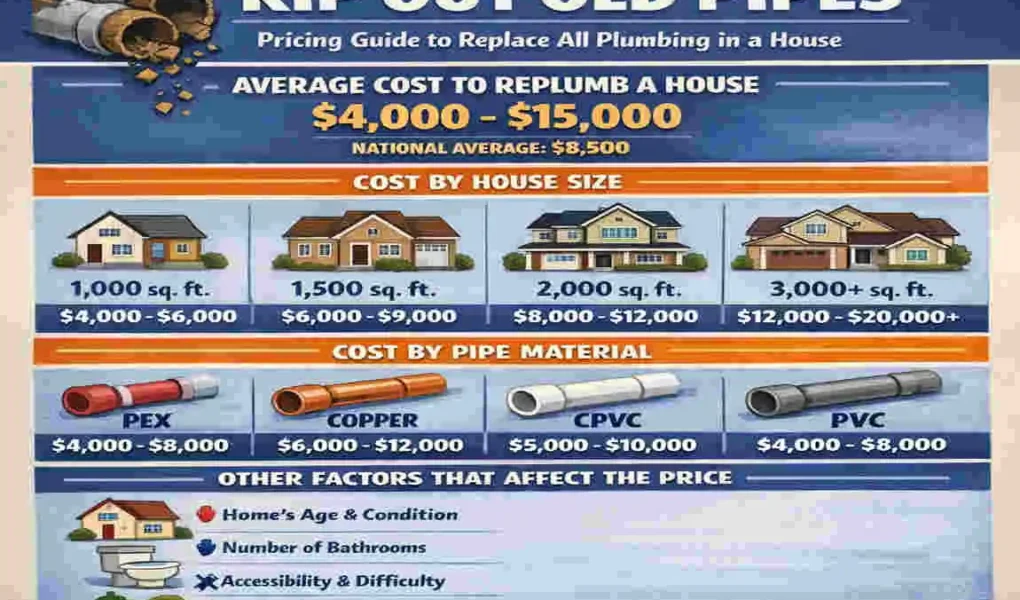
Naturally, the first question that pops into your mind during a plumbing crisis is about the budget. If you are wondering how much to replace all plumbing in a house, you should expect to spend between $4,000 and $16,000 on average.
While that number might take your breath away, whole-house repiping is not just a repair; it is a major investment in your home’s safety, value, and longevity. Ignoring aging pipes can lead to devastating mold growth, ruined foundations, and massive structural repair bills that easily dwarf the cost of new pipes.
| Component | US Average Cost | Notes | |
|---|---|---|---|
| Repiping per linear foot (PEX/PPR) | $0.40–$2 | PEX cheaper than copper ($2–$8/ft) | |
| Full house repipe (1,500–2,000 sq ft) | $4,000–$6,000 (PEX) | Scales with size; copper doubles US cost | |
| Per bathroom renovation | $5,000+ | Includes sinks, toilets, drains | |
| Per kitchen renovation | N/A | Basic piping and fixtures | |
| Labor (plumber hourly/day) | $42–$180/hr | Higher for emergencies or certified pros |
Average Costs Breakdown: What to Expect in 2026
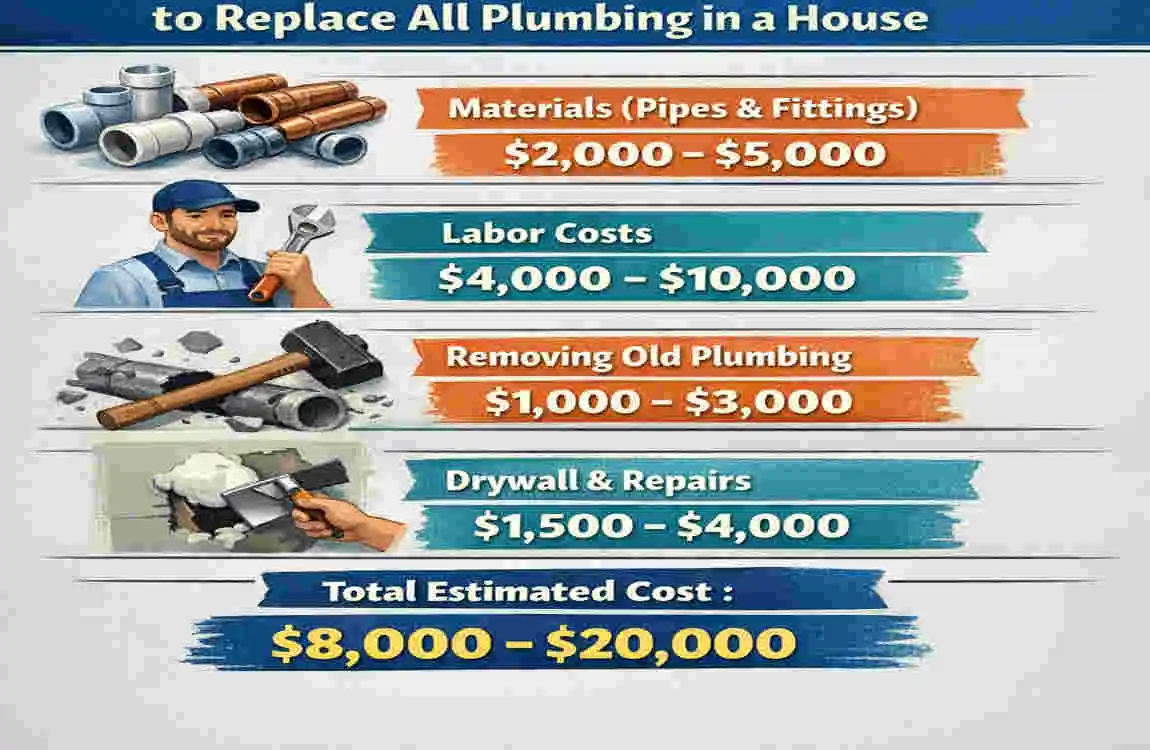
When you ask a contractor how much to replace all plumbing in a house, they will rarely give you a single flat rate right away. That is because every home is unique. However, we can look at the national averages to give you a realistic baseline for your budget.
For a standard, whole-house repiping project in 2026, homeowners typically spend around $8,500. But that number can vary significantly based on your property’s total square footage and the number of bathrooms.
Here is a quick breakdown of what you can expect to pay based on the size of your home:
Home Size Square Footage Estimated Cost Range Example Notes
Small (1 Bath) Under 1,500 sq. ft. $4,000 – $6,000 Basic PEX repipe, single-story access
Medium (2-3 Baths) 1,500 – 3,000 sq. ft. $7,000 – $12,000 Multi-story home, moderate accessibility
Large (3+ Baths) Over 3,000 sq. ft. $12,000 – $16,000+ Complex layouts, luxury fixtures, multiple floors
Breaking Down the Costs Per Fixture
Sometimes plumbers calculate the cost of your plumbing replacement based on the number of fixtures in your home. A “fixture” is any point where water connects, such as a toilet, bathroom sink, shower, kitchen sink, or washing machine.
On average, you can expect to pay between $450 and $1,800 per fixture for replacement.
For example, replacing the piping leading to a standard toilet might cost between $250 and $750. Meanwhile, repiping a complex master bathroom shower with multiple showerheads could push closer to that $1,800 mark. The more fixtures you have, the higher your overall bill will be.
Partial vs. Full Replacement
Do you actually need to replace every single pipe in your house? Not always. Sometimes, you only need a partial repipe.
If you are just remodeling a single bathroom or updating your kitchen, a partial replacement usually costs between $2,000 and $5,000. This targets specific problem areas while leaving the rest of your home’s plumbing intact.
However, if your entire home is made of deteriorating galvanized steel, a full replacement is the only safe option. A complete system overhaul ranges from $5,000 to $15,000 or more, depending on the materials you choose.
Regional Variations and Inflation Adjustments
Where you live plays a massive role in your whole-house repiping expenses. If you live in a bustling urban metropolis or a high-cost-of-living coastal city, you should expect to add 20% to 30% to these average costs. Plumbers in these areas face higher overhead, insurance, and licensing costs, which they pass on to consumers.
Conversely, if you live in a rural area or the Midwest, you might find prices on the lower end of the spectrum. Additionally, keep in mind that the prices listed here reflect 2026 inflation-adjusted estimates. The cost of raw materials, especially copper, fluctuates widely due to global supply chains.
Key Factors Affecting Your Plumbing Replacement Cost
You might be looking at the ranges above and wondering why there is such a massive gap between $4,000 and $16,000. It all comes down to the unique characteristics of your house and the specific choices you make during the project.
Let’s break down the top factors that determine how much it costs to replace all the plumbing in a house.
Your Choice of Pipe Material
The material you select for your new pipes is one of the biggest cost drivers. Plumbers measure materials by the linear foot.
Modern PEX piping is incredibly budget-friendly, usually costing between $0.40 and $2.00 per linear foot. It is flexible and easy to snake through walls. On the other hand, traditional copper piping is much more expensive. If you insist on outfitting your entire home with rigid copper, you will see your material costs skyrocket, often doubling the project’s total price.
The Age and Layout of Your Home
Older homes often come with hidden surprises. If you live in a historic house with thick lath-and-plaster walls, plumbers will have a much harder time cutting through to access the pipes.
Modern drywall is easy to cut and patch, but historic materials require delicate demolition. If your home has a complex layout, tight crawlspaces, or multiple sprawling stories, the plumbers have to work harder to route the new lines. You can easily add $1,000 or more to your bill just for the extra demolition and wall repair required in an older home.
Foundation and Accessibility
How easily can your plumber reach your main water lines? Accessibility is everything in the plumbing world.
If your home has a spacious, unfinished basement or an easily accessible crawlspace, plumbers can run new pipes quickly and efficiently. But if your home is built on a solid concrete slab foundation, accessibility becomes a major headache. To reach pipes buried beneath the concrete, plumbers have to jackhammer through your floor. Trenching through a slab foundation can add a painful $2,000 to $5,000 to your final invoice.
Professional Labor Rates
Plumbing is highly skilled, physically demanding labor. You are not just paying for pipes; you are paying for years of training, licensing, and expertise.
Most licensed plumbers charge between $50 and $200 per hour, depending on their experience level and your geographic location. A standard whole-house repiping job typically takes a crew between 40 and 80 labor hours to complete. When you do the math, labor often makes up the largest chunk of your total bill.
Permits and Unexpected Issues
You cannot just tear out all your plumbing without telling the city. Most municipalities require you to pull building permits for a whole-house repipe to ensure everything is done to code.
Permits generally cost between $100 and $500. Additionally, you should always build a buffer into your budget for unexpected issues. It is incredibly common for plumbers to open up a wall and discover extensive water damage, hidden mold, or rotting studs from previous slow leaks. Remediating these surprises mid-job can add $500 to $2,000 to your final costs.
Pipe Material Options: Choosing the Right Fit
The pipes you choose will determine not only your upfront costs but also the lifespan and water pressure of your plumbing system. Let’s look at the most common materials used today, compare their prices, and weigh their pros and cons.
Material TypeCost per Linear Ft.Top ProsMajor ConsExpected Lifespan
PEX (Cross-linked Polyethylene) $0.40 – $2.00 Highly flexible, affordable, resists bursting in freezing weather Cannot be used outdoors (UV sensitive), rodent damage risk 50+ years
PVC / CPVC $1.00 – $3.00 Very affordable, completely immune to rust and corrosion Becomes brittle with age, sensitive to UV light 50 – 70 years
Copper $2.00 – $10.00 Extremely durable, handles high heat, naturally limits bacteria Very expensive, rigid and hard to install, high theft risk 50+ years
Galvanized Steel (Old) N/A (Obsolete) None (Do not install this today) Rusts internally, causes low water pressure, prone to bursting 20 – 50 years
PEX: The Modern Miracle
If you want to keep your repipe house price low, PEX is the undisputed champion of modern plumbing. PEX stands for cross-linked polyethylene. It is a highly flexible, colorful plastic tubing (usually red for hot water and blue for cold).
Because it is so flexible, plumbers can bend it around corners and snake it through existing walls with minimal demolition. This drastically reduces labor hours. On average, choosing PEX can save you roughly 40% compared to copper. We highly recommend PEX for indoor residential repiping.
PVC and CPVC: The Reliable Plastics
PVC (Polyvinyl Chloride) and its heat-resistant cousin CPVC are hard, rigid plastic pipes. They are slightly more expensive than PEX but still incredibly affordable.
These pipes will never rust, pit, or corrode. They are highly reliable for main water supply lines. However, they do not bend, meaning plumbers have to cut and glue elbows and joints to navigate around corners. Over many decades, CPVC can sometimes become brittle, but it remains a highly reliable choice for budget-conscious homeowners.
Copper: The Premium Standard
Copper is the grandfather of plumbing materials. It has been used for generations, and for good reason. It is exceptionally durable, completely fire-resistant, and it does not off-gas any chemicals into your water supply.
However, copper is a rigid metal. Installing it requires a plumber to painstakingly measure, cut, and solder every single joint with a blowtorch. Because the price of raw copper fluctuates on the commodities market, it is by far the most expensive option. If you want a premium, old-school feel and have the budget for it, copper is excellent, but it will significantly increase your plumbing replacement costs.
Galvanized Steel: The Ghost of Plumbing Past
If you are living in a house built before the 1980s, you likely have galvanized steel pipes. Do not install these today!
Galvanized pipes were coated in zinc to prevent rusting, but over decades, that coating wears away. The pipes rust from the inside out, creating thick layers of gunk that restrict water flow and eventually lead to catastrophic bursts. If you have these pipes, getting them out of your house should be your top priority.
The Repiping Process Step-by-Step
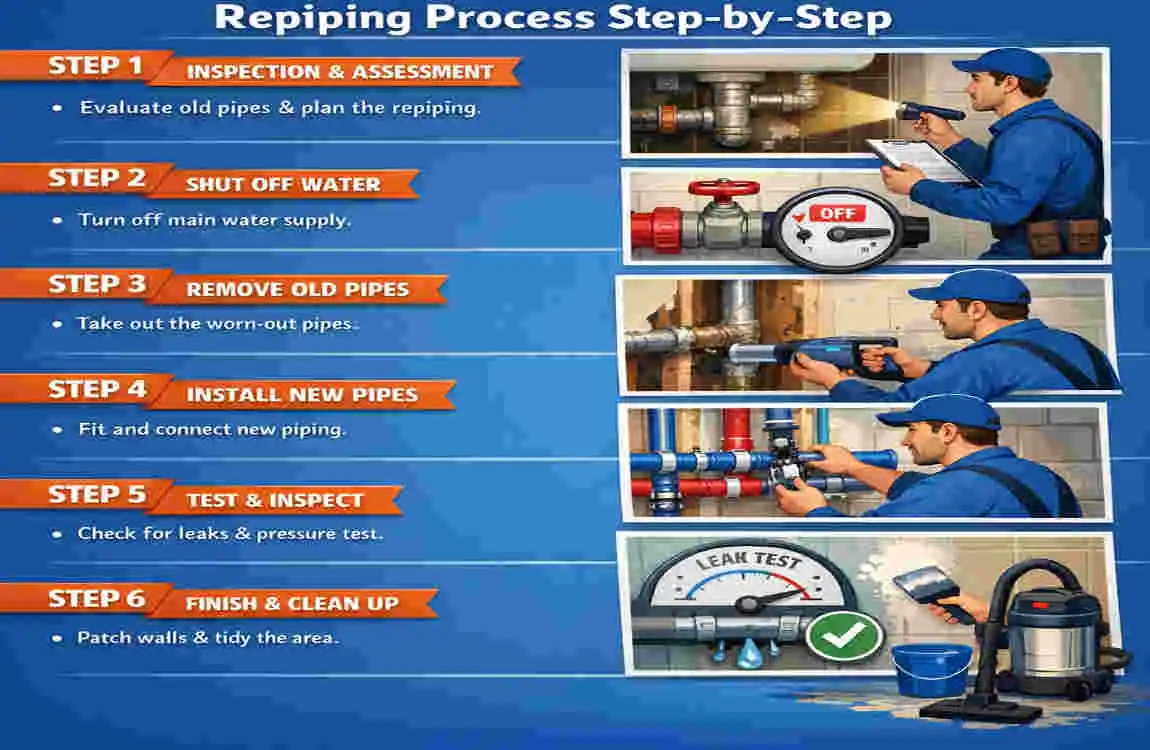
Understanding the timeline and the process helps demystify your whole-house repiping expenses. It is a major construction project, but a professional crew knows how to minimize the chaos in your home.
Here is exactly what you can expect when you hire a professional team for a whole-house repipe.
The Initial Inspection and Free Quote
The process begins with a master plumber visiting your home. They will inspect your current layout, check your foundation, assess the number of fixtures, and listen to your material preferences. After this thorough audit, they will provide a detailed, itemized quote so you know exactly how much it will cost to replace all the plumbing in a house.
Preparation and Water Shut-Off
On installation day, the crew will prep your home. They will lay down heavy drop cloths to protect your floors and seal off work areas with plastic sheeting to contain the dust. Once everything is protected, they will shut off your main water valve. You will be without running water during the active working hours, though many plumbers will temporarily turn the water back on at the end of each day so you can use the bathroom at night.
Wall Demolition and Old Pipe Removal
To install the new pipes, the plumbers have to open up your walls and ceilings. They will make strategic, precise cuts in your drywall to access the plumbing chases. Next, they will disconnect and drain your old, corroded cast iron or galvanized pipes. Depending on the setup, they will either haul the old pipes away or safely abandon them inside the walls if removing them would cause excessive structural damage.
Running the New Lines (The Rough-In)
This is the core of the project. The plumbers will run your brand-new PEX, CPVC, or copper lines through the floors, walls, and ceilings. They will secure the pipes to the wooden studs to prevent rattling or “water hammer” noises. The industry standard for rough-in plumbing usually costs around $4.50 per square foot.
Reconnection and Pressure Testing
Once the new plumbing skeleton is installed, the team will connect it to your sinks, toilets, showers, and water heater. Before they close anything up, they must test the system. They will turn the main water supply back on and run high-pressure tests to ensure there is absolutely no weeping or leaking at any of the new joints.
Drywall Patching and Final Cleanup
A good plumbing company will not leave you with gaping holes in your walls. Once the plumbing passes inspection, a crew (or a specialized drywall sub-contractor) will come in to replace the sheetrock, apply joint compound, and sand the walls smooth. Finally, they will sweep up the dust and leave your home exactly as they found it.
Timeline: Depending on the size of your home, the actual plumbing work takes about 3 to 5 days. The drywall patching and painting can add another few days, bringing the total project timeline to roughly 1 to 2 weeks.
DIY vs. Professional Replacement: Is it Worth the Risk?
With the rise of home improvement shows and online video tutorials, many homeowners try to tackle major renovations themselves. We all love a good weekend DIY project, but when it comes to replacing your entire plumbing system, you need to step back and assess the reality of the situation.
There is a dangerous myth floating around that doing it yourself will save you $4,000 or more. Let’s look at the facts and bust that myth wide open.
Project AspectDIY ApproachProfessional Approach
Upfront Cost Materials only ($2,000 – $5,000) Full service labor & materials ($4,000 – $16,000)
Time Investment 2 to 4 weeks (working nights/weekends) 3 to 10 days (dedicated full-time crew)
Risk Level Extremely High (Leaks, code violations) Very Low (Insured, bonded, and guaranteed)
Permits & Legal Often illegal without proper licenses Handled completely by the contractor
The Dangers of DIY Plumbing
First and foremost, whole-house repiping is heavily regulated. In many cities and counties, it is actually illegal for an unlicensed homeowner to pull a permit for a total plumbing overhaul.
If you attempt to do this without a permit and make a mistake, the consequences are disastrous. A single poorly crimped PEX fitting or a badly soldered copper joint can burst in the middle of the night. A major leak can destroy your flooring, ruin your drywall, and cause toxic mold to bloom inside your walls.
Furthermore, if your insurance company discovers that a flood was caused by unlicensed, unpermitted DIY plumbing work, they will likely deny your claim entirely. You will be left paying tens of thousands of dollars out of pocket for water damage restoration.
The Peace of Mind of Hiring a Pro
When you hire a licensed, bonded, and insured professional, you are buying peace of mind. Pros have specialized tools, municipal connections to fast-track permits, and deep knowledge of local building codes.
More importantly, professional plumbers offer strong warranties on their labor and materials. If a fitting leaks six months down the road, they will come back and fix it for free. Your home is your biggest asset; protect it. Always hire certified plumbers for safety and guaranteed results.
Clever Cost-Saving Tips for Your Repipe Project

Even though hiring a pro is the right move, you do not have to drain your life savings to get the job done. If you are looking to lower the cost of your plumbing replacement, here are some actionable tips to keep more money in your pocket.
- Get at Least Three Quotes: Never accept the very first estimate you receive. Invite at least three different reputable plumbing companies to bid on your project. Having multiple quotes allows you to compare labor rates and use the bids as leverage to negotiate a better deal.
- Opt for a Partial Repipe First: If your budget is incredibly tight right now, ask your plumber to prioritize the worst areas. You can replace the failing pipes in your main bathroom now, and save the kitchen and laundry room for next year.
- Choose PEX Over Copper: As discussed, choosing PEX piping is the easiest way to slash your materials budget by nearly half. It performs beautifully and saves a fortune on labor hours.
- Schedule During the Off-Peak Season: Plumbers are incredibly busy during the dead of winter (dealing with frozen or burst pipes) and during the height of summer (the major construction season). If you can schedule your non-emergency repipe during the slower fall or spring months, you can often negotiate a 10% to 20% discount.
- Bundle Upgrades Together: Are you also running out of hot water quickly? If you bundle a new water heater installation with your whole-house repipe, plumbers will often give you a steep discount on the labor. Adding a water heater during a repipe usually only adds $750 to $1,400 to the bill, whereas doing it separately later would cost much more.
- Look for Energy Rebates: If you upgrade to low-flow toilets, energy-efficient showerheads, or a tankless water heater during your repipe, check with your local utility company to see if you qualify for rebates. Many offer substantial cash rebates for water-conserving fixtures.
Frequently Asked Questions (FAQs)
When dealing with a massive project like this, it is normal to have many questions. Here are the most common inquiries we hear from homeowners regarding their old pipes.
How much to replace all plumbing in a house?
On average in 2026, you can expect to spend between $4,000 and $16,000 to replace all the plumbing in your house. The final price depends heavily on your property’s square footage, the number of water fixtures you have, and the type of pipe material you choose. Most standard American homes fall right around $8,500.
Is PEX tubing really safe for a whole-house repipe?
Absolutely! PEX is the current gold standard for residential plumbing. It is rigorously tested, highly durable, and does not corrode or leach chemicals into your water supply like old metal pipes can. With a life expectancy of over 50 years, it is a perfectly safe and highly economical choice for your home.
What is the average cost of repiping an old house?
Older houses generally cost more to repipe due to difficult accessibility, thick lath-and-plaster walls, and outdated layouts. While a standard modern home might cost $7,000 to repipe, an old, historic home will usually cost $8,500 to $12,000, reflecting the extra demolition, careful wall repairs, and complex routing required.Will my homeowner’s insurance cover the cost of repiping?
Generally speaking, no. Homeowner’s insurance considers pipe wear and tear a standard maintenance issue, the homeowner’s responsibility. However, if an old pipe suddenly bursts and floods your living room, your insurance will likely cover the cost of water damage repairs and the repair or replacement of the specific section of the broken pipe. They just will not pay for the preventative whole-house pipe replacement.