How to Install Dream Home Laminate Flooring: Easy Step-by-Step DIY Guide
FLOOR

How to Install Dream Home Laminate Flooring: Easy Step-by-Step DIY Guide

We have all been there. You are scrolling through home design feeds, drooling over those gorgeous, warm wood floors that seem to tie a whole room together. Then, reality hits. You look at the price tag of solid hardwood, add in the cost of professional installation, and suddenly that dream renovation feels like it is drifting out of reach. But what if I told you that you could get that high-end look without draining your savings account?

For homeowners who want the aesthetic of luxury hardwood without the luxury price tag, Dream Home laminate is a game-changer. It offers durability, water-resistant options, and incredibly realistic wood visuals that can fool even the sharpest eyes. But the best part? It is designed specifically for you—the DIY enthusiast.

Choosing to tackle this project yourself is one of the smartest financial moves you can make during a renovation. Professional flooring installation can cost anywhere from $3 to $8 per square foot just for the labor. By learning to install Dream Home laminate flooring yourself, you keep that money in your pocket. We are talking about saving hundreds, potentially thousands of dollars, depending on the size of your room.

What Is Dream Home Laminate Flooring?

How to Install Dream Home Laminate Flooring: Easy Step-by-Step DIY Guide

Before we start ripping up carpet or swinging hammers, let’s take a moment to understand exactly what we are working with. Dream Home has built a solid reputation for providing affordable, high-quality laminate flooring. But what makes it tick?

Unlike solid wood, which is a single piece of timber, Dream Home laminate is a composite product. It is constructed in layers, typically featuring a high-density fiberboard (HDF) core. This core provides exceptional stability, making the planks less likely to warp or twist than natural wood. On top of that core sits a high-definition photographic layer—this is what gives the floor its realistic oak, hickory, or maple appearance. Finally, it is topped with a clear, super-tough wear layer.

Why Choose Dream Home?

There are a few reasons why this specific flooring is a favorite among DIYers:

  • The Click-Lock System: The secret sauce for an easy install. The planks are engineered with interlocking edges that snap together. No messy glue, nails, or specialized staples are required.
  • Durability: The wear layer is rated for traffic (look for the AC rating on the box). It is highly resistant to scratches, stains, and fading. If you have energetic dogs or kids who love dragging toys across the floor, this is a huge plus.
  • Budget-Friendly: You get the “wow” factor of hardwood for a fraction of the cost.
  • Versatility: It works beautifully in living rooms, hallways, and dining rooms. Many modern versions are also water-resistant, making them viable candidates for kitchens and basements, provided you follow the specific moisture guidelines.

When you compare this to vinyl or traditional hardwood, Dream Home laminate sits in a sweet spot. It feels more substantial underfoot than thin vinyl, yet it is much easier to maintain than hardwood. It really is the best of both worlds.

Tools and Materials Needed for Installation

You wouldn’t bake a cake without checking your pantry first, right? The same logic applies here. Having the right tools on hand will make the difference between a fun weekend project and a frustrating ordeal. The good news is that installing Dream Home laminate planks doesn’t require a van full of heavy machinery.

Here is a breakdown of what you will need.

The Essentials List

Category Essentials Optional / Nice-to-Have

Tools Tape measure, Pencil, Circular saw (or Miter saw), Utility knife, Tapping block, Pull bar, Rubber mallet, Spacers (1/4 inch) Jigsaw (for tricky cuts), Knee pads, Speed square, Contour gauge, Safety glasses

Materials Dream Home laminate planks, Underlayment (foam/moisture barrier), Duct tape or Moisture tape, Transition strips (T-moldings) Quarter-round molding, Baseboards, Laminate floor cleaner

A Note on Costs and Quantities

In terms of budget, aside from the flooring itself, expect to spend about $1 to $2 per square foot on additional materials like underlayment and moldings.

Pro Tip: When buying your flooring, always follow the 10% Rule. Calculate the square footage you need, then add 10% to it. This extra amount accounts for waste from cutting and mistakes (we all make them!) and ensures you have a few spare planks left over for future repairs, if needed. It is much better to return an unopened box later than to stop mid-project because you are two planks short.

If you don’t own a saw, don’t panic. You can often rent a miter saw or a laminate floor cutter from your local hardware store for a reasonable daily rate.

Preparation: Essential Steps Before You Start

You can crack open the first box and start laying floors immediately. Please, resist that urge! The success of your DIY Dream Home flooring guide relies heavily on what you do before you lay a single plank. Preparation is 80% of the job.

Room Assessment and Measuring

Grab your tape measure and get accurate numbers. Calculate your total square footage by multiplying the length of the room by the width ($\text{Length} \times \text{Width}$). If you have a closet or an alcove, measure those separately and add them to your total.

Subfloor Preparation

Your new floor is only as good as the subfloor beneath it. If the subfloor is uneven, your new laminate will flex, squeak, and eventually break at the locking mechanisms.

  1. Remove Old Flooring: Pull up the old carpet, pad, and tack strips. If you have tile or vinyl that is well-adhered and flat, you can float the laminate right over it.
  2. Clean It Up: Sweep and vacuum thoroughly. Even small pebbles or chunks of drywall can cause problems later.
  3. Check for Flatness: Use a long level or a straight board. The general rule is that the floor should be flat to within 3/16 of an inch over a 10-foot span. If you find low spots, fill them with a floor leveling compound. If there are high spots or humps, sand them down.
  4. Moisture Barrier: If you are installing over a concrete subfloor (like in a basement or on a slab), you must install a 6-mil polyethylene moisture barrier. Concrete is porous and releases moisture that can warp your laminate.

Acclimation: The Most Crucial Step

This is the step most people skip, and it is the leading cause of floor failure. You must acclimate your flooring.

Laminate flooring is made of wood byproducts. It expands and contracts with changes in temperature and humidity. Bring the unopened boxes of Dream Home laminate into the room where they will be installed. Stack them flat (not standing on end) and leave them there for at least 48 hours. Keep the room temperature between 65°F and 75°F. This allows the planks to adapt to the room’s environment, preventing shrinkage or buckling after installation.

Planning Your Layout

Take a look at your room. Which wall is the longest? usually, you want to run the planks parallel to the longest wall or towards the main light source (like a big window).

You also need to plan your stagger. You do not want the ends of the planks to line up; it creates a weak floor and makes it look unnatural. You want a “stair-step” pattern. A good rule of thumb is to stagger seams by at least 12 inches.

Safety Note: Always prioritize safety. Wear your safety glasses when cutting planks to protect your eyes from flying debris. If you are using a saw indoors, wear a dust mask. Knee pads are also a lifesaver—your knees will thank you tomorrow!

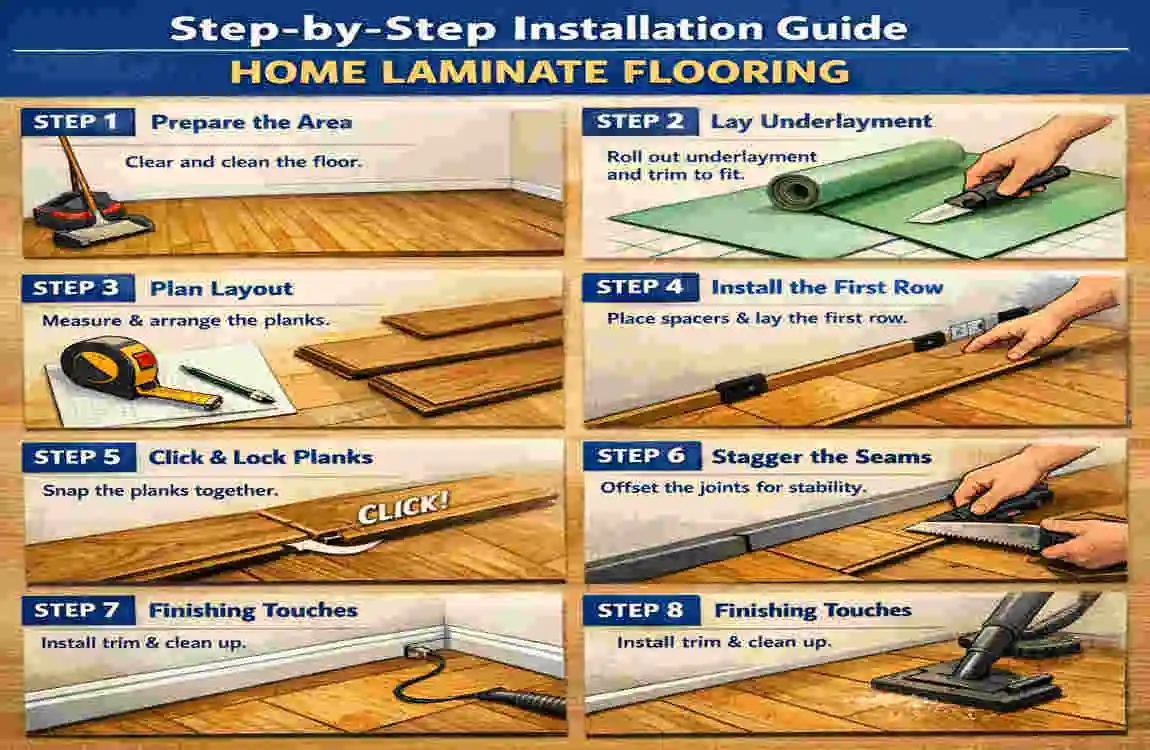
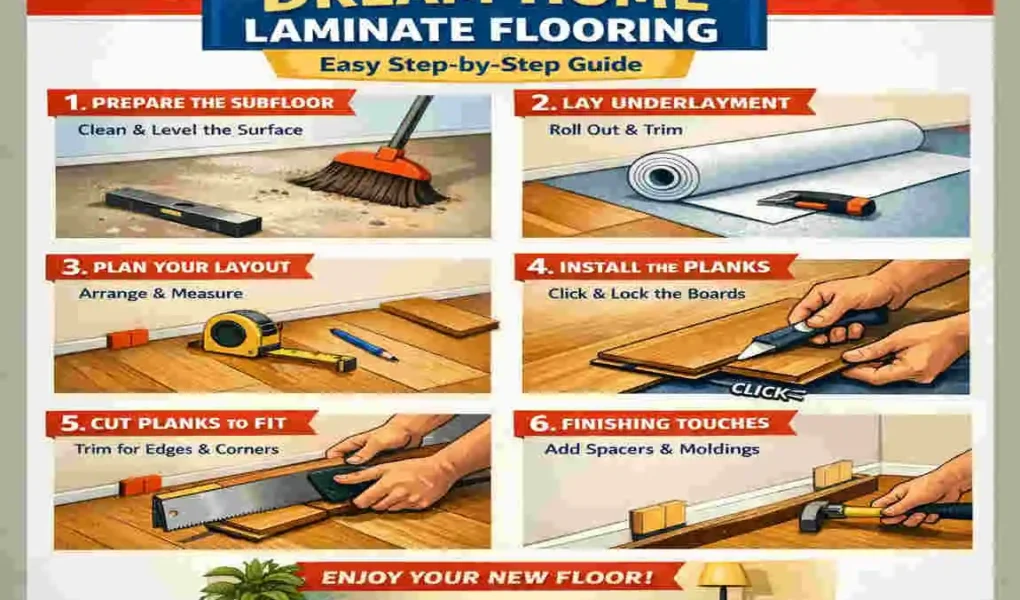
Step-by-Step Installation Guide: How to install Dream Home Laminate Flooring

How to Install Dream Home Laminate Flooring: Easy Step-by-Step DIY Guide

Now that the prep work is done, it is time for the fun part. Let’s get that floor down.

install the Underlayment

Unless your Dream Home planks come with a pre-attached pad, you need to roll out underlayment. This foam layer cushions the floor, reduces sound, and provides a little thermal insulation.

Roll out the underlayment one row at a time. Run it in the same direction you plan to lay the flooring. Don’t overlap the foam edges—butt them up against each other perfectly. Use clear packing tape or the adhesive strip provided on the roll to seal the seams. Trim the excess along the walls with your utility knife, but leave about an inch running up the wall (you will trim this later or cover it with baseboard).

Lay the First Row

The first row sets the trajectory for the entire room, so take your time here to get it straight.

Start in the left-hand corner of the room. Place your first plank down. Crucial Tip: Make sure the “tongue” side of the plank is facing the wall. This means the “groove” side is facing out into the room, ready to accept the next row.

Place 1/4-inch spacers between the plank and the wall. You need spacers on both the short and long sides. This gap is vital because the floor needs room to expand when the weather gets humid. Without this gap, your floor will buckle in the summer.

Connect the second plank to the first by interlocking the short ends. Usually, you angle the second plank slightly, insert the tongue into the groove, and lower it flat. Tap it gently with your tapping block and rubber mallet to ensure the gap is tight. Continue this until you reach the end of the row.

You will likely need to cut the last plank to fit. Measure the distance from the last plank to the wall (subtracting your 1/4 inch for the spacer). Mark the plank, cut it with your saw, and click it into place.

Stagger and Continue Rows

Now you are moving. For the second row, start with a cut piece to ensure your joints are staggered. A great trick is to use the leftover piece cut from the end of the first row to start the second row, provided it is at least 12 inches long.

To install the second row, hold the plank at a roughly 20-30-degree angle. Insert the long tongue into the groove of the first row. Press it in and fold it down.

Once the plank is flat, you will need to engage the short end. Insert the next plank’s long side first, slide it close to the previous plank’s short end, and drop it down. Now, use your tapping block. Place the block against the side of the plank (never hit the laminate directly with a hammer!) and give it a sharp tap to lock the joints together perfectly. You should see no gaps.

Pro Tip: Every few rows, stop and stand up. Look at the floor. Is it straight? Is it aligned? If you drift off-course now, it will look terrible by the time you reach the other side of the room.

Step 4: Handle Cuts and Obstacles

If rooms were perfectly square boxes, flooring would be easy. But we have door frames, closets, and heating vents to deal with.

Door Jambs: Never try to cut the laminate to the shape of a complex door jamb. It looks messy. Instead, undercut the door jamb. Lay a scrap piece of flooring (with underlayment) next to the door frame. Rest your handsaw flat on top of the scrap and saw through the wooden door frame. Now, your new flooring will slide cleanly underneath the wood for a seamless, professional look.

Pipes and Vents: For radiator pipes, measure exactly where the pipe will sit on the plank. Drill a hole that is 1/2 inch larger than the pipe diameter. Then, cut the plank through the center of the hole. Fit the two pieces around the pipe and glue them back together. You can cover the gap with a pipe rosette later.

Final Row and Finishing Touches

You have made it to the other side of the room! The final row is rarely a full plank width.

Measure the distance from the second-to-last row to the wall—don’t forget to subtract that 1/4-inch expansion gap again. Mark this width on your final planks. You will need to “rip” these planks (cut them lengthwise). A table saw is best for this, but a circular saw works if you have a steady hand.

Once cut, install the final row. You won’t have room to use a tapping block here. This is where the pull bar comes in. Hook the pull bar over the edge of the plank near the wall and hammer the other end of the bar to pull the plank tight into the locking mechanism.

Finally, remove all the spacers. Install your baseboards and quarter-round molding. These moldings are critical—they cover that expansion gap you left around the perimeter. Nail the molding into the wall, not into the floor. The floor needs to be able to “float” or move freely underneath the trim.

Post-Installation Care

Congratulations! You have successfully installed your Dream Home laminate flooring.

While you can walk on click-lock flooring immediately, it is best to wait about 24 hours before bringing in heavy furniture or allowing heavy foot traffic. This gives the floor a moment to settle.

When it comes to cleaning, keep it simple. Sweep or vacuum regularly (with the beater bar turned off). For mopping, use a damp (not wet!) mop with a laminate-specific cleaner. Never flood the floor with water, and avoid steam mops, as the heat and moisture can seep into the seams and cause swelling.

Common Mistakes to Avoid When Installing Dream Home Laminate Flooring

Even smart DIYers can get tripped up. Here are the most common pitfalls to avoid to ensure your floor lasts a lifetime.

  • Ignoring the Expansion Gap: I cannot stress this enough. If you fit the flooring tight against the wall, as soon as humidity rises, the planks will expand and have nowhere to go but up. This creates “tenting” or buckling in the middle of your room. Always use spacers!
  • Poor Staggering: Avoid “H-joints” where the seams line up in every other row, or “stair steps” that are too uniform. Random staggering looks much more like real wood and provides better structural integrity.
  • Not Checking Planks: Inspect every plank before you install it. Sometimes a plank comes out of the box with a chipped corner or a print defect. It is much easier to set it aside now than to rip up half the floor later.
  • Trapping the Floor: When installing door stops or closet guides, do not screw them through the laminate into the subfloor. This pins the floor down and prevents it from expanding.
  • Wrong Underlayment: Don’t use extra thick carpet padding thinking it will be softer. Too much cushion allows the planks to flex too much, which will snap the locking joints. Stick to underlayment designed for laminate.

FAQs: How to install Dream Home Laminate Flooring

Can I install Dream Home laminate over tile? Yes, absolutely! As long as the tile is flat, firmly attached, and level, you can float laminate right over it. If the grout lines are very deep/wide, you should fill them with a leveling compound first to prevent the underlayment from dipping.

Should I glue or float the floor? For Dream Home laminate, you should almost always use the floating method (click-lock). Glue is messy and unnecessary for this product type. Floating allows the floor to expand and contract naturally.

What about the warranty? Dream Home flooring typically comes with a robust residential warranty (often 30 years to lifetime). However, this warranty is valid only if you follow the installation instructions. This includes acclimation and the use of the moisture barrier on concrete.

How long does it take to install? For a standard 200-square-foot room, a beginner can finish the job in a weekend. Expect to spend Saturday on prep and laying the main floor, and Sunday on finishing touches and trim.

You may also like...

Leave a Reply

Your email address will not be published. Required fields are marked *