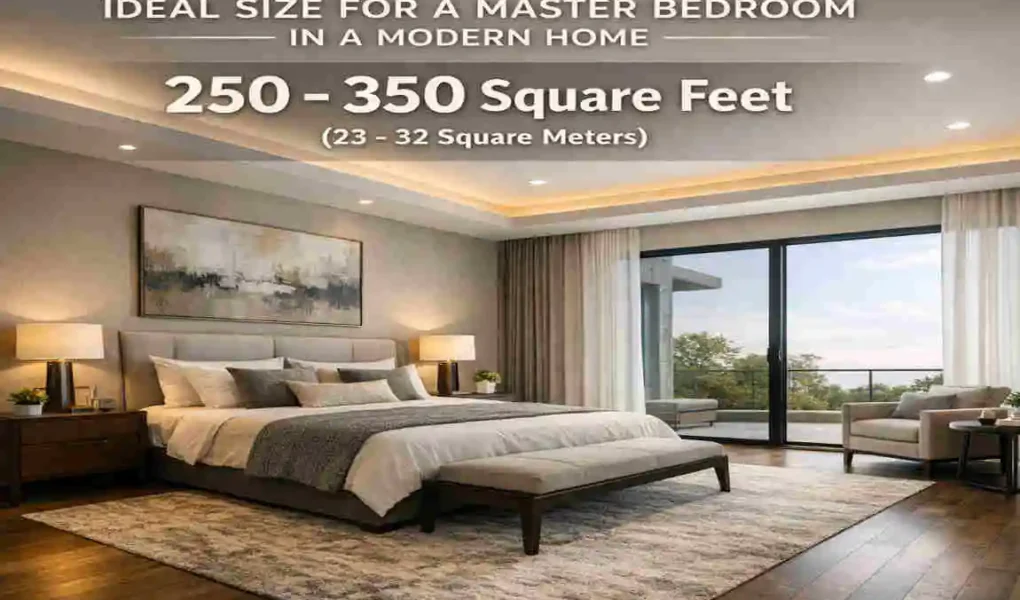
This size accommodates a king bed, nightstands, dresser, and extras like a seating area or desk while ensuring clear walkways. Modern designs often start at 14×16 feet for clean lines, large windows, and built-in storage.
Larger homes may go up to 400 square feet (18×20 feet) for zones like reading nooks.
Prioritize 11–13% of total home area for the master suite to feel proportional. Aim for 8–10 foot ceilings and natural light to enhance spaciousness. Minimum for a king bed is 12×12 feet, but add space for flow in contemporary layouts.
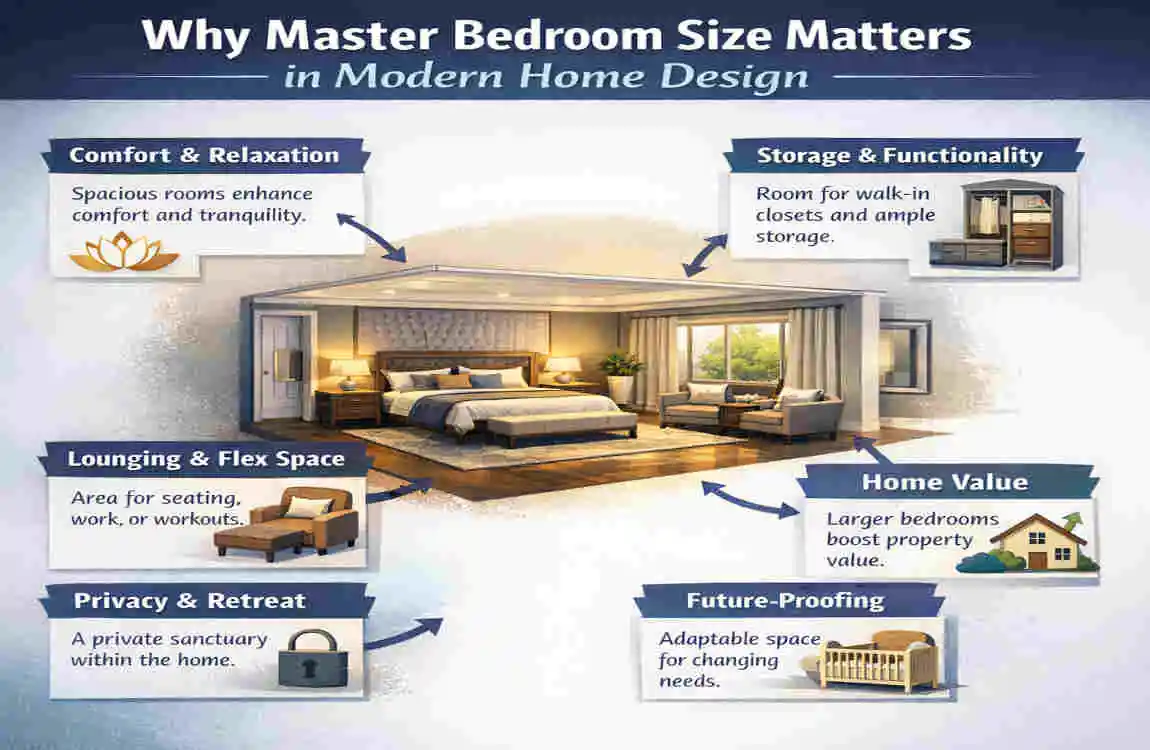
Why Master Bedroom Size Matters in Modern Home Design
To understand where we are going, it helps to look at where we have been. If you step into a home built in the 1950s, the “main” bedroom was often a modest 10 feet by 10 feet—barely 100 square feet! Back then, the bedroom had one job: it was a place to sleep. There were no sitting areas, no workout corners, and certainly no home office desks.
Fast forward to today, and the script has flipped completely. According to statistics from the National Association of Home Builders (NAHB), the average size of a main bedroom in new U.S. homes has ballooned to around 240 square feet or larger.
Why the shift? It comes down to how we live now. Your bedroom is no longer just for sleeping; it is a retreat. It is where you catch up on emails, practice morning yoga, or unwind with a book away from the noise of the household.
The Impact on Your Wallet and Wellness
Size matters for your sleep quality and your mental health. A cramped room can feel cluttered and chaotic, which subconsciously spikes stress levels before you even close your eyes. On the flip side, a room that allows for proper “Feng Shui”—the flow of energy—can significantly enhance relaxation.
From a financial perspective, square footage sells. Real estate data from platforms like Zillow suggests that homes with spacious, well-appointed master suites can command a resale value premium of 5-10% compared to similar homes with cramped quarters. Buyers are looking for that “luxury suite” feeling.
Three Key Benefits of the Right Size
- Enhanced Relaxation and Flow: You need physical space to clear your mind. Having clear walkways around the bed prevents that cramped, claustrophobic feeling.
- Furniture Flexibility: A standard 12×12 room struggles to hold a King-sized bed comfortably. A modern master needs to accommodate a 76×80-inch bed, nightstands, a dresser, and perhaps a bench without you bumping your shins in the dark.
- Future-Proofing: Life changes. You may want to add an en-suite bathroom connection, a nursery corner, or a treadmill. A properly sized room (200+ sq ft) gives you the flexibility to adapt.
Ideal Dimensions: What’s a Good Size Main Bedroom?
Let’s get specific. You want numbers? We have numbers.
A good main bedroom size for modern homes is 200-250 square feet. This usually translates to dimensions of 14×16 feet or 15×17 feet.
However, “one size fits all” rarely works in home design. A sprawling 400-square-foot bedroom might look ridiculous in a cozy 1,500-square-foot cottage, just as a 12×12 room would feel like a mistake in a luxury estate.
Here is a breakdown of recommended sizes based on the type of home you have:
Master Bedroom Size Guide by Home Type
Home Type Recommended Size Dimensions Why It Works Example Layout
Small / Urban Home (Approx. 1,500 sq ft) 196 sq ft 14 x 14 ft This is the sweet spot for efficiency. It fits a King bed, two nightstands, and a dresser while maintaining 36-inch walkways. King bed centered; tall dresser opposite; L-shaped corner layout.
Mid-Size Family Home (Approx. 2,500 sq ft) 240 sq ft 15 x 16 ft. This size adds breathing room. You can include a seating area or a reading nook, ensuring it adheres to NKBA guidelines for comfort. Bed against the main wall; bench at the foot of the bed; armchair in the corner.
Luxury / Modern Estate (4,000+ sq ft) 320+ sq ft 16 x 20 ft This creates a true “suite” vibe. You have space for a lounge area, perhaps a fireplace, creating a hotel-like experience. Floating bed in the center; separate lounge area with a sofa; direct view of the freestanding tub.
Visualizing the Space
If you have a 14×14 (196 sq ft) room, you are prioritizing function. You have exactly enough room for the essentials, plus a little airiness.
If you jump up to 16×20 (320 sq ft), you are entering luxury territory. This allows you to float furniture away from the walls. You could place a desk behind the headboard or create a distinct “living room” zone within the bedroom. This is what celebrity homes often feature, averaging around 400 square feet for the sleeping quarters alone.
Average Main Bedroom Sizes: Stats and Trends
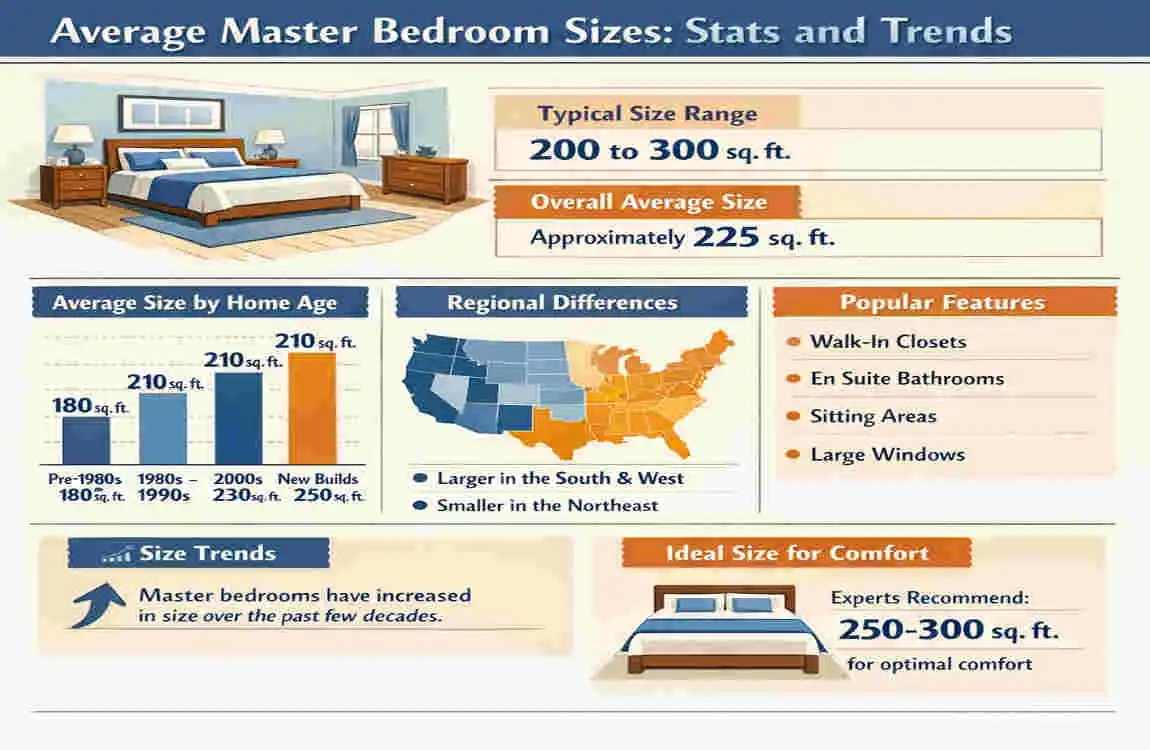
If you are worried that your bedroom plans are too big or too small, it helps to look at the averages.
As of 2024, the average main bedroom size in the United States is roughly 219 square feet. This number has actually ticked upward by about 10% since 2020. The driving force? The work-from-home (WFH) revolution. As more people needed quiet corners for Zoom calls, the bedroom evolved into a multifunctional space, demanding more square footage.
International vs. Domestic Trends
It is interesting to compare this globally. In Europe, where architecture is older and density is higher, the “main” bedroom (often called the main bedroom) averages 150 to 200 square feet. They prioritize efficiency over sprawling floor plans.
In the U.S., however, “bigger is better” still dominates, specifically in suburban areas.
- 1970s: The average was a tight 120 square feet.
- 2000s: We saw the “McMansion” era, pushing average square footage to 300+ square feet.
- 2026 Prediction: We are seeing a trend toward “Efficient Luxury.” Homeowners are scaling back slightly from the cavernous rooms of the 2000s to a more manageable, cozy 200-250 sq ft that costs less to heat and cool but still fits a King bed comfortably.
Regional Differences in Good Master Bedroom Sizes
Geography plays a massive role in what is considered “standard.”
- The U.S. Southwest (Texas, Arizona): Here, land is often cheaper and more abundant. It is not uncommon to find standard suburban master bedrooms pushing 250 to 300 square feet.
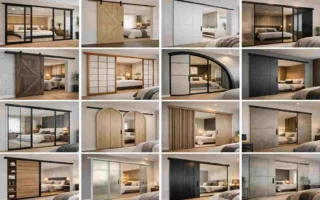
- Urban Centers (NYC, San Francisco): In these metros, a “main” bedroom might be 12×14 feet (168 sq ft). Builders here use “hacks” like built-in wardrobes and sliding pocket doors to make the smaller footprint feel luxurious.
Factors Influencing the Perfect Main Bedroom Size
Choosing the right size isn’t just about picking a number out of a hat. You need to consider the physical realities of what you want to put inside the room. Here are the key factors you must weigh:
The Bed Size (The Elephant in the Room)
The bed is the anchor of the room. You can’t plan the room without knowing your mattress size.
- Queen Bed (60×80 inches): Fits comfortably in a 12×14 ft room.
- King Bed (76×80 inches): This is 16 inches wider than a Queen. To avoid it looking cramped, you really need at least 12×14 feet, but 14×16 feet is ideal.
- California King (72×84 inches): It’s longer and narrower. You need extra length in the room dimensions to walk past the foot of the bed.
Furniture Layout and Clearance
It’s not just the bed. Do you have a “triple dresser” (usually 6 feet wide)? Do you want a cozy reading armchair?
- The 7-Foot Rule: Interior design pros, like those referenced in Alderfer’s guides, often suggest leaving a clear 7-foot circle or square of open space in the center of the room to maintain an airy feel.
- Clearance: You need at least 30 to 36 inches of walking space between furniture pieces. If you have dresser drawers that pull out, you need even more space so you aren’t trapped between the open drawer and the bed.
Home Architecture
The room’s volume matters as much as its floor area.
- Vaulted Ceilings: A 150-square-foot room with 12-foot vaulted ceilings will feel significantly larger than a 200-square-foot room with 8-foot ceilings.
- Windows: Large windows and natural light expand the “perceived space.”
Lifestyle Needs
How do you actually use the room?
- Pet Zones: Do you have a Great Dane with a massive dog bed? You need to budget an extra 20 square feet of floor space so you don’t step on Fido in the night.
- Yoga/Exercise: If you want to roll out a yoga mat permanently, you need a designated 6×8-foot clear zone.
Bathroom Integration
Modern design often treats the bedroom and bathroom as one fluid suite. If you are designing an open-flow concept where the sink or tub is visible from the bed, the total suite size needs to be larger—often 300-400 square feet total—to accommodate ADA accessibility and proper ventilation.
Bedroom Size Guidelines from Experts and Building Codes
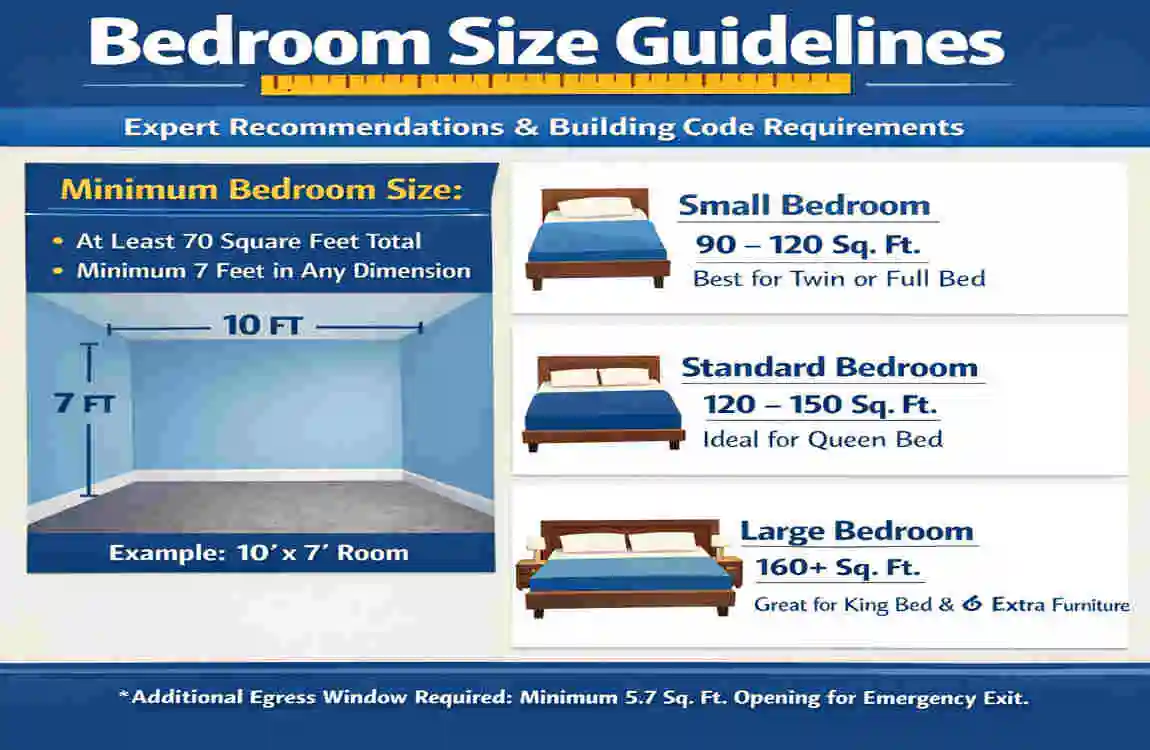
There is a big difference between what is legal and what is comfortable.
The Legal Minimum (IRC)
The International Residential Code (IRC) sets the bar incredibly low. Legally, a habitable room only needs to be 70 square feet (7 feet by 10 feet). Technically, you could sleep there, but you certainly wouldn’t call it a “main suite.”
The Architect’s Recommendation (AIA)
Professionals from the American Institute of Architects (AIA) generally recommend 150 square feet as the absolute minimum for a primary bedroom, with 225 square feet being the target for high-quality living.
The Feng Shui Perspective
Feng Shui experts often prefer square or rectangular rooms without sharp, odd angles. A 16×16-foot room is considered highly auspicious because it promotes balance and equality between partners (with space on both sides of the bed).
Common Mistakes in Master Bedroom Sizing
Even with the best intentions, homeowners make mistakes:
- Undersizing for Media: People forget that when mounting a TV, they need distance. Watching a 65-inch TV from 6 feet away causes eye strain. You need depth in the room.
- Ignoring Traffic Flow: The most common annoyance is “toe-stubbing” corners. If you have to turn sideways to shimmy between a dresser and the bed, the room is too small (or the furniture is too big).
Real-World Examples: Good Main Bedroom Sizes in Modern Homes
Let’s look at three distinct examples of how this plays out in real life.
The Minimalist Condo (14×15 ft)
- The Vibe: Sleek, efficient, urban.
- The Layout: This room features a Queen platform bed with built-in storage drawers (eliminating the need for a dresser). The 14-foot width allows for two floating nightstands. The 15-foot depth allows for a small desk by the window.
- Why it works: It feels spacious because the furniture is low-profile, keeping sightlines open.
The Suburban Retreat (15×18 ft)
- The Vibe: Family-oriented, cozy, traditional.
- The Layout: This room easily fits a King bed with a heavy wooden frame. The extra length (18 ft) allows for a beautiful upholstered bench at the foot of the bed and a distinct “dressing area” near the closet door.
- Why it works: It adheres to the “Golden Ratio” of room sizes, offering distinct zones for sleeping and dressing without feeling like a gymnasium.
The Celeb-Inspired Luxury Suite (20×20 ft)
- The Vibe: Opulent, airy, Taylor Swift-style.
- The Layout: A massive 400-square-foot square. The bed is centered on a rug in the middle of the room, not touching any walls. There is a seating area with a sofa and a coffee table in front of a fireplace.
- Why it works: It transforms the bedroom into a private apartment. This is the trending search for luxury builds—people want a “vacation at home.”
How to Measure and Plan Your Ideal Main Bedroom Size

Ready to get out the tape measure? If you are planning a renovation or a build, follow this step-by-step checklist to ensure you get the size right.
- Analyze Your Lot/Footprint: Generally, your main suite (bedroom, bath, and closet) should not exceed 15-20% of your home’s total square footage. If it’s bigger, the house will feel unbalanced.
- Sketch Your Furniture: Don’t guess. Use free tools like Room Sketcher or SketchUp. Draw a box that is 14×16. Drop in a King bed block (76 x 80). See how much white space is left.
- Factor the “Walk-Around”: Draw a 36-inch “halo” around every piece of furniture. These halos should not overlap. This is your traffic path.
- The Tape Test: If you are remodeling an existing space, use blue painter’s tape to mark the new walls on the floor. Walk around inside the taped lines. Lie down. Does it feel tight?
- Budget Reality Check: Remember, adding square footage costs money. In 2026, remodeling costs can average $100 to $200 per square foot, depending on finishes. Moving a wall to gain 2 feet (30 sq ft) could cost $6,000+. Is that extra space worth the cash?
Master Bedroom Size vs. Other Rooms: Proportions for Modern Homes
Harmony is key in design. Your main bedroom needs to make sense within the rest of the house. You don’t want a castle-sized bedroom and a closet-sized living room.
Here is a guide to proportional sizing for a balanced home:
RoomI deal Size Ratio to Main Bedroom
Guest / Kids Bedroom 120 sq ft (10×12) Should be about 50-60% of the master size.
Living Room 300+ sq ft (15×20) Should be roughly 1.5x larger than the main bedroom.
Main Bathroom 80-100 sq ft. It should be about 30-40% of the main bedroom size.
Walk-In Closet 60-80 sq ft. It should be about 25% of the main bedroom size.
The Golden Ratio Tip: Designers often aim to maintain a flow in which public spaces are significantly larger than private spaces. However, the main suite is the exception—it is the one private space that rivals public rooms in scale because of its multi-functional nature.
FAQs: What’s a Good Size Main Bedroom for Modern Homes?
Is 12×14 feet too small for a main bedroom? No, it is not too small, but it is the minimum comfortable size for a master. It works great for a Queen bed. If you want a King bed, a 12×14 room will feel tight, leaving you with only about 30 inches of walking space on the sides. You will likely need to skip the large dresser.
What is a good-sized room for a King bed? To comfortably fit a King-size bed (76″ x 80″), two nightstands, and a dresser, the ideal room size is 14′ x 16″ (224 sq ft). This allows for ample walkways and prevents the furniture from dominating the room.
What is the average size of a main suite (bed + bath + closet)? When you combine the sleeping area, the en-suite bathroom, and the walk-in closet, the average modern main suite totals around 350 to 400 square feet.
What is a good main bedroom size for a Tiny Home? In the tiny home movement, efficiency is king. A “master” loft or ground-floor bedroom is often 10×10 feet or 10×12 feet. Designers optimize this by using built-in storage under the bed and wall-mounted lighting to save floor space.