You paint the walls, lay down plush carpets, and bring in a beautiful bed. But when it comes time to sell your home or insure the new space, you hit a massive roadblock. You discover that your beautiful new room does not officially count as a bedroom.
This is a common and frustrating scenario. Understanding exactly what makes a basement bedroom legal is incredibly important before you swing a single hammer. It is not just about slapping some drywall over concrete blocks and calling it a day. Legal requirements exist for a reason. They protect your safety, safeguard your property value, and ensure your home insurance remains valid.
What makes a basement bedroom legal in your area? You are definitely not alone. Many homeowners get tripped up by the specific safety guidelines and building codes required to make a lower-level space habitable. Whether you are looking at the latest International Residential Code (IRC) updates or specific local building codes like those in Punjab, the core principles remain the same: safety, accessibility, and comfort.
Why Basement Bedrooms Need Special Legal Approval
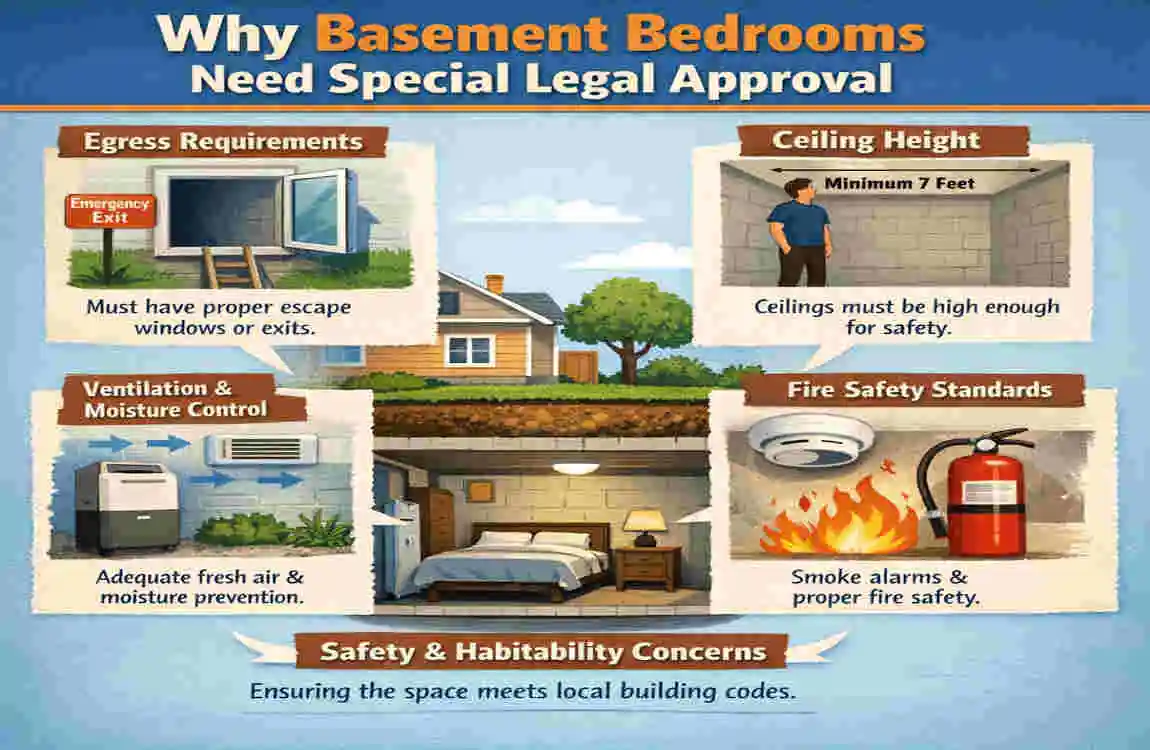
You might be wondering why you cannot just put a bed in a finished basement room and officially call it a bedroom. After all, it is inside your house! The reality is that building a bedroom below ground level carries a unique set of risks that above-ground rooms do not face.
First and foremost, let’s talk about the risks of illegal conversions. If you build a bedroom without pulling the proper permits and following local building regulations, you are opening yourself up to a world of trouble. Municipalities can slap you with heavy fines. If you try to sell your home, a home inspector will easily spot the illegal conversion, which can derail the sale or force you to lower your asking price drastically.
Even more frightening is the insurance aspect. If a fire or flood starts in an illegal, unpermitted basement bedroom, your homeowner’s insurance company has the right to deny your claim entirely. This means you could be left paying for catastrophic damages out of your own pocket.
The Difference Between Above-Ground and Below-Ground Living
Basement bedrooms are fundamentally different from above-ground bedrooms. Think about it. When you are below the earth, you are dealing with higher moisture levels. The ground holds water, and that water constantly wants to push its way into your basement.
Furthermore, basements lack natural light and ventilation. An above-ground room usually has large windows that let in fresh air and sunshine. Basements, by nature, are enclosed concrete boxes.
Most importantly, basements present unique challenges for escape routes. If a fire starts on the ground floor, you need a safe, fast way to get out of the basement. This is where building codes step in. Guidelines like the International Residential Code (IRC), which serves as a baseline for many local regulations, including specific regional rules adapted in places like Punjab, are designed specifically to address these dangers.
To give you a clear picture of what can go wrong, let’s look at some common issues found in non-legal basements.
Common Issue: The Danger or Consequence: The Legal Fix
No egress window creates a deadly fire trap with no escape route. Install a properly sized egress window and well.
Poor ventilation encourages toxic mold growth and poor air quality. Add an exhaust fan or mechanical ventilation system.
Low ceiling height causes injury risks and feelings of claustrophobia. Reroute ducts, raise the ceiling, or finish properly.
No smoke detectors. Delayed warning during a fire emergency. Hardwire interconnected smoke and carbon monoxide detectors.
Understanding the legal requirements for what makes a basement bedroom safe is your first step toward a successful renovation. You want a space that is not only beautiful but gives you absolute peace of mind.
The 7 Must-Know Features That Make a Basement Bedroom Legal
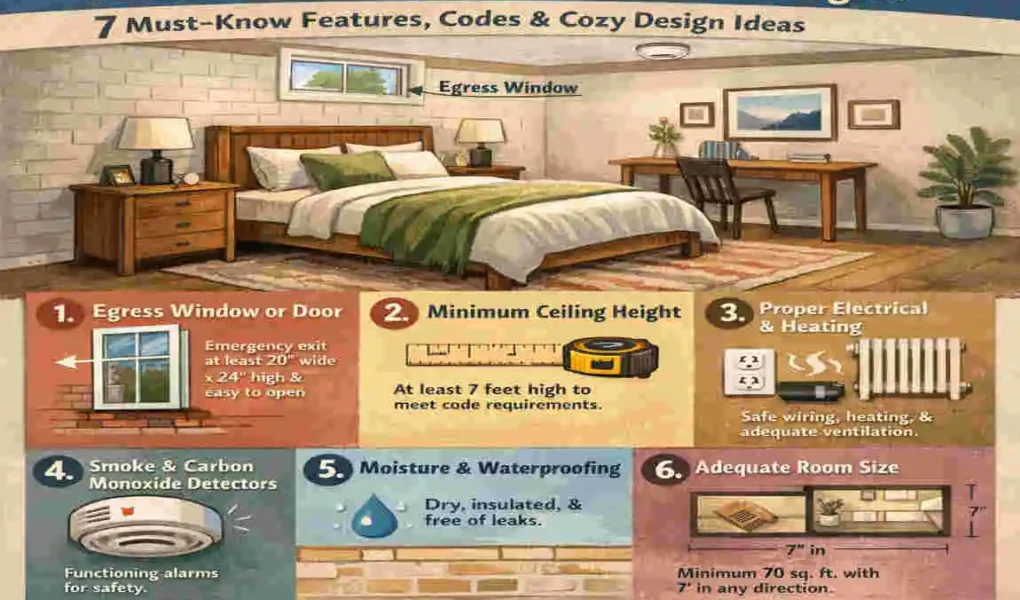
Now that we understand the “why,” let’s get into the “how.” If you want to know exactly what makes a basement bedroom legal, it boils down to these seven crucial features.
Egress Windows: Your Non-Negotiable Escape Route
If there is one absolute, non-negotiable rule for legalizing a basement bedroom, it is the egress window. The term “egress” means a way out. In the event of a fire, the stairs leading up to the main floor might be blocked by smoke or flames. You need a secondary escape route, and that is what the egress window provides.
According to standard building codes, this window must be large enough for a fully equipped firefighter—wearing a heavy oxygen tank and bulky gear—to climb into the room, and large enough for you to climb out.
Typically, the minimum requirements state that the window must have an opening of at least 5.7 square feet. The minimum height of the opening must be 24 inches, and the minimum width must be 20 inches. Additionally, the bottom of the window opening cannot be higher than 44 inches from the finished floor.
If your basement is entirely underground, you will also need to dig a window well outside. This well must provide a clearing of at least 9 square feet. If the well is deep, you are required to install a permanent ladder or steps so you can easily climb up to the yard.
Installing an egress window is a major project that often involves excavating dirt, cutting through your concrete foundation, and installing proper drainage. Depending on your location and the complexity of the dig, this can cost anywhere from a few hundred to a few thousand dollars. However, it is the single most important factor in what makes a basement bedroom legal and safe.
Ceiling Height Minimums: No Crouching Required
Nobody wants to feel like they are sleeping in a cave. Ceiling height plays a massive role in how a room feels, but it is also a strict legal requirement.
Generally, standard building codes require a habitable room to have a minimum ceiling height of 7 feet. This measurement is taken from the finished floor to the lowest point of the finished ceiling.
Basements often have tricky obstacles like plumbing pipes, heavy wooden beams, or bulky HVAC ductwork hanging down. If you have these elements, the rules sometimes allow for a slight drop. In some specific areas, beams or ducts can dip down to 6 feet 6 inches, but they cannot cover a massive percentage of the ceiling.
If your current basement ceiling is lower than these minimums, you have a few options. You should reroute plumbing and ductwork to sit flush between the ceiling joists. In extreme cases, homeowners actually excavate their basement floor, digging down to pour a new concrete slab lower into the earth to achieve the legal height!
Always check your local variances. The rules in North America might differ slightly from the rules in Pakistan or Europe. But universally, you need enough headroom to walk comfortably without crouching.
Proper Ventilation and Air Quality
Breathing easy should never be a luxury; it is a necessity. Basements are naturally prone to damp, stagnant air. Because they sit below ground, they do not benefit from the natural breezes that blow through your upstairs windows.
To legally classify a space as a bedroom, you must provide proper ventilation. The most common way to achieve this is through operable windows. Standard rules usually dictate that the openable area of the window must be equal to at least 4% of the room’s total floor area.
However, if your windows are sealed or you are relying heavily on artificial lighting, you must install mechanical ventilation. This means tapping into your home’s central HVAC system to provide fresh, conditioned air to the room. Often, codes require an exhaust system capable of moving a specific amount of air, such as 50 Cubic Feet per Minute (CFM).
Humidity control is another massive factor. While not strictly a “building code” in every single municipality, installing a heavy-duty dehumidifier or integrating a fresh air exchange system prevents moisture buildup. Too much moisture leads to mold, and mold makes a bedroom completely uninhabitable.
Electrical Wiring and Lighting Standards
A dark basement is inherently unsafe. When you are building a legal bedroom, you cannot just run a long extension cord from the laundry room and plug in a lamp. The electrical systems must meet rigorous safety standards.
First, your bedroom must have adequate lighting. The law usually requires at least two switched light fixtures, or one switched light fixture and a switched wall receptacle where you can plug in a lamp. The switch must be located right at the entrance of the door, so you never have to walk into a pitch-black room.
Next, consider your electrical outlets. Building rules dictate how far apart outlets can be placed along the walls. The goal is to prevent homeowners from using dangerous extension cords. You typically need an outlet on every wall, spaced no more than 12 feet apart.
Furthermore, the outlets in a basement often need to be Ground Fault Circuit Interrupter (GFCI) or Arc Fault Circuit Interrupter (AFCI) protected. These special outlets instantly cut the power if they detect a spark or a change in electrical current, preventing fires and deadly shocks.
Finally, you absolutely must install hardwired smoke detectors and carbon monoxide detectors. They need to be interconnected with the rest of the alarms in your house. If a fire starts in the attic, the alarm in the basement bedroom needs to sound immediately to wake up whoever is sleeping down there.
Moisture Control and Waterproofing
Water is a basement’s worst enemy. Before you even think about putting up drywall or laying down a carpet, you must ensure the space is bone dry.
Building codes strongly emphasize moisture control. If your basement has a history of leaks or puddles after a heavy rain, you must address the exterior and interior drainage.
This often means installing a reliable sump pump system. A sump pump sits in a pit in the lowest part of your floor, collects groundwater, and actively pumps it away from your foundation.
You will also need to utilize proper vapor barriers. A vapor barrier is a thick plastic sheet installed against the concrete walls before the insulation and drywall go up. It prevents the natural dampness of the concrete from seeping into your framing, which would rot the wood and cause massive mold problems.
Testing your space is also highly recommended. In many regions, testing for radon gas is a required step before finishing a basement. Radon is an invisible, odorless, radioactive gas that seeps up from the soil. If levels are high, you will need to install a radon mitigation system to ensure the air is safe to breathe night after night.
Staircase and Access Compliance
Getting into your new basement bedroom needs to be just as safe as escaping it. The staircase leading down to your lower level must meet strict building regulations. You cannot rely on steep, narrow, or wobbly stairs.
Standard codes require a minimum staircase width of 36 inches. This ensures that two people can pass each other and that emergency personnel can easily navigate the stairs while carrying equipment or a stretcher.
The steps themselves are also heavily regulated. The riser—which is the vertical part of the step—usually cannot be taller than 7.75 inches. The tread—which is the flat part you step on—must be at least 10 inches deep. This creates a natural, safe stepping rhythm and prevents dangerous tripping hazards.
Furthermore, you must have a continuous, sturdy handrail on at least one side of the stairs. The handrail needs to be at a specific height and have a profile that is easy for a human hand to grip securely. Headroom above the stairs is also vital; you generally need at least 6 feet 8 inches of clearance from the stairs to the ceiling above them.
Fire Safety and Separation
Finally, we arrive at fire safety. Because basements often house the mechanical heart of your home—like your furnace, water heater, and main electrical panel—the risk of fire is naturally higher.
If your new bedroom shares a wall with your utility room, building codes require you to create a fire-rated barrier. This usually involves installing special fire-resistant drywall, often referred to as Type X drywall. This material is denser and contains glass fibers that help it withstand flames for a much longer period, usually rated for at least one hour of fire resistance.
You also need to ensure proper spacing and clearance around your furnace and water heater. You cannot cram a bedroom wall right up against a gas-burning appliance. They need room to “breathe” and safely vent their exhaust gases outside.
In some newer building codes, particularly for newly constructed homes or major basement excavations, residential fire sprinkler systems are becoming mandatory. While this might sound extreme, it is a foolproof way to ensure that any fire that breaks out in the lower level is instantly suppressed, giving the occupants ample time to use their egress window.
Navigating Basement Bedroom Building Codes by Location
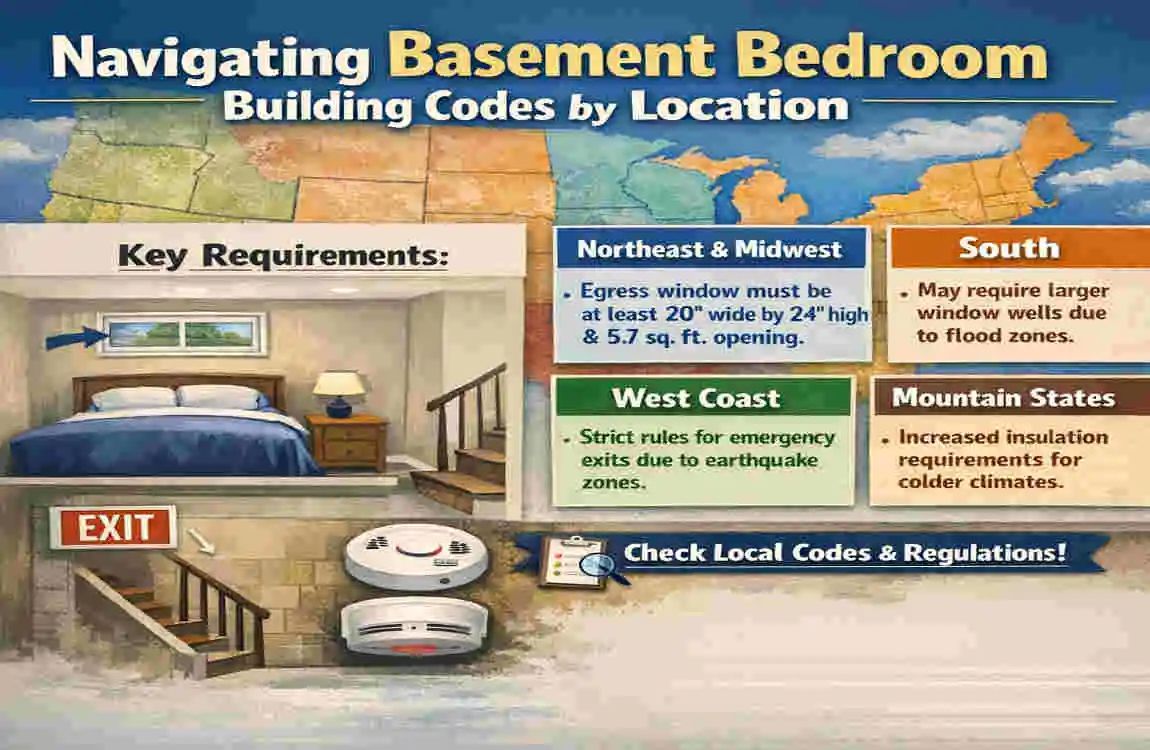
Understanding the general rules is a great start, but building codes are not a one-size-fits-all situation. The rules change depending on where you live.
When figuring out what makes a basement bedroom legal, you have to look at both national baselines and local amendments. Most regions use a version of the International Residential Code (IRC) as their foundation. However, local municipalities will take the IRC and tweak it to fit their specific climate and geography.
For example, if you live in a region prone to earthquakes, like parts of California or the Punjab region, your local building codes might require extra seismic reinforcement in your basement walls. If you live in an area with a high water table, your local rules might be much stricter regarding sump pumps and exterior waterproofing.
The Permit Approval Process
How do you actually make it official? You have to navigate the permit process. It might seem intimidating, but breaking it down into steps makes it manageable.
- Design and Sketch: First, you need a detailed floor plan. You do not always need an expensive architect. A clear, scaled drawing showing the room dimensions, window placements, electrical outlets, and smoke detectors is often enough for the city planners.
- Submit Your Application: Take your plans to your local municipal building or permit office. You will pay a fee and submit your drawings for review.
- The Review Phase: city officials will look over your plans to ensure they meet all the building codes for what makes a basement bedroom legal near you. They might ask for changes or clarifications.
- Rough-In Inspections: Once approved, you can start building. Before you put up the drywall, you must call the inspector. They will look at the “rough” framing, electrical wires, and plumbing pipes while they are still exposed.
- Final Inspection: After the drywall is painted, the floors are laid, and the lights are on, the inspector returns for one final walk-through. If everything looks good, they sign off, and your bedroom is legally recognized!
To make this easier on yourself, always reach out to your local building department and ask for a basement finishing checklist. Most offices are happy to provide documentation to help homeowners do things the right way.
5 Cozy Design Ideas to Make Your Legal Basement Bedroom Inviting
Congratulations! You have navigated the permits, installed the egress window, and passed the final inspection. Your basement bedroom is officially legal and safe. But “legal” does not automatically mean “beautiful.”
Basements inherently lack the warm, natural elements of above-ground rooms. If you are not careful, your new bedroom can feel like a cold, sterile box.
The goal now is to transform the space from compliant to incredibly cozy. Let’s explore five practical, Pinterest-worthy design ideas to breathe life into your new room.
Maximize Natural Light with Clever Tricks
Since your basement only has one or two windows, you need to make the absolute most of the sunlight you get. Start with your egress window. Instead of a dark, ugly corrugated metal window well outside, opt for a terraced stone window well. You can even plant low-light ferns or trailing vines in the well to create a beautiful, natural view.
Inside, avoid heavy, dark drapes. Hang light, sheer curtains that provide privacy but still allow sunshine to filter through. Place a large mirror directly across from the window. The mirror will catch the incoming light and bounce it around the room, instantly making the space feel twice as large and significantly brighter.
Layer Your Lighting for a Warm Glow
Because natural light is limited, artificial lighting is your best friend. However, a single glaring overhead light will make the room feel like an interrogation chamber. You need to layer your lighting.
Start with ambient lighting. Recessed LED ceiling lights are perfect for basements because they do not hang down and eat into your precious ceiling height. Put these lights on a dimmer switch so you can control the mood.
Next, add task lighting. Place a stylish lamp on the nightstand for reading. Finally, incorporate accent lighting. You can install LED strip lights behind the headboard or use a small wall sconce to highlight a piece of artwork. Mixing different types of light creates a warm, inviting atmosphere.
Choose Multi-Functional Furniture
Basement bedrooms are often smaller than primary bedrooms. To avoid a cluttered, cramped feeling, choose your furniture wisely. Multi-functional pieces are essential for small spaces.
Instead of a traditional bed frame, consider a platform bed with deep storage drawers built underneath. This eliminates the need for a bulky dresser. If the room will primarily be used as a home office but needs to occasionally host guests, look into a high-quality Murphy bed that folds neatly into the wall when not in use.
Keep your furniture scaled appropriately. A massive, heavy oak wardrobe will overwhelm a small basement space. Opt for sleek, lower-profile pieces with exposed legs, which create the illusion of more floor space.
Bring in Cozy Textures to Banish the Chill
Concrete floors and foundation walls can make a basement feel physically and psychologically cold. You need to fight that chill with rich, cozy textures.
Start from the ground up. Even if you installed luxury vinyl plank flooring, throw down a massive, plush area rug. A thick shag or a soft wool rug gives your bare feet a warm landing spot in the morning.
Layer your bed with tactile fabrics. Mix a crisp cotton duvet with a chunky knit throw blanket and velvet accent pillows. Consider adding a warm, textured material to the walls, like installing a wood slat accent wall behind the bed. Wood naturally brings warmth and organic beauty into an otherwise sterile environment.
Utilize Smart Storage and Gallery Walls
Clutter makes a small room feel tiny. Smart storage is crucial. Utilize vertical space by installing floating shelves high up on the walls. This draws the eye upward, making the ceiling feel higher, and provides a place for books and decor without taking up floor space.
Instead of leaving the walls bare, create a vibrant gallery wall. Basements are great places to display black-and-white photography, colorful abstract prints, or family photos. A well-curated gallery wall distracts from the fact that you are underground and adds a massive dose of personal character.
Once you focus on these design elements, you will completely transform what makes a basement bedroom cozy and inviting. You will forget you are even in a basement!
Common Mistakes and How to Avoid Costly Fixes
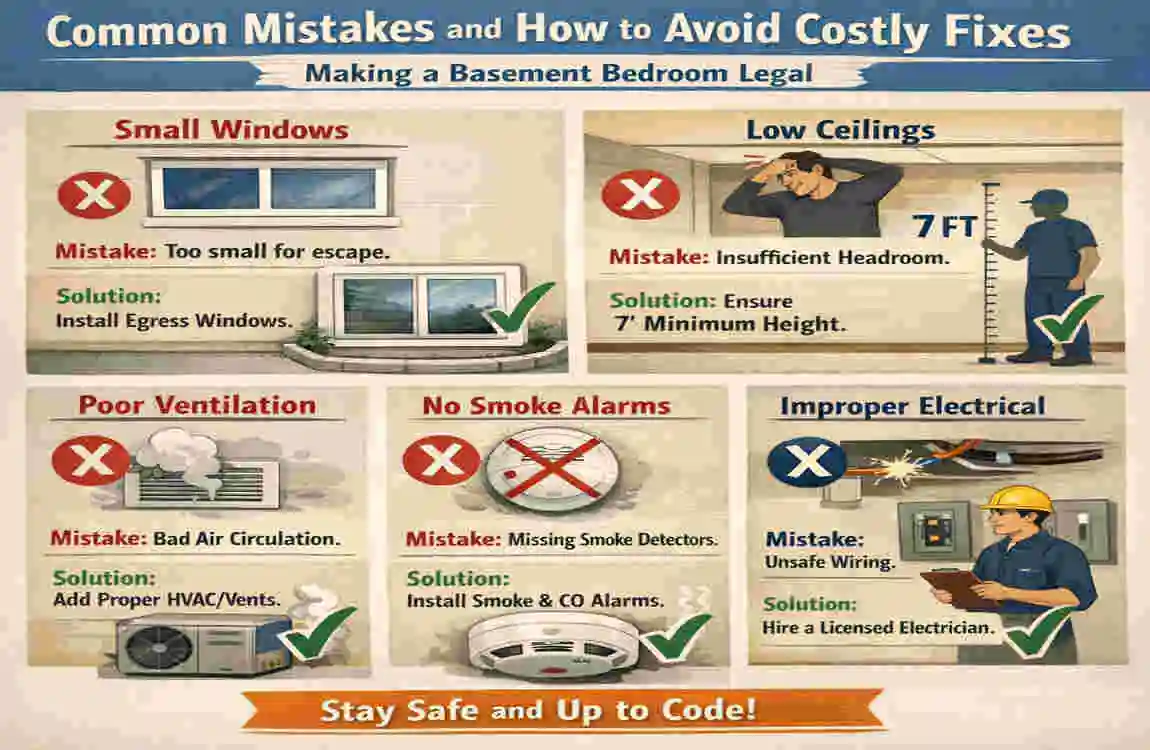
Even with the best intentions, homeowners often stumble when trying to create a legal basement bedroom. Making a mistake down here can be incredibly costly. Let’s look at the most common pitfalls and how you can actively avoid them.
The most frequent mistake is skipping the permit process entirely. It is tempting to save the municipal fees and avoid the hassle of inspections. However, when you go to sell your home, the buyer’s inspector will demand to see the permits for the basement bedroom. If you do not have them, you will have to tear open your finished walls to prove the electrical and plumbing are up to code, costing you thousands in repairs and potentially ruining the sale.
Another massive error is ignoring early signs of moisture. If you see a tiny water stain on the concrete block, do not just paint over it. Moisture issues never fix themselves; they only get worse. Putting up drywall over a leaky foundation is a recipe for toxic black mold. Always spend the money on professional waterproofing before you frame the room.
Finally, relying on uncertified handypersons for critical safety features is a huge risk. While you can certainly paint the walls and lay the floor yourself, you should always hire licensed professionals to cut your foundation for the egress window and to run the new electrical circuits.
While doing things by the book takes time and money, the Return on Investment (ROI) is well worth it. Adding a fully legal, permitted bedroom can boost your total home value by 10% to 15%. It is an investment that pays for itself.
Frequently Asked Questions (FAQ)
To wrap up the technical side of things, let’s address some of the most common questions homeowners ask about legalizing a basement space.
What makes a basement bedroom legal? At its core, a legal basement bedroom must have an egress window for emergency escape, a ceiling height of at least 7 feet, proper ventilation, smoke/CO detectors, and compliant electrical wiring. These elements ensure the space is safe for sleeping.
Can I use an existing small window as an egress window? Usually, no. Standard basement hopper windows are far too small to meet the 5.7 square foot opening requirement. You will need to enlarge the window opening by cutting into the concrete foundation.
Do I absolutely need a closet for a room to be considered a legal bedroom? Interestingly, building codes (like the IRC) generally do not require a bedroom to have a built-in closet. However, real estate agents often require a closet to list the room as a true bedroom on the housing market. From a strict code perspective, safety features like the egress window matter far more than a closet.
Can my furnace be in the same room as my bed? No. Building codes strictly prohibit gas-burning appliances from being located in a room used for sleeping due to the risk of carbon monoxide poisoning. The furnace must be walled off and properly separated from the bedroom space.
Does a basement bedroom add value to my home? Yes, absolutely! But only if it is legal. An illegal bedroom adds zero official square footage or bedroom count to your listing. A permitted, legal bedroom significantly increases your home’s market value and buyer appeal.