
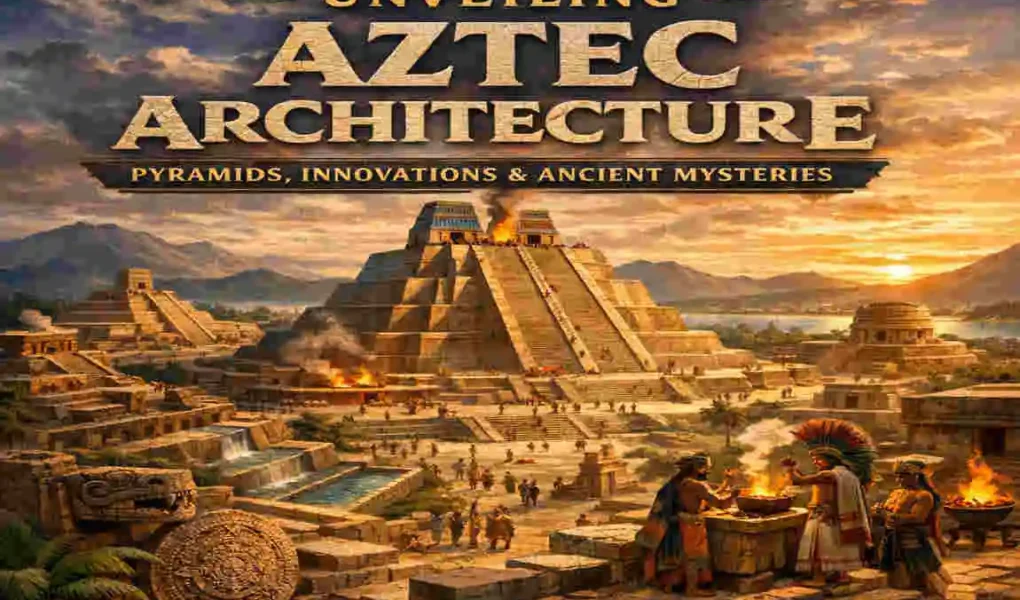
Imagine standing in the center of a vast, shimmering lake. The air is thin and crisp, filled with the scent of burning copal incense. Before you rise a mountain of stone, painted in vibrant shades of blood-red and sky-blue, towering over a city that floats on water, this isn’t a fantasy novel; this was Tenochtitlan, the heart of the Aztec Empire, at its peak in the early 16th century.
When we ask the question, “What is Aztec architecture?” we are diving into one of the most sophisticated and dramatic building styles in history. Originating in central Mexico between 1325 and 1521 CE, this architectural style wasn’t just about stacking stones. It was a powerful blend of deep religious belief, terrifying military power, and genius-level urban planning.
The Aztecs didn’t just build homes; they built a cosmos on earth. From the massive stepped pyramids that mimicked sacred mountains to the intricate hydraulic systems that controlled the waters around them, their engineering rivaled the best of Europe at the time. Yet, for all its grandeur, much of it remains shrouded in mystery.
What Is Aztec Architecture? A Core Definition
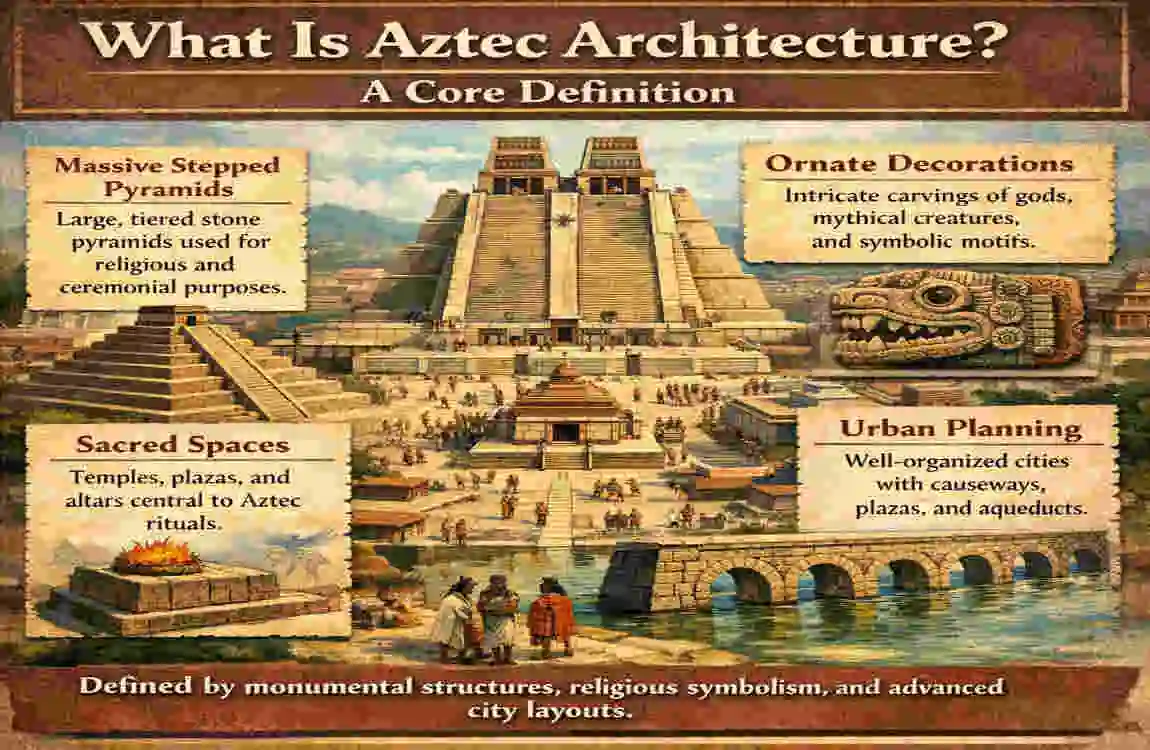
To truly understand what Aztec architecture is, we have to look at where it came from and what it stood for. It is easy to look at a ruin and see a pile of rocks, but to the Aztec people, these structures were alive with meaning.
Historical Context and Timeline
The story begins in the Valley of Mexico. After the collapse of the earlier Toltec civilization, various nomadic tribes entered the region. The Aztecs, or the Mexica people, were late arrivals. According to their legends, they wandered until they saw a sign from their god Huitzilopochtli: an eagle perched on a cactus, devouring a snake. They found this sign on a small, swampy island in Lake Texcoco around 1325 CE.
From these humble, muddy beginnings, they built an empire. The peak of their architectural achievement occurred roughly between 1428 and 1521 CE, particularly under the reign of rulers such as Moctezuma II. However, this golden age was cut short. The arrival of the Spanish conquistadors led to the tragic destruction of Tenochtitlan. The Spanish literally dismantled the Aztec temples to build their own churches and colonial palaces, meaning much of what we know today comes from buried ruins and historical chronicles.
Core Characteristics of Aztec Architecture
So, what are the defining traits of this style?
- Stepped Pyramid Temples (Teocallis): The most famous structures are the teocallis, or “god houses.” These were not tombs like the Egyptian pyramids; they were massive stone platforms meant to serve as artificial sacred mountains. They raised the rituals from the earth toward the heavens.
- Local Materials: The Aztecs were masters of using what they had. They utilized adobe (sun-dried mud bricks) for homes and stone for temples. They didn’t use mortar in the way we do; instead, they cut stones with such precision that they fit together perfectly.
- Symbolic Alignment: Nothing was random. A key answer to what the Aztec architecture is lies in astronomy. Their buildings were oriented to align with the sun during solstices or the cycles of the planet Venus.
Why Aztec Architecture Stands Out
What makes Aztec architecture different from other ancient styles is its audacity. They built their capital, Tenochtitlan, directly on water. This required a level of urban planning that was almost unheard of. They connected their island city to the mainland with massive causeways (raised roads) and crisscrossed the city with canals, making it a “Venice of the New World.”
Furthermore, their architecture fused religion and state power. The flat tops of their pyramids were stages for public ceremonies, including human sacrifice. It was a masterful blend of form, function, and faith, designed to intimidate enemies and please the gods simultaneously.
Iconic Aztec Pyramids: Engineering Marvels
When you picture Aztec civilization, you likely picture a pyramid. These structures are the crown jewels of Mesoamerican engineering. Let’s look closely at the most significant examples.
Templo Mayor: Heart of Tenochtitlan
The Templo Mayor (Main Temple) was the absolute center of the Aztec universe. Located in the sacred precinct of Tenochtitlan (modern-day Mexico City), it wasn’t just one pyramid—it was a growing entity.
- Dual Shrines: unlike many other pyramids, the Templo Mayor was unique in having two shrines on its summit. One was dedicated to Huitzilopochtli, the god of war and sun, painted in red and white. The other was for Tlaloc, the god of rain and agriculture, painted in blue and white. This symbolized the Aztec economy: war (tribute) and agriculture (farming).
- Layers of History: The Aztecs believed in cycles. Every time a new ruler took power or a cycle of time ended, they didn’t tear down the old temple. They built a new, bigger shell over the old one. Archaeologists have found seven distinct layers of the Templo Mayor, like a massive stone onion.
- Excavations: For centuries, this temple was lost under Mexico City. It was only in the late 1970s, when electrical workers accidentally struck a massive stone disk depicting the moon goddess Coyolxauhqui, that the site was rediscovered. Since then, excavations have revealed thousands of artifacts, including skull racks and 7-ton monoliths.
Other Famous Aztec Pyramids
While the Templo Mayor is the most famous, other structures define Aztec architecture.
- Pyramid of the Sun (Teotihuacan): It is important to note that the Aztecs did not build Teotihuacan; an earlier culture did. However, the Aztecs revered this abandoned city as the “Place Where Gods Were Born.” They adopted its architectural style and used it for their own rituals, proving they were students of history.
- Great Pyramid of Cholula: This is technically the largest pyramid in the world by volume, with a base of 450 meters on each side. It was a multi-cultural site used by the Aztecs later in its history.
- Santa Cecilia Acatitlan: This is one of the few smaller Aztec pyramids that remains relatively intact today, giving us a clear look at the stucco carvings and original shape that the Spanish didn’t destroy.
Pyramid Design and Construction Techniques
How did they actually build these giants without metal tools or the wheel?
- Layered Platforms: They used a core of rubble and earth, faced with stone.
- Talud-Tablero: This is a hallmark of the region. It consists of a sloping wall (talud) surmounted by a vertical panel (tablero). This design provided immense earthquake resistance and created flat surfaces perfect for painting murals.
5 Key Pyramid Features:
- Steep Staircases: Often, they are climbing at 45-degree angles to ensure the humiliating posture of captives being led up.
- Double Stairways: Specifically on the Templo Mayor to access the dual shrines.
- Serpent Walls (Coatepantli): Walls carved to look like snakes surrounding the sacred precinct.
- Chacmool Statues: Reclining figures holding bowls, placed at temple entrances to receive offerings.
- Volcanic Stone: Use of tezontle (a porous volcanic rock), which was light enough to prevent the heavy structures from sinking into the lakebed.
Innovations in Aztec Architecture: Beyond Pyramids
If we focus only on pyramids, we miss the true genius of the Aztecs. The answer to what the Aztec architecture is also found in their infrastructure and civil engineering. They were masters of water and city planning.
Urban Planning and Infrastructure
Tenochtitlan was a marvel. At its height, it housed over 200,000 people—larger than London or Paris at the same time. Because the city was on an island, space was at a premium. The Aztecs laid out the city on a grid system, divided into four quadrants (campan).
They built three massive causeways connecting the island to the mainland. These weren’t just roads; they were removable bridges. In times of war, they could pull up the wooden bridges, turning their city into an impenetrable fortress. They also built a complex system of aqueducts. The Great Aqueduct brought fresh spring water from Chapultepec Hill, passing over the salty lake water via two channels—one in use while the other was being cleaned.
Chinampas: The Floating Gardens
Perhaps the most brilliant innovation was the chinampa. To feed a growing population on a small island, they created land where there was none.
- How it worked: They wove reeds together to form giant rafts, anchored them to the lakebed with willow trees (whose roots grow deep and fast), and piled mud and decaying vegetation on top.
- Efficiency: These artificial islands were incredibly fertile. They allowed for up to seven harvests a year! This agricultural architecture enabled the empire to sustain such a massive army and population.
Advanced Building Techniques
The Aztecs were not just piling rocks; they were engineering solutions.
- Foundations: Building on a swamp is a nightmare. To prevent heavy stone temples from sinking, they drove thousands of wooden stakes deep into the soft soil to create a stable foundation—a technique similar to modern pile driving.
- Hydraulic Engineering: The Nezahualcoyotl Dike was a 10-mile-long dam that separated the fresh water of the west from the salty waters of the east, protecting the city from floods and its crops from salt.
Materials and Sustainability
The Aztecs were surprisingly sustainable.
- Tezontle: This red volcanic rock was the superstar of Aztec buildings. It is full of air bubbles, making it strong but lightweight—perfect for building on soft ground.
- Lime Plaster: They covered their buildings in stucco made from lime. This wasn’t just for looks; it sealed the stone against rain.
- Color: We see grey ruins today, but Aztec cities were explosions of color. Temples were bright red, blue, and yellow, symbolizing life, water, and deities.
Symbolism and Mysteries of Aztec Architecture
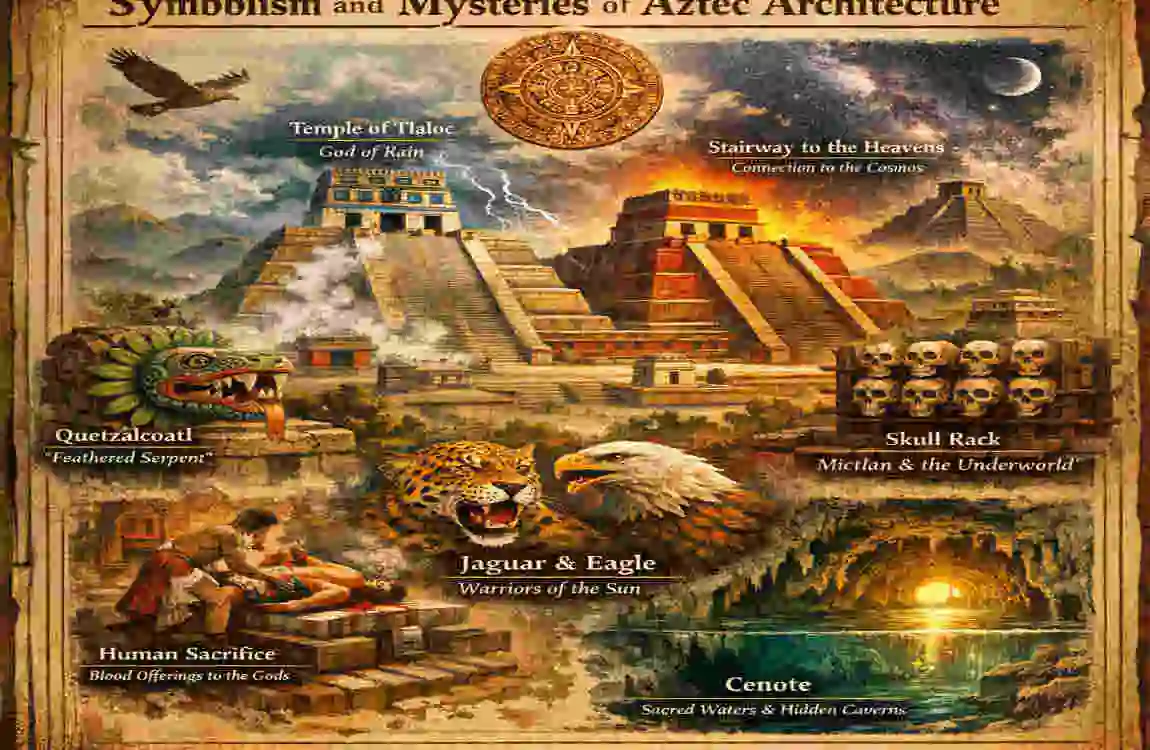
Architecture is never just about physics; it is about philosophy. For the Aztecs, their buildings were a means of communicating with the terrifying forces of the universe.
Cosmic and Religious Symbolism
Every building was a physical representation of their myths.
- The New Fire: The Aztecs believed the world might end every 52 years. Their architecture played a role in the “New Fire Ceremony.” They would extinguish all fires in the empire, and the priests would watch the stars from the tops of their temples. If the stars aligned correctly, they would light a new fire on a victim’s chest, and runners would carry torches to relight every hearth in the city.
- Cenotes and Caves: The Aztecs believed caves were the wombs of the earth. Many pyramids were built directly over natural caves or artificial tunnels to tap into this earth energy.
Unsolved Ancient Mysteries
Despite all we know, some questions still baffle experts.
- Acoustic Engineering: Did they design their plazas to amplify sound? Some researchers believe the layout of the plazas allowed a priest’s voice to carry to thousands of people without having to shout.
- The Lost Tomb: We have found the tombs of Maya kings, but the tomb of a great Aztec emperor, such as Ahuitzotl or Moctezuma, remains missing. Some anomalies detected under the modern Zócalo in Mexico City hint at underground chambers that haven’t yet been opened.
- Alignment Precision: How did they align their massive structures to celestial events with such accuracy without telescopes or modern surveying tools? They likely used simple yet effective tools, such as crossed sticks for sighting, but the precision remains distinct.
Top 5 Enigmas of Aztec Architecture:
- The Invisible Geometry: How they mapped the city grid perfectly over water.
- Transportation: Moving 10-ton stones without the wheel or beasts of burden (they had no horses or oxen).
- The Missing Rulers: Where are the ashes of the great kings?
- Underground Tunnels: The extent of the tunnel networks beneath Teotihuacan and Tenochtitlan.
- Construction Speed: How they rebuilt the Templo Mayor seven times in such short windows.
Aztec Influence on Modern Design
The legacy lives on. What is the Aztec architecture doing today? You can see “Neo-Aztec” styles in modern Mexico. The use of geometric patterns, bold colors, and the integration of indoor and outdoor spaces in modern Mexican architecture pays homage to these ancient roots. Architects today study Aztec water management for clues on how to build sustainable cities in flood-prone areas.
Aztec Architecture vs. Other Mesoamerican Styles
It is common to confuse Aztec architecture with Maya or Inca styles, but they are distinct.
Comparison Table
Feature Aztec Maya Olmec
Pyramids: steep stairs, dual shrines on top, built in layers. Steep, often with a “comb” on top, used corbel arches. Earlier, mostly earth mounds or smaller stone platforms.
Materials: Tezontle (volcanic stone), adobe, lime stucco. Limestone, stucco. Basalt (famous for giant heads), clay.
Urban Focus: Highly organized grid on water, canals, and causeways. Jungle cities, often sprawled, centered on plazas. Ceremonial centers have less urban density.
Vibe Militaristic, imposing, blood-red colors. Artistic, astronomical, intricate carvings. Foundational, mysterious, earthy.
Key Differences
The main difference lies in the purpose.
- Maya architecture was often obsessed with astronomy and the calendar. Their buildings were observatories and canvases for intricate carvings that told intricate stories.
- Aztec architecture was more militaristic and political. It was designed to project power and intimidation. While the Maya built in the dense jungle, forcing them to build up, the Aztecs built on a wide-open lake, forcing them to engineer the ground itself.
FAQ Section
What Is the Aztec Architecture Known For?
Aztec architecture is primarily known for its massive stepped pyramids (such as the Templo Mayor), the use of volcanic stone (tezontle), and its incredible urban planning, which integrated canals and causeways into a grid-based city on a lake.
Where Can I See Aztec Pyramids Today?
The best place to see them is in Mexico City at the Templo Mayor Museum (right next to the Zócalo). You can also visit Tenayuca and Santa Cecilia Acatitlan nearby. The massive site of Teotihuacan is just an hour’s drive away; while pre-Aztec, it was central to their culture.
Did Aztecs Use Advanced Tech in Architecture?
They did not have “technology” like computers or cranes, but they had advanced engineering. They used complex hydraulics for water control, “pile driving” for foundations in soft mud, and precise astronomical alignment tools to orient their buildings.
Why were Aztec pyramids built in layers?
The Aztecs viewed time as cyclical. Rather than destroying an old temple, they would build a new, larger layer over the existing one to mark the end of a 52-year calendar cycle or the reign of a new king. This preserved the sacred energy of the original spot.