Meta Description: Discover how many amps to power a house – from 100A basics to 400A modern needs. Calculate your home’s electrical load, get upgrade tips, and learn NEC safety rules.
Have you ever turned on your hair dryer while the microwave was running, only to have the lights flicker or the power go out completely? It is a frustrating scenario, but it is also a warning sign. It tells you that your home’s electrical system is reaching its limit. With the rise of electric vehicles, high-powered HVAC systems, and smart home technology, our electricity demand has skyrocketed.
If you are planning a renovation, building a new home, or just tired of tripping breakers, you are probably asking the big question: how many amps to power a house effectively and safely?
Basics of Home Electrical
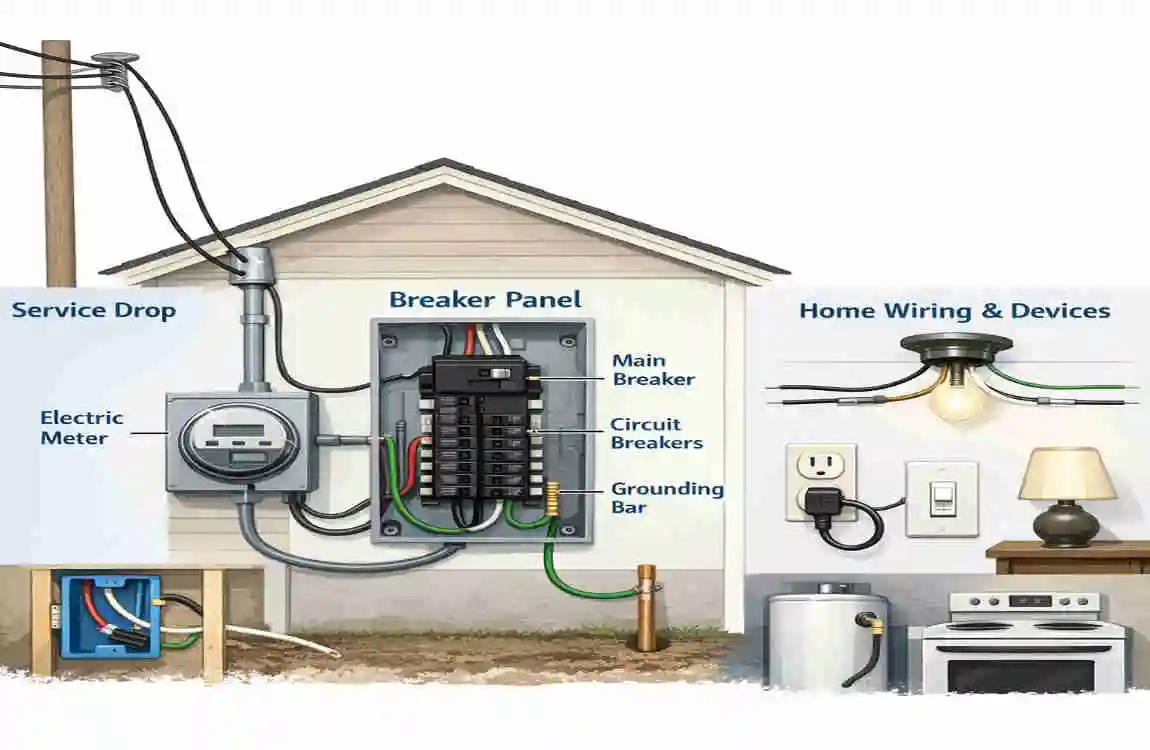
Before we dive into the numbers and calculators, we need to understand what we are actually measuring. Electricity can be invisible and confusing, but it follows simple rules. To determine how many amps to power a house, you first need to know what an “amp” actually is.
What Are Amps and Why Do They Matter
Think of your home’s electrical wiring like plumbing pipes.
- Volts (Voltage): This is the water pressure pushing the water through the pipe. In most US homes, this is 120V or 240V.
- Amps (Amperage): This is the volume of water flowing through the pipe.
- Watts (Wattage): This is the total work the water can do (like spinning a water wheel).
The relationship is simple: Watts = Volts × Amps.
Why does this matter for your breaker panel? Your electrical panel is the main valve for that water. If you try to push too much “water” (amps) through a valve that is too small, the system shuts down to prevent the pipes (wires) from melting or catching fire. When we ask how many amps a house needs, we are asking how big the main breaker needs to be to handle everything you want to turn on at once.
Standard Service Sizes Explained
Over the decades, the standard for electrical service has evolved as our lifestyles have become more power-hungry. Here is a breakdown of the standard service sizes available in residential properties.
The 60-Amp Service (Obsolete) If you live in a home built before 1960 that hasn’t been updated, you might still have 60-amp service. This is dangerously undersized for modern living. It cannot support electric dryers, ovens, or air conditioners. If you have this, you need an upgrade immediately.
The 100-Amp Service (The Minimum). For a long time, 100 amps was the code standard. It is sufficient for a small home (under 1,600 sq ft) that uses gas for heating and cooking. However, if you try to add a central air conditioner or an electric vehicle charger to a 100-amp panel, you will likely overload it.
The 200-Amp Service (The Gold Standard). This is the current benchmark for most new construction. A 200-amp panel provides enough power for a large home (up to 3,000+ sq ft) with all-electric appliances, central heating and cooling, and modest future expansion. When people ask how many amps to power a house, “200” is usually the safest answer.
The 300-Amp and 400-Amp Service (The Heavy Hitters). For large luxury estates, homes with full workshops, or properties with multiple electric vehicles and tankless water heaters, 400 amps is becoming common. This is usually delivered via two 200-amp panels or a dedicated 320/400-amp meter base.
Factors Determining How Many Amps to Power a House
You cannot simply guess your electrical needs based on your neighbor’s house. Your power consumption is as unique as your fingerprint. Several critical factors influence the final calculation of the number of amps needed to power a house.
Home Size and Layout
The physical size of your home plays a massive role in your electrical load calculation. The National Electrical Code (NEC) suggests a basic calculation for “general lighting and receptacle load.”
Roughly speaking, you need to allocate about 3 watts per square foot of livable space for lighting and standard outlets.
- A 1,000 sq ft apartment needs 3,000 watts (roughly 12.5 amps at 240V) just for the basics.
- A 4,000 sq ft mansion needs 12,000 watts (50 amps) before you even plug in a refrigerator.
As your square footage increases, the length of the wiring increases as well, which can introduce voltage drop and require careful planning by an electrician.
Appliance and Load Breakdown
The biggest drain on your panel isn’t the lights; it’s the heavy-duty appliances. To accurately figure out how many amps a house needs, you need to tally the specific machines you run.
Here is a look at what typical appliances demand:
- Central Air Conditioner: 20 to 50 amps.
- Electric Range/Oven: 40 to 50 amps.
- Electric Water Heater: 25 to 30 amps.
- Clothes Dryer: 30 amps.
- Electric Vehicle (EV) Charger: 30 to 60 amps (Level 2).
- Hot Tub or Pool Pump: 40 to 60 amps.
If you have a home that runs entirely on electricity (no gas hookup), your amp requirement will be significantly higher than a home that uses gas for the furnace, water heater, and stove.
Future-Proofing
When upgrading your panel, you shouldn’t just build for today; you should build for the next 20 years. The automotive industry is shifting toward electric vehicles. Installing a Level 2 fast charger at home adds a significant load—equivalent to running a second oven for hours.
Furthermore, many homeowners are switching to electric heat pumps and induction cooktops for efficiency and environmental reasons. If you install a 100-amp panel today to save money, you might be unable to install that car charger next year without spending thousands on another upgrade.
Step-by-Step Amp Calculator
Now, let’s get into the math. While a licensed electrician should always perform the final official load calculation for permits, you can do a rough estimate yourself to understand how many amps to power a house.
This method mimics the standard load calculation used by pros.
Manual Load Calculation The Estimator
Grab a piece of paper and a calculator. We are going to calculate the total Watts (Volt-Amps) and then convert that to Amps.
Calculate General Lighting and Plugs. Multiply your home’s total square footage by 3.
- Example: 2,500 sq ft × 3 = 7,500 watts.
Add Small Appliance Circuits. The code usually requires at least two 1,500-watt circuits for the kitchen and one for the laundry.
- Standard Add: 4,500 watts.
Add Fixed Appliances (Nameplate Rating). Look at the stickers on your big appliances to find the wattage. If it only lists amps and volts, multiply them to get watts.
- Water Heater: 4,500 watts
- Dryer: 5,000 watts
- Range: 12,000 watts
- Dishwasher: 1,200 watts
- A/C Unit: 6,000 watts
The Total and The “Demand Factor”. Add all these numbers up.
- 7,500 + 4,500 + 4,500 + 5,000 + 12,000 + 1,200 + 6,000 = 40,700 Total Watts.
However, you don’t turn everything on at the same second. The NEC allows for a “demand factor.” You take the first 10,000 watts at 100%, and the remaining watts at 40% (excluding HVAC, which is always calculated at 100%).
- First 10,000 watts = 10,000
- Remaining (excluding AC) = 24,700 × 0.40 = 9,880
- AC Load (100%) = 6,000
- Adjusted Total = 25,880 Watts.
Convert to Amps. Divide your Adjusted Total Watts by 240 Volts.
- 25,880 Watts / 240 Volts = 107.8 Amps.
In this example, a 100-amp panel would be overloaded. You would need to step up to a standard 200-amp service.
Online Tools and Apps
If math isn’t your strong suit, there are plenty of online “Electrical Load Calculators.” These tools let you enter the number of appliances you have, and they do the heavy lifting for you. When using these tools, always overestimate slightly to be safe. It is better to have too much power available than not enough.
Common House Types and Recommended Amps
To make this even easier, we can look at common home profiles. Most homes fall into one of three categories. Identifying which category you fit into is a shortcut to figuring out how many amps to power a house effectively.
Small Homes and Apartments 100-150 Amps
If you live in a condo, a small townhome, or a cottage under 1,500 square feet, you likely have modest power needs.
- Heating/Cooking: Often gas-powered.
- Appliances: Standard washer/dryer, refrigerator, dishwasher.
- Cooling: Window units or a small central system.
For this profile, a 100-amp service is usually sufficient. However, if the home is all-electric (electric baseboard heat and electric stove), you might need to push that to 150 amps.
Average Family Homes 200 Amps
This is the most common scenario for suburban living. We are talking about a 3-4 bedroom house, roughly 2,000 to 3,000 square feet.
- Heating/Cooling: Central HVAC.
- Amenities: Multiple TVs, gaming consoles, desktop computers, perhaps a second fridge in the garage.
- Appliances: Electric washer/dryer and range.
For this home, 200 amps is the sweet spot. It handles the current load with ease and leaves “room in the panel” for a future hot tub or electric vehicle charger.
Large or Modern Luxury Homes 300-400 Amps
If you are building a dream home or renovating a large estate (3,500+ sq ft), standard power won’t cut it.
- High Demand: Heated swimming pool, large sauna, electric vehicle charging for two cars, extensive outdoor lighting, professional-grade kitchen appliances.
- Workshop: Heavy-duty power tools like welders or table saws.
- HVAC: Multiple A/C condensers for different zones.
In this case, you are looking at a 400-amp service. This is typically installed as a 320-amp continuous meter that feeds into two separate 200-amp breaker panels inside the house.
Signs You Need a Panel Upgrade
You may not be building a new house. You may be an older homeowner and are wondering whether your current system is safe. Determining how many amps to power a house often starts with recognizing that your current setup is failing.
Here are the red flags that indicate you need to call an electrician immediately:
- Breakers Trip Frequently: If turning on the vacuum cleaner while the toaster is on causes the power to cut, your circuits are overloaded.
- Dimming or Flickering Lights: If your lights dim when the air conditioner kicks on, it means the heavy appliance is drawing so much current that it is starving the rest of the house.
- Panel Warmth: Place your hand on the metal cover of your breaker panel. It should feel cool. If it is warm or hot to the touch, dangerous resistance is building up inside.
- Buzzing Sounds: Electricity should be silent. A buzzing sound coming from the panel indicates loose connections or a bad breaker.
- Use of Power Strips: If you are relying on daisy-chained power strips because you don’t have enough outlets, you are likely overtaxing the few circuits you do have.
- Rust or Corrosion: If you see rust on your panel, water has gotten in. Water and electricity do not mix.
- Inability to Add Circuits: If your panel is physically full and you want to add a dedicated line for a new appliance, you need a “service upgrade” or a “panel swap.”
- Old Fuse Box: If your home still uses screw-in glass fuses instead of flip-switch breakers, your system is outdated, and insurance companies may refuse to cover you.
Upgrade Process and Safety Tips
Deciding you need more power is step one. Getting it installed is step two. This is not a DIY project. Changing your service size involves working with the main power lines coming from the street, which are live and lethal.
The Steps to Upgrade
- Assessment: A licensed electrician will perform a “load calculation” (like the one we did above) to determine exactly how many amps to power a house of your size.
- Permits: Your electrician must file for a permit with your local city or county.
- Utility Coordination: The power company (utility) must come out to disconnect power at the pole or transformer.
- Installation: The electrician removes the old meter and panel, installs the new equipment, and drives new grounding rods into the earth for safety.
- Inspection: A city inspector must sign off on the work to ensure it meets the current National Electrical Code (NEC).
- Reconnection: Once inspected, the utility company turns the power back on.
Safety Considerations
When upgrading, ensure your electrician installs a Whole Home Surge Protector. With modern homes full of sensitive electronics (smart fridges, computers, LED drivers), a surge protector at the panel saves you thousands in damage during lightning storms.
Also, new codes usually require Arc-Fault Circuit Interrupters (AFCI) and Ground-Fault Circuit Interrupters (GFCI) on many breakers to prevent fires and shocks.
Cost Breakdown and Savings
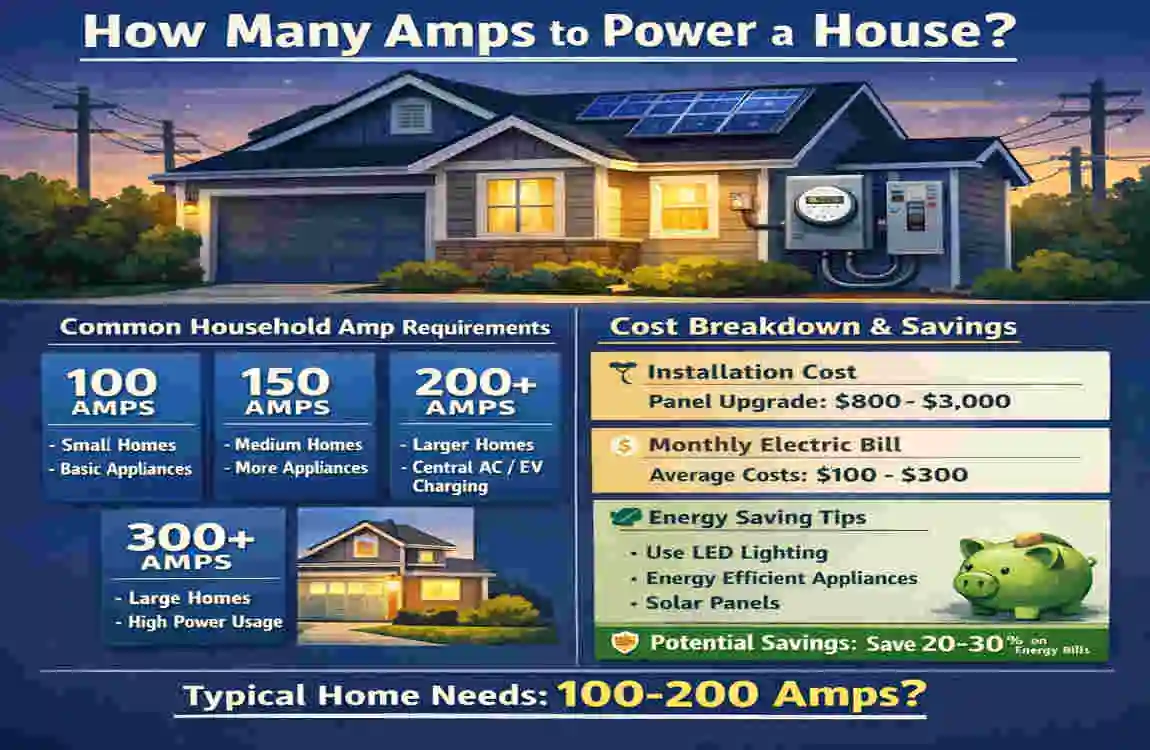
Upgrading your electrical service is an investment, but it adds significant value to your property.
Service Upgrade Type, Estimated Cost, Best For
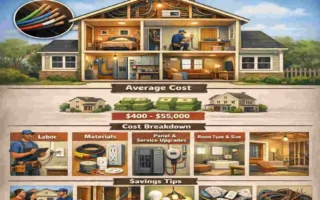
100A to 200A $2,000 – $4,500 Most standard family homes need modernization.
200A to 400A $4,000 – $8,000+ Large luxury homes or homes with extensive electric heating/EVs.
Panel Swap (Same Amps) $1,500 – $2,500 Replacing an old/unsafe panel without increasing total power.
Where do the savings come from? While the upfront cost is high, an updated panel runs more efficiently. Loose connections in old panels generate heat, which is wasted energy. Furthermore, upgrading to 200+ amps allows you to switch to energy-efficient electric appliances (like heat pump water heaters) that save money on monthly utility bills compared to gas or oil.
Real estate data also suggests that homes with updated 200-amp electrical systems sell faster and for a higher premium than those with outdated 60 or 100-amp services.
FAQs: How Many Amps to Power a House
How many amps are needed to power a 1,500 sq ft house? Generally, a 1,500 sq ft house can function on 100 amps if it uses gas appliances. However, for modern convenience and resale value, 200 amps is highly recommended to handle central AC and potential electric vehicle charging.
Is 100 amps enough for a modern house? For most modern families, 100 amps is considered the bare minimum and often insufficient. If you have an electric stove, electric dryer, and central air, you are pushing a 100-amp panel to its limit. 200 amps is the new standard.
What is the difference between a 200-amp and a 400-amp service? A 200-amp service is sufficient for 90% of residential homes. A 400-amp service provides double the capacity and is reserved for very large homes (over 3,500 sq ft) or homes with high-demand equipment, such as multiple EV chargers, heated pools, or all-electric heating systems in cold climates.
Can I install a 200-amp panel myself? No. Replacing a main service panel involves working with high-voltage lines that a switch cannot shut off. It requires a licensed electrician and permits from your local municipality.