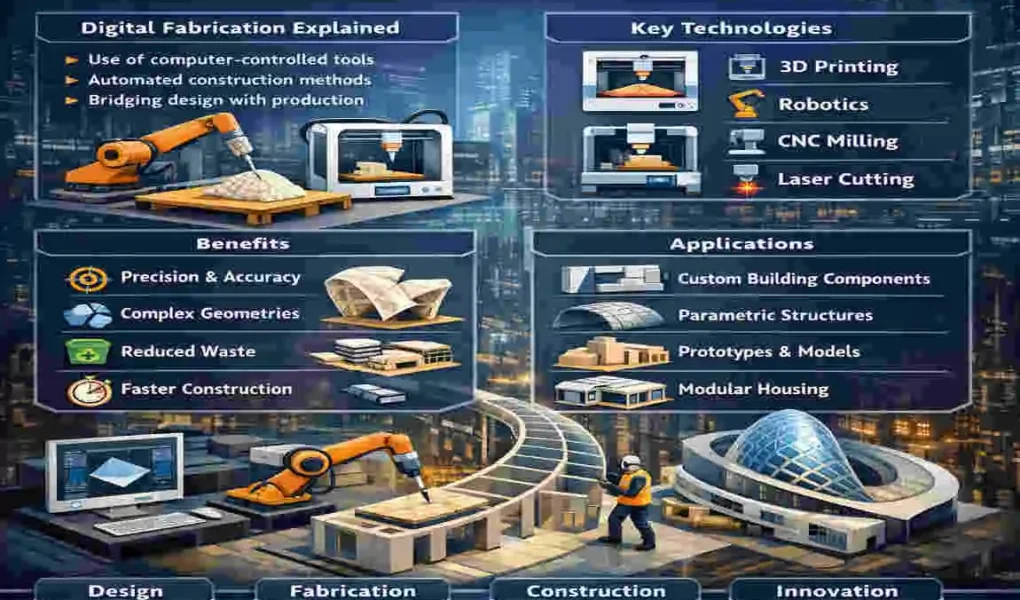
It is a staggering statistic, isn’t it? If you are involved in the building industry, whether you are an architect in Lahore, a construction manager in New York, or a homeowner looking to build a modern house, this shift changes everything. We are moving away from the era where blueprints were just suggestions and into an age where digital precision dictates reality.
In simple terms, what is digital fabrication in architecture? It is the process of using computer-driven machines to turn digital 3D models directly into physical building components. It bridges the gap between the dream you see on a computer screen and the brick-and-mortar reality on the construction site.
What Is Digital Fabrication in Architecture? Core Definition
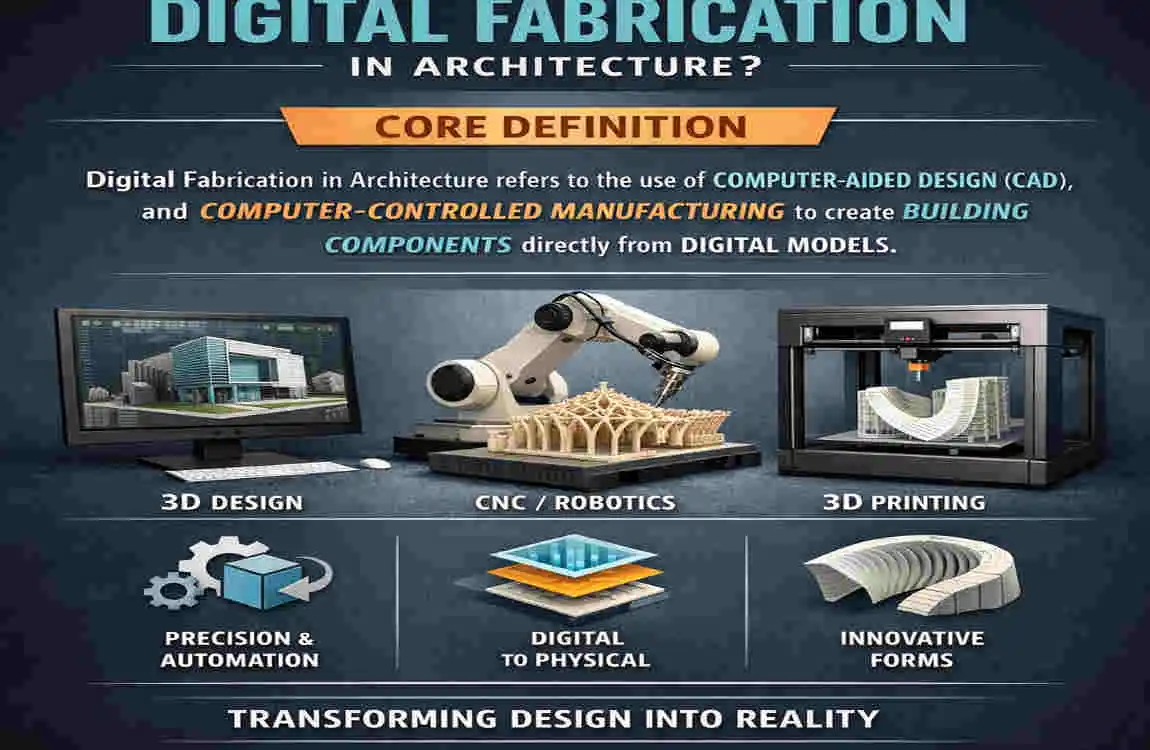
To truly understand this concept, we need to strip away the jargon. When you search for what digital fabrication is in architecture, you are asking about a workflow. It is a “file-to-factory” process.
Imagine typing a document on your laptop and hitting “print.” Your printer reads the digital data and creates a physical copy. Digital fabrication is the same concept, but instead of ink on paper, we print, cut, or carve wood, steel, concrete, and glass to build structures.
Historical Evolution: From Hand to Machine
Architecture wasn’t always this automated. For centuries, everything was handcrafted. If a stonemason made a mistake, the stone was ruined. Then came the CAD (Computer-Aided Design) revolution in the 1980s. Architects started drawing on computers, but builders were still measuring by hand.
The real turning point came in the 1990s. The adoption of CAM (Computer-Aided Manufacturing) allowed architects to send their files directly to machines. A pivotal moment in this history was Frank Gehry’s Guggenheim Museum in Bilbao (1997). The complex, curving titanium curves of that building were simply impossible to build using traditional methods. They required aerospace software and digital fabrication to become a reality.
Key Principles of the Technology
Three main pillars hold this concept together:
- Parametric Modeling: This is designing with rules. Instead of drawing a wall, you define the rules for the wall (height, curve, thickness). If you change one rule, the whole model updates automatically.
- File-to-Factory Workflow: This eliminates the “interpretation” error. The file the architect creates is the exact code the machine reads.
- BIM Integration: Building Information Modeling (BIM) software, such as Revit or Rhino, serves as the brain. It contains all the data the fabrication machines need to do their jobs.
How Digital Fabrication Works: Step-by-Step Process
You might be wondering, “How does a drawing actually become a building part?” It is a fascinating journey. The workflow transforms abstract data into tangible objects through a seamless loop.
Here is the step-by-step breakdown of how digital fabrication works in a modern architectural project:
The Design Phase
Everything starts in the digital realm. Architects use advanced parametric software like Grasshopper or Fusion 360. In this stage, they aren’t just drawing lines; they are programming geometry. They create complex shapes—twisting towers, organic facades, or intricate lattices—that would be a nightmare to calculate by hand. This is where creativity meets computation.
Digital Modeling and Translation
Once the design is finalized, it can’t be sent to a machine right away. The 3D model must be “sliced” or translated into a language the machine understands. This is usually G-code. This code tells the machine exactly where to move, how fast to spin, and how deep to cut. This step is crucial because it ensures that the digital fabrication in architecture process is error-free.
The Manufacturing Phase
This is where the magic happens. The G-code is fed into the fabrication hardware.
- A CNC router might carve a foam mold.
- A laser cutter might slice through steel sheets.
- A 3D printer might extrude layers of concrete. The machine follows the instructions with sub-millimeter precision, producing components that are perfect matches to the digital model.
Assembly and Testing
Finally, the fabricated parts are shipped to the site. Because they were cut with computer precision, they fit together like a giant, perfect puzzle. Contractors spend less time cutting materials on-site and more time assembling. This phase often involves rigorous quality checks to ensure the structural integrity matches the digital simulation.
Top Digital Fabrication Techniques in Architecture
Now that we know the process, let’s talk about the tools. If you are looking into digital fabrication techniques in architecture, you will find a variety of methods. Each has a specific strength, depending on whether you are building a skyscraper or a custom pavilion.
CNC Milling and Routing
CNC (Computer Numerical Control) milling is the workhorse of the industry. It is a subtractive process, meaning it starts with a solid block of material (wood, stone, foam, or metal) and carves away everything that isn’t the final shape.
- How it works: A spinning drill bit moves along multiple axes (X, Y, and Z) to cut materials.
- Best use: creating complex, curved concrete molds or intricate wooden panels for interiors.
- Example: If you see a fluid, wavy wooden wall in a modern lobby, it was likely made using CNC milling. Zaha Hadid Architects often used this for their sweeping, seamless forms.
3D Printing in Architecture
While CNC removes material, 3D printing adds it. This is additive manufacturing. It builds an object layer by layer. In architecture, we aren’t just printing plastic models anymore; we are printing houses.
- How it works: A massive nozzle extrudes quick-drying concrete or plastic composites based on the digital path.
- Sustainability factor: This technique is a hero for waste reduction. It only uses the material needed for the structure, reducing construction waste by up to 60%.
- Example: The “Office of the Future” in Dubai is a fully functional, 3D-printed building that showcases speed and efficiency.
Robotic Arm Fabrication
If you want to see the future, look at robotic arms. These are the orange manufacturing arms you usually see in car factories, but now they are building walls.
- How it works: These arms have multi-axis flexibility (usually 6 axes). They can hold a welder, a gripper, a printer head, or a saw. They can reach around corners and work on complex angles that standard machines can’t touch.
- Innovation: Researchers like Gramazio Kohler have programmed these robots to lay bricks in intricate, twisting patterns that no human mason could replicate efficiently.
Laser Cutting and Waterjet
For flat materials, nothing beats the precision of lasers and waterjets.
- Laser Cutting: Uses a high-powered beam to cut through thin materials such as steel, acrylic, or wood. It is perfect for detailed facade screens.
- Waterjet: Uses a stream of water mixed with abrasive particles at incredibly high pressure. It can cut through thick granite or titanium without heat, preventing the material from warping.
Comparison of Fabrication Methods
Feature CNC Milling3D Printing Robotic Arms Laser/Waterjet
Process Type : Subtractive , Additive , Assembly/Hybrid , Subtractive (Cutting)
Material Waste High (removes material) Low (uses only what is needed) Varies Medium
Best For Molds, Wood, Foam Walls, Prototyping, Bricklaying, Welding, Flat Panels, Facades
Precision Very High Medium-High High Extreme
Benefits of Digital Fabrication in Modern Architecture
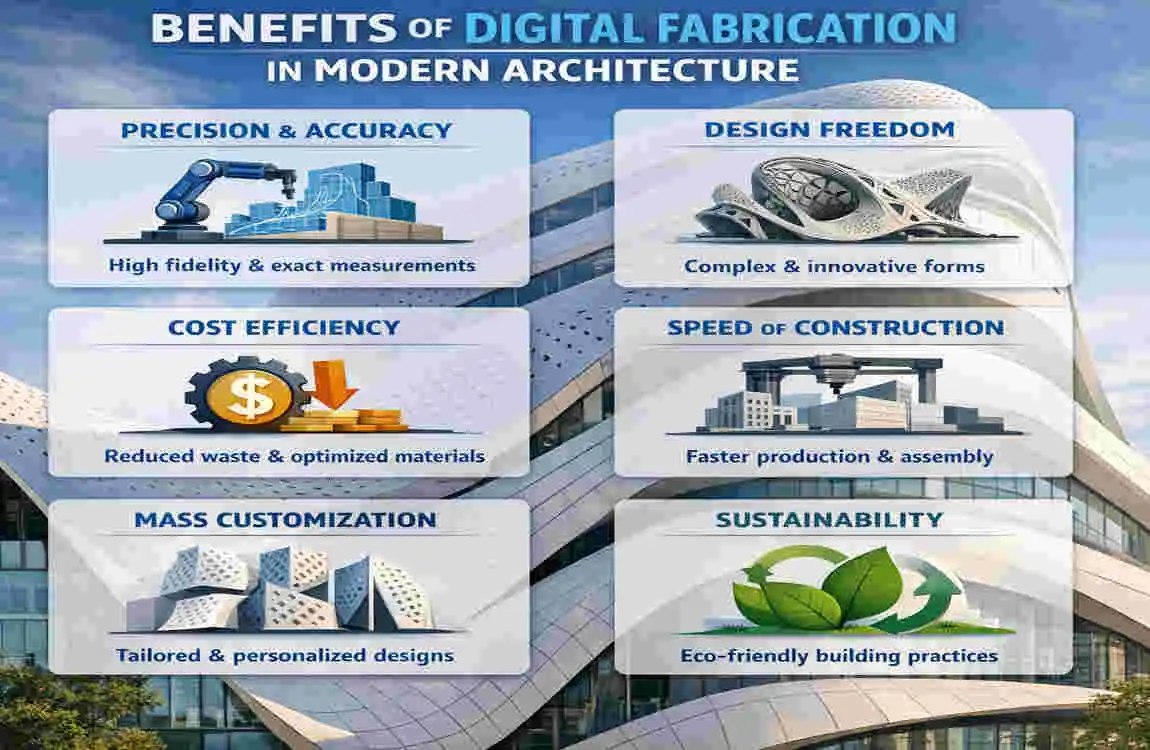
Why are architects and construction firms investing millions in these machines? Why should you care? The benefits of digital fabrication go far beyond just “looking cool.” They solve fundamental problems in the construction industry.
Precision and Customization
In traditional construction, a tolerance (error margin) of 5mm to 10mm is common. In digital fabrication, the error rate is often under 0.1mm. This level of precision allows for mass customization.
- What this means: You can manufacture 1,000 facade panels where every single one is a slightly different shape to fit a curved building, and it costs roughly the same as making them all identical.
Efficiency and Cost Savings
Time is money. Digital fabrication speeds up the prototyping and production phases by 20% to 50%.
- Rapid Prototyping: Architects can test a design, find flaws, and reprint a fixed version in hours rather than weeks.
- Labor Reduction: While the machines are expensive, they reduce the hours of manual labor required for repetitive or dangerous tasks, balancing out the costs over the life of a project.
Sustainability and Waste Reduction
The construction industry is notorious for waste. Digital fabrication techniques in architecture are helping to clean that up.
- Optimization: Algorithms calculate exactly how to cut a sheet of metal to get the most parts out of it, leaving minimal scrap.
- Recyclability: Many digital fabrication materials (like bioplastics for printing) are recyclable. 3D-printed concrete produces almost no waste compared to traditional formwork.
Innovation Potential
This is the most exciting part. Digital fabrication enables impossible shapes. Organic forms, biomimetic structures (mimicking nature), and responsive skins are now buildable.
- Why Lahore architects love it: In rapidly growing cities like Lahore or Karachi, developers are looking for ways to stand out. Digital fabrication allows them to create iconic, modern landmarks that define the skyline, all while managing the fast pace of urban development.
Real-World Examples of Digital Fabrication in Architecture
Theory is great, but let’s look at the buildings. These examples of digital fabrication in modern buildings highlight how the technology is applied globally and locally.
Iconic Global Projects
The Beijing National Stadium (The Bird’s Nest). You have likely seen this tangle of steel. It was a masterpiece of digital logic. The twisted steel beams looked chaotic, but they were the result of advanced parametric modeling. CNC-guided manufacturing was essential for cutting and welding the steel sections to ensure they aligned perfectly on site. Without digital fabrication, calculating the geometry for the thousands of unique connection points would have taken decades.
Al Bahar Towers, Abu Dhabi. This building is alive. It features a responsive facade that opens and closes in response to the sun’s position. The geometric panels were manufactured using laser cutting and robotic assembly. The precision required for these mechanical parts to function in the desert heat could only be achieved through digital means.
Emerging Trends and Local Relevance
Parametric Pavilions at Expo 2020 The recent Expo in Dubai was a playground for digital fabrication. Many pavilions featured carbon-fiber weaving and 3D-printed concrete benches. It showed that this tech is scalable for both temporary and permanent structures.
3D-Printed Housing in South Asia We are seeing a rise in 3D printing start-ups in India and Pakistan, aiming to solve the housing crisis. By printing simple concrete shells, they can provide affordable housing much faster than traditional brick-and-mortar methods. For urban developers in Lahore, this offers a glimpse of a future in which high-rises could be partially prefabricated to reduce traffic and on-site pollution.
Challenges and Future of Digital Fabrication
It is not all smooth sailing. There are hurdles we need to overcome before every house is built by a robot.
Common Hurdles
- High Initial Costs: A good industrial CNC machine or robotic arm costs a fortune. For small firms, this is a barrier to entry.
- The Skill Gap: There is a shortage of people who know how to design (code) and operate the machines. Architects need to learn to think like builders, and builders need to learn to think like programmers.
- Material Limits: We are still figuring out how to 3D print efficiently with materials like steel and glass on a large scale.
What’s Next? The Future Outlook
By 2030, the landscape will look very different.
- AI Integration: Artificial Intelligence will begin automatically generating G-code, optimizing designs for structural integrity without human intervention.
- Hybrid Workflows: We will see a mix of human craft and robotic precision. Robots will do the heavy lifting and dangerous cuts, while humans handle the finishing touches.
- Prediction: Industry experts suggest that by 2027, 40% of global architecture firms will utilize some form of digital fabrication in their daily workflow, moving it from a “niche luxury” to an “industry standard.”
Frequently Asked Questions About Digital Fabrication in Architecture
What is digital fabrication in architecture? Digital fabrication in architecture is the workflow of using computer-aided design (CAD) data to drive manufacturing machines (CAM). It automates the production of building components, enabling the creation of complex, precise structures directly from digital files.
What are the main tools for digital fabrication? The “Big Four” tools are CNC Routers (for cutting and carving), 3D Printers (for additive layering), Laser Cutters (for precise slicing of thin materials), and Robotic Arms (for assembly, welding, and bricklaying).
Is digital fabrication expensive for small projects? Initially, yes. The machinery and programming time can be costly. However, for complex designs, it can actually save money by reducing manual labor hours and material waste. As the technology becomes more common, costs are dropping rapidly.
How does it support sustainable building? It significantly reduces waste. Additive manufacturing (like 3D printing) uses only the material needed for the structure. Furthermore, precise cutting allows for better material nesting, resulting in less scrap metal or wood ending up in the landfill.
Top software for beginners? If you want to get started, look into Rhino 3D combined with Grasshopper. This is the industry standard for parametric design. Fusion 360 is also excellent for understanding the CAM (manufacturing) side of the process.