
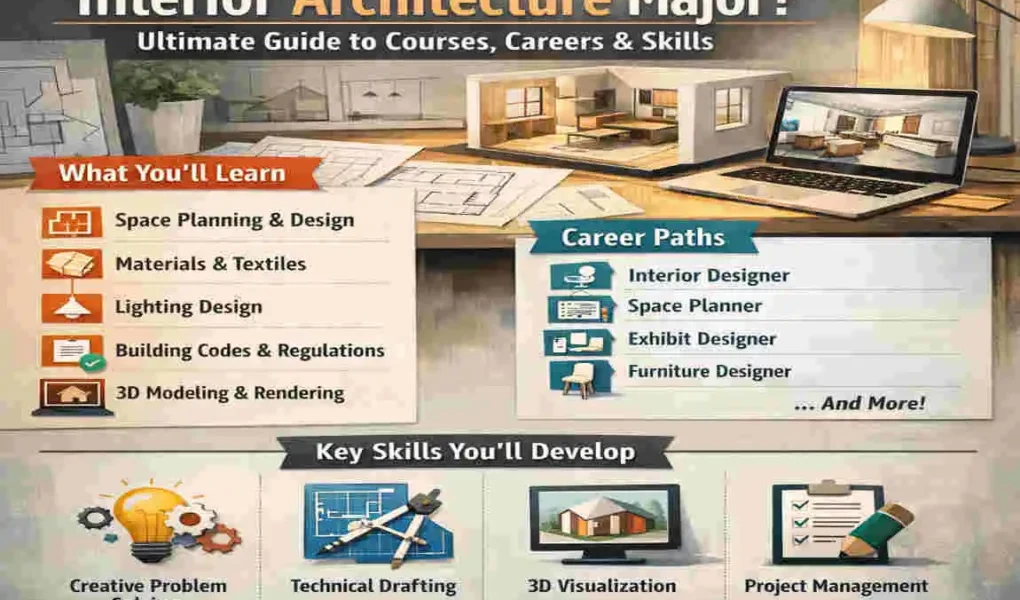
Have you ever walked into a building—perhaps a sleek modern hotel, a comforting hospital waiting room, or a buzzing open-plan office—and felt an immediate shift in your mood? That feeling isn’t accidental. It is the result of meticulous planning, structural understanding, and psychological insight.
If you have a creative eye but also possess a mind that loves problem-solving and engineering, you might be standing at the threshold of a perfect career path. The global interior design and architecture market is projected to reach staggering heights—over $152 billion by 2028. This growth makes choosing an interior architecture major not just a passion project, but a financially smart decision for aspiring creative professionals.
What Is an Interior Architecture Major? Core Concepts and Differences
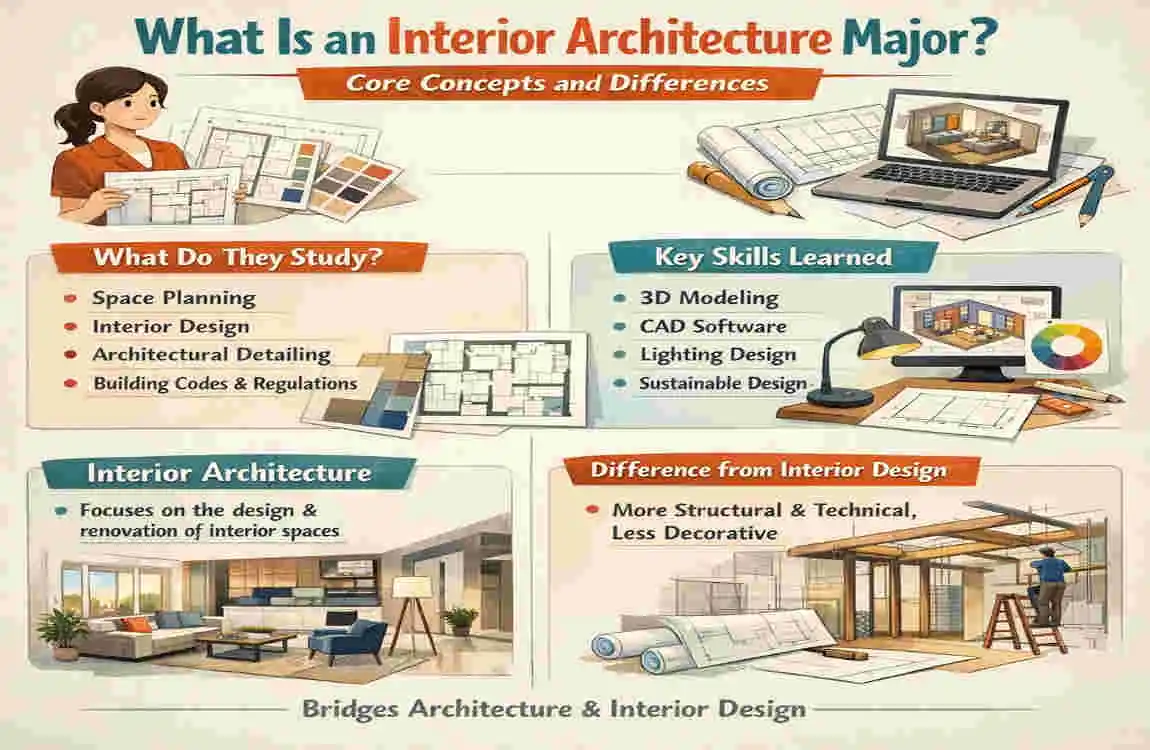
To understand what an interior architecture major is, we first need to clear up a common misconception. It is not just “decorating,” and it isn’t strictly “building exteriors.” It sits right in the sweet spot between the two.
Interior architecture focuses on the design, renovation, and adaptive reuse of existing buildings. While an architect might design the shell of a skyscraper, an interior architect decides how the inside of that shell functions to meet human needs. It is a discipline that blends art, engineering, psychology, and sociology.
The Historical Evolution
This isn’t a new fad. The concept of designing interiors has evolved from the opulent, status-driven interiors of Ancient Rome and the ornate palaces of Versailles to the modern functionality of the Bauhaus movement. Today, an interior architecture major focuses heavily on sustainability and adaptive reuse—the practice of transforming an old factory into luxury lofts, for example.
Key Principles You Will Study
When you declare this major, you aren’t just learning to match colors. You are diving into complex principles:
- Spatial Planning: How do people move through a room? Where should walls be moved to improve flow?
- Ergonomics: How does the human body interact with the built environment?
- Material Science: Understanding the durability, acoustic properties, and environmental impact of wood, glass, steel, and textiles.
- Building Codes: Ensuring safety through knowledge of fire codes, ADA (Americans with Disabilities Act) compliance, and load-bearing structures.
Interior Architecture vs. Interior Design vs. Architecture
This is the most common question students have. To help you visualize the difference, take a look at this comparison:
Field Primary Focus Typical Degree Level Licensing/Certification
Interior Architecture: Structural interiors, adaptive reuse, building systems, and human functionality. Bachelor’s (B.I.Arch) or Master’s (M.I.Arch) NCIDQ (often required for senior roles)
Interior Design Aesthetics, furnishings, lighting, color theory, and surface finishes. Associate or Bachelor’s Degree, NCIDQ or state-specific certification
Architecture: The entire building structure, exterior envelope, site planning, and engineering. Bachelor’s (B.Arch) or Master’s (M.Arch) ARE (Architect Registration Examination) – Mandatory
As you can see, an interior architecture major is more technically rigorous than a standard interior design degree, but focuses more on the human experience inside the box than a general architecture degree does.
Why Pursue an Interior Architecture Major? Benefits and Opportunities
Why should you commit four years of your life to this specific discipline? Beyond the sheer joy of creation, there are practical and professional reasons why this major is gaining massive popularity.
Robust Job Growth and Stability
The demand for functional, safe, and sustainable spaces is not going away. According to labor statistics, employment in design and architecture-related fields is projected to grow roughly 4% from 2023 to 2033. However, the niche for sustainable design and green architecture is growing much faster. As businesses try to reduce their carbon footprint, they need interior architects to retrofit existing buildings to make them more energy-efficient.
The Perfect Balance of Creativity and Logic
If you are the type of person who loves Art class and Physics class, this is your home.
- Visual Thinkers: You get to sketch, render, and play with textures.
- Engineering Aptitude: You get to solve puzzles. How do we fit a commercial kitchen into this small historic building without knocking down a load-bearing wall?
Incredible Versatility
With an interior architecture degree, you are not pigeonholed into one industry. Your skills are transferable worldwide. You could find yourself working in:
- Hospitality: Designing boutique hotels in Bali or luxury resorts in the Swiss Alps.
- Healthcare: Creating healing environments in hospitals that reduce patient stress.
- Corporate: Designing “post-pandemic” hybrid offices that encourage collaboration.
- Retail: creating immersive shopping experiences for major brands.
Personal Fulfillment and Mental Health Impact
One of the most rewarding aspects of this major is learning about biophilic design—the concept of connecting building occupants more closely to nature. By studying interior architecture, you learn how to improve people’s mental health through better lighting, air quality, and spatial flow. You aren’t just making pretty rooms; you are effectively changing how people feel every day.
Summary of Benefits:
- High Earning Potential: Starting salaries often average around $65,000, with rapid growth for specialized roles.
- Tangible Results: You get to walk inside your work.
- Freelance Flexibility: Once you have a portfolio, you can work remotely or start your own firm.
Typical Courses in an Interior Architecture Major
So, what does the actual coursework look like? An interior architecture major is a studio-based program. This means you won’t spend all your time in lecture halls; you will be at a drafting table or a computer station, creating.
Here is a breakdown of what you can expect from your first year to graduation.
The Foundation
Your first year is about breaking down your preconceived notions of space and teaching you how to “see.”
- Design Fundamentals: Learning the elements of design—line, shape, form, texture, and color.
- Architectural Sketching: You will learn to draw by hand before touching a computer. This trains your brain to visualize 3D spaces.
- History of Architecture and Interiors: Understanding the past to design the future.
- Introduction to Sustainability: The basics of eco-friendly building.
Technical Proficiency
This is where the “Architecture” part of the major comes into play. The difficulty level usually ramps up here.
- Digital Rendering & BIM: You will master industry-standard software. Expect deep dives into AutoCAD, SketchUp, and Revit. You will learn to build digital 3D models that contain data about materials and lighting.
- Building Systems: How does a building breathe? You will study HVAC (heating, ventilation, and air conditioning), plumbing, and electrical systems. You need to know where the pipes go so you don’t design a wall right through them!
- Materials and Methods: A tactile course where you learn about wood, stone, concrete, and synthetics. You will learn about “life-cycle assessment”—how long a material lasts and how it is recycled.
The Studio Focus
By now, you are applying your skills to specific sectors.
- Lighting Design: This is often a favorite. You will learn to calculate lumens and foot-candles to create mood and function.
- Acoustics: Learning how to control sound. Essential for designing theaters, offices, or libraries.
- Commercial Design Studio: You might be tasked with redesigning a defunct warehouse into a modern tech office.
- Furniture Design: Understanding how to design custom joinery and millwork.
Professional Practice and Capstone
The final year focuses on launching your career.
- Senior Capstone Project: A massive, semester-long project where you select a site, identify a problem, and design a complete solution. This is the centerpiece of your portfolio.
- Codes and Regulations: A deep dive into safety protocols and universal design (accessibility for all).
- Portfolio Development: Learning how to market yourself to top firms.
Pro Tip: If you want to get ahead before college, look for online courses on platforms like Coursera or Udemy that teach basic SketchUp or Photoshop. Knowing these tools beforehand gives you a massive advantage in your first year.
Essential Skills You Gain from an Interior Architecture Major
Graduating with a major in interior architecture equips you with a diverse toolkit. Employers value these graduates because they are “T-shaped” employees—they have deep technical knowledge in one area but broad capabilities across many others.
Hard Technical Skills
These are the non-negotiables. You cannot work in this field without them.
- CAD Proficiency: Computer-Aided Design is the language of the construction industry. You must be fluent in 2D drafting.
- 3D Modeling: The ability to take a flat floor plan and extrude it into a photorealistic 3D environment using tools like Rhino or 3ds Max.
- Building Information Modeling (BIM): Mastery of Revit is highly sought after. This allows you to create “smart” models in which a change to the floor plan automatically updates the ceiling plan, elevations, and material lists.
- Adobe Creative Suite: You will become a pro at Photoshop (for rendering), InDesign (for presentations), and Illustrator (for diagrams).
Critical Soft Skills
Architecture is a service industry. You are designing for people.
- Client Communication: You must be able to translate a client’s vague desire (“I want it to feel airy”) into concrete design decisions.
- Project Management: You will learn to juggle budgets, timelines, contractors, and vendors.
- Problem Solving: What happens when the custom sofa doesn’t fit in the elevator? You need to think on your feet.
- Empathy: The ability to put yourself in the shoes of the user—whether that’s a surgeon in an OR or a toddler in a daycare.
Emerging Skills for 2026 and Beyond
The industry is changing fast. A modern interior architecture major will also expose you to:
- AI Design Tools: Using AI generators (like Midjourney) for rapid concept iteration and mood boarding.
- Virtual Reality (VR): creating walkthroughs where clients can wear a headset and “walk” through your design before it is built.
- LEED Certification Knowledge: Understanding the requirements for Leadership in Energy and Environmental Design ratings.
Top Careers After an Interior Architecture Major
One of the best things about an interior architecture degree is that it doesn’t limit you to a single job title. Your unique blend of structural knowledge and aesthetic sense makes you valuable in many roles.
Here are some of the most popular career paths:
Interior Architect
Average Salary: $72,000 – $95,000+ The Role: You work on the structural alteration of interiors. You are moving walls, redesigning staircases, and changing the physical layout of a building. You work closely with structural engineers and contractors.
Space Planner
Average Salary: $68,000 – $85,000. The Role: Highly analytical. You figure out how to fit 200 employees into a new office floor plan while adhering to fire codes and ensuring everyone has access to natural light. This is huge in the corporate real estate sector.
Exhibition Designer
Average Salary: $65,000 – $80,000. The Role: You design temporary or permanent displays for museums, galleries, and trade shows. This requires a flair for storytelling and dramatic lighting. It is fast-paced and creative.
Sustainable Design Consultant
Average Salary: $75,000-$100,000+. The Role: You advise architects and owners on how to make their interiors more sustainable. You select non-toxic materials, design for daylighting to reduce electricity use, and help projects achieve LEED certification.
Lighting Designer
Average Salary: $70,000-$90,000. The Role: You specialize strictly in illumination. You design the lighting plans that define the mood of restaurants, hotels, and retail stores. It is a very technical but artistic niche.
Adaptive Reuse Specialist
Average Salary: Variable (often high for specialized firms). The Role: You focus specifically on historic preservation and modernizing old buildings. This is a booming field in cities with rich histories, such as London, New York, and Lahore, where preserving heritage while adding modern utility is key.
Salary Expectations and Job Outlook for Interior Architecture Graduates
Money matters. When you are investing in a degree, you want to know the Return on Investment (ROI). The financial outlook for an interior architecture major is positive, but it varies heavily based on your specialization and location.
The Numbers Breakdown
- Entry-Level (0-2 years): Expect to start between $50,000 and $65,000. At this stage, you are likely a “Junior Designer” or “CAD Technician,” doing the heavy lifting on drafting and modeling.
- Mid-Career (3-7 years): As you gain autonomy and perhaps manage small projects, salaries jump to $70,000 – $90,000.
- Senior Level (8+ years): Principals, Partners, and Design Directors often earn $100,000-$150,000+.
Factors Influencing Salary
- Location: An Interior Architect in major hubs like San Francisco, New York, or London will earn significantly more than one in a rural area (though the cost of living is also higher).
- Sector: Commercial and Corporate design generally pays better than Residential design in the early years.
- Certification: Getting your NCIDQ (National Council for Interior Design Qualification) or similar regional licenses can instantly boost your earning power by 15-20%.
2026 Trends to Watch
- Remote Work: The shift to hybrid work means you can now work for a firm in a high-paying city while living in a more affordable area, expanding your salary potential.
- AI Integration: Professionals who know how to leverage AI for efficiency are commanding higher rates because they can deliver work faster.
How to Get Started: Choosing Programs and Entry Requirements
If you are sold on the interior architecture major, the next step is getting into a program. Not all degrees are created equal, so you need to look for accreditation.
Choosing the Right School
Look for programs accredited by bodies such as CIDA (Council for Interior Design Accreditation) or its equivalent, or NAAB (National Architectural Accrediting Board) or its equivalent.
- Art Schools (e.g., RISD, Pratt, SCAD): These programs focus heavily on the artistic, conceptual, and avant-garde side of the major.
- State Universities often offer a more balanced, technical approach and might be more affordable.
- International Options: Schools like NCA in Lahore or Politecnico di Milano offer incredible perspectives on heritage and modern design.
Entry Requirements
Admissions for this major are competitive. Here is what you usually need:
- Portfolio: This is the deal-breaker. Schools want to see your creativity. This doesn’t mean you need perfect architectural drawings yet. Include photography, sketches, sculpture, or painting. They are looking for potential and spatial awareness.
- GPA: A solid academic record (usually 3.0+ or equivalent) is required because the coursework is academically rigorous.
- Essay: You will likely need to write about why you want to design spaces. Be honest and passionate.
Alternative Paths
Can’t commit to a 4-year degree right now?
- Community College: Many offer 2-year Associate degrees in Interior Architecture technology, which can get you a job as a drafter.
- Bootcamps: Intensive 3-6 month courses can teach you specific software like Revit, allowing you to enter the industry from a technical angle.
Real-World Success: Profiles of Interior Architecture Major Alumni

To help you visualize where this degree can take you, let’s look at the types of success stories common in this field.
The Commercial Icon: Think of designers like Kelly Wearstler. While she is known for decoration, her firm employs interior architects who handle the structural overhauls of the massive hotels she designs. Alums who follow this path often end up leading design teams at global hospitality brands such as Marriott or Hilton.
The Heritage Restorer: Consider a graduate who works in a city like Lahore or Rome. They might specialize in restoring Mughal-era havelis or Roman villas, turning them into modern museums or boutique guesthouses. This career path blends history with modern engineering and offers an incredibly culturally rewarding experience.
The Healthcare Innovator: Some graduates find their calling in designing hospitals. They use evidence-based design to create patient rooms that reduce infection rates and lower stress. It is a career where your design decisions literally save lives.
Key Takeaway: The common thread among successful alums is networking. Joining organizations like ASID (American Society of Interior Designers) or IIDA (International Interior Design Association) as a student is crucial for landing that dream job.
Frequently Asked Questions (FAQ)
Is an interior architecture major math-heavy? It is not “Calculus-heavy,” but you need a strong grasp of geometry, algebra, and basic physics. You need to calculate areas, volumes, material costs, and lighting loads. If you can handle high school geometry and algebra, you will be fine.
Can I become a licensed architect with this degree? Generally, no. To become a “Licensed Architect,” you typically need a B.Arch or M.Arch degree. However, with an Interior Architecture degree, you can often become a “Certified Interior Designer” or earn licensure in specific states that recognize interior architecture as a distinct practice.
Is an interior architecture major worth it in 2026? Absolutely. As the world focuses more on sustainability and repurposing existing buildings rather than building new ones, interior architects are more valuable than ever. The skills are specialized and in high demand.
Can I do an interior architecture major online? Yes, but with a caveat. While online programs exist (such as those from Southern New Hampshire University or various art academies), the “studio” culture of an on-campus program is incredibly valuable for learning to collaborate. If you choose to go online, ensure you find internships to gain hands-on experience.