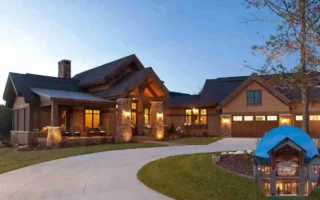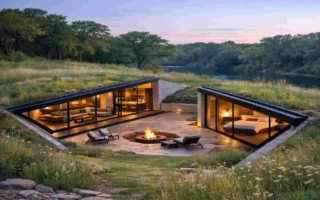

From the majestic pyramids of Egypt rising from the desert sands to the delicate, sweeping roofs of Japanese pagodas, our ancestors built structures that have miraculously stood the test of time. In fact, if you look closely at the buildings around you today, you will notice that traditional architecture has quietly influenced a vast majority of our modern designs worldwide. But this brings up a fascinating question that many design enthusiasts and homeowners ask: What is traditional architecture, really?
You immediately feel a sense of place, history, and profound comfort. This is the magic we are talking about. When we define traditional architecture, we are talking about building styles that are deeply rooted in their cultural, historical, and environmental contexts. These are structures built using local materials and brilliant, practical techniques that have been passed down through generations.
Unlike the sleek, glass-and-steel modern minimalist trends that often look exactly the same whether they are in New York, Tokyo, or Dubai, traditional buildings belong to their specific landscape. They tell a story about the people who lived there, the climate they braved, and the resources they had at hand. Traditional architecture embraces sustainability, cultural identity, and a deep, abiding connection to the natural world.
| Region/Style | Key Features | Iconic Examples |
|---|---|---|
| Classical (Greece/Rome) | Symmetry, columns, proportion | Parthenon, Pantheon |
| Gothic (Europe) | Pointed arches, ribbed vaults, height | Notre-Dame Cathedral |
| Japanese Pagodas | Flexible timber joints, seismic sway | Horyu-ji Temple |
| Indian/Mughal | Domes, ornamentation, vibrant colors | Taj Mahal |
| Adobe/Pueblo (SW US) | Earth-based walls, thermal mass | Taos Pueblo |
| Islamic/Persian | Wind towers, courtyards for cooling | Badgir in Yazd |
Defining Traditional Architecture: Core Principles and Characteristics
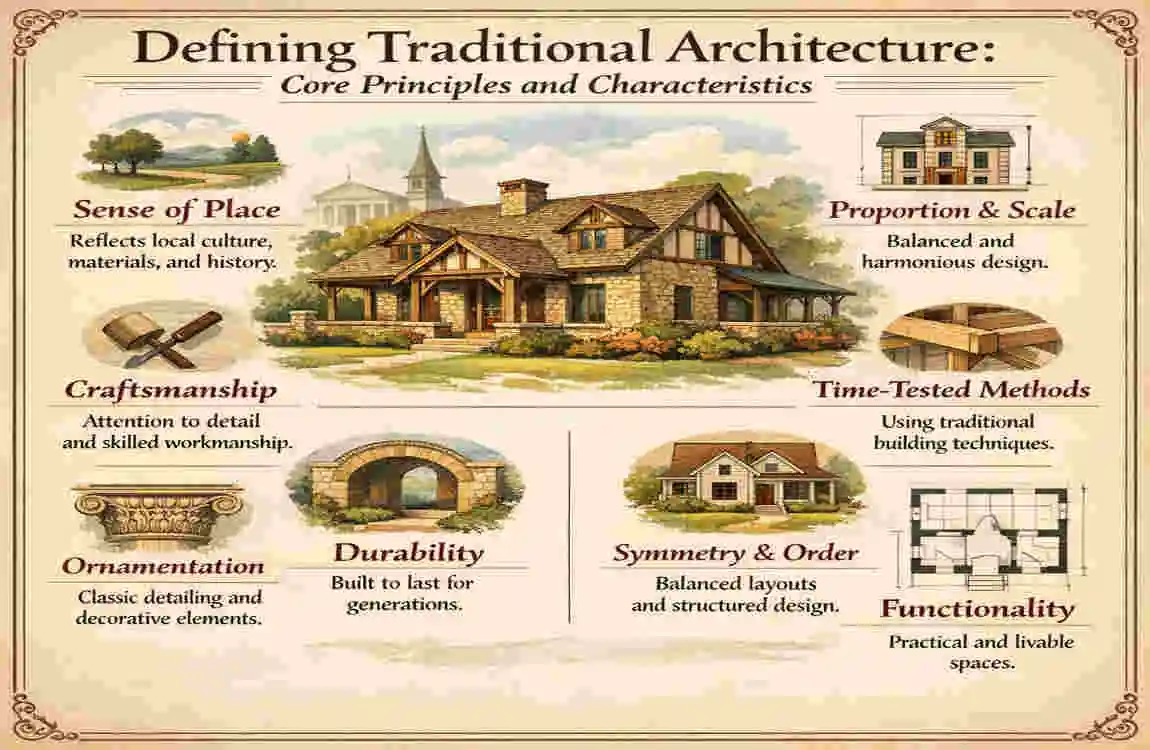
To truly understand what traditional architecture is, we need to break down the core elements that separate it from contemporary, mass-produced buildings. What makes a building feel “traditional”? It all comes down to a few brilliant, time-tested principles.
First and foremost is the use of vernacular materials. Long before global shipping existed, builders had to use exactly what the earth provided them locally. If you lived in a dense forest, you would build with timber. If you lived in a rocky mountainous region, you carved your home from stone. If you lived in the desert, you baked the earth itself into adobe bricks. This reliance on local materials gave traditional architecture its unique, region-specific charm.
Climate-responsive design is another massive piece of the puzzle. Our ancestors did not have air conditioning or central heating. They had to build smart. They designed steep roofs to shed heavy snow, small windows to keep out the blistering desert sun, and wide courtyards to capture cooling breezes.
Furthermore, traditional buildings are rich in symbolism. They often feature spiritual motifs, intricate carvings, and specific layouts designed to reflect the religious or cultural beliefs of the community. A traditional home is never just a shelter; it is a profound expression of a community’s identity.
Core Principles of Traditional Building
When you study traditional structures, you will notice they all share three beautiful core principles:
- Harmony with Nature: Buildings are designed to blend into their surroundings, not dominate them. They work with the local climate rather than fighting against it.
- Community Function: Traditional spaces are built to foster human connection. They prioritize central courtyards, large gathering hearths, and shared communal spaces.
- Craftsmanship Over Mass Production: You will find hand-carved details, locally forged ironwork, and carefully laid masonry. Human hands, not machines, give these buildings their soul.
Take, for example, the iconic Adobe homes found in the Southwest United States. These structures are the perfect answer to the question of what traditional architecture is in a harsh climate. The thick mud-brick walls absorb the intense heat of the day, keeping the inside cool. Then, during the freezing desert nights, those same walls slowly release the stored heat, keeping the family warm. It is pure, natural thermal regulation without a single wire or duct.
Traditional vs. Modern Architecture: A Quick Comparison
To help you visualize the differences, here is a simple breakdown comparing the traditional approach with modern architectural trends:
Feature: Traditional Architecture, Modern Architecture
Materials Local, natural (wood, stone, mud, clay) Manufactured, global (steel, concrete, glass)
Climate Control Passive (thick walls, strategic shade, cross-ventilation) Active (HVAC systems, artificial heating/cooling)
Design Focus: Cultural identity, heritage, local customs. Minimalism, functionalism, universal appeal
Construction Hand-crafted, slow, generational techniques Machine-assisted, rapid, standardized
Aesthetics: ornate, symbolic, detailed. Clean lines, geometric, unadorned
Key Characteristics at a Glance
If you are trying to spot a traditional building, look out for these 7 key characteristics:
- Locally Sourced Materials: Sourced from the immediate environment.
- Climate Adaptability: Features explicitly designed to handle local weather.
- Human Scale: Proportions that feel comfortable and natural to the human body.
- Cultural Symbolism: Decorative elements that tell a local story.
- Generational Techniques: Built using methods taught from parent to child.
- Ornamentation: Beautiful details added for aesthetic and spiritual joy.
- Asymmetry and Organic Growth: Buildings that expand naturally as families grow.
A Brief History of Traditional Architecture
Understanding what traditional architecture is requires us to take a step back and trace its fascinating historical roots. The history of traditional architecture is essentially the history of human Survival, ingenuity, and cultural blossoming.
The Dawn of Human Settlement
Our journey begins with the timeline of ancient civilizations. Around 4000 BCE in Mesopotamia—often called the cradle of civilization—humans made a massive leap. We stopped wandering as nomads and started settling down to farm. This meant we needed permanent structures. Early builders in Mesopotamia created the first sun-dried mud bricks, stacking them to create homes and eventually massive, stepped temples called ziggurats.
As we moved into the Neolithic era, human settlements became more sophisticated. People began to realize that building a shelter was not just about hiding from the rain; it was about protecting the community, storing food, and honoring the gods.
The Evolutionary Drivers of Design
Why did architectural styles change and evolve? Several massive evolutionary drivers pushed our ancestors to innovate:
- Religion: The desire to reach the heavens or honor deities led to massive leaps in engineering. Temples and tombs became the testing grounds for new building techniques.
- Trade: As the Silk Road and spice routes opened up, merchants did not just trade goods; they traded ideas. You can see the influence of foreign lands in the sudden appearance of new archways or tile colors in port cities.
- Climate Changes: When populations migrated to colder or hotter regions, they had to invent new ways to keep their homes livable.
- Societal Shifts: The transition from tribal clans to massive empires required new building types, like grand palaces, public baths, and defensive fortresses.
Major Historical Milestones
As centuries passed, traditional architecture hit several incredible milestones. The Romans, for example, revolutionized the world with the invention of concrete and the mastery of the arch. This allowed them to build massive domes and aqueducts that still stand today.
Later, the Islamic Golden Age brought us breathtaking advancements in geometry and tile work. Builders figured out how to create perfectly proportioned mosques and palaces that seemed to float like a mirage in the harsh desert environment. Meanwhile, medieval Europe was slowly lifting its sights upward, moving from dark, heavy stone castles to the bright, soaring ceilings of later eras.
Through all of this history, the everyday homes of the common people remained deeply tied to the earth. The farmers, artisans, and merchants continued to refine their local, traditional building methods, creating a rich tapestry of global styles.
Iconic Traditional Architecture Styles Around the World
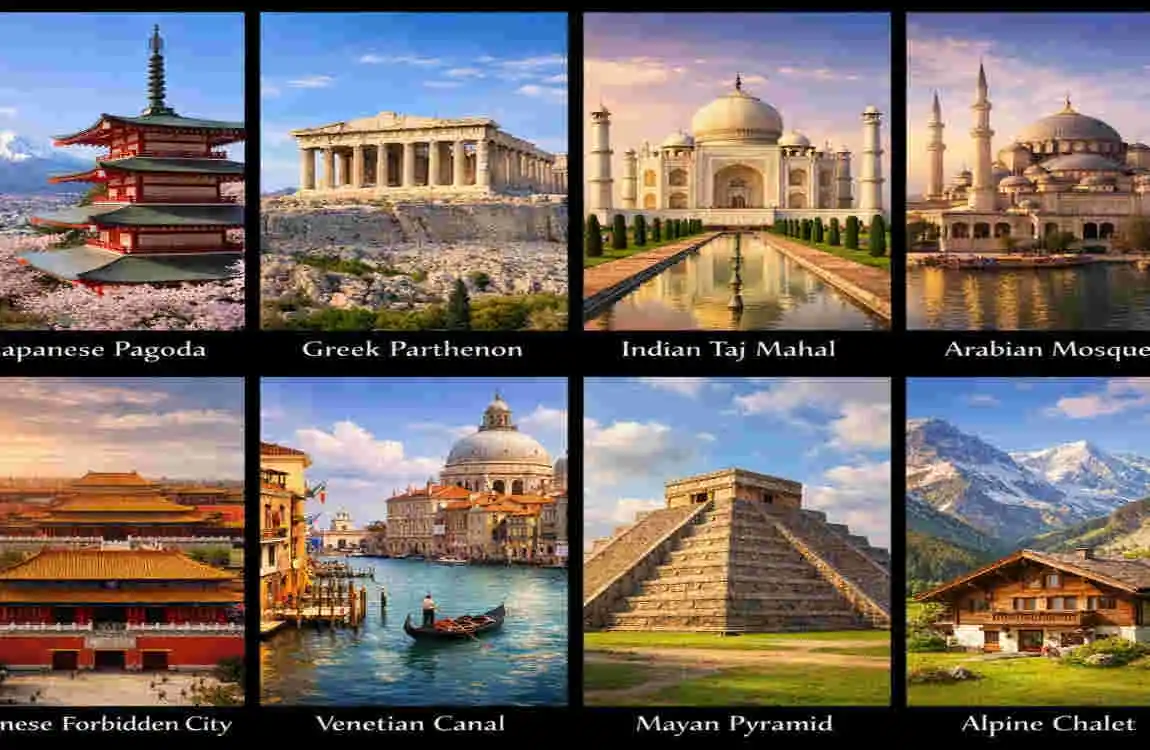
Now that we have covered the basics, let us travel the globe. Exploring traditional architecture examples from different continents is like reading a history book written in wood, stone, and clay. We have divided these global styles into regional sections, making it easy for you to explore the stunning diversity of our built world. These timeless designs continue to inspire modern luxury homes and even celebrity residences today.
European Traditional Architecture: Gothic and Renaissance Marvels
When you think of traditional European architecture, your mind likely jumps to massive stone cathedrals and perfectly symmetrical villas. Europe has given us some of the most recognizable building styles in human history, driven heavily by religion and the rebirth of classical art.
The Soaring Heights of Gothic Architecture Originating in France in the 12th century, the Gothic style is all about reaching for the heavens. The most famous example is the breathtaking Notre-Dame Cathedral in Paris. But how did builders create such massive, light-filled spaces using heavy stone? They used a brilliant secret: the flying buttress.
Flying buttresses are external stone ribs that support the weight of the massive walls. Because these external ribs held the building up, builders could punch huge holes in the walls and fill them with dazzling stained glass windows. These windows were not just pretty; they symbolized divine light and served as picture books for a population that largely could not read. Every pointed arch and ribbed vault in a Gothic building is designed to pull your eyes upward, inspiring awe and a sense of spiritual wonder.
The Perfect Harmony of the Renaissance. A few centuries later, Italy sparked the Renaissance, a period that looked back to the ancient Greeks and Romans for inspiration. Renaissance architecture, seen in gorgeous Italian villas and grand public squares, is completely obsessed with symmetry, proportion, and geometry.
Builders brought back classical columns, perfectly round arches, and majestic domes. The idea was that mathematical perfection in a building reflected the perfection of the universe. This style feels incredibly balanced and serene.
Modern Celebrity Tie-Ins. The allure of European traditional architecture has never faded. Have you ever wondered why so many modern luxury homes look like Italian villas? The Renaissance style heavily influences modern high-end real estate. Celebrities like George Clooney have famously purchased and lovingly restored 18th-century Tuscan villas. They are drawn to the timeless elegance, the thick stone walls, the terracotta roofs, and the sense of enduring history that cannot be replicated with a new build.
Asian Traditional Architecture: Harmony and Serenity
If European architecture is about conquering gravity and reaching for the sky, Asian traditional architecture is largely about living in perfect harmony with the earth. It is a masterclass in balance, spirituality, and blending the indoors with the outdoors.
Chinese Courtyards and the Flow of Energy. In China, traditional architecture is deeply intertwined with the philosophy of Feng Shui—the practice of arranging your environment to maximize the flow of positive energy (chi). The ultimate expression of this is the Siheyuan, a historical courtyard home.
A Siheyuan features buildings arranged perfectly around a central, open-air courtyard. This design creates a private, enclosed world for the family. The solid outer walls offer total privacy and protection from harsh winds, while the inner courtyard brings in sunlight, fresh air, and a private slice of nature. The sweeping, curved roofs you often see in Chinese architecture are not just beautiful; they are designed to throw rainwater far away from the building’s wooden foundations.
Japanese Temples and Earthquake Resistance Japanese traditional architecture is heavily influenced by the country’s unique environment, which is prone to frequent earthquakes. When you look at Kyoto’s stunning wooden pagodas, you are looking at an engineering marvel.
Japanese builders relied almost entirely on wood framing. They developed a genius system of interlocking wooden brackets—without using a single metal nail. This flexible wooden skeleton allows the building to sway and dance during an earthquake rather than snapping and collapsing like rigid stone would. The central pillar of a pagoda, known as the shinbashira, acts as a shock absorber. This brilliant, ancient secret of Japanese traditional architecture is a concept modern engineers still study today for earthquake-proofing skyscrapers!
Indian Stepwells and Intricate Havelis India offers a wildly diverse range of traditional styles, heavily influenced by its scorching summers and monsoon rains. Two incredible examples are the stepwells and the Havelis.
Stepwells are massive, inverted architectural wonders dug deep into the earth. They feature hundreds of intricate stone steps leading down to a water source. They served as vital water conservation systems and beautifully cool community gathering places during the hottest months. Meanwhile, wealthy merchants lived in Havelis—grand mansions known for their unbelievable stone carvings, interior courtyards, and beautiful overhanging balconies. These balconies provided much-needed shade, keeping the interior rooms cool and comfortable.
Middle Eastern and African Styles: Desert Adaptations
Building in the extreme heat of the desert requires serious ingenuity. Middle Eastern and African traditional architecture showcases some of the most brilliant passive cooling secrets the world has ever seen.
The Geometric Beauty of Islamic Architecture. Islamic architecture is famous for its mesmerizing beauty and profound mathematical precision. Take a walk through the Alhambra in Spain, a masterpiece of Moorish design, and you will see the hallmarks of this style.
Because Islamic tradition generally prohibits the depiction of human or animal forms in religious art, builders turned to geometry, calligraphy, and stunning tile work to decorate their spaces. The repeating geometric patterns symbolize the infinite nature of the universe.
Practically, these buildings are designed for the heat. You will find horseshoe arches, lush interior courtyard gardens, and the constant, cooling presence of moving water through shallow reflecting pools and fountains.
The Genius of African Mud Architecture In West Africa, traditional builders mastered the art of building with the earth itself. The Great Mosque of Djenné in Mali is the largest mud-brick building in the world, and it is a breathtaking sight.
Mud, or adobe, is the ultimate material for natural cooling. The immensely thick mud walls of these African structures absorb the intense heat of the sun during the day, keeping the inside surprisingly cool. At night, the walls release the heat, keeping the occupants warm.
What makes the Great Mosque even more special is its communal design. Because mud architecture eventually washes away in the rainy season, the entire local community gathers every single year for a massive festival to re-plaster the mosque by hand. It is a powerful example of how traditional architecture builds not just walls, but community bonds.
The Wind Towers of the Middle East. One of the best-kept secrets of the Middle East is the Badgir, or wind tower. Long before electric fans, builders in places like Iran erected tall, beautifully decorated towers atop their homes. These towers catch the high-altitude breezes and funnel the cool air straight down into the living spaces below. It is a completely zero-energy air conditioning system that has worked perfectly for centuries.
Americas: Indigenous Ingenuity
Long before European settlers arrived, the Indigenous peoples of the Americas were creating architectural masterpieces perfectly suited to their environments. From the dense jungles to the arid deserts, their ingenuity is truly inspiring.
The Astronomical Precision of Mayan Pyramids. In the dense jungles of Mesoamerica, the Maya civilization built towering stone pyramids and sprawling city-states. But these were not just piles of rock; they were massive, functioning calendars.
Mayan stonework was aligned with astonishing astronomical precision. For example, at the pyramid of El Castillo in Chichén Itzá, the structure is designed so that during the spring and autumn equinoxes, the shadow of the sun creates the illusion of a massive serpent slithering down the staircase. This required an advanced understanding of mathematics, astronomy, and architectural geometry.
The Communal Defense of Native American Pueblos In the American Southwest, Native American tribes like the Ancestral Puebloans built incredible multi-story structures out of adobe and stone. You can still see magnificent examples built directly into the sides of sheer cliffs at places like Mesa Verde.
These Pueblos were designed for both community living and defense. They were built in terraced layers, meaning the roof of a lower home served as the front porch for the home above it. Originally, there were no doors on the ground floor. People used wooden ladders to access the upper levels, and in times of danger, they pulled the ladders up, turning their village into an impenetrable fortress.
Key secrets from the Americas:
- Astronomical Alignment: Buildings positioned to track the sun and seasons.
- Thermal Mass: Thick adobe walls for desert temperature regulation.
- Defensive Layouts: Cliff dwellings and ladder-access homes for safety.
Timeless Secrets: Why Traditional Architecture Endures Today
You might be wondering, with all our modern technology, steel beams, and smart glass, why do we still care about old building methods? The truth is, traditional architecture holds timeless secrets that modern builders are desperately trying to relearn. As we face global challenges, the “old ways” are proving to be incredibly valuable.
The Unbeatable Sustainability Edge Perhaps the biggest secret of traditional architecture is its inherent sustainability. Before the invention of cheap fossil fuels, a building had to be energy efficient, or you would freeze in the winter and boil in the summer.
Traditional buildings use passive cooling and heating techniques. By utilizing thick thermal mass walls, strategic window placements to catch cross-breezes, and deep roof overhangs to block the high summer sun, these buildings naturally regulate their temperature. Studies show that incorporating these traditional passive design strategies into modern homes can reduce energy consumption by a staggering 30% to 50%. In a world trying to fight climate change, looking backward is our best path forward.
The Psychological Benefits of Biophilic Design. Have you ever noticed that you feel instantly more relaxed in an old timber-framed cabin or a stone cottage than you do in a fluorescent-lit concrete office? That is not just nostalgia; it is psychology.
Traditional architecture relies heavily on natural materials and organic shapes—a concept modern designers call “biophilic design.” Biophilia is the innate human desire to connect with nature. When we surround ourselves with natural wood grains, rough-hewn stone, and earthy clay, it actually lowers our blood pressure and reduces stress. Traditional architecture naturally boosts our mental well-being because it feels like an extension of the natural world.
Economic Perks and Heritage Tourism. There is also a massive economic upside to the enduring legacy of traditional styles. Homes built with timeless, traditional proportions and high-quality natural materials tend to require less drastic maintenance over the centuries compared to modern buildings that rely on complex, breakable synthetic systems.
Furthermore, traditional architecture holds immense value in heritage tourism. According to UNESCO data, there are over 1000 World Heritage sites across the globe, and the vast majority of them are rooted in traditional, vernacular building styles. Entire local economies thrive simply because people want to travel and stand in the presence of these beautiful, historical structures.
The Challenge of Preservation. Of course, this endurance does not come without challenges. We are currently facing a battle between preservation and rapid urbanization. As cities expand and populations boom, there is immense pressure to bulldoze old, low-rise traditional neighborhoods to build high-rise apartment blocks. Preserving our architectural heritage while accommodating modern growth is one of the greatest challenges city planners face today.
Traditional Architecture in the Modern World: Inspiration for Today
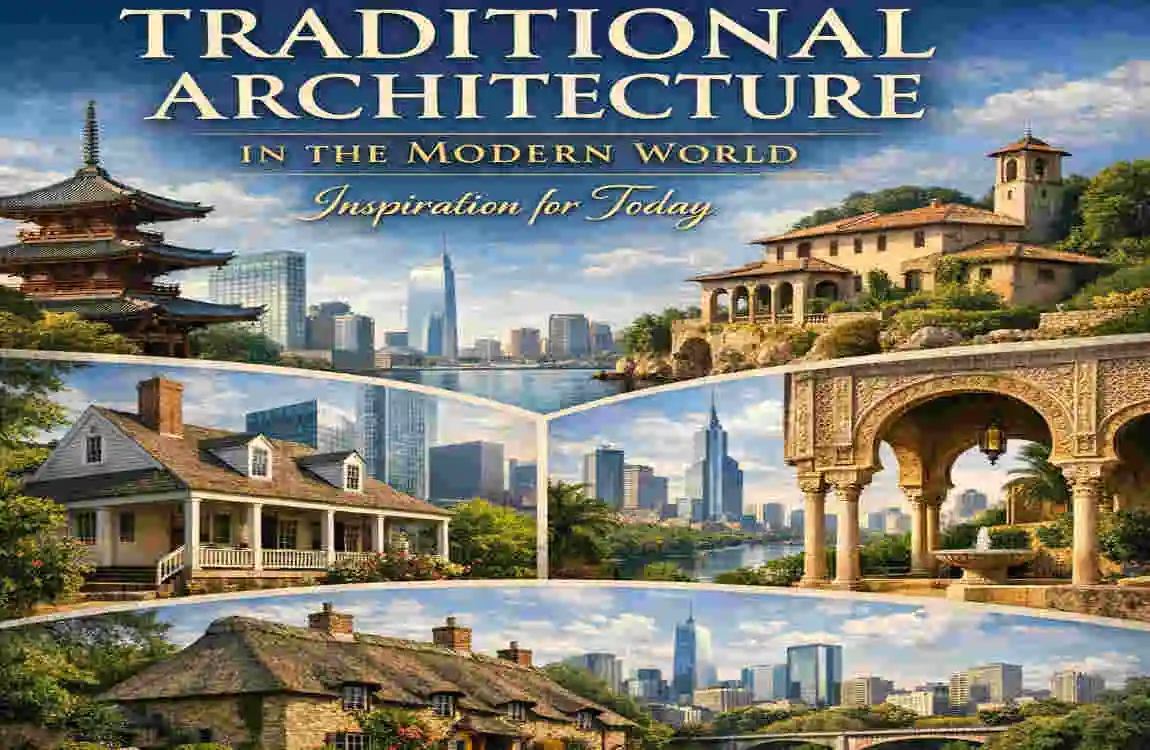
We do not just have to admire traditional architecture in museums or on vacation; we can bring its warmth and wisdom into our own lives. Today, we are seeing a massive revival trend as people push back against cold, ultra-modern designs.
Neo-traditional homes are becoming highly sought after. People want the conveniences of modern plumbing and the internet, but they want the look, feel, and soul of a traditional house. We are also seeing the rise of eco-villages that use ancient techniques like rammed earth walls and thatched roofs to create hyper-sustainable, modern communities.
How to Incorporate Traditional Elements in Your Home
You do not need to build a castle to capture this magic. Here are 5 practical tips for weaving the secrets of traditional architecture into your modern space:
- Expose the Bones: If you are renovating, expose natural wooden ceiling beams or original brick walls. Let the raw structure of the home shine through.
- Use Local Materials: Skip the imported synthetic countertops and look for local stone, reclaimed wood, or regional clay tiles to anchor your home to its location.
- Prioritize Natural Ventilation: Instead of immediately turning on the AC, arrange your furniture and open windows to create a natural cross-breeze, mimicking traditional cooling.
- Embrace Courtyard Living: If you have outdoor space, create an enclosed, private courtyard area with a small water feature to mimic the peaceful, cooling sanctuaries of Asian and Middle Eastern styles.
- Add Hand-Crafted Details: Replace factory-made hardware with hand-forged iron handles, or add a piece of locally carved woodwork. Celebrate human craftsmanship.
The Business Angle for Design Enthusiasts. If you are a builder, designer, or real estate investor, there is a lucrative market here. Monetizing heritage-inspired designs is highly profitable. Buyers are increasingly willing to pay a Premium for homes that offer “character” and eco-friendly passive cooling features. Blending smart-home technology with traditional aesthetics is the ultimate winning combination in today’s luxury real estate market.
FAQ: Common Questions About Traditional Architecture
What is traditional architecture in simple terms? In simple terms, traditional architecture refers to the way people historically built their homes and structures using only the natural materials they could find nearby. Instead of using globalized, factory-made parts, they used local wood, stone, or mud. They also designed these buildings specifically to handle their local weather, like building steep roofs for snowy areas or thick clay walls to keep cool in the desert. It is a building focused on local culture, natural materials, and practical Survival.
How does traditional architecture differ from modern architecture? The main difference lies in materials, technology, and aesthetic goals. Modern architecture often relies on mass-produced, industrial materials like steel, concrete, and large sheets of glass. It uses active, energy-consuming systems like air conditioning to control the temperature. Visually, modern design favors minimal, clean lines and a universal look that fits anywhere in the world. Traditional architecture relies on natural, local materials, uses passive (zero-energy) design to control the temperature naturally, and features ornate, culturally specific decorations.
What are some famous examples of traditional architecture styles? There are stunning examples all over the world! Some of the most famous include the soaring stone Gothic cathedrals of Europe (like Notre-Dame), the beautifully balanced wooden pagodas and temples of Japan, the majestic Adobe pueblos of the Native American Southwest, and the intricately tiled, courtyard-centered Islamic palaces of the Middle East, such as the Alhambra in Spain.
Is traditional architecture sustainable? Yes, it is incredibly sustainable! Because traditional builders did not have electricity or HVAC systems, they had to design buildings that naturally stayed warm in winter and cool in summer. They used techniques like thermal mass (thick walls that absorb heat), natural cross-ventilation, and deep shading. By using these ancient, passive cooling and heating techniques, traditional buildings often use significantly less energy than modern glass buildings. Furthermore, building with local, natural materials produces a much smaller carbon footprint than manufacturing and shipping steel and concrete across the globe.