
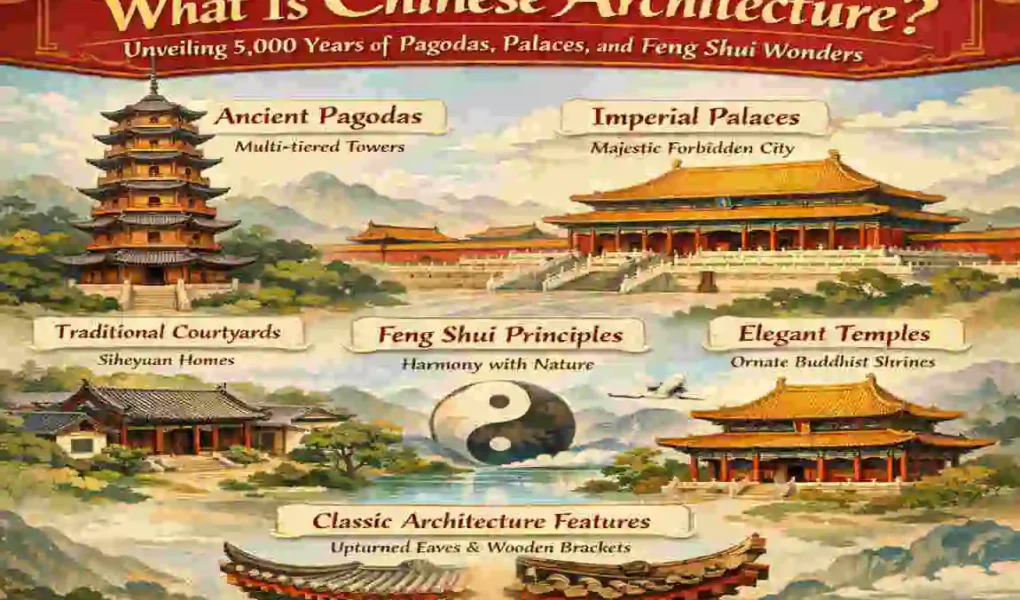
If you have ever looked at the Forbidden city, a tall pagoda, or even the sweeping line of a traditional Chinese roof, you have probably felt that Chinese buildings carry a special kind of presence. They do not just stand on the land. They seem to belong to it. Their shapes, colours, and layouts often feel calm, balanced, and deeply meaningful.
At its heart, Chinese architecture is a 5,000-year-old building tradition shaped by art, belief, power, family values, and the natural world. It is known for symmetry, wooden structures, curved roofs, careful planning, and the belief that buildings should work in harmony with heaven, earth, and human life. This is where ideas like Feng Shui, cosmic order, and respect for ancestors become part of architecture, not just decoration.
Unlike many traditions that focus only on stone monuments or technical innovation, Chinese architecture brings together function, symbolism, and spiritual meaning. A palace was not just a home for an emperor. A pagoda was not just a tower. A courtyard house was not just a place to live. Every space had a purpose, and every purpose often reflected a larger idea about order, family, status, or energy.
The Ancient Origins: Birth of Chinese Architecture
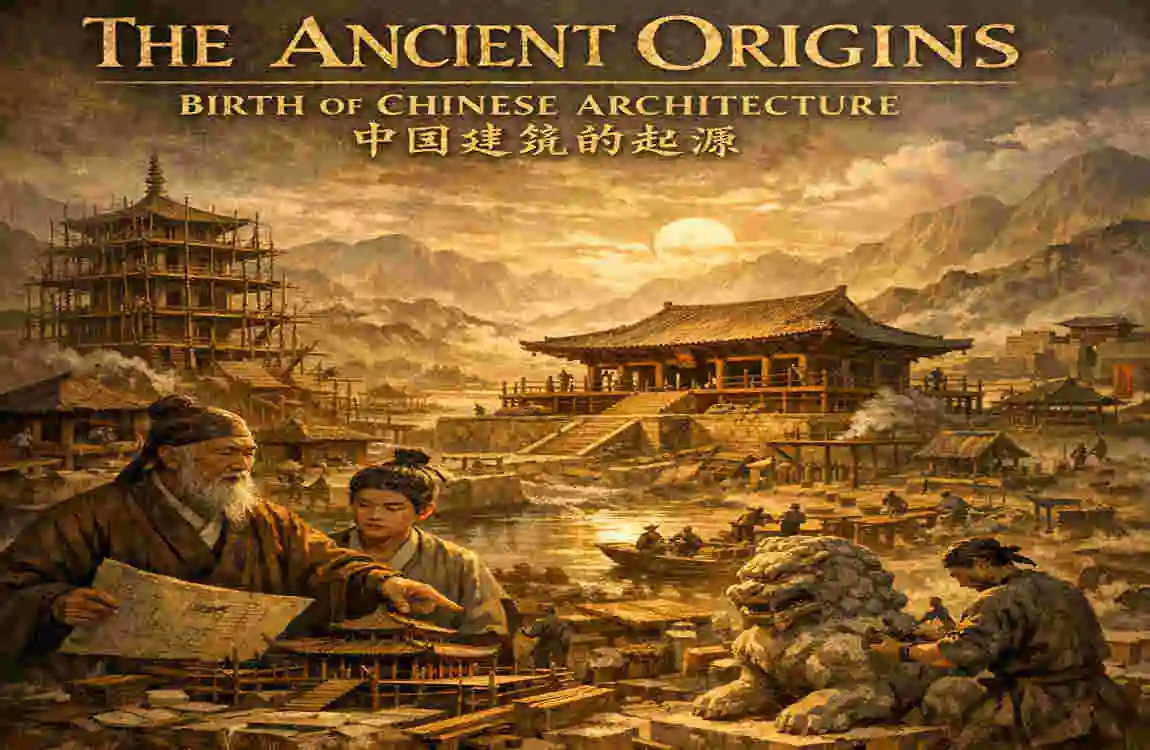
To understand Chinese architecture, you need to start at the very beginning. Long before imperial palaces and tall pagodas, people in ancient China were already shaping the land in careful and meaningful ways. These early forms were simple, but they laid the foundation for one of the world’s longest and richest architectural traditions.
What Defines Early Chinese Architecture?
The earliest roots of Chinese architecture go back to the Neolithic period, when farming communities began building permanent settlements. One well-known example is Banpo village, near modern Xi’an. Homes there were often built as semi-underground pit houses, which helped regulate indoor temperature. These structures were practical, but they also reveal an important fact: early Chinese builders were already adapting architecture to the climate and daily life.
As villages grew, builders started using wood, earth, and rammed-earth walls. Rammed earth involved packing layers of soil tightly together to create strong walls and platforms. This method became one of the earliest and most important building techniques in Chinese history.
Religion and belief also shaped early structures. Ancient Chinese communities practised forms of ancestor worship and nature-based beliefs. People believed the world of the living and the world of spirits were connected. Because of this, buildings were not seen as simple shelters. They could also be spaces for ritual, respect, and communication with unseen forces.
Even in these early stages, you can see the seeds of later Chinese design:
- A strong connection to the natural environment
- A focus on orientation and placement
- The use of local materials
- The idea that a structure can carry social and spiritual meaning
This is one reason the history of Chinese architecture feels so continuous. Early builders did not just create forms. They created habits of thinking about space.
Key Developments in the Shang and Zhou Dynasties
As Chinese society became more organised during the Shang Dynasty and later the Zhou Dynasty, architecture grew more advanced. Settlements became more planned, and buildings began to reflect power and social order more clearly.
During the Shang period, rulers built palaces, ceremonial platforms, and walled compounds. Many of these structures used timber frames set on raised earth platforms. Although wood decays over time, archaeological remains show that these early buildings already relied on systems that would define Chinese architecture for centuries.
The Zhou period brought even stronger ideas about ritual order, social hierarchy, and spatial planning. This is when the idea of axial symmetry became especially important. In simple terms, this means buildings and courtyards were arranged along a central line. The main hall stood on that line, while secondary spaces were placed to either side in a balanced fashion.
Why did this matter? Because symmetry reflected order. And order was a major value in ancient Chinese thought. A well-planned building mirrored a well-ordered family, a well-run state, and even a well-balanced universe.
Here is a simple table that shows how early Chinese architecture evolved:
Period: Main Building Materials, Key Features, Why It Mattered
Neolithic Earth, wood, thatch , Pit houses, basic village planning, Adapted to climate and daily needs
Shang Dynasty Timber, rammed earth , raised platforms, palaces, ritual spaces , linked power with architecture
Zhou Dynasty : timber, earth, axial symmetry, walled compounds, formal layouts. Introduced stronger ideas of order and hierarchy
These early forms were not yet the grand palaces people often imagine today. But they established the core language of Chinese building: platforms, timber structures, symmetry, ritual meaning, and planned space.
The Groundwork for Imperial Grandeur
By the end of these early dynasties, Chinese architecture had already developed its main character. Builders knew how to organise large compounds. Rulers understood that architecture could express authority. Religious and philosophical ideas were becoming part of design. And most importantly, structures were increasingly arranged to reflect a larger vision of how life should be ordered.
So when later emperors built vast capitals and powerful palace complexes, they were not starting from nothing. They were building on centuries of thought, technique, and tradition.
That brings us to one of the most famous chapters in the answer to the question of what Chinese architecture is: the age of imperial palaces.
Imperial Glory: Palaces and Forbidden Cities
If early Chinese architecture gave us the foundations, the imperial age gave us the grandest expressions of the tradition. This is where architecture became a powerful language of empire. Palaces were designed not only for living and ruling, but for displaying authority, maintaining ceremony, and showing the emperor’s place between heaven and earth.
Evolution of Chinese Palaces Across Dynasties
As China unified and expanded under large dynasties, palace architecture became bigger, more formal, and more symbolic. During the Qin and Han dynasties, rulers created huge compounds with audience halls, courtyards, gates, and defensive walls. These were not isolated buildings. They were planned worlds of their own.
The Qin period is often remembered for the Terracotta Army, which reflects the same mindset seen in architecture: order, scale, control, and the desire to create a complete imperial universe. Han architecture built on this and developed more refined palace layouts, often using raised terraces and timber halls.
By the time of the Tang and Song dynasties, palace design had become more sophisticated. Builders paid closer attention to the relationship between buildings, open space, ceremonial routes, and the surrounding city. The multi-courtyard system became especially important. Instead of one large structure doing everything, palace compounds used a series of linked spaces, each with a clear role.
This layout did several things at once:
- It created a sense of procession and ceremony
- It reinforced social hierarchy
- It allowed for clear movement between public and private spaces
- It reflected a sense of cosmic order
When you walked through such a palace, you did not just move from room to room. You moved through layers of status and meaning.
The Forbidden city: Ultimate Example of What Chinese Architecture Is
If someone asks for the clearest answer to what Chinese architecture is, the Forbidden city in Beijing is one of the best places to point to.
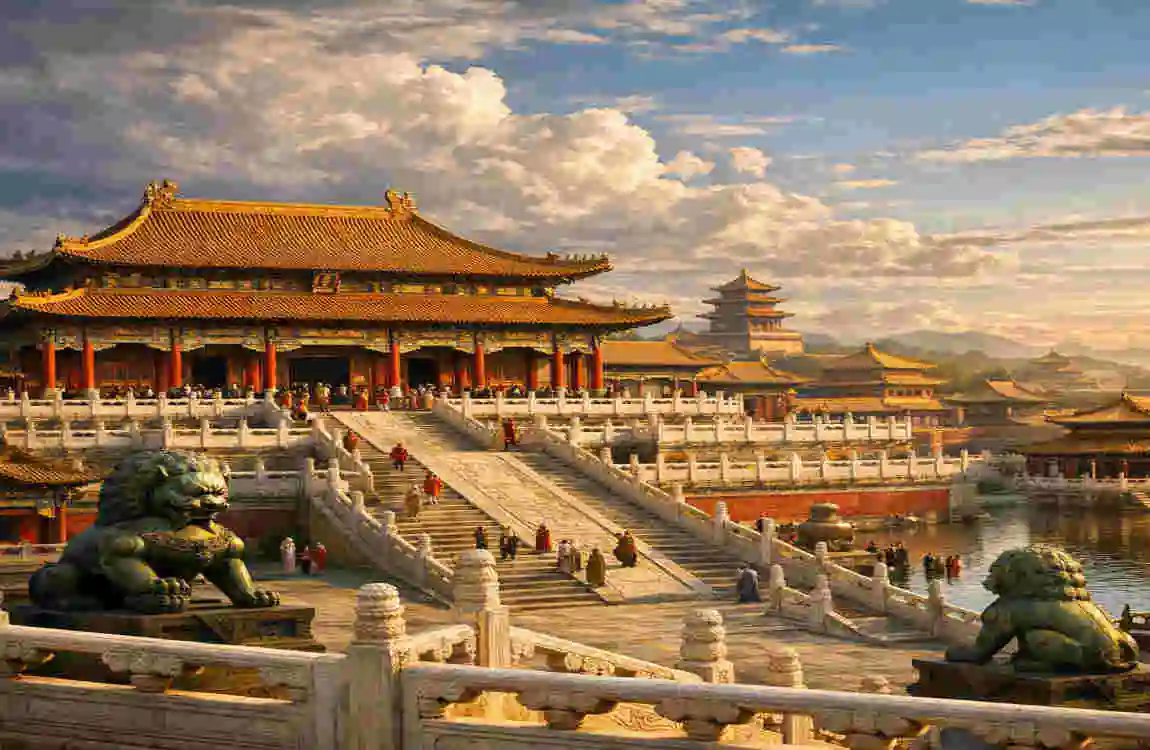
Built during the Ming Dynasty and later used by the Qing emperors, the Forbidden city is one of the greatest palace complexes in the world. It covers roughly 180 acres and contains hundreds of buildings. Tradition famously says it had 9,999 rooms, a number close to the symbolic perfection associated with heaven.
But what makes the Forbidden city so important is not just its size. It gathers many of the most defining features of Chinese architecture into one place.
First, there is symmetry. The main buildings are arranged along a strong north-south axis. This central line organises the whole complex and gives it visual and symbolic stability.
Second, there is a hierarchy. The most important halls stand on high platforms and occupy the central route. Lesser buildings sit around them in careful relation. Architecture tells you who matters, where power sits, and how ceremony should unfold.
Third, there is colour symbolism. The red walls and pillars represent luck, vitality, and authority. The yellow glazed roof tiles were strongly associated with the emperor. Even colour became part of political meaning.
Fourth, there is the remarkable dougong bracket system. These interlocking wooden brackets sit between the columns and the roof. They help distribute weight and support the wide eaves that are so characteristic of Chinese buildings. They also provide flexibility, which helps many wooden structures better handle movement and even earthquakes.
This is a major reason Chinese timber architecture lasted so long as a tradition. Builders were not simply placing beams on posts. They were using a highly developed structural logic that combined strength, grace, and adaptability.
Other Famous Palaces Worth Knowing
While the Forbidden city often gets the most attention, it is far from the only palace that matters in the story of traditional Chinese palaces.
The Summer Palace in Beijing offers a different expression of imperial design. It combines palaces, pavilions, lakes, bridges, and gardens in a more relaxed setting. Instead of emphasising only central political power, it also highlights leisure, scenery, and harmony with the landscape. It reminds you that Chinese architecture is not only about strict formality. It can also be poetic and deeply connected to natural beauty.
The Potala Palace, though shaped by Tibetan influence, is another important example in the broader world of Chinese architecture. Rising dramatically over the landscape, it shows how regional styles and religious traditions blended with imperial identity. It has a distinct visual character from Beijing palaces. Yet, it still conveys ideas of sacred power, hierarchy, and symbolic placement.
Why Palace Architecture Still Matters
Palace architecture matters because it reveals the deepest values of the society that built it. When you study these complexes, you are not just looking at old buildings. You are looking at a system of thought made visible.
Chinese palaces teach us that architecture can:
- Express political power
- Organise social life
- Reflect moral and cosmic ideas
- Shape how people move, behave, and feel
So if you are still asking what Chinese architecture is, the palaces offer a powerful answer: it is architecture that turns order into space.
And yet Chinese architecture is not only horizontal, enclosed, and court-centred. It also reaches upward. That is where pagodas enter the story.
Majestic Pagodas: Towers of Enlightenment
Among the most iconic structures in China, the pagoda stands out immediately. Tall, layered, and elegant, the pagoda is one of the most recognisable symbols of East Asian architecture. It carries religious meaning, technical skill, and visual beauty all at once.
What Makes Chinese Pagodas Unique?
The pagoda did not begin in China. Its earliest roots lie in the Indian stupa, a Buddhist monument used to hold sacred relics. As Buddhism spread into China, local builders adapted this form to Chinese tastes, materials, and construction methods. Over time, the stupa evolved into the distinctly Chinese pagoda.
One early and important example is the White Horse Temple area, linked to the arrival of Buddhism in China around 68 AD. As Buddhist architecture developed, Chinese builders transformed the simple mound-like stupa into a vertical tower with multiple levels.
This change was significant. It reflected both religious purpose and local architectural habits. Chinese builders already had experience with wooden towers and multi-level structures. Hence, the pagoda became a natural meeting point between imported belief and native design.
A typical Chinese pagoda often includes:
- Multiple stories
- Curved eaves
- A strong vertical form
- An odd number of levels, often linked with yang energy and auspicious symbolism
- A religious role, such as holding relics or serving as a place of devotion
These buildings were both practical and symbolic. Their height made them visible from a distance. Their form drew the eye upward, suggesting spiritual aspiration or a path toward enlightenment.
Famous Chinese Pagodas to Know
When people search for famous Chinese pagodas, a few names appear again and again, and for good reason.
The Giant Wild Goose Pagoda in Xi’an is one of the most celebrated. Built during the Tang Dynasty, it was used to store Buddhist scriptures brought from India. It’s simple, solid form reflects both beauty and function. It has also survived earthquakes and long stretches of history, which makes it a powerful example of Chinese engineering.
The Porcelain Pagoda of Nanjing became legendary for a different reason. Covered in white-glazed bricks and colourful details, it was once considered one of the most beautiful buildings in the world. Though the original structure was destroyed, its memory remains strong because it showed just how decorative and refined pagoda architecture could become.
Even modern architecture sometimes draws on the pagoda form. While it is not a pagoda in the religious sense, some contemporary towers in China use tiered shapes, upward movement, and symbolic height in ways that echo this tradition. This shows how old ideas continue to inspire new building design.
Engineering and Symbolism in Pagoda Design
Pagodas are not only beautiful. They are also smart pieces of engineering.
The curved eaves help direct rainwater away from the structure. The layered design spreads weight and creates stability. In some cases, central columns or carefully balanced frameworks helped pagodas remain standing through natural stress.
But engineering is only part of the story. In Chinese architecture, form often carries meaning. A pagoda’s height can symbolise closeness to the divine. Its repeated levels can suggest spiritual progress. Its location may reflect Feng Shui principles or religious geography.
In this way, the pagoda helps answer the question of what Chinese architecture is from another angle. It shows that Chinese architecture is not limited to homes or palaces. It also includes sacred forms designed to inspire, protect, and connect the human world with something greater.
Next, we turn to one of the most influential ideas behind many Chinese structures: Feng Shui.
Feng Shui Wonders: Harmony with Nature
You cannot fully answer what Chinese architecture is without talking about Feng Shui. This idea has shaped homes, tombs, gardens, cities, and major monuments for centuries. To some people, Feng Shui may sound mysterious. Still, its basic purpose is actually quite practical and human: it seeks balance between people and their environment.
Core Principles of Feng Shui in Chinese Architecture
The phrase Feng Shui is often translated as “wind and water.” At its core, it is a system for understanding how energy (qi) moves through space. The goal is to place buildings, rooms, doors, and pathways in ways that support health, harmony, and good fortune.
Several key ideas guide Feng Shui in architecture.
The first is qi flow. A site should allow energy to move smoothly, not become blocked or rushed. This affects everything from the placement of a gate to the shape of a garden path.
The second is the balance of the five elements:
- Wood
- Fire
- Earth
- Metal
- Water
These elements are not just physical materials. They represent qualities, relationships, and cycles of change. Good design seeks balance among them.
The third is orientation. Traditional buildings often face south, which brings better sunlight and warmth in many parts of China. In Feng Shui, orientation also has symbolic importance.
The fourth is landform—mountains, hills, rivers, and open space matter deeply. Ideal sites were often described in terms of protective backing, open front space, and balanced side features. This is where ideas like dragon veins come in, referring to powerful lines of energy running through the landscape.
When used in architecture, these principles encourage builders to ask simple but important questions: Does the site feel sheltered? Does the building welcome light and airflow? Does the layout create a sense of calm or tension? Does it support the lives of the people inside?
Real-World Applications in Chinese Architecture
Feng Shui is not just a theory. It has shaped many famous places.
The planning of Beijing reflects Feng Shui and cosmic order in powerful ways. The city’s main axis, gate placement, and imperial centre were all part of a larger vision of balance and authority. The emperor, as the “Son of Heaven,” occupied the central place in a carefully ordered world.
The Great Wall is not usually the first example people think of when discussing Feng Shui. Still, some traditions connect defensive building and landscape placement to the control of harmful forces. Whether symbolic or strategic, the relation between construction and terrain is clear.
The classical gardens of Suzhou show Feng Shui at a more intimate level. Curved paths, framed views, ponds, rocks, and pavilions are arranged to guide movement and shape experience. These gardens do not force nature into straight lines. Instead, they create a carefully composed sense of natural flow.
Feng Shui Tips You Can Apply at Home
You do not need to build a palace or garden to use some Feng Shui ideas. Many people apply its basic principles in simple, practical ways. Here are a few easy examples:
- Keep your entry clear and welcoming.
- The main door is often seen as the place where energy enters the home.
- Let natural light in.
- Bright, fresh spaces usually feel better and function better.
- Avoid clutter.
- Too much clutter can make a room feel heavy and stressful.
- Place the bed in a stable position.
- Many Feng Shui traditions recommend placing your bed. Hence, you feel secure and can see the door without being directly in line with it.
- Use balance in furniture and décor.
- A room should not feel too empty or too crowded.
These ideas work because they are rooted in human experience. A calm, balanced space often supports a calm, balanced mind.
Why Feng Shui Still Matters Today
Modern design often emphasises wellness, sustainable planning, biophilic design, and human-centred spaces. In many ways, Feng Shui has been exploring similar concerns for centuries, just in a different language.
This is why Feng Shui in Chinese architecture continues to matter. It reminds us that buildings are not just technical objects. They influence mood, movement, relationships, and daily life.
So when you ask what Chinese architecture is, Feng Shui gives you one of the clearest answers: architecture that seeks harmony between human beings and the living world around them.
Modern Evolution and Global Influence
Chinese architecture is ancient, but it is not frozen in the past. It continues to evolve. Modern China has produced buildings that look very different from old palaces and pagodas. Yet, many still carry traditional ideas in new forms.
20th-21st Century Shifts
In the early modern period, Chinese architecture began to blend traditional styles with Western planning and construction methods. Buildings from the Republican era often blended classical Chinese roofs or decorative features with new materials and more modern layouts.
The Sun Yat-sen Mausoleum is one example of this hybrid spirit. It feels monumental and modern, yet still draws on Chinese symbolic planning and ceremonial procession.
Later, the Communist period introduced another shift. Architecture often emphasised collective identity, state power, and modern urban growth. Large public buildings, housing blocks, and civic squares changed the visual landscape of Chinese cities.
In recent decades, China has also become known for bold contemporary projects. Buildings like the CCTV Headquarters in Beijing show how Chinese cities now engage with global architectural trends while developing their own urban identity.
Chinese Architecture Today
Modern Chinese architecture is incredibly diverse. In one city, you may see a glass tower, a restored temple, a traditional courtyard home, and a futuristic museum all within the same area.
What makes this exciting is the way many designers now return to older ideas with fresh eyes. They may use:
- Courtyard layouts for light and community
- Screening elements inspired by traditional latticework
- Rooflines that echo historic forms
- Sustainable planning that reflects older ideas of climate response and harmony with nature
The Bird’s Nest Stadium from the Beijing Olympics is a good example of modern symbolism and engineering working together. It is not “traditional” in appearance. Yet, it reflects the Chinese interest in strong visual meaning, structural expression, and public identity.
Global Spread of Chinese Architectural Ideas
Chinese architecture has also travelled far beyond China itself. You can see its influence in Chinatowns, diaspora temples, garden design, and even luxury architecture that borrows from Chinese motifs.
Traditional Chinese courtyard ideas have influenced modern home design. Feng Shui is discussed in interior design circles worldwide. Pagoda-inspired forms have shaped buildings across Asia and beyond.
This global reach proves something important: the answer to what Chinese architecture is not limited to the past. It is also a living source of inspiration.
The Future: Eco-Feng Shui and Smart Cities
Looking ahead, Chinese architecture may become even more interesting. As cities face climate challenges and growing populations, designers are finding value in traditional wisdom. Ideas such as orientation, airflow, shade, water management, and harmony with the landscape are more relevant than ever.
You might think of this future as a kind of eco-Feng Shui—using old principles of balance and placement together with new technology, green materials, and smart urban systems.
In that sense, Chinese architecture is not only preserving heritage. It is helping shape what the future of building could look like.