you are looking around your home, desperately trying to figure out how to squeeze more functionality into a tight, underutilized space. You may have a growing family fighting over mirror time every morning, or you frequently host overnight guests who are forced to trek down the hall in their pajamas. You know you need an extra bathroom, but you do not have the square footage for a massive, spa-like retreat complete with a freestanding bathtub.
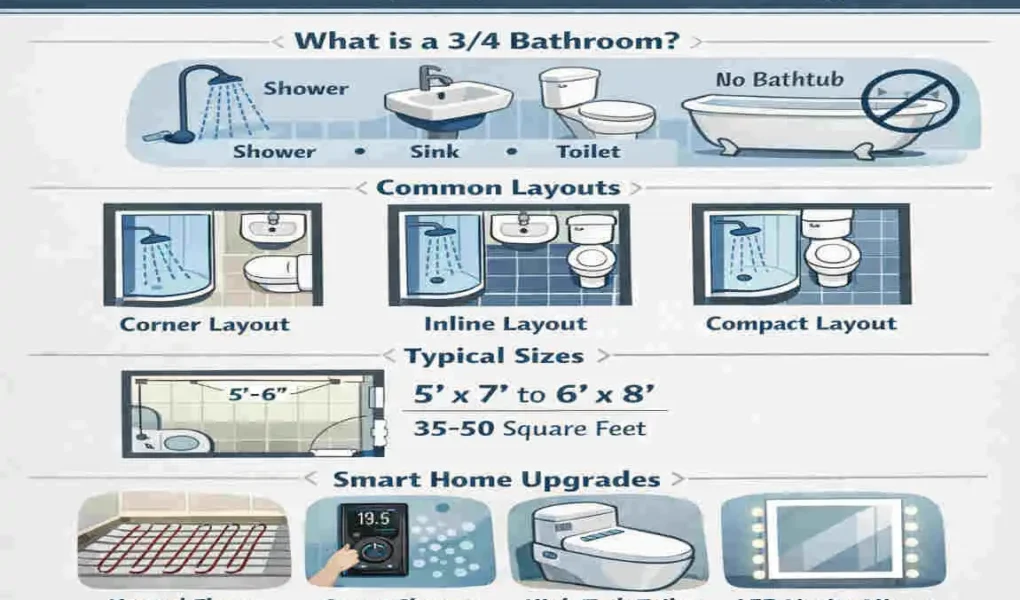
If you are wondering what a 3/4 bathroom is, the definition is surprisingly simple. A 3/4 bathroom is a compact, highly functional washroom that features exactly three plumbing fixtures: a toilet, a sink, and a shower. Notice what is missing? There is no bathtub. By ditching the bulky tub, you instantly save a massive amount of floor space while still providing everything a person needs to get clean and ready for the day.
| Term | Fixture(s) included | What it usually lacks | Typical use case |
|---|---|---|---|
| Full bathroom | Toilet, sink, shower, plus bathtub | Nothing missing | Master or main bathroom |
| 3/4 bathroom | Toilet, sink, shower only (most common) | Bathtub | Guest bath, small home, basement, or secondary bathroom |
| 3/4 bathroom (variant) | Toilet, sink, bathtub only (no shower) | Standing shower | Less common; sometimes in older homes |
| Half bathroom | Toilet + sink only | No shower or bathtub | Powder room / downstairs guest bath |
Core Definition: Breaking Down the 3/4 Bath
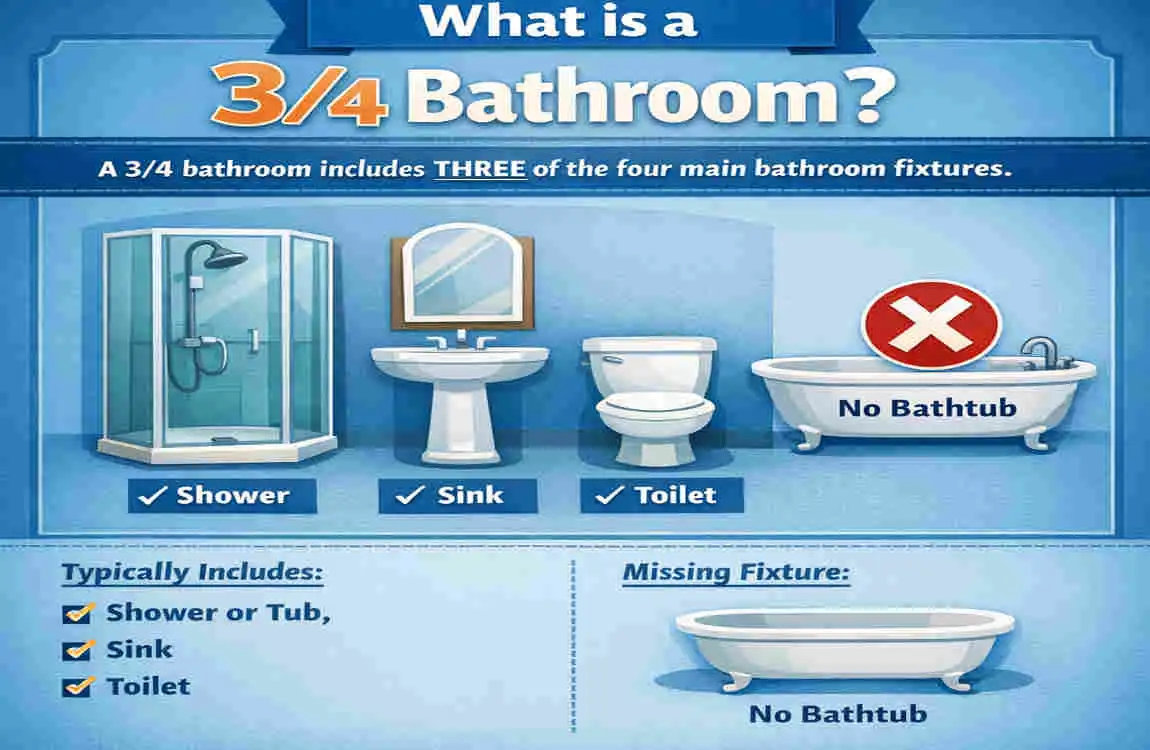
To truly understand what makes a 3/4 bathroom so special, we need to look closely at its core DNA. As we mentioned, this room is defined by its three primary fixtures. Let’s break them down.
The Essential Fixtures
First, you have the toilet. This is a non-negotiable staple of any bathroom space. Second, you have the sink. In smaller 3/4 baths, you will often see space-saving variations like a pedestal sink or a sleek, wall-mounted floating vanity. Finally, you have the shower. This is usually a walk-in shower or a standing shower stall. Because there is no bathtub taking up a massive footprint, the shower can sometimes be more luxurious, featuring glass doors and beautiful custom tile work.
Contrasting Bathroom Types
To put this into perspective, let’s contrast the 3/4 bath with its siblings:
- The Half Bath (Powder Room): This room only has two fixtures—a toilet and a sink. It is perfect for quick guest visits but useless if someone needs to wash up.
- The Full Bath: This traditional setup features four fixtures—a toilet, a sink, a shower, and a bathtub (often combined). It is luxurious but requires significant square footage.
The 3/4 bath sits perfectly in the middle. It offers the practical hygiene benefits of a full bath without demanding the real estate of a bathtub.
A Brief History
You might think the 3/4 bathroom is a modern invention, but it actually has a rich history. These layouts became incredibly popular in mid-century homes built during the post-war housing boom. Families needed more amenities, but houses were relatively small. Builders began tucking these efficient spaces into master bedrooms to create “ensuites.” They also became the go-to solution for finished basements and upgraded powder rooms.
Pros and Cons
Like any home design choice, the 3/4 bathroom comes with distinct advantages and disadvantages.
The Pros:
- Highly Efficient Plumbing: Because the fixtures are grouped closely together, running the plumbing lines is usually straightforward and cost-effective.
- Guest-Friendly: Visitors have total privacy to shower and get ready without invading your primary bathroom.
- Space Maximization: You can fit a 3/4 bath into spaces where a full bath cannot go.
The Cons:
- Less Soaking Luxury: If you are someone who loves a long, hot bubble bath after a stressful day, this room will not scratch that itch.
- Tougher for Toddlers: Bathing infants and toddlers is generally much easier in a traditional tub than in a standing shower.
Standard Sizes: How Small Can You Go?
One of the most common questions homeowners ask is, “Do I actually have enough room for a 3/4 bathroom?” The answer is almost always yes. Because you are omitting the bathtub, the footprint shrinks dramatically.
Here is a helpful breakdown of common 3/4 bathroom sizes:
Common 3/4 Bath Sizes
Size Category Dimensions Square Footage Best Used For
Minimum 5 x 6 feet 30 sq. ft. Tight basement corners, closet conversions
Comfortable 5 x 8 feet 40 sq. ft. Standard guest baths, small master ensuites
Spacious 6 x 8 feet+ 45+ sq. ft. Family use, accessible bathrooms
Understanding Building Codes
Before you start knocking down walls, you absolutely must consider local building codes. These rules keep you safe and ensure the space is actually usable.
- Shower Minimums: Most building codes require a shower stall to be at least 30 x 30 inches. However, if you want to avoid feeling like you are showering in a phone booth, we highly recommend aiming for at least 36 x 36 inches.
- Toilet Clearances: Your toilet needs room to breathe. The standard code requires at least 15 inches of clearance from the center of the toilet to any side wall or fixture, and a minimum of 21 inches of clear space in front of it.
Crucial Layout Factors
When dealing with small square footage, every single inch matters. You need to think about the door swing. If a traditional door swings inward, it might hit the vanity or block the toilet. Pro Tip: install a pocket door or an outward-swinging door to reclaim precious interior space instantly.
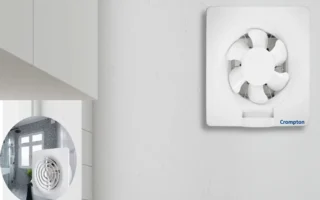
Ventilation is another massive factor. Showers generate a lot of steam. Without proper ventilation, that steam turns into mold and mildew. If you do not have an operable window, investing in a high-quality, perfectly sized exhaust fan is mandatory.
Finally, if you want to save serious money during construction, try to locate your new 3/4 bath near an existing plumbing stack. Tying into the existing water and waste lines—rather than running completely new pipes across the house—will keep your budget happy. Just as an experienced professional maps out the exact scope of a project to ensure successful delivery , mapping your new bathroom against your home’s existing plumbing infrastructure is the smartest way to plan.
Popular Layouts for 3/4 Bathrooms
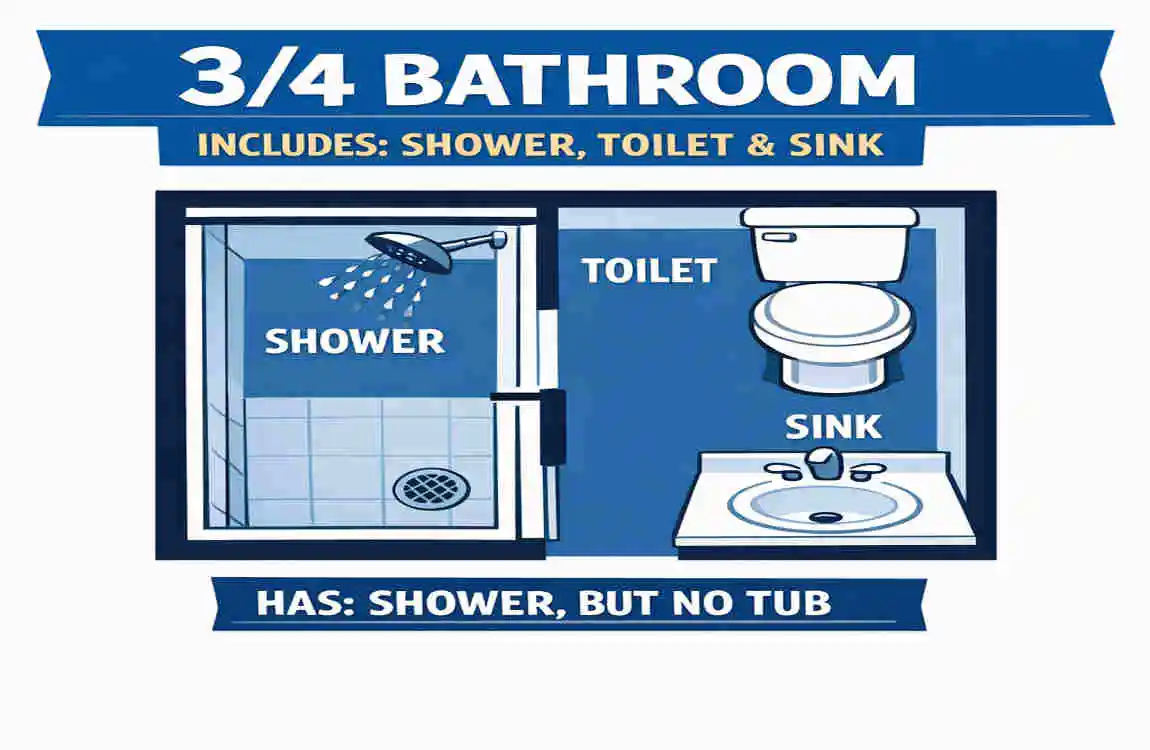
Designing a 3/4 bathroom requires an architectural puzzle. You have three specific pieces to fit into a confined space. Luckily, designers have perfected several layouts over the years. By carefully selecting the right floor plan, you can make a 30-square-foot room feel surprisingly airy.
The Linear Layout
The Linear Layout is arguably the most popular and cost-effective design. In this setup, all three fixtures—the sink, the toilet, and the shower—are lined up along a single wall.
Why is this so great? Because all the water supply lines and drainage pipes share one wall, drastically reducing plumbing labor costs. This layout is absolutely ideal for the classic 5×8 foot room. Typically, you place the sink nearest to the door, the toilet in the middle, and the shower tucked at the far end of the room.
The Corner Layout
If you are dealing with a truly square room—say, 6×6 feet—the Corner Layout is your best friend. In this design, a specialized corner shower stall (often featuring a curved glass front) takes up one corner. The toilet and sink are placed on the adjacent walls.
This brilliant layout can save up to 20% of your usable floor space. It opens up the center of the room, giving you plenty of room to dry off and get dressed without banging your elbows against the walls.
The Galley Layout
Inspired by the cramped but highly efficient kitchens found on ships, the Galley Layout places fixtures on opposite, parallel walls. For example, you might have the vanity and toilet on the left wall, with a long, narrow walk-in shower running along the entire right wall.
This design works wonders for long, narrow rooms. It creates a clear, central walkway that draws the eye toward the back wall, making the room feel longer and more spacious than it actually is.
The Split Layout
For larger families or shared guest spaces, the Split Layout offers the ultimate luxury: privacy. This design uses a pocket door or a partition wall to separate the vanity area from the toilet and shower area.
This means one person can be brushing their teeth or doing their makeup at the sink while another person is showering in complete privacy. It doubles the functionality of the room.
Expert Design Tips to Maximize Space
When you are working with less than 50 square feet, smart design choices make all the difference between a claustrophobic closet and a stunning, functional oasis. Here is how the pros make small 3/4 bathrooms look incredible.
Maximizing the Physical Space
The goal is to keep the floor as visible as possible. The more floor you see, the bigger the room feels.
- Floating Vanities: Instead of a bulky cabinet that sits on the floor, install a wall-mounted floating vanity. It provides the storage you need while creating an illusion of open space underneath.
- Niche Storage: Do not let shelves eat into your room. Build recessed wall niches into your shower and above your vanity to hold shampoo, soap, and decor.
- Frameless Shower Glass: Ditch the heavy shower curtains and thick metal frames. A clear, frameless glass shower enclosure allows the eye to travel all the way to the back wall, making the room feel significantly larger.
Choosing the Right Style
Your aesthetic choices heavily impact the room’s vibe.
- The Modern Look: If you love contemporary design, consider incorporating matte black fixtures against neutral tiles. It provides a sharp, sophisticated contrast that looks highly expensive.
- The Minimalist Approach: You cannot go wrong with clean, bright white. Using classic white subway tile with light gray grout reflects light beautifully, making tight spaces feel bright and expansive.
Perfecting Lighting and Ventilation
A dark room feels like a small room. Because 3/4 bathrooms often lack large windows, artificial lighting is crucial. Use recessed LED lights in the ceiling to provide even, bright illumination without cluttering the visual headspace. Add sconces on either side of the mirror to eliminate harsh shadows on your face.
Pair your lighting with a high-quality, whisper-quiet exhaust fan to keep the air fresh and protect your beautiful new drywall from moisture damage.
Prioritizing Accessibility
As you design, consider making the space safe and accessible for everyone. A zero-threshold shower (where the bathroom floor flows seamlessly into the shower floor without a lip) looks incredibly sleek and prevents tripping hazards. Adding stylish, modern grab bars ensures the space is safe for aging family members or guests with mobility issues. For more specific accessibility standards, you can always consult the NKBA (National Kitchen and Bath Association) guidelines.
Cost Breakdown: What to Expect in 2026
Let’s talk numbers. Planning a home renovation requires understanding exactly where your money is going. While costs fluctuate based on your location and the materials you choose, we have compiled the average 2026 US costs for a standard 3/4 bathroom remodel.
3/4 Bath Costs (2026 US Average)
Project Component Low-End Estimate High-End Estimate
Demolition & Plumbing $2,000 $5,000
Materials & Fixtures $3,000 $8,000
Labor & Finishing $5,000 $12,000
Total Estimated Cost $10,000 $25,000
Understanding the Return on Investment (ROI)
While spending $10,000 to $25,000 might seem daunting, it is important to view this as a strategic investment in your property. Adding a functional 3/4 bathroom to a home that desperately needs one can yield a fantastic Return on Investment (ROI).
On average, homeowners recoup between 50% to 70% of the project cost when they sell their home. Effective content writing in real estate listings often highlights these brand-new, modern bathrooms, directing potential buyers’ attention to the home’s increased functionality and value .
Tips to Protect Your Budget
If you want to keep costs closer to the low-end estimate, stick to mid-range materials. You do not need imported Italian marble to create a beautiful space. High-quality porcelain tiles that mimic the look of natural stone are incredibly durable and much more affordable. Additionally, avoid moving the main plumbing lines if you can help it; rearranging the layout drastically inflates your plumbing and demolition costs.
Smart Upgrades for a High-Tech Haven
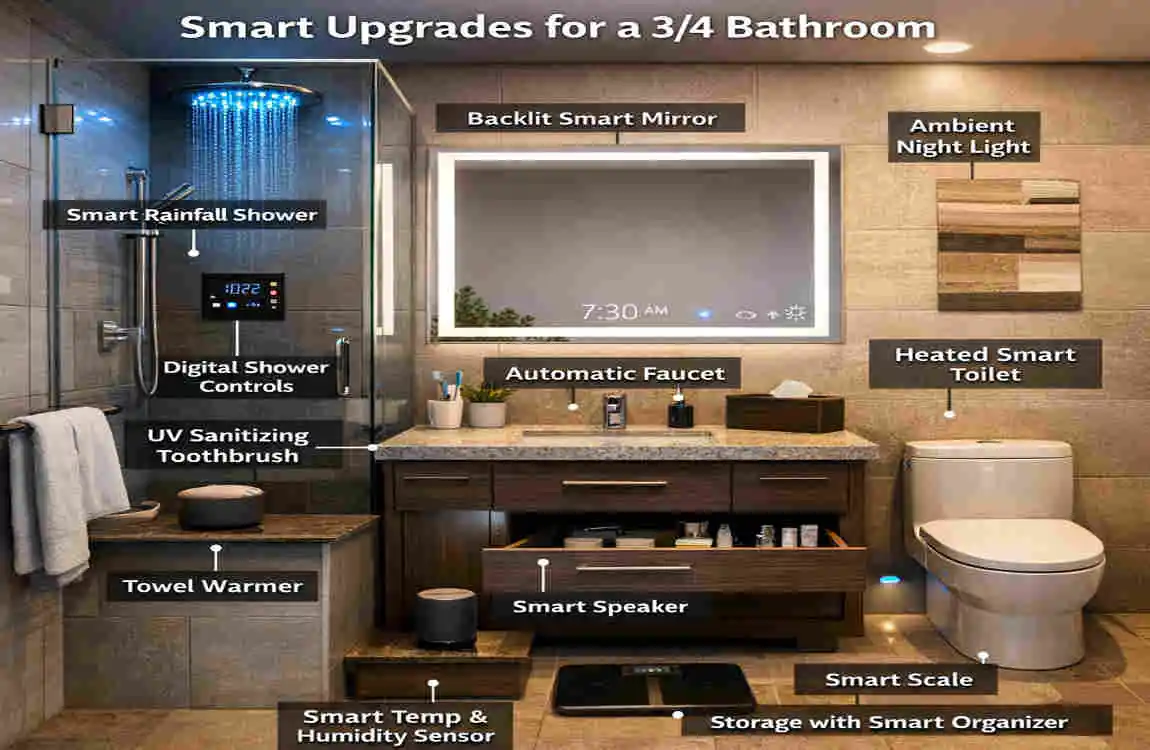
We are living in the future, and your bathroom should reflect that. Integrating smart technology into your 3/4 bathroom not only adds a “wow” factor but actually improves efficiency and comfort.
The Voice-Activated Shower
Imagine waking up on a freezing winter morning and simply saying, “Alexa, start my shower at 102 degrees.” Voice-controlled smart showers allow you to set precise temperatures, control the flow rate, and even pause the water while you lather up. You control everything via a smartphone app or a smart home assistant. It is pure luxury and helps you save water.
The Ultimate Smart Mirror
Forget about wiping condensation off the glass with a towel. Modern smart mirrors feature built-in defogging pads so they stay crystal clear even after the hottest shower. But that is just the beginning. Many feature hidden LED displays that show you the morning news, the weather forecast, and your daily calendar. They even include Bluetooth speakers so you can listen to your favorite podcasts while you get ready.
Intelligent Lighting
Lighting sets the mood. By installing motion-sensor LED lighting, your bathroom will automatically illuminate with a soft, gentle glow when you walk in for a midnight bathroom break—no more blinding overhead lights. You can also install color-changing LEDs in the shower niche to create different moods, from energizing morning blue to relaxing evening amber.
The Next-Generation Toilet
Smart toilets are rapidly becoming a staple in modern renovations. Features include heated bidet seats, automatic open-and-close lids, self-cleaning UV light cycles, and auto-flush technology. They offer a superior hygiene experience while saving paper.
Seamless Integration
The true magic happens when you connect all these devices to a central smart hub. By automating your lighting, water heating, and exhaust fans, you can achieve up to 20% water and energy savings annually.
Expert Insight: “Integrating smart tech during a remodel is the best way to future-proof your bathrooms. It adds tremendous value and makes daily routines effortless.” — Master Plumbing Professional
Installation Steps: The Remodeling Process
Curious about how an empty corner actually transforms into a working bathroom? Here is a simple, step-by-step breakdown of the installation process.
- Plan and Plumb: The most critical step. You must map out the floor plan, secure the necessary building permits from your local city council, and run the rough plumbing lines for the water supply and drainage.
- Demolition: Out with the old. Contractors will tear down existing drywall, remove old flooring, and strip the space down to the bare wooden studs.
- Framing and Wetwall Installation: Next, the walls are framed to the new dimensions. Moisture-resistant drywall (often called green board) and specialized cement backer board are installed in the shower area to completely waterproof the room.
- Fixture Installation: The heavy lifting begins. The shower pan is set, the floor and walls are tiled, and the vanity cabinet and toilet are locked into place.
- The Final Finish: The exciting part! The walls are painted, the mirrors are hung, the light fixtures are wired, and the glass shower door is carefully mounted.
Timeline Expectations: For a standard 3/4 bathroom remodel, you can expect a professional crew to finish the job in roughly 5 to 10 days, assuming all permits are cleared and materials are readily available on site.
Maintenance Guide: Keeping It Pristine
Once your beautiful new bathroom is finished, you want to keep it looking brand new. Because a 3/4 bath is compact, moisture can build up quickly if you are not careful.
- Weekly Cleaning: Make it a habit to clean your tile grout weekly. Use a mild, pH-neutral cleaner to prevent mold spores from taking root. Use a squeegee on your frameless glass shower doors after every single use to prevent hard water stains.
- Descaling: Every few months, descale your shower heads and sink aerators by soaking them in white vinegar. This removes mineral buildup and keeps your water pressure strong.
- Leak Prevention: Take advantage of technology by placing small, battery-operated smart water sensors near the base of your toilet and under your vanity sink. If they detect even a drop of leaking water, they will send an immediate alert to your phone, saving you from catastrophic water damage.
Frequently Asked Questions (FAQs)
Still have a few lingering questions? We have got you covered. Here are the most common questions homeowners ask about 3/4 bathrooms.
What is a 3/4 bathroom exactly?
A 3/4 bathroom is a specific type of restroom that features exactly three plumbing fixtures. Typically, this includes a toilet, a sink, and a standalone shower. It does not include a bathtub.
What is the absolute minimum size for this layout?
According to most building codes and practical design standards, the absolute minimum size is 30 square feet (usually measuring 5×6 feet). Anything smaller than this, and you will not have enough physical clearance to safely use the toilet or shower.
Can I add a bathtub later?
Yes, but it requires a significant remodel. If you have the adjoining square footage to expand the walls, you can upgrade a 3/4 bath into a full bath by tearing out the standalone shower and plumbing in a standard shower/tub combo.
What is the cost to build one in Pakistan?
If you are reading this from overseas, costs vary by region. For example, if you are looking to build or remodel a high-quality 3/4 bathroom in Lahore, Pakistan, you can expect to spend approximately PKR 2,000,000 to PKR 5,000,000, depending heavily on the luxury level of the imported tiles and sanitary fittings you choose.
Do I really need a permit for a small bathroom?
Yes. Anytime you are adding new plumbing lines, moving electrical wiring, or altering the structural footprint of a home, your local municipality will require a permit and an inspection to ensure the work is safe and up to code.