Stand under the open oculus of the Pantheon and look up. Daylight pours through a perfect circle, gliding across coffered panels as the hours pass. You feel both tiny and timeless. Now step into the Colosseum, and imagine the roar of 50,000 voices rising like a wave. These places don’t just stand—they speak. And they force us to ask a simple, powerful question: what influenced the Roman architecture that still shapes our cities and imaginations today?
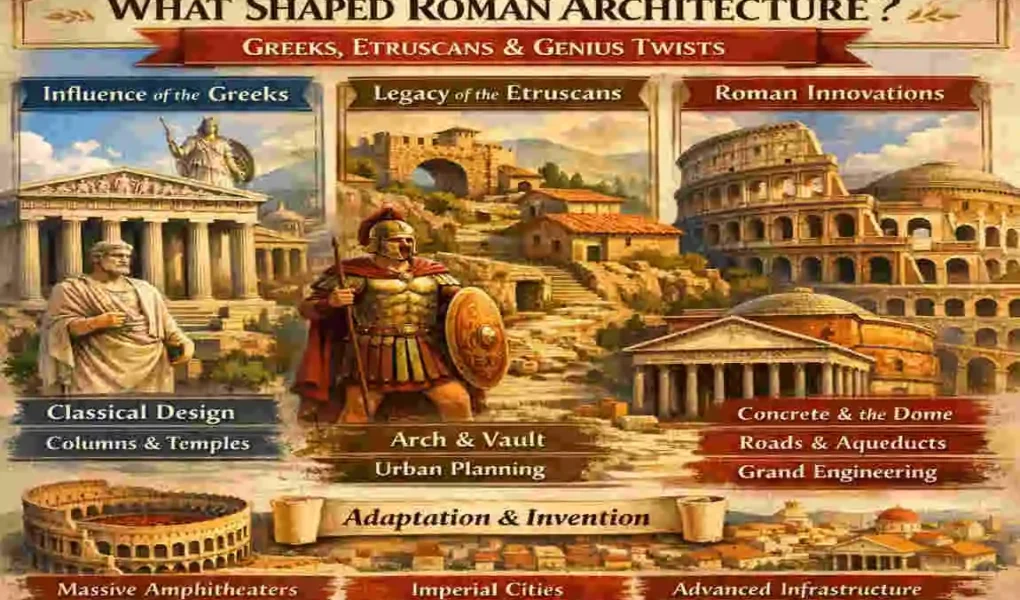
The Romans didn’t invent beauty from scratch. They learned, borrowed, and then boldly improved. The Greeks handed them a classical blueprint of proportions, column orders, and sculptural clarity. The Etruscans passed down arches, vaults, podium temples, and city planning—the practical tools to build for real life. Then the Romans added their genius twist, inventing concrete, perfecting domes and vaults, and mastering infrastructure on a continental scale.
Historical: Roots of Roman Architectural Influence
Rome’s origin story and its first building need
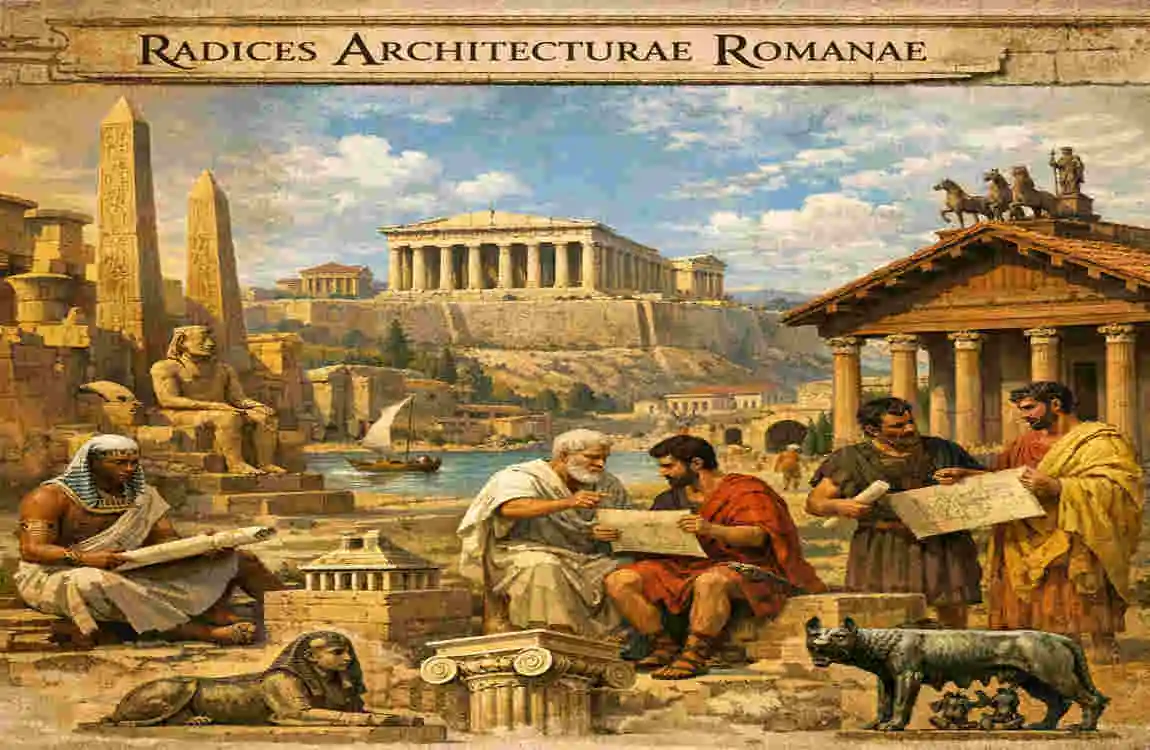
Rome’s traditional founding date is 753 BCE. It began as a cluster of hilltop settlements along the Tiber River—an ideal position between the Latin-speaking communities to the south and the Etruscans to the north. From its earliest days, Rome was a social and commercial crossroads. That geography matters. It meant constant exchange: of goods, beliefs, and yes, building ideas.
Early Romans needed temples, homes, and defensive works more than eye-catching monuments. Wood, mudbrick, and local stone dominated. But with the rise of kings (and later the Republic), public projects appeared: walls, drains, and sanctuaries. The everyday needs of a growing city nudged architecture toward both function and form.
A quick timeline for clarity
- Kingdom (753–509 BCE): Foundations, Etruscan contact, early temples and walls.
- Republic (509–27 BCE): Conquest, urban growth, and the spread of Greek cultural prestige in Italy.
- Empire (27 BCE–476 CE in the West): Monumental scale, concrete revolution, imperial image-building.
This timeline helps answer which factors influenced Roman architecture at each phase. In the Kingdom, Etruscan neighbors shaped techniques and planning. In the Republic, Greek styles flooded in as Rome conquered the Mediterranean. In the Empire, Romans tied it all together and built big—really big.
The cultural crossroads effect
Because Rome sat where trade routes intersected and armies marched, it absorbed ideas quickly. Skilled artisans traveled. Spoils of war—statues, columns, even whole buildings—moved from Greek cities to Rome. Meanwhile, Etruscan practices filtered down through early kings and local builders. This constant blend trained Roman architects to be practical borrowers and fearless adapters. That habit—borrowing and improving—became their superpower.
Greek Influence on Roman Architecture: The Classical Blueprint
Why the Greeks mattered so much
Ask any Roman writer from the late Republic what influenced the Roman architecture they admired, and you’ll hear one refrain: Greece taught Rome what “beautiful” looked like. Through art, literature, and philosophy, Greek culture set the standard. Roman patrons wanted buildings that spoke the language of order, proportion, and harmony—and the Greek architectural toolkit delivered exactly that.
The orders of columns: Doric, Ionic, Corinthian
The Greeks systematized design through the column orders:
- Doric: stout, no base, plain capital—power and restraint.
- Ionic: slimmer, with a base and volutes—lively elegance.
- Corinthian: leafy capitals with acanthus—ornate splendor.
Romans adopted all three. Over time, they favored Corinthian and created the Composite order (a Roman blend of Ionic volutes and Corinthian foliage). You see this preference on the Pantheon’s portico, where soaring Corinthian columns set a ceremonial tone long before you enter the dome.
Proportions, symmetry, and the Vitruvian ideal
Roman architect-engineers like Vitruvius (1st century BCE) distilled Greek ideas into practical rules: symmetry, axial alignment, and modular ratios guided layouts from temples to basilicas. Compare the Greek Parthenon with the Roman Temple of Portunus (often called Temple of Fortuna Virilis): the Roman version keeps the classical vocabulary—columns, pediment, clear proportions—but shifts the plan to suit a denser, more urban context. It’s the Greek look with a Roman lifestyle.
From theaters to urban stages
Greek theaters hugged hillsides and celebrated performance in nature. Romans admired this, but their growing, flatter cities needed different solutions—result: freestanding stone theaters supported by complex substructures. The Theatre of Marcellus and the Theatre of Pompey are Roman answers to Greek inspiration—bigger, bolder, and easier to place in a crowded capital.
Sculpture and decoration at scale
Greeks perfected friezes, pediments, and sculptural programs that told myths and honored gods. Romans borrowed this toolkit but used it to shape public narratives: victories, emperors, law, and civic pride. They enlarged pediments, stacked colonnades, and multiplied decorative themes to suit massive facades and forums. Decoration didn’t just beautify; it advertised Rome’s story.
Side-by-side comparison table
Greek Feature Roman Adaptation Iconic Example
Doric Columns Simplified, bolder proportions in state projects, Parthenon (Greek) → Temple of Hercules Victor (Roman circular temple using classical grammar)
Ionic Elegance Used for refined civic spaces and porticos, Erechtheion (Greek) → Porticoes in the Forum of Augustus
Corinthian Flourish Preferred for grandeur; led to Composite order Temple of Olympian Zeus (Athens) → Pantheon portico.
Theatres in Hillsides: Freestanding theaters with substructures. Epidaurus (Greek) → Theatre of Pompey (Roman)
Post-and-Lintel Limits Combined with arches for wider spans, Greek stoas → Roman basilicas with arch-and-vault interiors
Narrative Friezes Expanded to imperial propaganda at monumental scale Parthenon frieze → Ara Pacis and triumphal arches
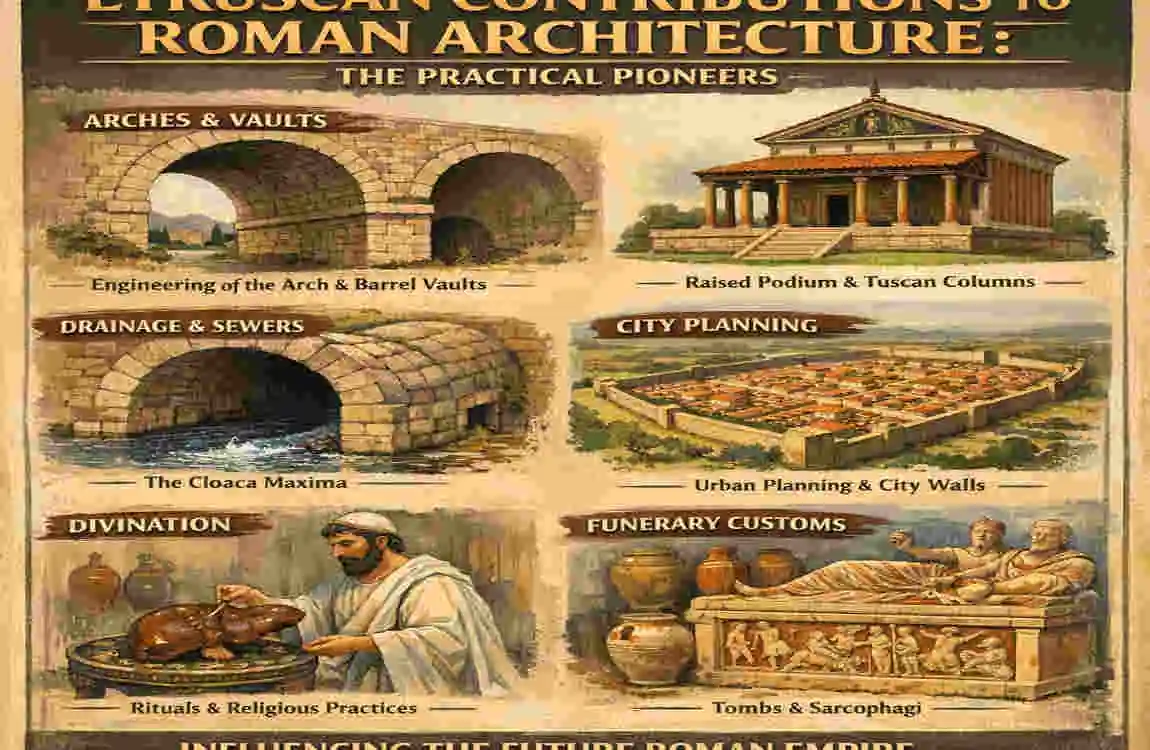
Etruscan Contributions to Roman Architecture: The Practical Pioneers
The often-overlooked origin
If the Greeks gave Rome a visual language, the Etruscans gave it a structural backbone. From the 8th to the 3rd centuries BCE, Etruscan cities in northern and central Italy developed techniques that the Romans quickly embraced. When you ask what influenced the Roman architecture beneath the marble, the Etruscan imprint is unmistakable.
Arches and vaults: unlocking space
Etruscan builders used the true arch, made of wedge-shaped stones (voussoirs) that press against each other and channel weight into supports. This single insight unlocked wider doorways, stronger gates, and covered spaces. The Romans learned fast. They refined stone cutting, multiplied arches into arcades, and extended them into barrel and groin vaults. From city gates to bridges and aqueducts, this was the quiet revolution.
- Key innovation: the voussoir arch enabled spans that were impossible with Greek post-and-lintel construction.
- Long-term result: arches became the skeleton of Roman cities—functional, repeatable, scalable.
City planning and defenses
Etruscan towns featured walls, gates, and organized streets. Rome’s early fortifications, like the Servian Wall, show Etruscan influence in planning and stonework. Etruscan priests even practiced augury and haruspicy—rituals that helped determine auspicious orientations for temples and cities. While the rituals faded over time, the idea that a city should be ordered and purposefully aligned stuck.
Temples on podiums: raising the sacred
Etruscan temples typically sat on high podiums, accessible by a frontal staircase. They often had deep porches and emphasized the front approach. Romans absorbed this podium tradition, and it became a hallmark of urban temples, which needed to stand out amid busy streets. The raised platform enhanced the procession, ceremony, and visibility—a practical way to make sacred architecture stand out in a crowded city.
Tombs, drainage, and early infrastructure
Etruscans built tumulus tombs—earthen mounds over stone chambers—that influenced later Roman burial monuments and memorials. They were also skilled in hydraulic engineering, laying out drains, culverts, and sewers. The famous Cloaca Maxima, Rome’s great drain, reflects this practical lineage. Before monumental facades, reliable water and waste management laid the groundwork for a healthy, expanding capital.
Roman Genius Twists: Innovations That Transformed Influences
The turning point: from borrowing to groundbreaking
By the late Republic and into the Empire, Rome didn’t just borrow; it also borrowed. It synthesized. This is where the answer to what influenced the Roman architecture becomes most exciting. Greek aesthetics and Etruscan engineering were starting points. Roman materials science, standardization, and logistical mastery turbocharged the mix, making buildings bigger, lighter, and longer-lasting.
Concrete (opus caementicium): the secret ingredient
Roman concrete changed everything. Made from lime, water, aggregate, and crucially, volcanic ash (pozzolana), it could set underwater, resist cracking, and be cast into almost any shape.
- Why it mattered:
- Freed designers from post-and-lintel limits.
- Enabled vast domes, vaults, and curved walls.
- Reduced dependence on massive cut stone, speeding construction.
- Case in point: the Pantheon’s dome, spanning about 43 meters. Its stepped aggregate (heavier at the base, lighter pumice near the crown) and hidden ribs make a stone-only version unthinkable. Imagine swapping concrete for marble blocks—the weight alone would doom the structure.
Domes and vaults: sculpting interior space
With concrete and the arch tradition, the Romans could span baths, basilicas, and rotundas with confidence.
- Barrel vaults: long, tunnel-like ceilings perfect for corridors and halls.
- Groin vaults: intersecting barrels that concentrate loads at four points, allowing windows between supports—great for large, airy spaces.
- Domes: pure geometry meeting clever mix design. From the Baths of Caracalla to the Pantheon, domes and vaults turned interiors into awe-inspiring volumes fit for imperial life.
Amphitheaters and basilicas: hybrid types for a new society
Greeks had theaters; Etruscans had strong substructures. Romans combined them into the amphitheater, a double-theater-in-the-round. The Colosseum stands as a masterclass in:
- Tiered arcades (stacked arches).
- Modular seating and circulation.
- Multi-material framing (stone piers, concrete cores, travertine exteriors).
The basilica—a rectangular hall with aisles—became the engine room of urban life: law courts, business, and administration all under one roof. Later, basilican planning templated early Christian churches, proving Roman architectural innovations had staying power beyond the empire.
Aqueducts and roads: infrastructure as architecture
Ask what influenced the Roman architecture of city life, and you’ll quickly land on infrastructure. Romans celebrated utility in stone:
- Aqueducts bridged valleys with multi-tiered arcades and fine-tuned gradients. They delivered water to baths, fountains, and homes, turning public hygiene and leisure into a civic right.
- Roads used layered construction—large stones, gravel, sand, and paving blocks—to create durable paths that shrugged off weather. Milestones, way stations, and bridges made long-distance travel routine.
These weren’t just engineering feats; they were design statements. The regular rhythm of arches, the careful siting of bridges, and the monumentality of termini all expressed a Roman belief: well-built things should also look ordered and grand.
Quick comparison list: who did what?
- Greek: aesthetic focus, elegant orders, proportional ideals.
- Etruscan: functional arches, podiums, city planning, and early hydraulic works.
- Roman: concrete revolution, domes and vaults at scale, integrated infrastructure.
Legacy: How These Influences Shape Modern Architecture
From revival to reinvention
The story doesn’t end in antiquity. Renaissance masters studied Roman ruins to rebuild a language of space and order—think St. Peter’s Basilica with its vast dome and crisp classical detailing. Later, Neoclassicism took Roman forms to the modern state: courthouses, capitol buildings, museums, and libraries echoed basilicas, porticos, and triumphal arches to project stability and civic virtue.
Even cutting-edge structures borrow Roman thinking. The logic of vaults, the clarity of ratios, and the idea that infrastructure can be beautiful all live on. Modern stadiums plan circulation like amphitheaters. Transit hubs channel crowds like basilicas. And concrete—continuously refined—still underpins the skylines of our biggest cities.
Bringing It Together: The Complete Answer
The clearest way to say it
When someone asks, “What influenced the Roman architecture we admire so much?” here’s the crisp answer:
- The Greeks gave Rome the visual grammar—orders, symmetry, and refined decoration.
- The Etruscans gave Rome the structural toolkit—arches, vaults, podiums, and planning know-how.
- The Romans combined both, then pushed further with concrete, domes, vaults, and imperial-scale infrastructure.
Why it still resonates
Roman architecture didn’t just build buildings. It built a way of thinking: that form and function can work together, that materials science can multiply possibilities, and that public life deserves monumental spaces. That idea is why Roman designs keep returning in new guises, century after century.
If you’re near a historic district or a major civic building, pause and look for the signs: a column order, a pediment, a vaulted hall, or a raised platform. You’re seeing a living tradition—Greeks and Etruscans whispering through Roman stone, across time, into our built world.
A Closer, Section-by-Section Deep Dive
To make this guide even more practical and enjoyable to read, let’s break down each pillar—Greek, Etruscan, and Roman innovations—with extra focus on how they worked in everyday design decisions. This helps translate big ideas into concrete visuals you can spot on your next walk through a historic city.
Greek Blueprint in Practice
- Facades: Look for a strong horizontal entablature resting on a column rhythm. The columns aren’t just supports; they’re visual beats in a musical measure.
- Proportions: Greeks and Romans often used module systems (like column diameters) to size everything else—door widths, intercolumniation, even stair risers.
- Details: The molding profiles—ovolo, cavetto, cyma recta—soften transitions between planes, catching light and shadow to animate facades.
Etruscan Practicalities on the Ground
- Gateways: An arched gate signals Etruscan DNA. Look for carefully cut wedge stones and a keystone at the crown.
- Temples: A deep porch set on a high podium with a single frontal staircase. This layout controls processions and focuses attention.
- Sites: Etruscan hills and valleys taught builders to negotiate terrain. Romans scaled up that lesson into terraces, substructures, and monumental staircases.
Roman Innovation at Work
- Materials: Concrete cores with brick or stone facings—beauty outside, muscle inside. This combo made repairs and modular construction easier.
- Interiors: Groin vaults funnel loads to corners, freeing wall space for windows and side aisles. That’s how basilicas felt open and bright.
- Systems: Everything connects—roads feed forums; aqueducts feed baths; baths, basilicas, and theaters feed daily urban life. It’s one integrated civic machine.
Practical Tips for Readers and Learners
How to “read” a classical building in minutes
- Start at the base: podium or no podium?
- Scan the supports: which order—Doric, Ionic, Corinthian, or Composite?
- Find the spans: flat lintels, arches, vaults, or domes?
- Trace circulation: how do crowds move? stairs, arcades, corridors?
- Sense the message: is this about piety (temple), law and business (basilica), spectacle (amphitheater), or everyday life (baths, markets)?
Quick glossary to anchor the concepts
- Order: a classical system combining column and entablature design.
- Arch: curved support of wedge-shaped stones or concrete.
- Vault: an extended arch; barrel is simple, groin is intersecting barrels.
- Podium: a raised platform under a building, often a temple.
- Concrete (opus caementicium): Roman mix of lime and volcanic ash bonded to aggregate.
FAQs
What influenced Roman architecture the most?
In simple terms: Greek aesthetics, Etruscan engineering, and Roman innovation. Greeks set the style with columns and proportions. Etruscans supplied arches, vaults, podium temples, and planning. Romans fused both and added concrete, domes, and mass infrastructure to build on an imperial scale.
How did Greek influence Roman architecture?
Greeks shaped the look and feel of architecture through Doric, Ionic, and Corinthian orders; symmetry; pediments; and sculptural friezes. Romans used these elements in temples, porticos, theaters, and public squares—often larger and more urban than their Greek models.
What Etruscan features shaped Roman architecture?
The Etruscans introduced the true arch and inspired vaults, podium-based temples, and organized town planning with walls and gates. They also influenced early drainage and sewer systems, which the Romans expanded dramatically.
What were the key Roman architectural innovations?
The headline breakthrough was concrete (opus caementicium). With it came domes, barrel and groin vaults, and vast interior spaces like baths and basilicas. Romans also excelled in aqueducts and roads, turning infrastructure into artful public architecture.
Why did Romans prefer Corinthian and Composite orders?
These orders conveyed grandeur and refinement. Their detailed capitals fit imperial messaging and looked impressive on large-scale facades, triumphal arches, and porticos.
How did Roman amphitheaters differ from Greek theaters?
Greek theaters were semicircular and built into hillsides. Roman amphitheaters were freestanding ovals, stacked with arcades and vaults to move crowds efficiently. They hosted gladiatorial games and mass spectacles, not just plays.
Does Roman architecture still influence modern buildings?
Yes. From domed capitols to vaulted train stations, from stadium circulation to civic porticos, Roman ideas of structure, order, and public space continue to guide contemporary design.