Dreaming of extra storage, a secure place for your car, or a dedicated home workshop without the headache of council red tape? You are not alone. In 2026, homeowners across the UK are increasingly looking to maximize their property’s potential without getting bogged down in the lengthy and often expensive planning application process. Whether you are a car enthusiast needing a double garage or a remote worker craving a garden office, the good news is that you have more freedom than you might think.
The burning question for most of us is straightforward: how big can a home garage be without planning permission? The answer lies in understanding “Permitted Development” (PD) rights. These are a set of statutory rights that grant homeowners implied planning permission to carry out certain building works—such as erecting a garage—without submitting a full application to the local authority.
However, “permitted” does not mean “unlimited.” There are specific, non-negotiable criteria regarding height, location, and garden coverage that you must meet to stay legal. In this comprehensive guide, we will walk you through the exact sizes, the critical 2026 rules, and the exceptions you need to know.
Detached Garages: Size Limits and Rules
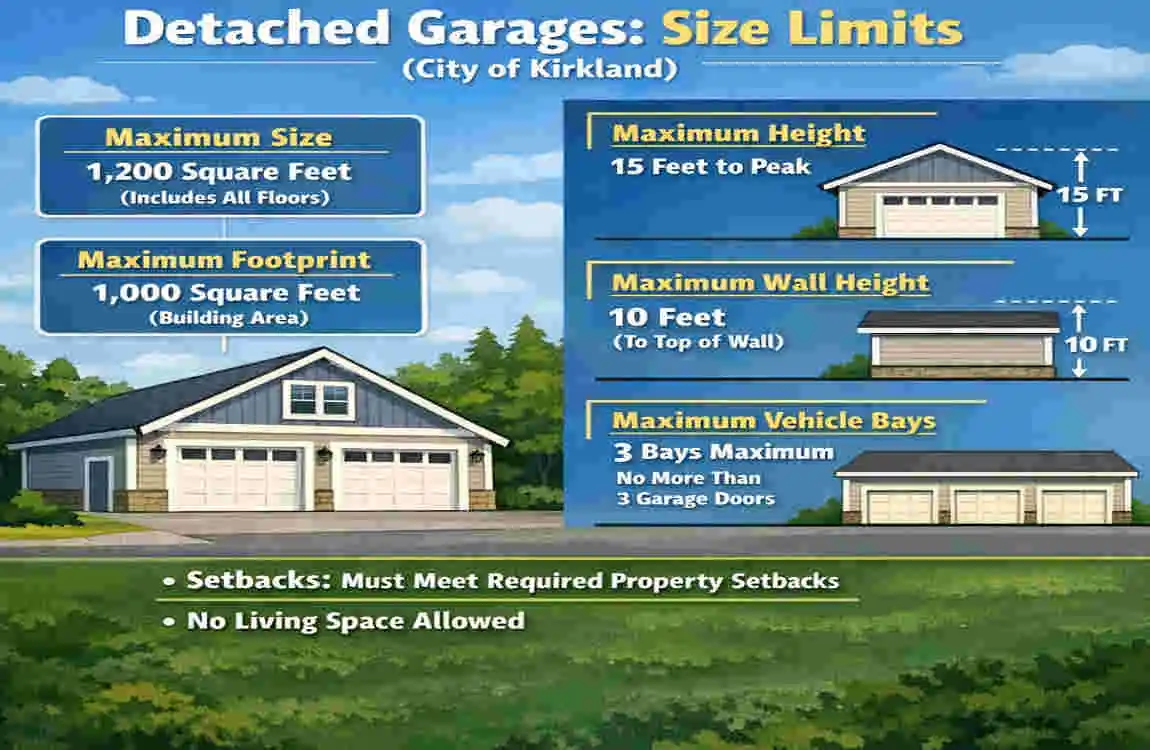
When we talk about building a garage without planning permission, we usually mean Class E of the Permitted Development rules. This class covers “outbuildings,” which include garages, sheds, greenhouses, and garden rooms. The most common misconception is that there is a strict limit on the garage’s floor area (footprint).
Surprisingly, there isn’t a single, fixed number like “30 square meters” that applies to everyone regarding planning permission (though that number is important for Building Regulations, which we will discuss later). Instead, the size is limited by a combination of height, proximity to boundaries, and how much of your garden you are covering.
Height Rules: The Critical Factor
The height of your detached garage is often the primary stumbling block for homeowners. To keep your project within Permitted Development, you must adhere to strict vertical limits. These exist to ensure your new structure doesn’t overshadow your neighbors or dominate the local landscape.
- Dual-Pitched Roofs: If you are building a garage with a dual-pitched roof (a traditional triangle shape), the maximum height at the ridge (the very top) is 4 meters. This is generous enough to allow for some overhead storage or a nice aesthetic that matches your main house.
- Other Roof Types: For mono-pitch or flat roofs, the maximum height is limited to 3 meters.
- Eaves Height: Regardless of roof style, the eaves (the part where the roof meets the wall) cannot exceed 2.5 meters.
The 2-Meter Boundary Rule. There is one massive exception to the height rules above. If any part of your garage is located within 2 meters of your property boundary (the fence or line dividing you from your neighbor), the entire building cannot exceed 2.5 meters in total height.
This is a common trap. If you plan to squeeze a garage right into the corner of your garden against the fence, you are limited to a maximum height of 2.5m. This usually necessitates a flat roof, as fitting a pitched roof under 2.5m is architecturally difficult and leaves little headroom.
Garden Coverage: The 50% Rule
While there isn’t a specific square footage limit for the garage itself, there is a limit on how much of your land you can cover. Under Permitted Development, outbuildings (including your new garage, plus any existing sheds, greenhouses, or extensions added after 1948) must not cover more than 50% of the total area of the “curtilage”.
The “curtilage” essentially refers to your garden land, excluding the ground covered by the original house.
- Example: If your garden is 200 square meters, you cannot cover more than 100 square meters with outbuildings.
- Implication: If you have a massive garden, you could build a massive garage, provided it doesn’t hit the 50% cap and meets the height/use restrictions. However, the use must be “incidental” to the enjoyment of the house (e.g., parking, storage, gym), not for a separate dwelling or business.
Example Sizes: What Fits?
So, how big can a home garage be without planning permission, in practice?
- Single Garage (3m x 6m): This easily falls within PD rights for most homes. It comfortably fits one car and some shelving.
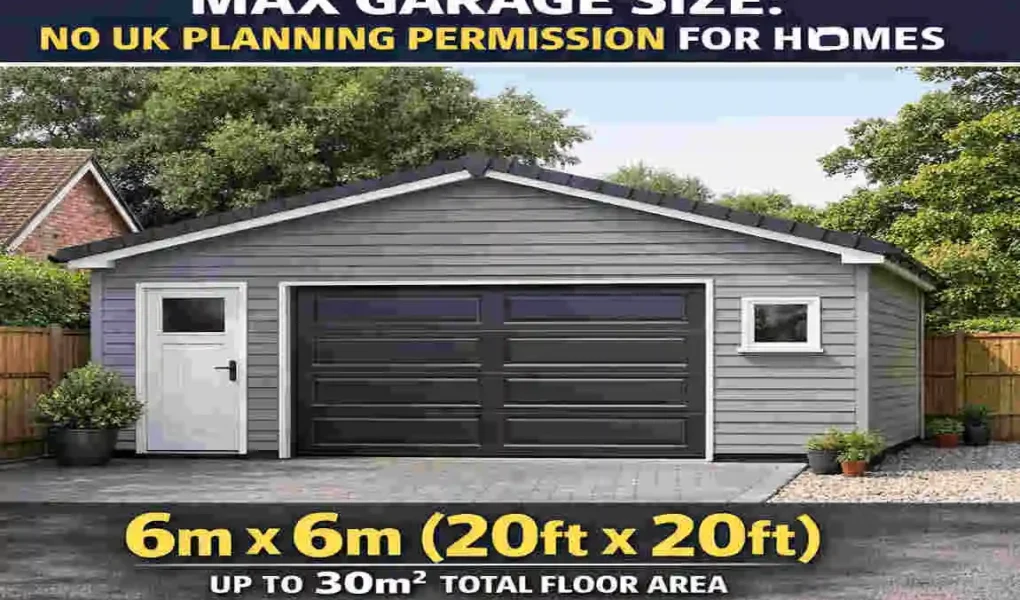
- Standard Double Garage (6m x 6m): This is a very popular size (36 square meters). As long as you have a decent-sized garden (so you don’t breach the 50% rule) and you are mindful of the height relative to the boundary, this is perfectly acceptable without planning permission.
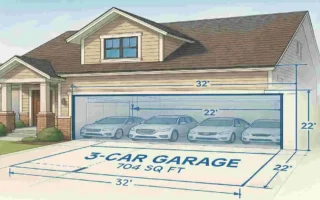
- Triple Garage: Even a triple garage is possible on a large plot, provided it remains single-story and incidental in use.
Attached Garages: Key Differences
Building an attached garage (one that connects physically to your house) is treated differently from a detached one. In the eyes of the planning department, an attached garage is considered an extension, not an outbuilding. Therefore, it falls under Class A (extensions) rather than Class E.
This distinction changes the rules significantly. While you can still build without full planning permission, the constraints are tighter because you are altering the main dwelling.
Depth and Width Restrictions
For attached garages, the allowable size is often dictated by how far you project from the original house walls.
- Rear Extensions: If you are attaching the garage to the rear of a detached house, it can typically extend up to 4 meters in depth. For semi-detached or terraced houses, this limit drops to 3 meters.
- Side Extensions: Side garages are very common. However, under PD rights, a side extension can only be single-story and must not exceed 4 meters in height. Crucially, the width of the side garage cannot exceed half the width of the original house.
- Example: If your house is 10 meters wide, your attached side garage cannot be wider than 5 meters.
Height and Eaves
Just like detached structures, attached garages have height caps.
- Single Story: Permitted development for extensions generally covers single-story structures.
- Top Height: The maximum height is 4 meters.
- Eaves Matching: If the garage is within 2 meters of the boundary, the eaves height rules apply. Furthermore, the materials used for the exterior of an attached garage must be similar in appearance to those used in the construction of the existing house. You cannot simply bolt a metal box onto a brick Victorian home; it must visually blend in.
Boundary Placement for Attached Garages
If your attached garage is essentially a side extension, the boundary rules are critical. You can build up to the boundary, but standard extension rules apply regarding the “45-degree rule” (blocking light to neighbors), which might trigger a planning concern even if it technically fits PD dimensions.
Generally, sticking to the single-story limit prevents most overshadowing issues, but if you are building within 2 meters of the boundary, keeping the eaves low is essential to avoid neighbor disputes and stay compliant.
Comparison Table: Detached vs. Attached
Feature: Detached Garage (Class E), Attached Garage (Class A Extension)
Max Height 4m (dual-pitch), 3m (flat) 4m max height
Floor Limit None (limited by 50% garden coverage) Limited by depth (3-4m) & width (50% of house)
Boundary Rule: Max 2.5m height if <2m from boundary. Must not exceed 4m height; side limits apply
Materials: No strict rule (though recommended to match). Must match the existing house
Example Size 6m x 6m (Double Garage) 3m-4m depth extension
Special Areas: Conservation Rules
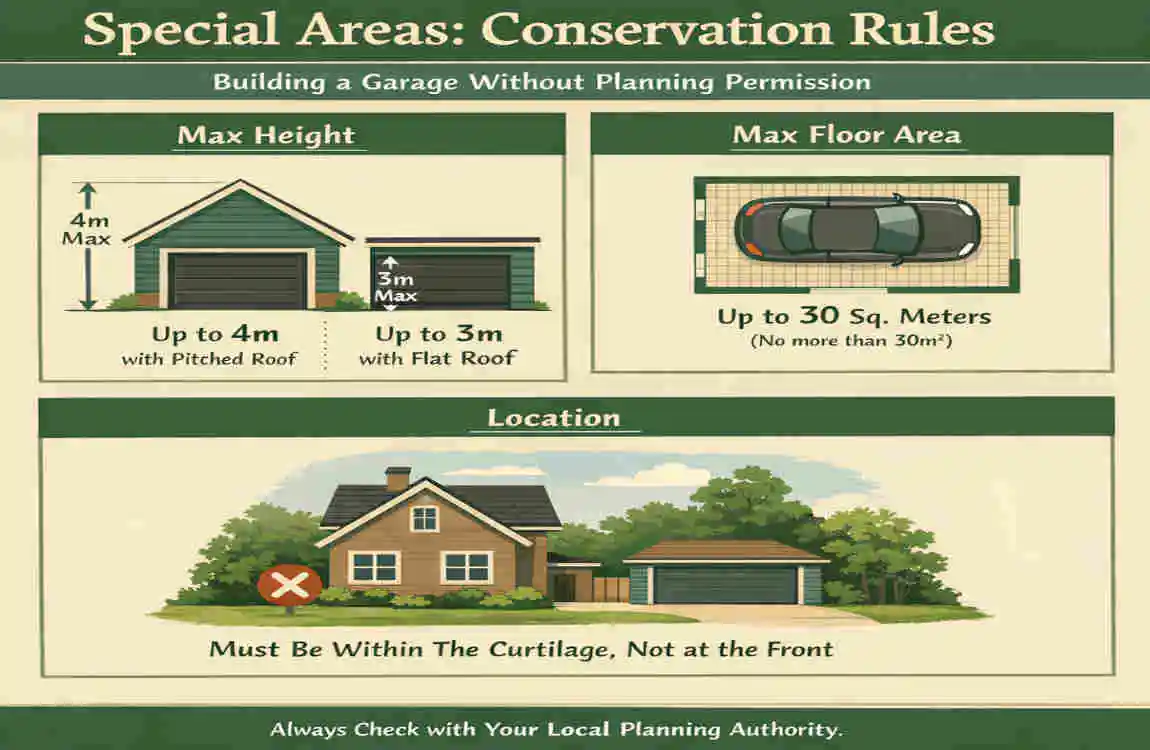
If you live in a designated area, the rules for “how big can a home garage be without planning permission” change drastically. “Designated areas” include:
- Conservation Areas
- National Parks
- Areas of Outstanding Natural Beauty (AONB)
- World Heritage Sites
- The Norfolk Broads
In these locations, your Permitted Development rights are restricted or removed entirely to protect the character of the environment.
Stricter Limits
- Side Extensions: In conservation areas and other designated lands, you typically cannot build a side extension (attached garage) without planning permission.
- Rear Outbuildings: For detached garages in these areas, you cannot cover more than 10 square meters of land if the outbuilding is more than 20 meters from any wall of the house.
- Placement: Generally, no outbuilding can be placed on land between the side elevation of the house and the boundary of the curtilage. Essentially, you can’t build it in the side garden visible from the street.
Listed Buildings
If your home is a Listed Building, Permitted Development rights generally do not apply to the construction of new structures. You will need both Planning Permission and Listed Building Consent. Do not attempt to build a garage at a listed property without first speaking to a conservation officer, as it is a criminal offense to alter the character of a listed building without consent.
Pro Tip: Always check your local council’s map online. You might be in a conservation area without realizing it, especially if you have recently moved.
Building Regulations vs. Planning Permission
This is the area where most homeowners get confused. Planning Permission and Building Regulations (Building Control) are two completely separate entities. Even if your garage is exempt from planning permission (PD), it might still need to comply with Building Regulations regarding structure, fire safety, and drainage.
However, there is a “sweet spot” for detached garages where you can avoid Building Regulations as well.
The 30 Square Meter Exemption
You generally do not need Building Regulations approval for a detached garage if:
- The floor area is less than 15 square meters.
- The floor area is between 15 and 30 square meters, provided it is at least 1 meter away from any boundary, OR it is constructed substantially of non-combustible materials (like brick, block, or concrete).
When You DO Need Regulations
- Attached Garages: Any attached garage will require Building Regulations approval because it affects the thermal envelope and fire safety of the main house.
- Large Garages: Any detached garage over 30 square meters will need approval.
- Utilities: If you run electricity, water, or drainage to the garage, those specific installations must comply with regulations (often certified by the tradesperson, e.g., a Part P electrician).
Why Compliance Matters: Even if you are exempt, building to regulatory standards (proper foundations, damp proofing) is wise. If you ever sell your home, a shoddy garage can devalue the property. Furthermore, if you build a garage that collapses or causes a fire, your insurance may be void if it wasn’t built to standard.
Cost Savings and Property Boost
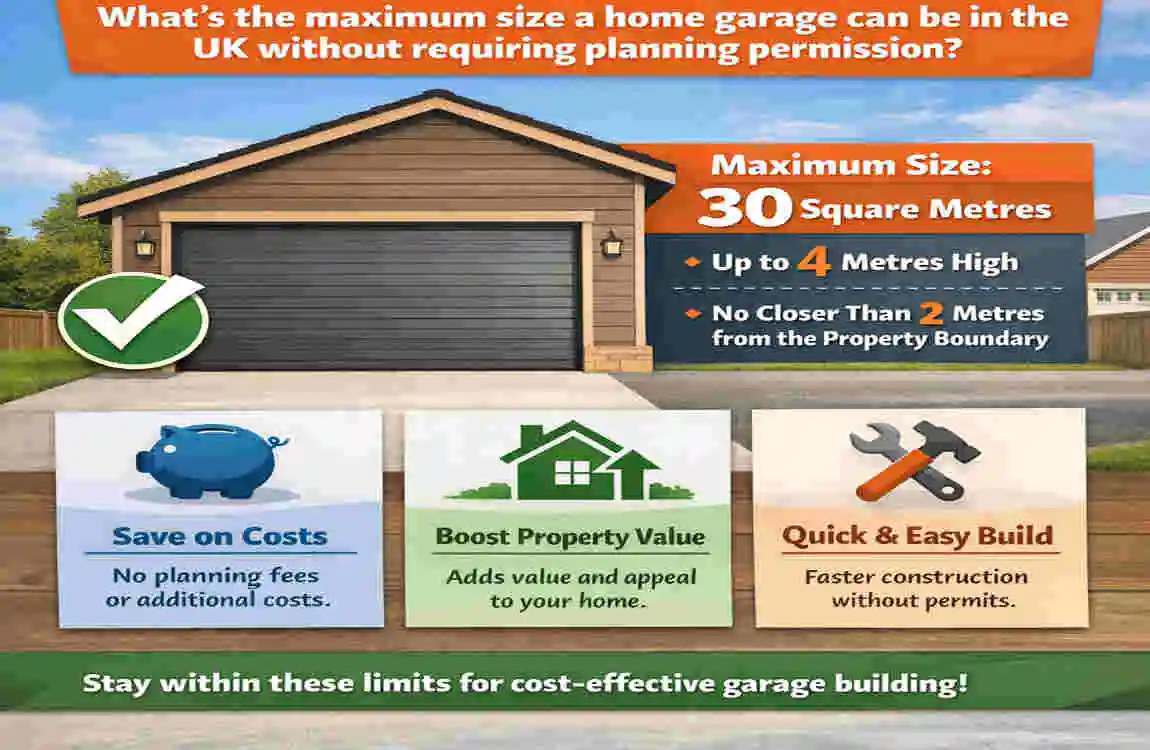
Understanding how big a home garage can be without planning permission is financially savvy. Avoiding the planning application process saves you the application fee (roughly £258 for householders in 2026, though prices fluctuate) and the potential costs of hiring an architect to draw up “valid” planning drawings, which can cost upwards of £1,000.
20-30% Cheaper Build
By sticking to PD rights, you eliminate the waiting period (usually 8 weeks) and the risk of rejection. This streamlined process can effectively make your build 20-30% cheaper in terms of upfront “soft costs” (fees, design revisions, consultant time).
Return on Investment (ROI)
A well-built garage is a massive asset. In 2026, the trend for “hybrid working” has solidified, making external space premium.
- Value Add: Estate agents estimate that a functional double garage can add 5% to 10% to a property’s value.
- Versatility: A garage is no longer just for cars. It’s a home gym, a workshop, or secure storage for high-value electric bikes.
Real World Example: Consider the “Smith” family. They wanted a gym and storage space. A full extension would have cost £40,000 plus planning fees. Instead, they built a 28-square-meter detached garage (under the 30m² Building Regs threshold and within PD height limits) for £18,000. They added substantial usable space and instantly increased their home’s resale appeal, all without filling out a single council form.
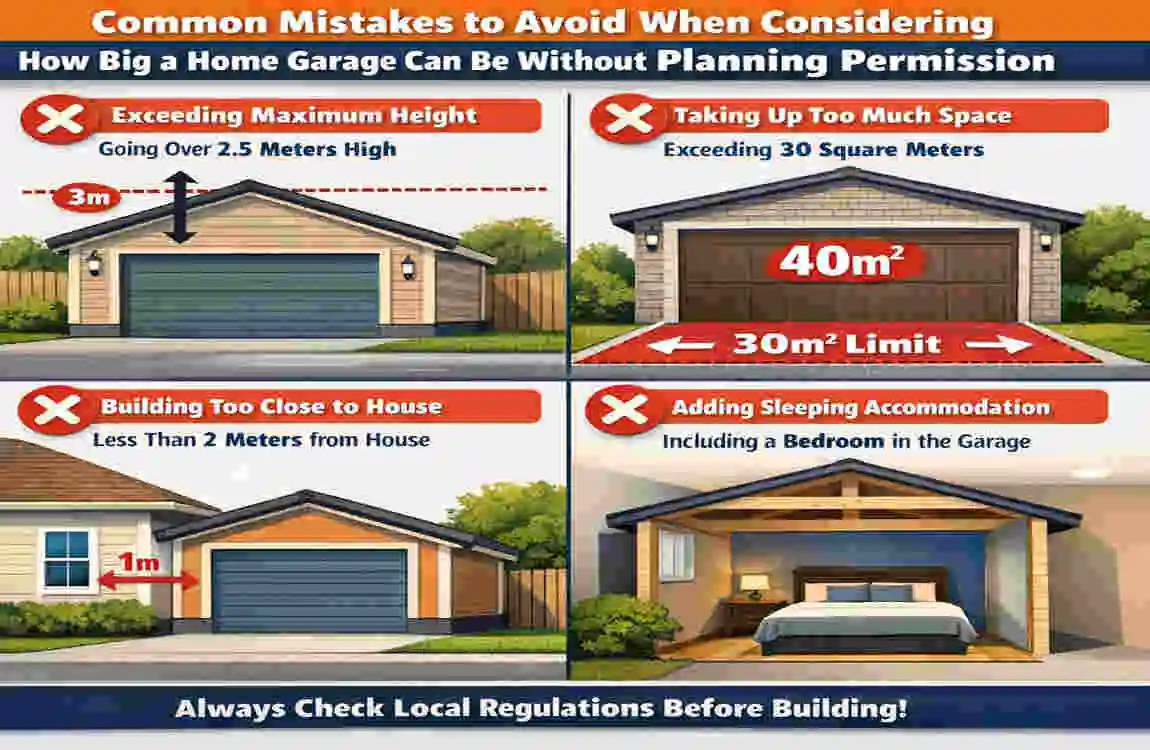
Common Mistakes to Avoid
Even with the best intentions, homeowners often trip up on specific clauses within the Permitted Development text. Here are the most common pitfalls to watch out for.
- Forward of the Principal Elevation: You generally cannot build a garage in front of your house. If your garage extends beyond the front wall of your home (the wall facing the highway), you will need planning permission. This rule preserves the “street scene.”
- The “Veranda” Trap: Permitted development for outbuildings does not allow for verandas, balconies, or raised platforms (over 300mm). If your garage design includes a cool roof terrace, you need planning permission.
- Living Accommodation: A garage built under Class E PD rights must be for “incidental” use. If you install a toilet, a shower, and a bed, the council may view this as a separate self-contained dwelling (Class C3), which definitely requires planning permission.
- Flats and Maisonettes: PD rights apply to houses. If you live in a flat or maisonette, you do not have these rights. You must apply for planning permission for any external changes.
- Ignoring Article 4 Directions: Sometimes, a local council will remove PD rights for a specific street or neighborhood (even outside conservation areas) to control development. This is called an “Article 4 Direction.” Always check with the council before starting.
Checklist for Safety:
- Is it behind the front building line?
- Is it under 2.5m high if near the fence?
- Is it less than 50% of the garden?
- Is it for incidental use only?
When You Still Need Permission
Sometimes, your dream garage just doesn’t fit within the Permitted Development box. You may need a 5-meter-high garage to accommodate a car lift, or you want to build a triple garage in the front garden because of your driveway layout.
In these cases, do not panic. needing planning permission is not a dead end; it just means you need to make a formal request.
The Application Process
- Pre-Application Advice: Most councils offer a “pre-app” service where you can sketch your idea and get informal feedback. This costs a small fee but saves you from submitting a doomed application.
- Full Submission: You will need scaled drawings (floor plans and elevations) and a site map. The fee is standard across the UK.
- The Decision: The council assesses your design based on local policies, impact on neighbors, and road safety. If you design sympathetically—matching materials to your house and respecting neighbor privacy—approval is very common.
If you are unsure whether your project falls under PD or needs permission, apply for a Lawful Development Certificate. This is a document from the council proving your build was legal at the time of construction. It is invaluable when you eventually sell the house, as solicitors will demand proof that the garage is legal.
FAQ: How Big Can a Garage Be Without Planning Permission?
Building a garage is a fantastic way to add storage or workspace to your home, but nobody wants to get tangled up in red tape. Generally, you can build under “Permitted Development” rights if you stick to specific size limits.
Here are the most common questions answered simply.
What is the maximum floor area allowed?
In many regions (particularly the UK), the “magic number” for the floor area is often 30 square meters. If you build a detached, single-story garage under this size, you can often avoid the extra hassle of Building Control regulations, provided it does not contain any sleeping accommodation .
However, for general planning permission exemptions, the rule is often about land usage. The garage (and other outbuildings) must not take up more than 50% of the total land around the original house .
Is there a height limit?
Yes, height is very important. To stay within permitted development rules:
- Close to the Boundary: If the garage is within 2 meters of your property line, the maximum height is usually restricted to 2.5 meters .
- General Limit: If it is further away from the boundary, you can typically go up to 4 meters for a dual-pitched roof .
Can I build it anywhere on my property?
No, location is key. You generally cannot build a garage that sits forward of the principal elevation (the front wall) of your house that faces the highway . It usually needs to be positioned to the side or rear of the property.
Do these rules apply everywhere?
Rules vary significantly by location. For example, in many parts of the United States, the limit for a building without a permit is often much smaller, typically around 120 square feet . Always check with your local council or zoning office, as specific local codes can override general guidelines .