
you are sitting in your living room, enjoying a quiet evening, when you suddenly notice a water stain spreading across your ceiling. Or perhaps you are looking at your home from the driveway, realising that years of brutal summer sun and the ash from recent wildfire seasons have left your shingles curling and brittle. Across the Golden State, the demand for roof repairs and replacements is skyrocketing. Our aging housing infrastructure, combined with extreme weather patterns, means that getting a new roof is no longer just a cosmetic upgrade—it is an absolute necessity for protecting your family and your biggest financial investment.
When you finally decide to call a contractor and get that roof replaced, you will quickly run into a critical piece of red tape: the building permit. You might be tempted to ask your contractor to skip the paperwork to save a few bucks. However, permits matter incredibly for your safety, your homeowner’s insurance policy, and the validity of your roofing material warranties. Without a permit, you are flying blind.
Why Permits Are Required for Your Roof
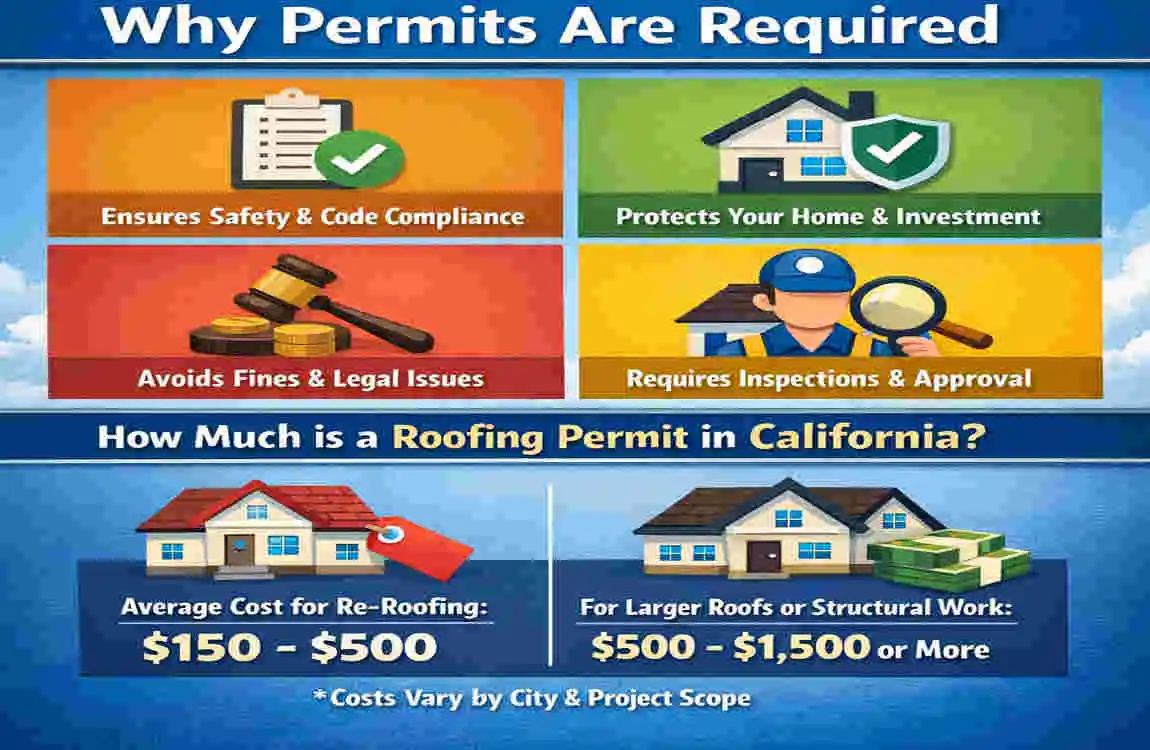
You might be thinking, “It is my house! Why do I need the government’s permission to fix my own roof?” It is a fair question. However, roofing permits are not just arbitrary hoops to jump through. They are vital consumer protection tools designed to keep you, your family, and future buyers of your home safe from shoddy artistry.
Understanding the California Building Code (CBC) Title 24
In California, state laws fall under the California Building Code (CBC). Specifically, you will hear contractors and city officials talk a lot about Title 24. Under these state regulations, you are legally mandated to pull a building permit for any re-roofing project that covers more than 100 square feet.
To put that into perspective, 100 square feet is just a 10-foot-by-10-foot section. If the wind blows off a couple of shingles and you need to patch a tiny spot, you are generally in the clear to do it without a permit. But if you are replacing an entire roof slope, or doing a full tear-off and replacement, the law requires you to have a permit on file.
Energy Efficiency and the “Cool Roof” Mandate
California leads the nation in environmental regulations, and your roof is right on the front lines of that battle. Title 24 isn’t just about structural safety; it is heavily focused on energy efficiency. If you live in Southern California or the Central Valley, you are likely subject to “Cool Roof” requirements.
What is a cool roof? It is a roofing system specifically designed to reflect more sunlight and absorb less heat than a standard roof. This means your air conditioning does not have to work as hard during those blazing August heatwaves, reducing the strain on the state’s electrical grid. When an inspector comes out to look at your permitted roof, they are checking to ensure your contractor used the right, energy-compliant materials.
The Steep Fines for Skipping the Permit
Let’s talk about the elephant in the room: what happens if you ignore the rules and replace your roof under the radar? The consequences can be incredibly costly.
If a city code enforcement officer spots unpermitted work happening on your property—or if a disgruntled neighbour reports you—the city will issue a “Stop Work” order immediately. From there, you will face hefty fines. Fines for skipping permits can reach up to $1,000 or double the original permit fees, depending on your local jurisdiction.
Furthermore, if your home suffers a fire or a massive leak down the line, and your insurance company discovers the roof was installed without a permit, they can outright deny your insurance claim. When you sell your house, unpermitted work will also come to light during the buyer’s inspection, potentially derailing the sale. The bottom line? Getting a permit is an upfront investment that saves you from massive financial headaches later.
Statewide Cost Factors: What Drives the Price?
So, how exactly does your local building department arrive at the final number on your permit invoice? Roofing permit costs in California are rarely a flat, one-size-fits-all fee. Instead, they are calculated using a sliding scale based on several unique factors related to your specific home.
Permits generally hinge on three main things: roof size, materials, and inspections.
Across the state, you will find that base fees typically start anywhere from $150 to $500. But that is just the starting line. Here is how the costs break down and add up:
The Size of Your Roof (Square Footage)
In the roofing industry, size is measured in “squares,” where one square equals 100 square feet. The larger your roof, the more time the city inspector will need to walk it, and the higher your permit fee will be. A sprawling 3,500-square-foot ranch-style home will inherently cost more to permit than a compact 1,200-square-foot bungalow.
The Type of Roofing Material
Are you going with standard asphalt composition shingles, or are you upgrading to heavy Spanish clay tiles? The materials you choose directly impact the permit cost. Heavy materials like concrete or clay tile add immense weight to your home’s structure. Therefore, the city may require additional structural engineering plans to ensure your walls can actually hold the roof up without collapsing during an earthquake. This added review process brings added surcharges.
Title 24 Compliance Reviews
As we mentioned earlier, proving that your new roof meets the state’s strict energy codes requires paperwork. Your contractor must submit energy calculation forms alongside the permit application. City officials must review these documents to ensure compliance, and the Title 24 compliance review typically adds $100 to $300 to your total permit bill.
Complex Job Surcharges
If your roof has a particularly steep pitch, multiple valleys, skylights that require structural framing, or you are changing the roofline of your house, the city classifies this as a “complex” job. Complex jobs require more meticulous plan reviews and multiple inspection phases (such as a pre-decking inspection before the shingles go on), driving the administrative costs higher.
Major Cities Breakdown
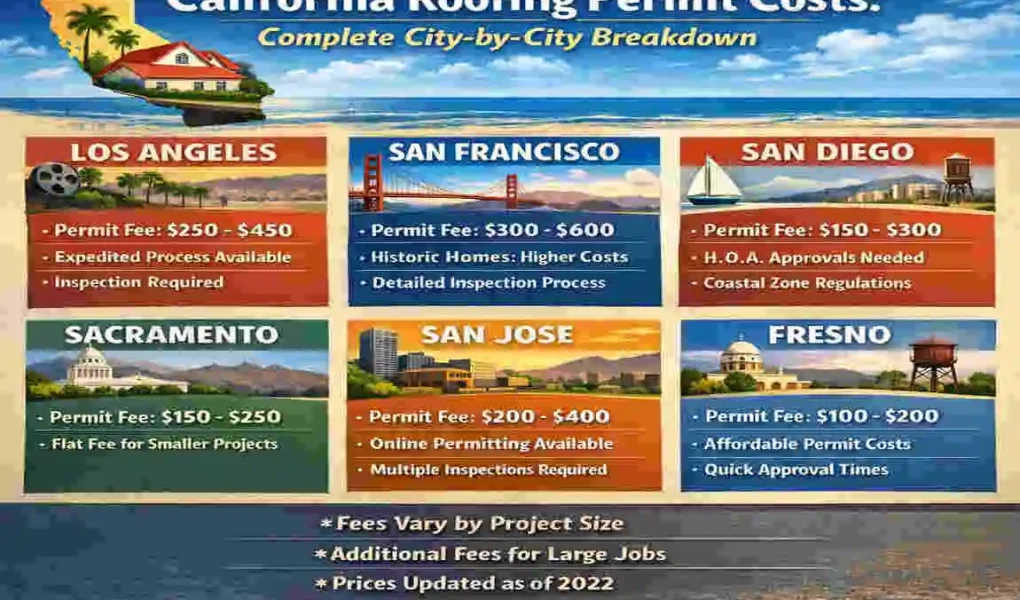
Because local city councils and building departments set their own administrative fees, crossing a city limit line can drastically change what you pay. To make things easy for you, we have compiled a quick-reference table of the major metropolitan areas in California.
Below is a quick scan of what you can expect in various regions:
City Base Permit Cost, Additional Fees, Notes
Los Angeles $250–$800 $100–$300 inspections , strict seismic checks
San Francisco $400–$1,200 $200 Title 24 High labour, steep roofs
San Diego $200–$600 $150 fire-resistant Coastal moisture rules
San Jose $150–$1,000 Varies by size Bay Area codes apply
Sacramento $200–$700 $100–$250 Wildfire zones extra
Fresno $150–$500 Minimal Lower rural rates
Bakersfield $175–$550 $75 plan review Inland fire focus
Let’s dive much deeper into these cities so you understand exactly what you are paying for when you write that check to the building department.
Los Angeles
In the City of Angels, you will be dealing with the Los Angeles Department of Building and Safety (LADBS). Los Angeles is known for having some of the most rigorous building codes in the entire country, and their permitting fees reflect that bureaucracy.
When you search for the roof replacement permit cost in LA, you will find that costs vary widely based on the “valuation” of the project—meaning how much the contractor is charging you for the total job. For example, if you are doing a standard 2,000-square-foot asphalt shingle re-roof, you can expect a base fee of around $450. However, Los Angeles sits on major fault lines. If you want to install a heavy tile roof, the LADBS will mandate strict seismic checks to ensure your roof framing won’t pancake during a major earthquake. These extra structural plan checks, along with standard inspection fees, easily push the total cost toward $800.
San Francisco
If you own property in San Francisco, prepare your wallet. The Department of Building Inspection (DBI) in San Francisco charges some of the highest permit fees in the state, ranging from $400 to a staggering $1,200 for the base permit alone.
Why is it so expensive? First, the administrative and labour costs for city employees are higher in the Bay Area. Second, San Francisco’s architecture is unique. Homes are often built shoulder-to-shoulder on incredibly steep hillsides. The city has to enforce strict wind zone regulations because the gales coming off the Pacific Ocean can easily rip poorly installed roofs right off the decking. Additionally, a flat $200 Title 24 energy review fee is practically standard here. The tight spaces, steep pitches, and high-density neighbourhoods mean city inspectors have a much tougher job, and those costs are passed directly to the homeowner.
San Diego
Down in sunny San Diego, the permit structure is slightly more forgiving, with base fees ranging from $200 to $600. However, San Diego faces unique geographic challenges that building codes must address.
Because so much of the city borders the ocean, building departments are highly focused on coastal moisture rules. Salt spray and heavy marine-layer fog can cause severe mould and rot if a roof’s underlayment isn’t installed properly. Therefore, inspections are very thorough regarding waterproofing membranes. Furthermore, due to the tragic history of canyon fires in San Diego County, there is often a $150 surcharge to verify that the roofing materials are highly fire-resistant (Class A fire-rated) to prevent flying embers from igniting the neighbourhood.
San Jose
As the capital of Silicon Valley, San Jose represents a massive swath of the housing market. Depending on the size of your tech-hub estate, permits here range from $150 to $1,000.
San Jose enforces strict Bay Area building codes, heavily emphasising energy efficiency and structural integrity. Because the city has a mix of sprawling suburban ranch homes and dense, multi-story townhouses, permit fees are highly variable and tied directly to the project’s square footage. If you are doing a simple tear-off and replacement of the same lightweight material, you stay on the lower end. But if you are altering the roof deck or adding solar mounts at the same time, expect those fees to climb rapidly.
Sacramento
In California’s capital city, expect base permit costs to range from $200 to $700. The defining feature of roofing in the Sacramento region—and much of the surrounding foothills—is the threat of wildfires.
Sacramento building codes strictly enforce Wildland-Urban Interface (WUI) regulations. If your home is located in or near a designated fire hazard severity zone, you will pay extra fees (usually around $100 to $250) for specialised WUI plan reviews. The city mandates that everything from the shingles down to the attic vents be designed to resist the intrusion of flames and burning embers. Inspectors will spend extra time ensuring your roof features “bird-stopped” eaves and spark-arresting materials.
Fresno
Moving into the Central Valley, Fresno offers a breath of fresh air when it comes to bureaucratic costs. Thanks to lower administrative overhead and more rural surroundings, you will find some of the lowest permit rates in the state here.
Base fees in Fresno range from $150 to $500. There are minimal surcharges, and the permitting process is generally faster and less convoluted than in the coastal megacities. The primary focus for inspectors in Fresno is ensuring the roof can withstand the blistering summer heat, so proper attic ventilation and Title 24 cool roof compliance are the main things they look for during the final sign-off.
Bakersfield
Further down the Central Valley, Bakersfield follows a similar trend to Fresno, with base rates sitting comfortably between $175 and $550.
Bakersfield requires a standard $75 plan review fee upfront before it will even issue the permit. Like the rest of the inland empire, their building codes heavily focus on inland fire safety and extreme heat defence. Because Bakersfield does not have to deal with coastal salt spray or the extreme seismic engineering required in Los Angeles, the city keeps their permit fees relatively reasonable for the average homeowner.
The Application Process: Getting It Done Right
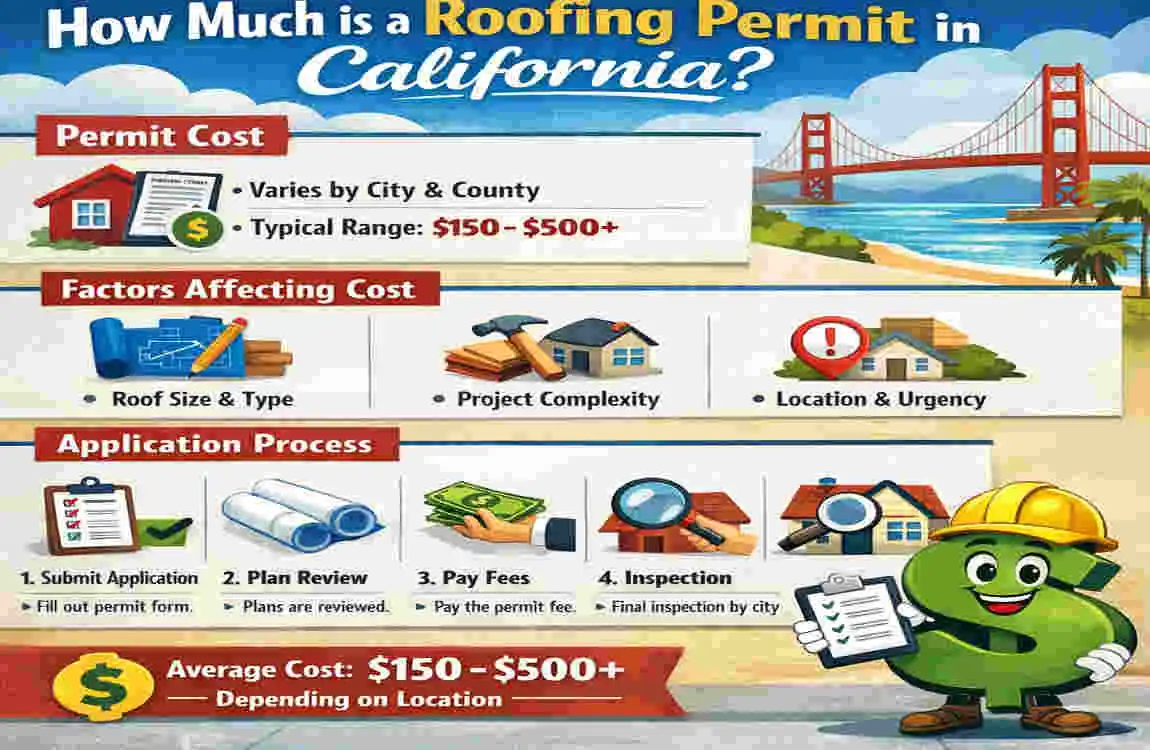
Now that you know what it will cost, you may wonder how the actual process works. Applying for a building permit might sound like a nightmare of waiting in line at a stuffy government building. Still, modern technology has actually made it quite manageable.
Here is exactly what the application process looks like from start to finish.
Step-by-Step Permit Approval
- Submit the Plans: First, submit a detailed application to your local building department. This isn’t just a basic form; it must include a site plan, details on the existing roof, the type of new materials being used, the underlayment specifications, and all required Title 24 energy calculation documents.
- Pay the Fees: Once the application is submitted, the city will assess the scope of the work and generate an invoice. The permit is not considered “pulled” until these fees are paid in full.
- Schedule the Inspections: A roofing project is not a one-and-done inspection. Usually, the city requires a “tear-off” or “pre-deck” inspection to look at the bare wood of your roof before new shingles hide it. Once the job is done, you must schedule a “Final Inspection” where the city official signs off on the completed work.
Timeline: Depending on how backlogged your city’s building department is, the initial approval process can take anywhere from 1 to 4 weeks. Do not wait until water is pouring into your living room to start this process!
Pro-Tips for a Smooth Process
Use Online Portals: Gone are the days of taking a paper blueprint down to City Hall. Almost every major city in California now uses an online portal (like Accela or similar software) where applications, plans, and payments can be uploaded digitally.
Hire Licensed Contractors: This is the most important advice you will ever receive regarding roof replacements. You should always hire a contractor who holds an active C-39 Roofing Contractor License issued by the California Contractors State License Board (CSLB). A licensed professional will handle the entire permitting process for you. They know exactly what the city inspectors want to see, so you don’t have to worry.
Common Pitfalls to Avoid
The number one reason roofing permits get delayed is incomplete documentation. If your contractor forgets to attach the fire-rating certificate for the shingles or fails to complete the Title 24 energy forms properly, the city will reject the application and send it back. This restarts the clock, delaying your project by weeks. Always double-check that your contractor is submitting a fully complete package on the first try.
Cost-Saving Tips for Smart Homeowners
Nobody likes paying government fees, but since they are unavoidable, how can you soften the blow to your wallet? Here are a few legitimate ways to save money on your overall roofing project.
Bundle Minor Repairs
Remember the 100-square-foot rule we talked about earlier? Minor repairs under this threshold are often entirely permit-free. If you have a few missing shingles or a cracked flashing pipe, call a roofer to do a simple patch job. If the total repair cost is under $500, you generally will not need to pay a dime to the city for a permit. Keep your roof well-maintained with minor patches, and you can push off the need for a fully permitted replacement for years.
Seek Out Energy Rebates
California wants you to have an energy-efficient home, and they are willing to pay you for it. When you install a Title 24-compliant cool roof, check with your local utility company (like PG&E, SoCalGas, or SCE). Many of them offer substantial cash rebates for energy-efficient roof upgrades. These rebates can easily offset your permit fees, putting cash back in your pocket.
Compare Contractor Quotes Carefully
When you collect bids for your new roof, pay close attention to the fine print. Ask each contractor: “Does this quote include the cost of pulling the permit and handling the inspections?” Some contractors give you an artificially low bid, only to slap you with the permit fees and administrative hourly rates later. Choose a contractor who offers a transparent, all-inclusive quote so hidden costs don’t blindside you.
Frequently Asked Questions (FAQs)
Still have a few lingering questions? Let’s clear them up with quick, straightforward answers to the most common things California homeowners ask us.
How much is a roofing permit in California on average? While the extremes range from $150 to over $1,000, the average California homeowner can expect to pay between $200 and $600 for a standard residential roofing permit.
Do I need a roofing permit for minor repairs? Generally, no. If the repair area is less than 100 square feet and does not involve changing the structural framing of the roof, the California Building Code allows you to proceed without a permit.
Can I pull the permit myself as an owner-builder? Yes, you legally can act as an “owner-builder” and pull the permit in your own name. However, we highly advise against it. If you pull the permit, you assume 100% of the liability for code compliance, worker injuries, and construction defects. It is always safer to have your licensed C-39 contractor pull the permit.
Does a roof replacement permit cost more if I add solar panels? Yes. Adding a rooftop solar array involves electrical work and additional weight on your roof structure. This requires a separate solar permit or an expanded combo-permit, which will increase your total fees and require more rigorous structural and electrical inspections.
Replacing your roof in California doesn’t have to be a stressful, confusing ordeal. By understanding the building codes, knowing what your specific city charges, and partnering with a reputable, licensed contractor, you can navigate the permitting process with confidence. Protect your home, protect your investment, and rest easy under a safe, fully permitted roof.