
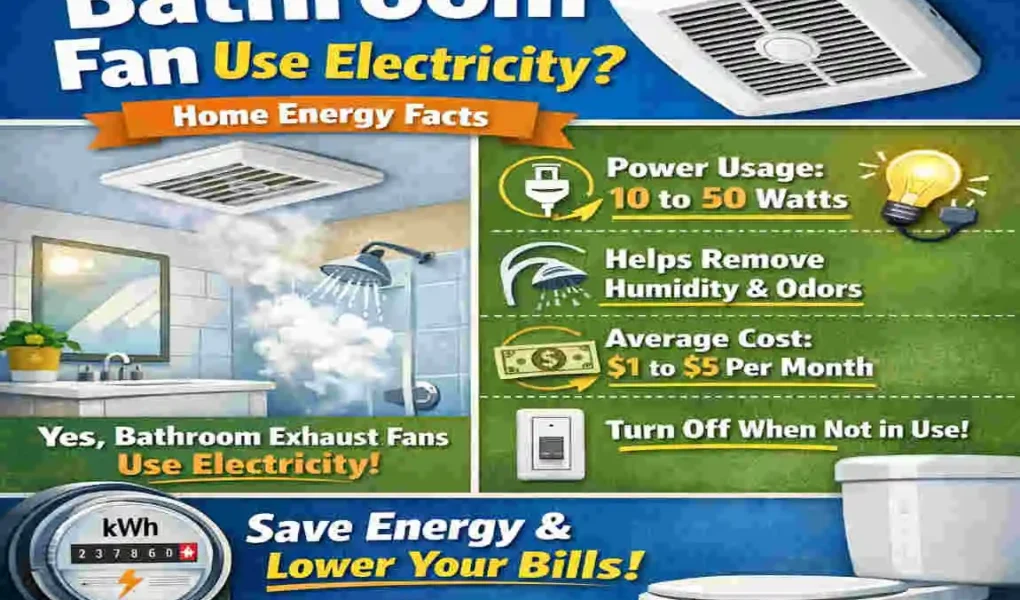
You’ve just stepped out of a steaming hot shower. The mirror is completely fogged over, condensation is dripping down the walls, and the air feels heavy. You instinctively reach for the switch, and the familiar hum of the exhaust fan kicks in. As the steam begins to clear, a thought might cross your mind—does bathroom fan use electricity enough actually to make a dent in your monthly budget?
It is a scenario every homeowner faces. We know we need ventilation to prevent the dreaded creep of mould and mildew, but in an era of rising energy costs, every appliance is under scrutiny. You might be hesitant to leave that fan running for the recommended 20 minutes, fearing the meter is spinning out of control.
Why Bathroom Fans Matter
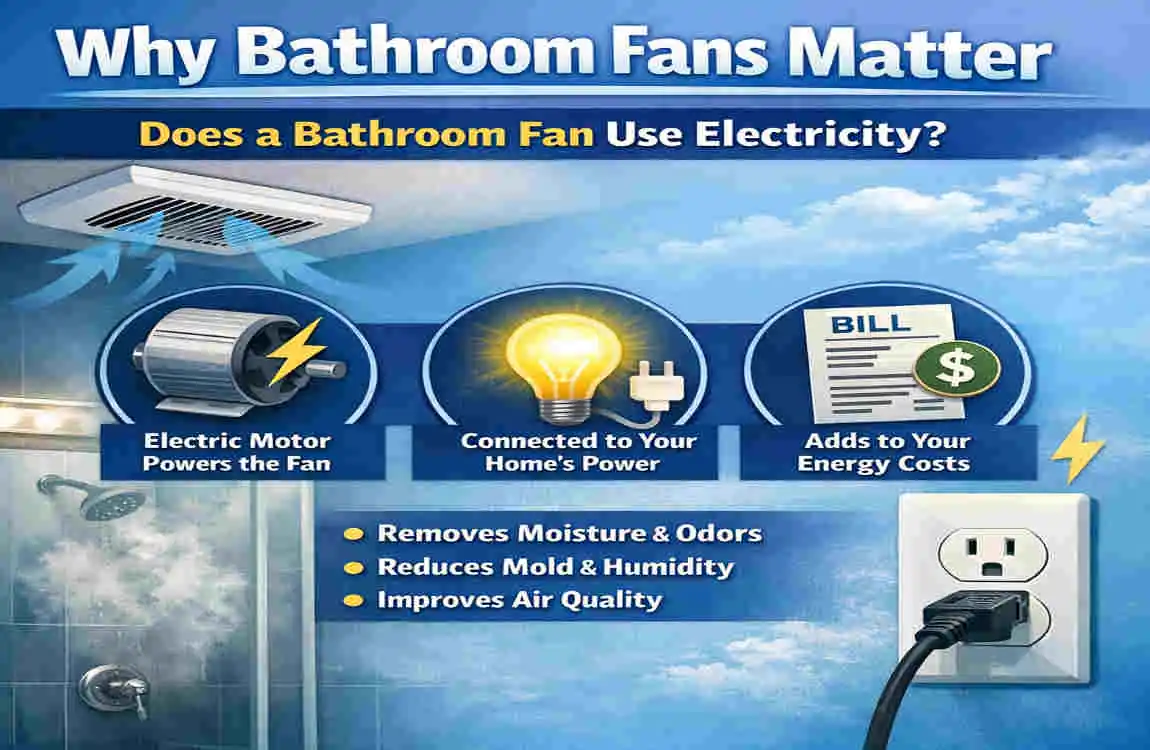
Before we start crunching the numbers on electricity, it is vital to understand why we spend that money in the first place. A bathroom exhaust fan isn’t just a noise-maker designed to cover up sounds; it is a critical component of your home’s respiratory system. Its primary job is ventilation—removing moisture, humidity, and odours from the bathroom and venting them outdoors.
When you skip using the fan to save a few pennies on electricity, you are often inviting much more expensive problems. Excess moisture is the enemy of a healthy home. It seeps into drywall, peels wallpaper, warps wooden vanities, and creates the perfect breeding ground for mold and mildew.
The Hidden Value of Ventilation
Beyond just keeping the mirror clear, a properly functioning bathroom fan offers significant benefits that protect both your health and your property value:
- Improves Indoor Air Quality: It removes pollutants, cleaning chemicals, and biological contaminants from the air you breathe.
- Reduces HVAC Strain: By removing hot, humid air before it spreads to the rest of the house, your air conditioner doesn’t have to work as hard to cool down your home.
- Prevents Structural Damage: Long-term exposure to high humidity can rot framing and ruin insulation.
- Code Compliance: Most modern building codes require a minimum ventilation rate, often cited as 50 CFM (Cubic Feet per Minute) for standard bathrooms .
The cost of remediating mold or replacing rotted drywall far outweighs the electricity cost of running a fan. Essentially, you are spending pennies to save thousands. Now, let’s look at exactly how many pennies we are talking about.
Core Answer: Yes, But Minimally
So, does bathroom fan use electricity? Absolutely. However, compared to other appliances in your home—like your refrigerator, HVAC system, or even your hair dryer—the energy consumption of a standard bathroom fan is minimal.
Typically, a standard bathroom exhaust fan uses between 10 to 80 watts of electricity . To put that in perspective, a standard incandescent light bulb uses about 60 watts. Running your fan is equivalent to leaving a single light on.
However, not all fans are created equal. Energy usage fluctuates significantly depending on the type of fan you have installed. A simple exhaust fan is efficient, but if your unit includes a built-in heater or high-intensity lighting, the wattage jumps significantly.
Fan Type Comparison Table
To give you a clear picture, we have broken down average consumption by fan configuration.
Fan Type Avg. Wattage Hourly kWh Monthly Cost (1hr/day @ $0.13/kWh)
Standard Exhaust Only 20-40W 0.02-0.04 $0.08 – $0.16
Fan with LED Light 50-60W 0.05-0.06 $0.20 – $0.23
High-CFM / Fan with Heater 500-1500W 0.5-1.5 $2.00 – $6.00
The Math Behind the Usage
Understanding your bill requires a quick look at the math. Utility companies bill you by the Kilowatt-hour (kWh).
The formula to calculate this is simple: kWh = (Watts ÷ 1000) × Hours Used
Let’s say you have a typical 30-watt fan and you run it for 1 hour total per day (perhaps split between two showers).
- 30 watts ÷ 1000 = 0.03 kW
- 0.03 kW × 1 hour = 0.03 kWh
If you pay the US average of roughly $0.13 per kWh, that one hour of usage costs you $0.004. That is less than half a penny per day . Even if you leave it on for 24 hours by mistake, it would cost less than a dime.
Factors Affecting Usage
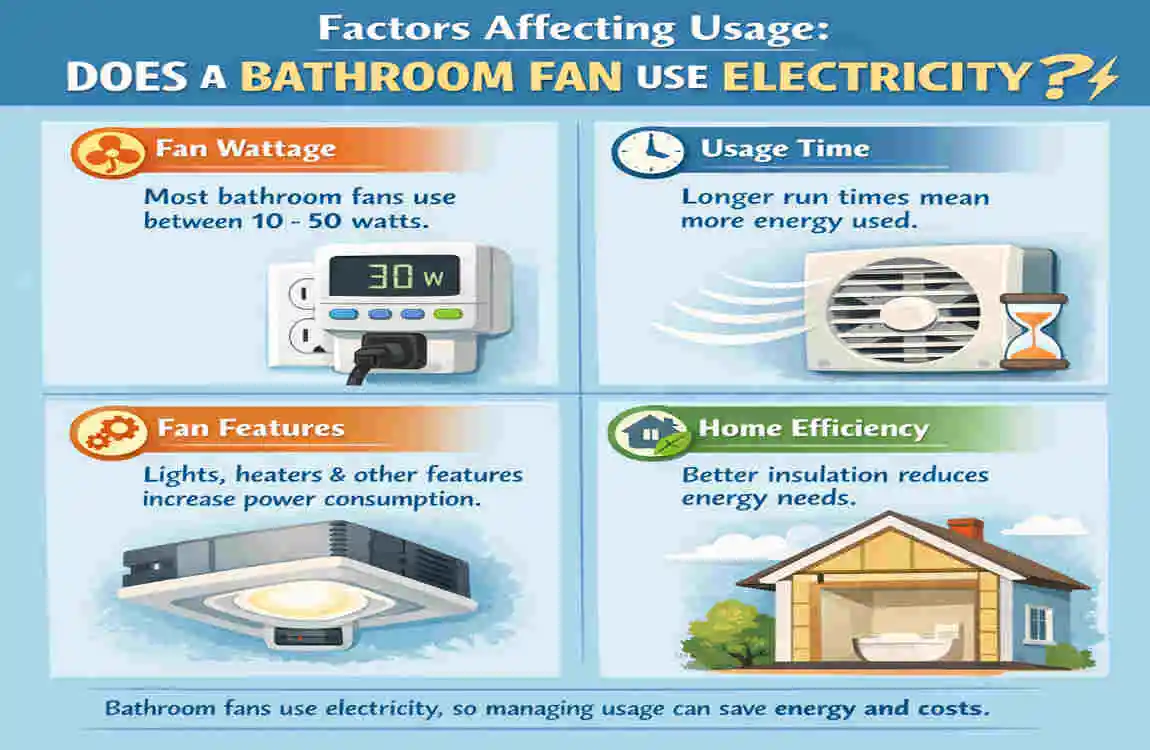
While the average wattage is low, several factors determine exactly how much electricity your specific bathroom fan consumes. It is rarely a “one size fits all” scenario. If you are trying to audit your home’s energy use, you need to look at the specific characteristics of your unit.
Size and CFM Rating
The power of a fan is measured in CFM (Cubic Feet per Minute), which indicates how much air the fan moves. Larger bathrooms require higher CFM ratings. Naturally, a motor capable of moving 110 CFM will generally require more wattage than a small motor moving 50 CFM. If you have a large master bath with a high-powered fan, your energy consumption will be on the higher end of the 10-80 watt spectrum .
Motor Efficiency (ECM vs. Standard)
The technology inside the fan matters. Older models typically use standard AC motors, which are reliable but less efficient. Newer, high-end models often utilize ECM (Electronically Commutated Motors). These DC motors are incredibly efficient, often using less than 10 watts to move the same amount of air as an AC motor would at 30 or 40 watts. They also tend to run cooler and last longer.
Integrated Features
This is the biggest variable.
- Lights: If your fan has an old incandescent bulb socket, the bulb is likely using more power than the fan motor.
- Heaters: This is the energy hog. A bathroom fan with a resistive heater can draw 1500 watts. Running a heater-fan combo is equivalent to running a hair dryer or a portable space heater. If you use the heater daily, “does bathroom fan use electricity” changes from “minimally” to “significantly.”
- Timers and Sensors: While these don’t use much power themselves, they control how long the fan runs, which dictates total consumption.
Regional Variables
Environmental factors play a role too. For example, in high-humidity regions—such as parts of Florida or international locations with intense climates, like Lahore during monsoon season—fans need to run longer to clear moisture effectively. The ambient humidity makes the air heavier and harder to clear, often requiring extended run times that linearly increase your electricity usage.
Cost Breakdown
Let’s get into the nitty-gritty of the costs. We have established that the hourly cost is low, but how does that look over the course of a year? And how does it compare to the other energy-hungry appliances in your home?
Annual Usage Scenarios
Let’s stick with our standard 30-watt fan. If a family of four takes showers daily, the fan might run for roughly 2 hours a day.
- Daily: 0.06 kWh
- Monthly: ~1.8 kWh
- Yearly: ~21.6 kWh
At an average electricity rate of $0.13/kWh, the total annual cost to run that fan is roughly $2.80. That is less than the cost of a single cup of coffee for a full year of mold prevention.
Now, let’s look at a High-Heat Fan (1500W) used for 30 minutes a day during winter (4 months).
- Daily: 0.75 kWh
- Monthly: 22.5 kWh
- Season Cost (4 months): ~$12.00
Even with the heater, the cost is manageable, but it is significantly higher than the fan alone.
Comparison to Other Appliances
To truly answer “does bathroom fan use electricity” in a meaningful way, we have to compare it to the heavy hitters in your house:
- Refrigerator: Uses 1-2 kWh per day (30 to 60 times more than your fan).
- Central Air: Can use 3500 watts per hour.
- Dehumidifier: Often uses 300-700 watts.
In the grand scheme of your energy bill, the bathroom fan is a blip on the radar.
Regional Cost Variations
It is important to note that electricity rates vary wildly. In the US, rates range from $0.10 to $0.30 per state. Globally, the variance is even higher. In places like Pakistan, where energy costs can hover around PKR 40/kWh or higher, homeowners are much more conscious of every watt. However, even at higher rates, the low wattage of a standard fan keeps it affordable.
Pro Tip: If you are unsure about your specific fan, you can use a smart plug with energy monitoring capabilities. Plug the fan (if it has a plug) into the smart device to see exactly how much power it draws in real-time .
Energy-Efficient Fan Options
If you are renovating your bathroom or looking to replace a noisy, rattling old fan, you can upgrade to an energy-efficient model. Today’s market is filled with “green” options that minimise electricity use while maximising airflow.
Look for ENERGY STAR®
The gold standard for efficient appliances is the ENERGY STAR rating. ENERGY STAR-certified bathroom fans use roughly 50% less energy than standard models . They achieve this through better blade design and high-efficiency motors.
Top Rated Efficient Models
Several manufacturers are leading the charge in low-wattage ventilation:
- Panasonic WhisperGreen: Legendary in the industry. Some models in this line use as little as 5 to 11 watts while moving a significant amount of air. They are also incredibly quiet.
- Broan-NuTone: Another massive player, Broan offers low-sone (quiet) models that balance price with efficiency.
- Delta Breez: Known for using DC motor technology, Delta fans are often some of the most efficient on the market, with some running at just 8 watts.
Efficiency Comparison
Model Series Est. Wattage CFM Range Approx. Price Efficiency Benefit
Panasonic FV-0511VF1 11W 50-110 $150 – $200 Uses ~50% less energy than standard
Delta Breez Green Builder ~11W 80 $100 – $150 Ultra-low usage, high reliability
Standard Builder Grade 40W+ 50 $30 – $50 Cheap upfront, costs more to run
While an efficient fan might cost $100 more upfront, the silence and energy savings (plus the motor’s longevity) often pay for themselves over the life of the home.
Installation Impact
You might buy the most efficient fan in the world, but if it is installed incorrectly, you are throwing money down the drain. The installation quality directly affects how hard the fan has to work, which, in turn, answers the question “does bathroom fan use electricity efficiently?”
The Ducting Factor
The most common issue is poor ducting. If the duct leading from the fan to the outside is crushed, too long, or has too many bends, the “static pressure” increases. The fan motor has to fight the back pressure to push air out.
- Standard motors will spin but move less air, meaning you have to run them longer.
- Smart DC motors will sense the pressure and speed up to compensate, drawing more wattage than their rating implies.
Efficiency gains from proper ducting are massive. Using rigid metal ducting instead of sagging flexible hose allows for smooth airflow and lower energy usage .
Wiring and Circuits
There is a common myth that bathroom fans need special heavy-duty wiring. In reality, most standard fans are plugged into or hardwired to standard 15- or 20-amp lighting circuits. They don’t draw enough power to require a dedicated circuit unless they include a powerful heater.
DIY vs. Professional Installation
Installing a fan can be a DIY project, but it involves cutting drywall, venting through a roof or wall, and electrical work.
- DIY Cost: Just the price of the fan and materials ($100-$200).
- Pro Cost: Varies by region. In the US, it might cost $300-$500. In international markets like Lahore, labour might range from PKR 5k to 10k, depending on the complexity of the work.
Hiring a pro ensures the venting is done right, which is crucial for energy efficiency. Venting into an attic rather than outside is a recipe for mould and energy waste.
Myths Debunked
When discussing home energy, misinformation spreads fast. Let’s tackle some of the most common myths surrounding bathroom fans and electricity.
Fans use as much electricity as your lights.
False. This was true back when we all used 60W or 100W incandescent bulbs. Today, a bathroom with a vanity strip of 4 LED bulbs might use only 30 watts total. However, a standard fan uses about 30-40 watts. So, they are comparable, but the fan certainly doesn’t use more than old-school lighting. If you have an efficient Panasonic fan (11W), it uses significantly less energy than the lights.
Leaving the fan on all day keeps the bathroom fresh and is cheap.
Mixed. While it is cheap (as we calculated, pennies a day), it is not always a good idea. Standard motors aren’t designed for 24/7 continuous duty and can overheat or wear out prematurely. Additionally, constantly pumping conditioned air (AC or heat) out of your house is a waste of your HVAC energy. Exception: Some modern “continuous run” fans are designed to run at a very low speed (low CFM) 24/7 for whole-house air quality, ramping up only when the bathroom is used .
It’s better to open a window and keep the fan off to save power.
False. While opening a window is free, it is rarely effective at quickly removing humidity. The longer moisture sits on your walls, the higher the risk of mold. The cost of mould remediation (hundreds or thousands of dollars) dwarfs the $ 3-per-year electricity cost of the fan. Ventilation is “cheap insurance.”
Savings Tips’
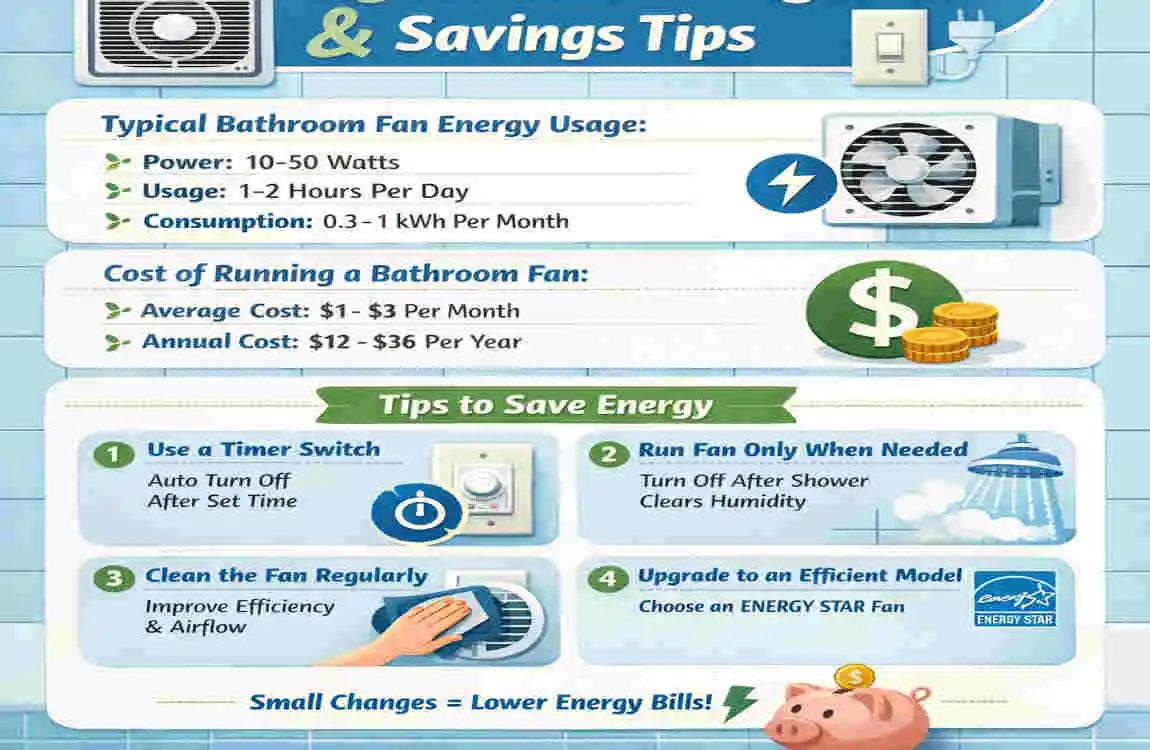
Even though the cost is low, we all like to save money. Here are actionable tips to cut your bathroom fan energy consumption by 30-50% without risking mold growth.
Install a Timer Switch
The biggest energy waste is human error—forgetting to turn the fan off. A simple countdown timer switch (10-20-30-60 minutes) ensures the fan runs long enough to clear the moisture but shuts off automatically. This prevents the fan from running for 8 hours while you are at work.
Use Humidity Sensors
This is the ultimate upgrade. A humidity-sensing switch detects increased moisture from showering and automatically turns the fan on. Once the humidity drops to a normal level, it shuts off. This guarantees the fan runs exactly as much as needed and no more .
Clean Your Fan Annually
Dust and lint build-up on the fan blades and motor housing creates drag. A dirty fan has to work harder and run hotter to move the same amount of air. Pop the cover off once a year and vacuum the insides. It improves efficiency and extends the fan’s life.
Zone Ventilation
Don’t rely on the fan alone if the weather is nice. If you have a window, crack it open while running the fan to create a cross-draft. This clears the room faster, allowing you to turn the fan off sooner.
Upgrade to LED
If your fan has a built-in light, check the bulb. If it’s an old incandescent or halogen, swap it for an LED. You will instantly reduce lighting energy usage from 60W to 9W.
Upgrades for Businesses
For our readers who own rental properties, hotels, or commercial spaces, the equation changes slightly. When you have 50 bathrooms in a hotel, “does bathroom fan use electricity” becomes a multiplication problem.
- Bulk Efficiency: Retrofitting a hotel with high-efficiency ECM motor fans can save substantial amounts on the master utility bill.
- Property Appeal: Marketing “green” or “eco-friendly” suites is a major draw for modern travelers.
- Protection: Tenants rarely care about your humidity levels. Installing humidity-sensing fans in rental units protects your investment from mold damage caused by tenants who never turn the fan on.
Common Questions (FAQ)
Here are some quick answers to the most frequent queries we get about bathroom ventilation energy.
Does bathroom fan use electricity if the switch is off?
Generally, no. Unless you have a smart fan with a standby mode or a built-in nightlight sensor, a standard fan draws zero power when the switch is off.
How many watts is a normal bathroom fan?
A “normal” residential fan typically draws between 20 and 50 watts. Older, cheaper builder-grade models are closer to 50W, while newer ENERGY STAR models are closer to 10-20W .
Does the fan speed affect electricity usage?
Yes. If you have a multi-speed fan, running it on “High” uses more electricity than “Low.” However, running it on Low might take longer to clear the steam, so it’s a balancing act.
Is it expensive to fix a bathroom fan that uses too much power?
If your fan is making a loud grinding noise, the motor is likely failing and drawing more amps than necessary. Replacing the motor or the entire unit is relatively affordable ($50-$150) and will lower energy usage and noise.