Did you know the global architecture and construction industry is currently valued at a staggering $10 trillion? That is a massive number that highlights just how much we rely on the spaces where we live, work, and play. But if you strip away the massive budgets and towering skyscrapers, what is architecture and construction really?
At its core, this industry is the perfect blend of art and science. It is the complex, fascinating journey of dreaming up a structure and then getting your hands dirty to build it from the ground up. Whether you are a curious homeowner, a budding student, or an entrepreneur looking to enter the market, understanding the basics of this field is absolutely essential.
Defining Architecture and Construction
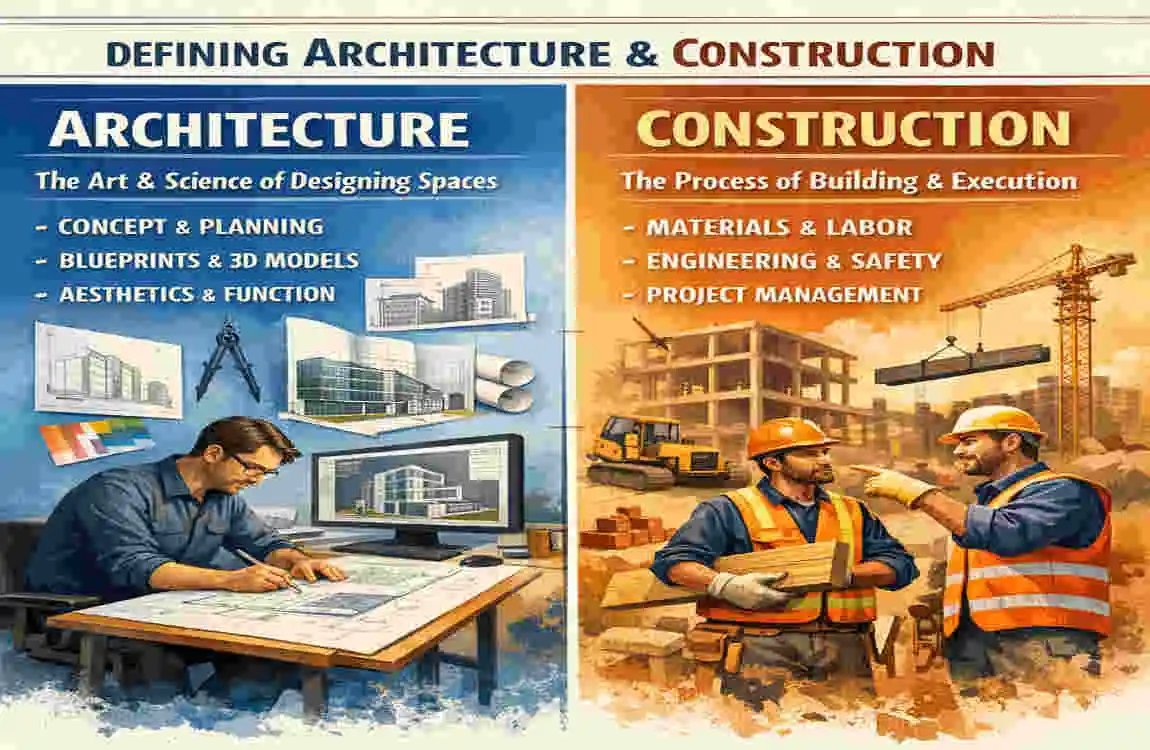
To truly grasp what architecture and construction are, you need to break the two concepts apart before you see how they perfectly fit together. Let us look at what makes each field unique and essential.
What Is Architecture? Core Principles and Role
Architecture is the creative mind behind the buildings you see every day. It is the art and science of designing physical structures that meet human needs.
If you look back at historical evolution, architecture has always told the story of human progress. From the ancient pyramids of Egypt that honored the divine, to the sleek glass skyscrapers of modern cities that represent global commerce, architectural design always reflects the values of its time.
Today, every great architect still follows a set of core elements first written down by the ancient Roman architect Vitruvius. This is known as the Vitruvius triad. First, a building must have form and durability; it needs to stand strong against the elements. Second, it must offer function and utility; it needs to serve its intended purpose perfectly. Finally, it must deliver aesthetics and beauty; it needs to bring joy and inspiration to the people who look at it.
The role of architects in modern society and business is massive. You rely on them to solve complex problems regarding space, light, and airflow. They must balance strict local zoning laws with your wildest creative dreams, ensuring that your new office or home is both legal to build and wonderful to experience.
What Is Construction? From Concept to Completion
If architecture is the dream, construction is the reality. The main difference from architecture is that construction is the hands-on building execution. It is the gritty, physical process of moving dirt, pouring concrete, and assembling materials to bring a drawing into the real world.
The construction industry breaks down into several unique types. Residential construction focuses on the homes, apartments, and townhouses where you sleep. Commercial construction builds the retail stores, massive malls, and office parks where you do business. Industrial construction creates the highly specialized factories, power plants, and refineries that keep society running. Finally, infrastructure construction deals with the roads, bridges, and water systems that connect us all together.
To pull off these massive projects, you need a diverse team of key players. General contractors oversee the entire daily operation on the site. Engineers calculate the math to ensure the roof will not cave in. Skilled laborers—like electricians, plumbers, and carpenters—do the heavy lifting and precise installations that make a building usable.
How Architecture and Construction Intersect
You cannot have a successful building without both disciplines working in perfect harmony. The intersection happens right at the blueprint. This is the magical document where imaginative design meets physical reality.
Think about a modern office tower project timeline. The architect spends months dreaming up a twisting glass facade that catches the sunset perfectly. However, the construction manager must look at that design and figure out exactly how many cranes, steel beams, and glass panels they need to order. They work together daily. When the builder discovers that a certain steel beam is unavailable, the architect must immediately redesign that section to keep the project moving. It is a constant, collaborative dance.
The Design Process in Architecture and Construction
Before a single shovel hits the dirt, a massive amount of planning takes place. The modern building design process is meticulous, ensuring that your final structure is safe, stunning, and on budget.
Step-by-Step Architectural Design Workflow
Every great building starts as a simple idea and moves through a strict workflow.
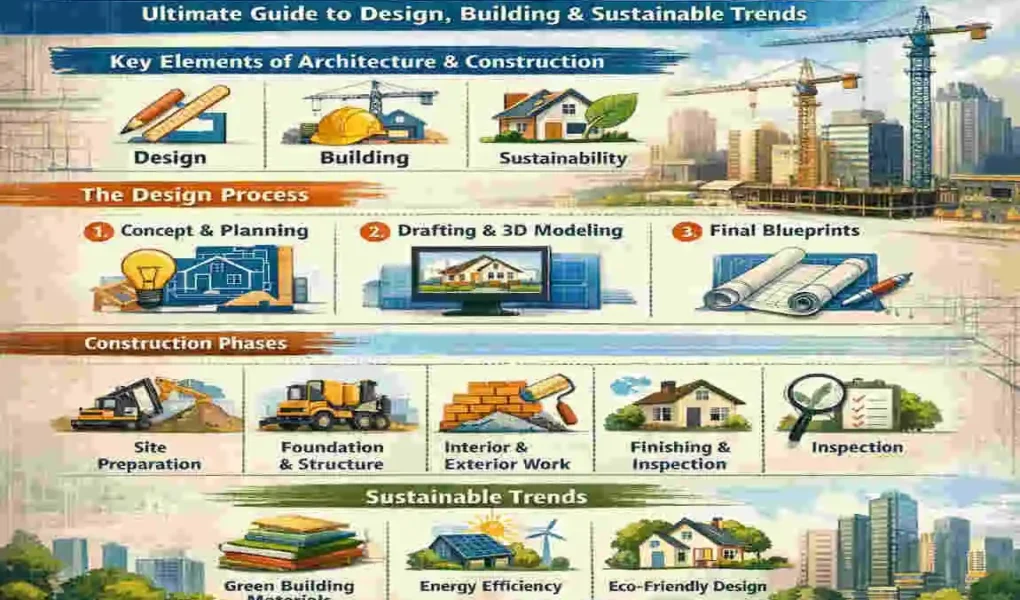
Conceptualization: This is the brainstorming phase. The architect sits down with you to understand your specific client needs. They also conduct a deep site analysis. They look at where the sun rises, how the wind blows across your property, and what the surrounding buildings look like.
Schematics and Blueprints: Next, the architect sketches out rough ideas. These schematics show the basic layout of rooms and hallways. Once you approve the rough sketches, the team drafts detailed blueprints. These are the exact, mathematically perfect drawings that builders will follow.
3D Modeling and BIM Software: Today, you rarely rely on just paper. Architects use Building Information Modeling (BIM) software, like Revit, to create exact 3D digital replicas of your building. This allows you to see the plumbing, electrical lines, and air ducts all in one digital space before anyone buys materials.
Revisions and Approvals: You will likely change your mind a few times. You might want a bigger window or a wider door. The team revises the plans until you are completely satisfied. Then, the final drawings go to the city for legal approval.
Pre-Construction Planning Essentials
Once the design is locked in, the construction team takes over for the pre-construction phase. This step is all about logistics and preparation.
First, teams conduct thorough site surveys to check the soil quality. If the soil is too soft, they need to plan for a deeper, more expensive foundation. Next, they secure the necessary building permits from local authorities. You cannot build anything legally without these stamps of approval.
Budgeting is the most critical step here. Estimators calculate the cost of every single nail, board, and hour of labor.
This is also when you finalize your material selection. Will you use flexible steel for an earthquake-prone zone? Will you pour heavy concrete for maximum soundproofing? Or will you choose engineered timber for a warm, eco-friendly aesthetic? Every choice impacts your budget and timeline.
Integrating Technology in Design
The technology used in architecture and construction is evolving at a breakneck pace.
Designers now use AI tools for rapid optimization. You can tell an artificial intelligence program the size of your lot, and it can instantly generate fifty different floor plans that maximize natural sunlight. This saves architects hundreds of hours of manual drafting.
Furthermore, Virtual Reality (VR) and Augmented Reality (AR) have completely changed how you experience a design. Instead of looking at flat blueprints, you can put on a VR headset and physically walk through your new home before it exists. You can see if the kitchen counters feel too high, or if the living room gets enough light.
The Construction Process Breakdown
Once the planning is complete, the physical labor begins. The construction process is a highly choreographed sequence of events where safety and precision are paramount.
Phases of Building Construction
Watching a building rise from an empty dirt lot is truly incredible. The process generally follows four major phases.
Foundation and Site Prep: First, massive excavators clear away trees, rocks, and old debris. Teams dig deep trenches and pour concrete to form the foundation. This is the anchor of your building. If the foundation is flawed, the entire structure is compromised.
Framing and Structural Work: Next comes the skeleton. Cranes lift heavy steel beams or wooden frames into place. Suddenly, you can see the actual shape and height of the building. Walls go up, and the roof goes on. At this point, the building is considered “dried in,” meaning rain can no longer get inside.
MEP Systems: MEP stands for Mechanical, Electrical, and Plumbing. With the shell finished, specialty workers come in to run miles of wire, install thick water pipes, and fit large air conditioning ducts behind the walls. This phase brings the building to life, giving it power, water, and breath.
Finishing and Inspections: Finally, the messy work ends, and the detailed work begins. Teams install drywall, paint the rooms, lay down flooring, and fit the cabinets. Once everything looks perfect, city officials conduct rigorous final inspections to ensure the building is entirely safe for you to occupy.
Common Tools, Materials, and Safety Standards
To pull off a modern build, you need serious equipment and heavy-duty materials.
Here are some of the most common items you will find on any active job site:
- Heavy Machinery: Tower cranes that reach the clouds, noisy concrete mixers, and powerful bulldozers.
- Traditional Materials: Cement, bricks, glass, and lumber.
- Sustainable Materials: Recycled steel beams, reclaimed wood, and low-emission paints that protect the environment.
With all this heavy machinery moving around, safety is an absolute priority. Sites must strictly follow guidelines set by organizations like OSHA (Occupational Safety and Health Administration). Workers must wear hard hats, steel-toed boots, and high-visibility vests. Harnesses are mandatory for anyone working high off the ground. A safe site is a productive site.
Challenges and Solutions in Construction
Despite the best planning, construction is notoriously unpredictable. You will almost certainly face challenges.
Weather delays are incredibly common. You cannot pour concrete in a freezing blizzard, and you cannot safely operate a crane in high winds. Cost overruns also happen frequently when material prices suddenly spike due to supply chain issues.
The best way to mitigate these strategies is through aggressive contingency planning. Smart project managers always build a financial buffer into their budget, usually around 10% to 15%, specifically for unexpected surprises.
Sustainable Trends in Architecture and Construction 2026
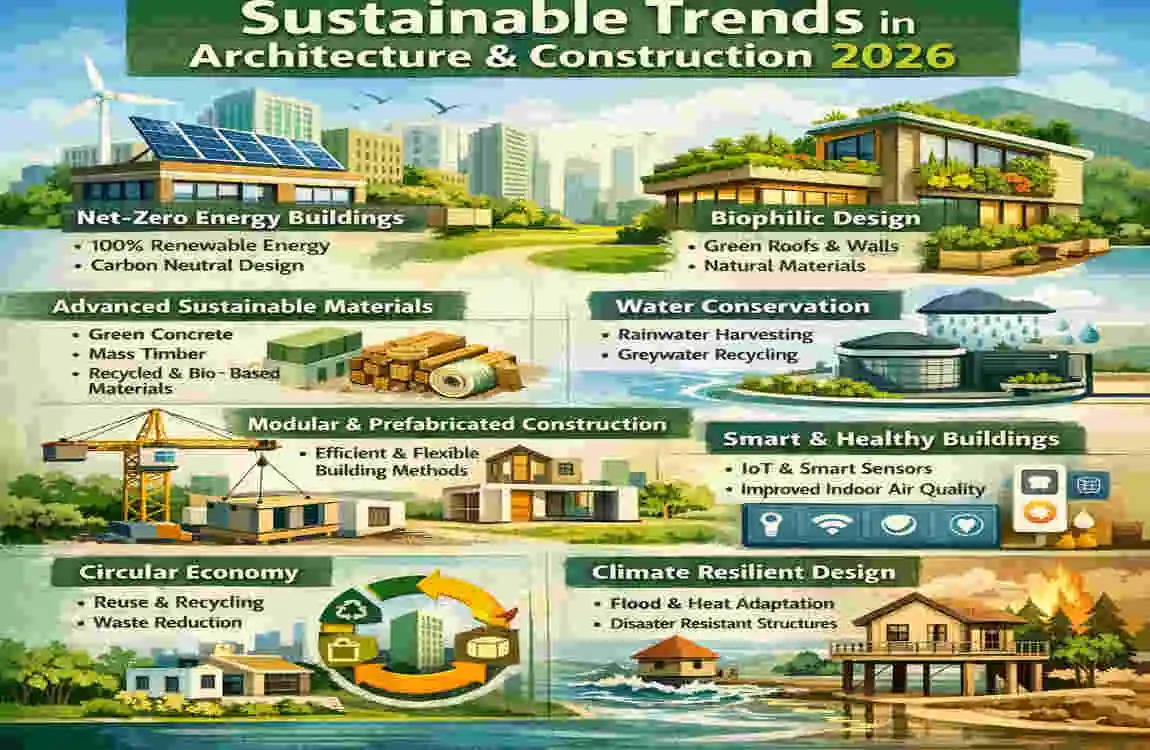
As we move deeper into 2026, the question is no longer how we build, but how we build responsibly. Sustainable architecture and construction trends 2026 are completely transforming the industry.
Why Sustainability Matters Now
You cannot ignore the environmental impact of building. According to recent United Nations data, buildings and the construction sector account for a massive 39% of global energy-related carbon emissions. That is a staggering footprint.
Because of this, governments and clients are pushing for strict new regulations. We are seeing a huge rise in LEED certification (Leadership in Energy and Environmental Design), which awards points to buildings that use less water and energy. Furthermore, many countries are adopting strict net-zero goals, meaning new buildings must generate as much clean energy as they consume.
Top Sustainable Architecture Trends
Architects are responding to these challenges with incredibly creative solutions.
Green roofs are becoming highly popular in urban environments. Instead of black tar that absorbs heat, roofs are covered in living soil and local plants. This naturally cools the building and provides a habitat for local birds and insects.
Passive solar design is another massive trend. Architects strategically place windows and roof overhangs so that the building naturally collects the sun’s heat during the cold winter, but blocks the harsh sun during the hot summer. This drastically reduces the need for artificial heating and cooling.
You also see a huge shift toward biophilic design. This is the practice of naturally integrating nature into the human environment. Think of large indoor living walls, natural water features in office lobbies, and massive skylights. It connects you to nature, which has been proven to reduce stress and boost human productivity.
Emerging Construction Innovations
On the building side, technology is pushing the boundaries of what is possible.
3D-printed homes are no longer science fiction. Massive robotic arms can now extrude layers of a special concrete mix, printing the entire exterior walls of a home in less than 48 hours. This drastically reduces material waste and labor costs.
We are also seeing the rise of carbon-capturing concrete. Traditional cement production releases a huge amount of CO2 into the air. New innovations allow manufacturers to inject captured CO2 directly into the concrete mix, trapping the greenhouse gas forever while actually making the concrete stronger.
Additionally, modular and prefab construction is changing timelines. Instead of building a house outside in the rain, entire rooms are built inside massive, climate-controlled factories. These finished modules are then driven to the site and stacked together like building blocks. It is incredibly efficient.
Business Benefits: Cost Savings and ROI
Going green is not just good for the earth; it is great for your wallet. Many developers initially worry that sustainable materials cost more upfront. However, the long-term Return on Investment (ROI) is undeniable.
When you invest in an energy-efficient design, you drastically reduce your monthly operating costs. High-quality insulation and smart HVAC systems can easily reduce energy bills by 30% or more. Furthermore, eco-friendly buildings often command higher rental rates because modern tenants want to live and work in healthy, green spaces.
Table: Traditional vs. Sustainable Building Approaches
Feature: Traditional Construction, Sustainable Construction (2026 Trends), Long-Term Business Benefit
Materials : Standard concrete, fresh timber , Carbon-capturing concrete, recycled steel . Lower carbon footprint, tax incentives
Energy Use Grid-reliant, high consumption Passive solar, solar panels, smart sensors Up to 30% reduction in monthly utility bills
Construction Method : Built entirely on-site, Modular/Prefabricated in factories , Faster completion times, less material waste
Lighting/Air Artificial lighting, standard AC Biophilic design, natural cross-ventilation Healthier tenants, higher property value
Key Skills, Careers, and Business Tips
Whether you want to design the next iconic skyscraper, manage a massive work site, or start your own firm, the architecture and construction industry offers incredible opportunities. However, you need the right mix of skills to succeed.
Essential Skills for Architecture and Construction Pros
To thrive in this field, you must develop a balance of hard and soft skills.
On the technical side, you must be comfortable with complex software. Architects need deep expertise in CAD (Computer-Aided Design) and modern 3D rendering tools. Construction managers need sharp project management skills, knowing how to balance multi-million dollar spreadsheets and highly complex scheduling software.
However, technical skills alone are not enough. You also desperately need strong soft skills. Clear communication is vital. An architect must clearly explain their vision to a client who knows nothing about building. A project manager must clearly instruct dozens of workers in a noisy environment. You also need fast problem-solving abilities because things will inevitably go wrong on a job site, and you must think on your feet.
Career Paths and Education
The career paths in this industry are distinct but highly rewarding.
If you choose to become an architect, you will focus heavily on design, aesthetics, and client interaction. This usually requires a rigorous 5-year bachelor’s degree followed by intense licensing exams.
If you prefer the execution side, becoming a construction manager might be your perfect fit. You will spend your days out in the field, wearing a hard hat, coordinating teams, and managing budgets.
To boost your career, consider earning recognized certifications. Getting your PMP (Project Management Professional) certification proves you can handle massive budgets and timelines. Earning your LEED AP (Accredited Professional) credential proves you are an expert in modern green building practices, making you highly valuable to eco-conscious clients.
Tips for Businesses Entering Architecture and Construction
Starting a new firm in this industry requires courage and a smart strategy.
First, focus heavily on your budgeting. Cash flow is the number one reason new construction businesses fail. You often have to buy materials upfront and wait weeks for the client to pay you. You must maintain strong credit lines and keep meticulous financial records.
Second, prioritize networking. This industry relies heavily on relationships. An architect needs to trust a contractor, and a contractor needs to trust their sub-contractors. Attend local industry events, shake hands, and build a reliable roster of partners.
If you look at local angles, regions experiencing rapid urban growth offer massive opportunities. Take the urban boom currently happening in Punjab, Pakistan, for example. As cities expand rapidly to accommodate a growing population, there is an immense demand for new commercial plazas, housing societies, and upgraded infrastructure. By positioning your business as a modern, reliable, and sustainable choice in these booming markets, you can secure highly profitable contracts.
Remember to showcase your expertise online clearly. A great website that explains your process and highlights your successful projects is your best sales tool. Be sure to highlight your comprehensive business services so clients know exactly how you can help them build their dreams.
Frequently Asked Questions (FAQs)
What is architecture and construction in simple terms? In the simplest terms, architecture is the creative process of designing a building, focusing on how it looks, feels, and functions. Construction is the physical process of taking those designs and actually building the structure using materials, tools, and human labor. One is the idea; the other is the execution.
How long does a typical construction project take? The timeline varies wildly depending on the scale. A standard single-family home usually takes about 6 to 9 months to complete from breaking ground to move-in day. However, a large commercial office building or a high-rise tower can easily take anywhere from 18 months to over 3 years, depending on weather and complexity.
What are the latest sustainable trends in architecture? The most exciting current trends focus on working with nature rather than against it. This includes biophilic design (bringing plants and natural light indoors), passive solar heating, green living roofs, and utilizing advanced materials like recycled steel and low-carbon concrete to heavily reduce environmental impact.
How much does architecture and construction cost in Pakistan? Costs fluctuate based on location, materials, and finish quality. As of recent estimates, standard residential construction in urban areas like Lahore or Islamabad generally ranges between PKR 3,500 to PKR 6,000 per square foot for grey structure and finishing. High-end luxury finishes or complex commercial designs will push those costs significantly higher.