You are sitting at your kitchen table, reviewing a few quotes for your upcoming roof replacement. Everything makes sense until you spot a line item that leaves you scratching your head. The contractor has written down that your home requires “25 squares” of materials.
Wait a minute, what? Your roof isn’t square, and you measure your house in square feet, not just “squares.” If you are feeling completely confused, take a deep breath. You are definitely not alone.
Many homeowners find themselves totally baffled when they first encounter industry jargon. But understanding what a square is in roofing terms is the key to unlocking your project’s budget. It is the golden rule of roofing measurements, and knowing how it works will protect your wallet.
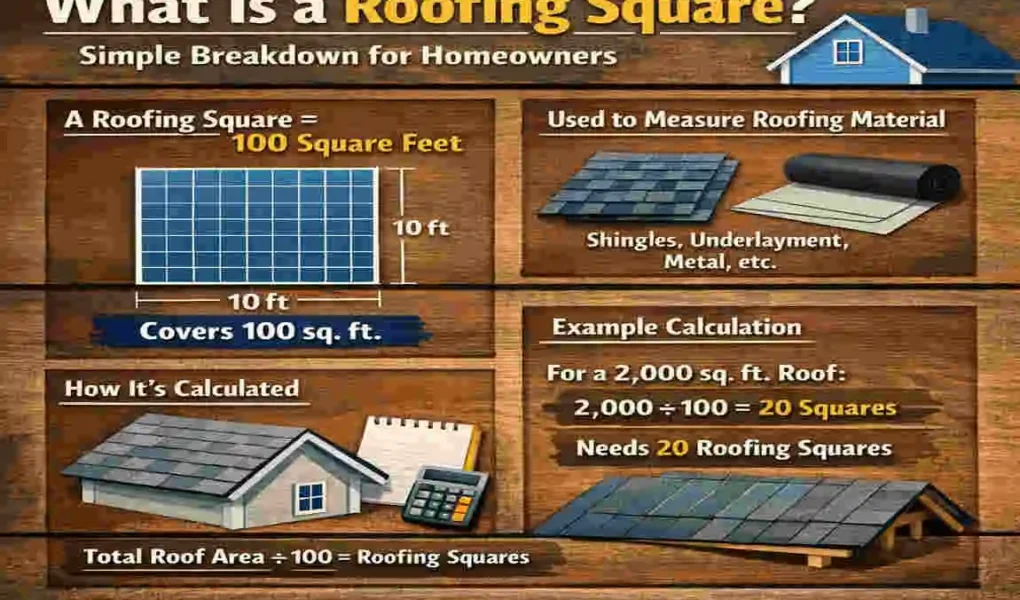
In simple terms, a square in roofing refers to exactly 100 square feet of roof surface. That is it! It is just a quick, easy shorthand that contractors use to measure your roof, order the right amount of materials, and give you an accurate price estimate.
Understanding the roofing square definition takes the guesswork out of your home improvement project. You will know exactly why the contractor ordered a specific number of shingles and how they arrived at their final price.
| Aspect | Description | Example |
|---|---|---|
| Size | 100 square feet of roof surface | 10 ft x 10 ft area |
| Calculation | Total sq ft ÷ 100 = squares | 2,400 sq ft = 24 squares |
| Purpose | Standardizes quotes and materials | 30 squares = 3,000 sq ft roof |
| Coverage | Includes slopes, not just flat area | All roof planes needing material |
Roofing Square Basics
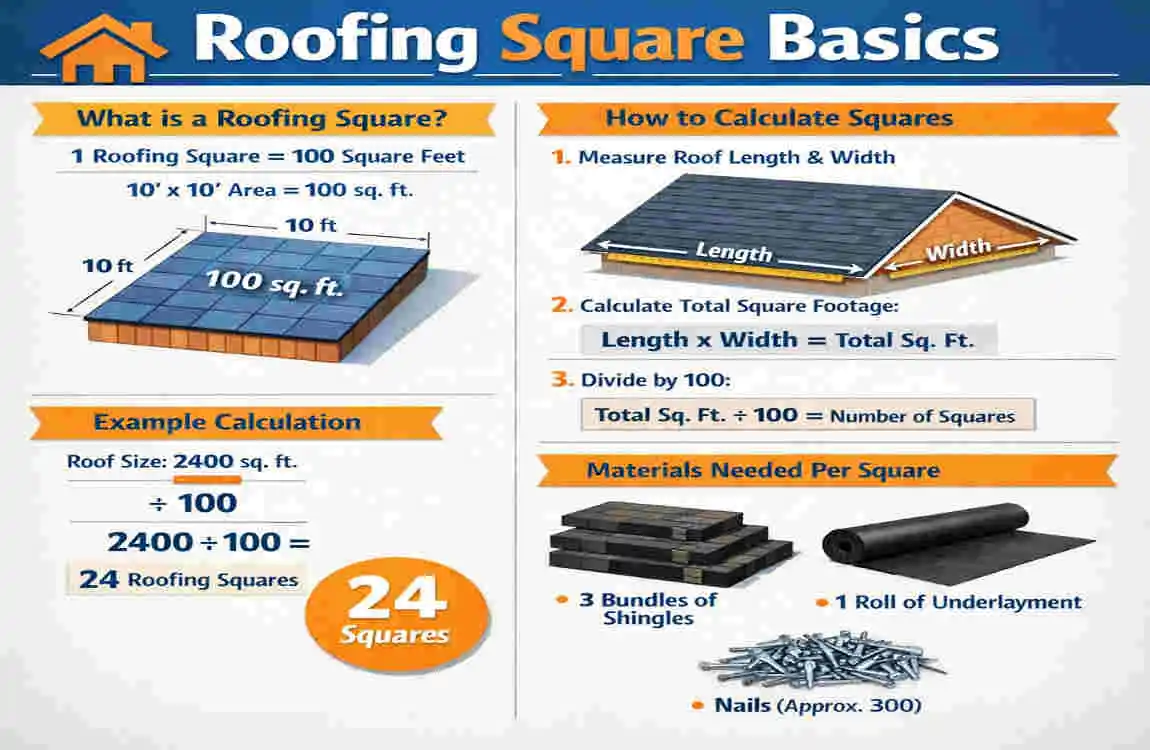
If you want to understand roofing measurements explained in plain English, we first need to look at where this terminology comes from and how you can visualize it on your own property.
The History Behind the Term
You might be wondering why roofers decided to invent their own measurement system rather than just use square feet like everyone else. The answer takes us back to the 19th century.
Back in the day, roofing materials were packaged and sold in bundles that naturally covered exactly 100 square feet. It was much easier for a builder to tell his crew, “Go grab three squares of shingles,” than to say, “Go get enough shingles to cover 300 square feet.” The shorthand stuck. Today, whether you are talking to a roofer in New York, Texas, or anywhere in North America, they all speak this same language.
Visualizing a Roofing Square
Let us paint a mental picture. Head out to your driveway or your backyard and imagine drawing a giant box on the ground. Make this box 10 feet long and 10 feet wide.
That 10×10 foot space equals exactly 100 square feet. That box represents one single roofing square.
If your contractor says your roof is 20 squares, imagine 20 of those 10×10 boxes laid out across the top of your house. It really is that simple.
House Footprint vs. Roof Area
Here is a very common trap that many homeowners fall into. You know your house is exactly 2,000 square feet on the inside, so you assume your roof must be 20 squares. Unfortunately, it does not work that way.
Your roof sits on a slant, which we call the pitch. Because of this slope, the roof actually has a much larger surface area than the flat floor plan of your home. Plus, your roof likely hangs over the edges of your exterior walls to create eaves. All of this extra space means your roof is always bigger than your indoor square footage.
Key Facts About Roofing Squares
To keep things simple, here is a quick checklist of facts to remember about a standard roofing square:
- Standard across the board: This measurement is standard across United States and Canadian roofing professionals. If you hire a pro, they will use this term.
- Not shape-specific: Despite the name, a “square” works for any roof section. Whether you have triangles, dormers, or weird angles, the total area is still grouped into 100-square-foot chunks.
- Works for all materials: This measurement is common for asphalt shingles, metal panels, and clay tiles. It does not matter what material you choose; the sizing method remains identical.
Now that we know the basic definition, how do you measure it, and why does the industry rely on it so heavily?
Why Use Squares in Roofing?
You might still be thinking, “Why not just use square feet and call it a day?” That is a fair question! But once you see the process from a contractor’s point of view, the roofing square for homeowners makes perfect sense.
Using squares benefits both you and the professionals working on your home. It simplifies the math, makes ordering materials a breeze, and helps reduce unnecessary waste.
Making Quotes Crystal Clear
When you look at a roofing estimate, you want to compare apples to apples easily. If Contractor A gives you a price based on 2,543 square feet, and Contractor B gives you a price based on 2,550 square feet, the big numbers can get messy.
By dividing everything into neat little packages of 100, the math becomes digestible. If a roofer charges $400 per square, and your roof is 20 squares, the math is simple: 20 times 400 equals $8,000. It keeps the pricing uniform and transparent.
Ordering Materials Without the Headache
Building suppliers sell roofing materials based on the square system. Let us look at standard asphalt shingles. In most cases, it takes exactly three bundles of asphalt shingles to cover one square (100 square feet) of your roof.
If your contractor knows your roof is 20 squares, they instantly know they need to order 60 bundles of shingles. If they had to calculate this using raw square footage with weird decimal points, the chances of making a math error would skyrocket.
The Infamous “Waste Factor”
Roofs are rarely perfect, simple boxes. They have valleys, ridges, chimneys, and vents. To fit materials around these obstacles, roofers have to cut the shingles. Every time they cut a shingle, a small piece is thrown away.
Contractors account for this by adding a “waste factor” to your total squares. Usually, this means adding 10% to 15% more material to the final order. Using squares makes this waste calculation incredibly fast and accurate.
To help you visualize the benefits, check out this simple breakdown:
Aspect Square Benefits Real-World Example
Quotes Uniform pricing per square $400/square = $8,000 for a 20 sq roof
Materials Bundles are sold by the square 3 bundles = 1 square of coverage
Communication Avoids confusion with massive numbers Saying “30 squares” is easier than “3,000 sq ft”
Homeowners save by understanding this before signing. When you know exactly how many squares your roof actually is, you can spot a contractor who might be trying to overcharge you for materials you do not need!
How to Calculate Roofing Squares
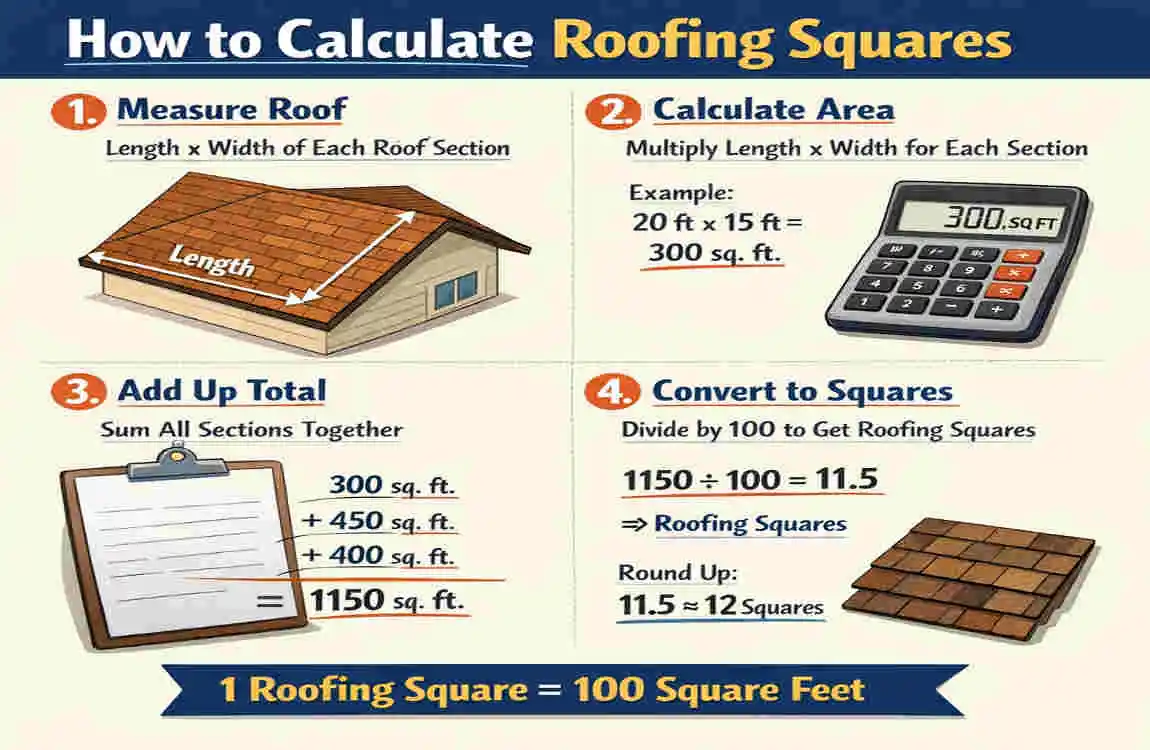
Are you feeling brave? Do you want to figure out your own roof size before calling a professional? Learning how to calculate roofing squares is entirely possible if you follow a few basic steps.
You do not even have to climb up on a ladder if you do not want to! We are going to walk through the exact process that professionals use to measure a home.
Sketch Your Roof
First things first, grab a piece of paper and a pencil. Walk around the outside of your house and look up. You want to draw a rough bird’s-eye view of your roof.
Do not worry if you are not an artist! Just draw the basic shapes. Note where the flat planes are, where the peaks (ridges) meet, and where the roof dips down (valleys). Break your roof down into simple geometric shapes, like rectangles and triangles.
Measure the Ground Area
If you have a simple gable roof (two sloping sides that meet at the middle), measuring is a breeze. Take a tape measure and measure the length and width of your home’s exterior walls on the ground.
Do not forget to add the overhangs! If your roof overhangs your exterior walls by 1 foot on each side, add those feet to your total ground measurements. Multiply the total length by the total width to get your flat ground square footage.
Account for the Roof Pitch
Here is the most important step. Because your roof is angled, it has more surface area than the flat ground below it. You have to multiply your flat ground measurements by a “pitch factor.”
Roof pitch is measured by how many inches the roof rises for every 12 inches it goes inward. A 4/12 pitch means the roof rises 4 inches for every 12 inches it extends toward the center.
Here is a quick cheat sheet for common pitch multipliers:
Roof Pitch Multiplier Visual Description
Flat Roof 1.000 Completely flat, common on commercial buildings.
4/12 Pitch 1.054 A very gentle slope, easy to walk on.
6/12 Pitch 1.118 A standard, medium slope found on most homes.
9/12 Pitch 1.250 A steep slope, difficult to walk on without gear.
12/12 Pitch 1.414 A very steep, sharp peak. Often seen on older farmhouses.
Do the Final Math
Now it is time to put it all together. Here is the golden formula for finding your roofing squares:
(Length × Width × Pitch Factor) ÷ 100 = Total Squares
Let us look at a real-world example to make this crystal clear. Imagine your home (including the roof overhangs) measures 50 feet long and 40 feet wide. You have a moderately steep roof with a 9/12 pitch, which gives us a pitch factor of 1.25.
- Multiply 50 x 40 = 2,000 flat square feet.
- Multiply 2,000 x 1.25 (pitch factor) = 2,500 true roof square feet.
- Divide 2,500 by 100 = 25 squares.
Add the Waste Factor
Remember our talk about the waste factor? You never want to order exactly 25 squares, because your crew will run out of materials when they have to cut shingles to fit around your chimney.
As a general rule, add 10% to your total for a simple roof, or up to 15% for a complex roof with lots of angles.
10% of 25 squares is 2.5 squares. Therefore, your contractor will likely order 27.5 squares of material to ensure your project is completed safely.
Roofing Square Costs Explained
Now we are getting to the part that really matters to your bank account: the roofing square cost.
When a contractor hands you a quote, they have already calculated your total squares and multiplied it by their unique cost per square. This cost includes both the physical materials (the shingles, underlayment, and nails) and the labor required to tear off the old roof and install the new one.
Breaking Down the Price Tag
As of 2026, the average cost to replace a roof ranges anywhere from $300 to $600 per square installed. However, this is a massive range! Why does one roof cost $300 a square, while another costs double that amount?
The final price tag comes down to three major factors: the materials you choose, the labor costs in your area, and the complexity of your roof.
Material Choices Matter
The single biggest factor in your per-square cost is what you are actually putting on your head.
Standard asphalt shingles are incredibly popular because they are highly cost-effective. But if you want something that lasts longer, like a metal roof, the materials cost significantly more. Let us look at a quick breakdown of average installed costs based on material types:
Material TypeCost per Square (Installed)Coverage Notes
Asphalt Shingles $300 – $450 Standard choice. Requires roughly 3 bundles per square.
Metal Roofing $500 – $800+ Highly durable. Can easily last 50+ years against the elements.
Clay / Concrete Tile $600 – $1,000+ Extremely heavy. Often requires extra structural reinforcement.
Labor and Location Factors
Your zip code plays a massive role in your roofing square cost. If you live in a high-cost-of-living region, contractors have to pay their crews higher wages, which are passed on to you.
Furthermore, local weather events completely change the market. For example, severe weather events, such as the intense Lahore storms, can suddenly raise prices in affected areas. When extreme winds or hail damage thousands of roofs at once, the demand for roofers skyrockets. Materials become scarce, and contractors have to work overtime, causing the cost per square to jump significantly during storm season.
Finally, consider the danger level. A flat, simple one-story roof is fast and easy to work on. A three-story home with a massive, steep pitch requires safety harnesses, extra time, and specialized equipment. Your roofer will charge a higher per-square rate to account for the added risk and time.
Common Myths About Roofing Squares
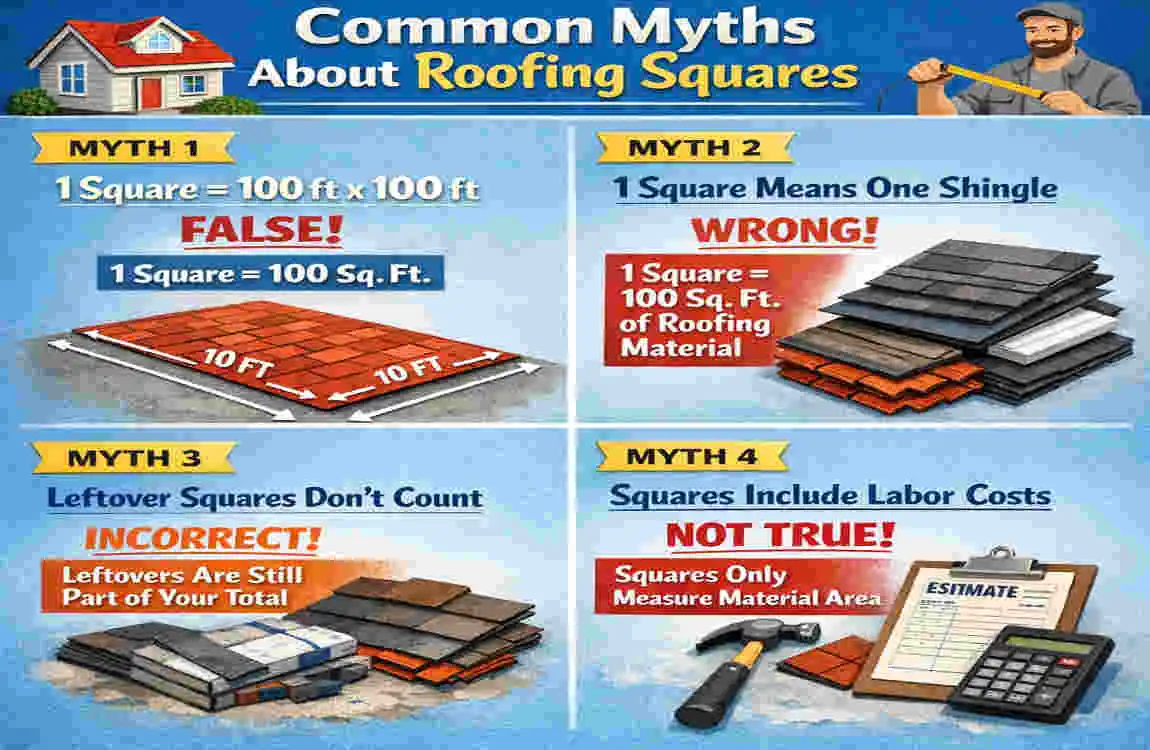
Whenever an industry has its own unique jargon, myths and misunderstandings are bound to pop up. When homeowners try to figure out what is a square in roofing terms, they often stumble across bad advice on the internet.
Let us clear the air and bust the three most common myths we hear from homeowners every single week.
Myth 1: Your Roof Size Matches Your House Size
We touched on this earlier, but it is worth repeating because it is the most common mistake homeowners make.
The Myth: “My house is 1,500 square feet, so I need exactly 15 squares of roofing.”
The Reality: Absolutely not! Because of the pitch (the slant) of your roof, and the eaves that hang over the sides of your house, your roof surface is always larger than your indoor living space. A steep pitch can easily inflate your total roof area by 20% to 30%. If you order exactly 15 squares for a 1,500-square-foot house, your contractor will run out of materials when the roof is only 75% finished.
Myth 2: The Whole World Uses Squares
The Myth: “If I look up global roofing advice, the math will be the same.”
The Reality: The roofing square is highly specific to North America. It is the gold standard in the United States and Canada. However, if you are reading a blog post from a contractor in the United Kingdom or Australia, they do not use squares. They measure roofs in square meters (m²). Always ensure you are reading local, North American advice when calculating your project budget!
Myth 3: A Square Always Costs the Same
The Myth: “My neighbor paid $350 a square last year, so my roof will definitely cost $350 a square.”
The Reality: As we learned in the cost section, the price per square is never fixed. Your neighbor might have a walkable, gently sloped roof, while you might have a steep roof with multiple skylights and valleys. Complexity adds time, and time adds labor costs. Furthermore, material prices fluctuate based on the economy and local weather events. Every quote is unique to the specific house.
Roofing Squares FAQs
Even with all this information, you might still have a few lingering questions bouncing around your head. To ensure you are fully prepared for your next home improvement project, we have compiled a list of the most frequently asked questions.
What is a square in roofing terms?
In the simplest terms, a roofing square is a unit of measurement equal to exactly 100 square feet of roof surface area. Contractors use this unit to easily estimate material needs and provide homeowners with clear, uniform pricing. Imagine a 10-foot by 10-foot box on your roof—that is one square!
How many squares on a 1,500 sq ft house?
You cannot just divide 1,500 by 100; you must account for the roof pitch and overhangs! On average, a 1,500-square-foot home with a standard slope will have roughly 1,800 to 2,000 square feet of actual roof surface. When you add a 10% waste factor, you are looking at roughly 20-22 roofing squares.
Do pros overcharge per square?
Reputable, licensed professionals do not overcharge per square. The price they quote per square includes the cost of tearing off your old roof, disposing of the trash, the new materials, the labor to install it, and their business insurance. If a quote seems exceptionally high, it is usually because the roof is dangerously steep or requires expensive structural repairs. Always get three quotes to compare!
Are bundles the same as squares?
No, bundles and squares are entirely different things. A square is a measurement of space (100 square feet). A bundle is a physical package of shingles. For standard asphalt shingles, you need to buy three bundles to cover one square of roof space.
Why do we add a waste factor?
Roofs have obstacles like chimneys, plumbing vents, and valleys. Shingles are manufactured in straight lines. To make straight shingles fit around round pipes or angled valleys, contractors have to cut them. The cut-off scraps cannot be reused, so they become waste. Adding a 10-15% waste factor ensures the crew has enough fresh material to finish the job without having to pause to order more.
Can I measure my roofing squares from the ground?
Yes, absolutely! You can measure the exterior footprint of your house with a tape measure, add the length of your overhangs, and multiply that flat number by a pitch multiplier to find your squares. Alternatively, you can use satellite imagery apps that handle all the dangerous measurement work for you, without anyone ever having to touch a ladder.