How much does it cost to build a house in Virginia amid rising 2026 prices? You are not alone. Many future homeowners in the state are asking the same question, especially as land, labor, and material prices continue to shift.
Building a home in Virginia can be exciting because it gives you more control. You can choose the layout, finishes, energy-saving features, and even the lot itself. But that freedom comes with a price. In many parts of the state, the average cost to build a house in Virginia now ranges from $155 to $500+ per square foot, and that means a typical home can land anywhere from $500,000 to $1,500,000 or more, depending on size, location, and the level of finish you want.
That is why the build vs. buy house decision in Virginia matters so much in 2026. In many cases, buying a move-in-ready home still costs around $350,000 to $450,000 turnkey, and it usually gets you into a home much faster. Building, on the other hand, can offer a better long-term fit if you want customization, better efficiency, and the chance to create a house that truly matches your lifestyle.
| Category | Cost Range | Notes |
|---|---|---|
| Per Sq Ft (Basic) | $150–$325 | Includes foundation, framing, basic materials; lower in rural areas ($120–$200). |
| Per Sq Ft (Custom) | $325–$500+ | Higher-end finishes, Northern VA/coastal regions up to $300+. |
| 2,000 Sq Ft Home | $310K–$600K+ | Excludes land; add $20K–$100K for site prep, permits, utilities. |
| 3,000 Sq Ft Home | $465K–$690K+ | Varies by metro vs. rural; construction loan down payments 20–25%. |
| Land (per acre) | $10K–$50K+ | State avg. ~$24K; urban lots cost more. |
| Regional Variance | Rural: $120–$200 Suburban: $150–$250 Urban: $180–$300+ |
Northern VA highest due to demand. |
Build vs. Buy in Virginia: Which Makes More Sense in 2026?
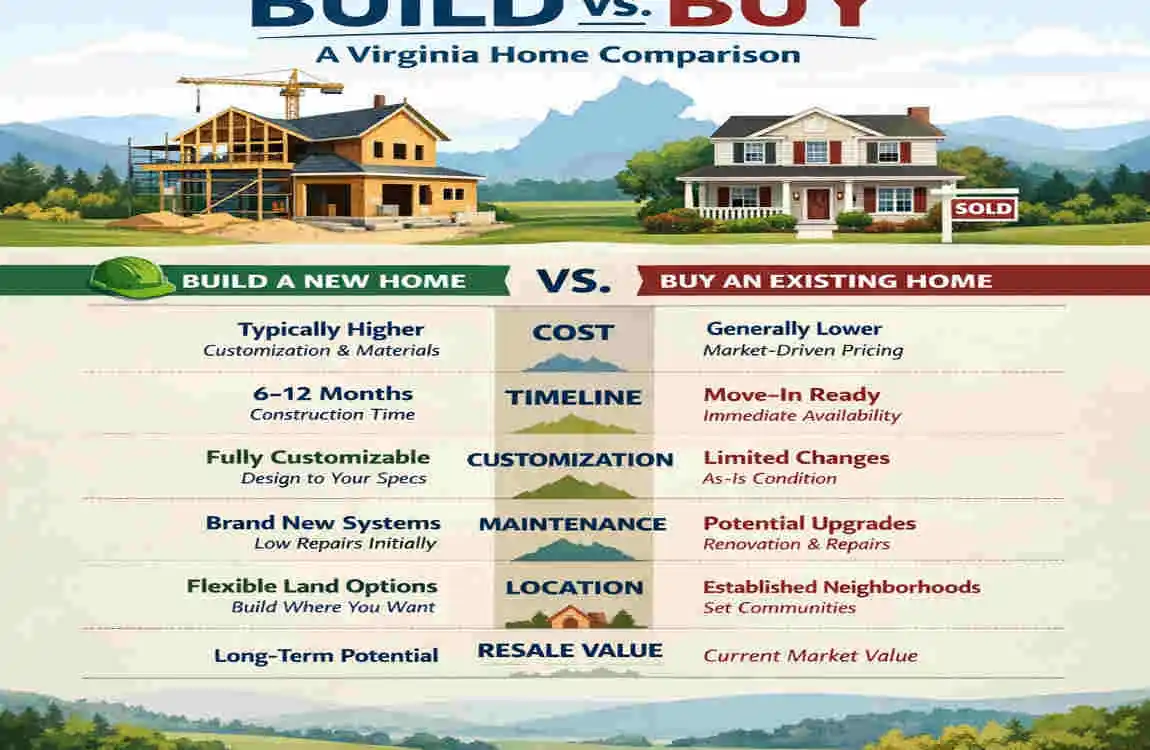
Before you dig into the full cost breakdown, it helps to compare the two main paths side by side. Many people begin with the dream of building a house, but once they look closely at the budget, timing, and risk, they realize that buying may be a better fit for their situation.
The truth is simple: building gives you control, while buying gives you speed. The better choice depends on what matters most to you.
Build vs. Buy Comparison Table
FactorBuild a House in VirginiaBuy a House in Virginia
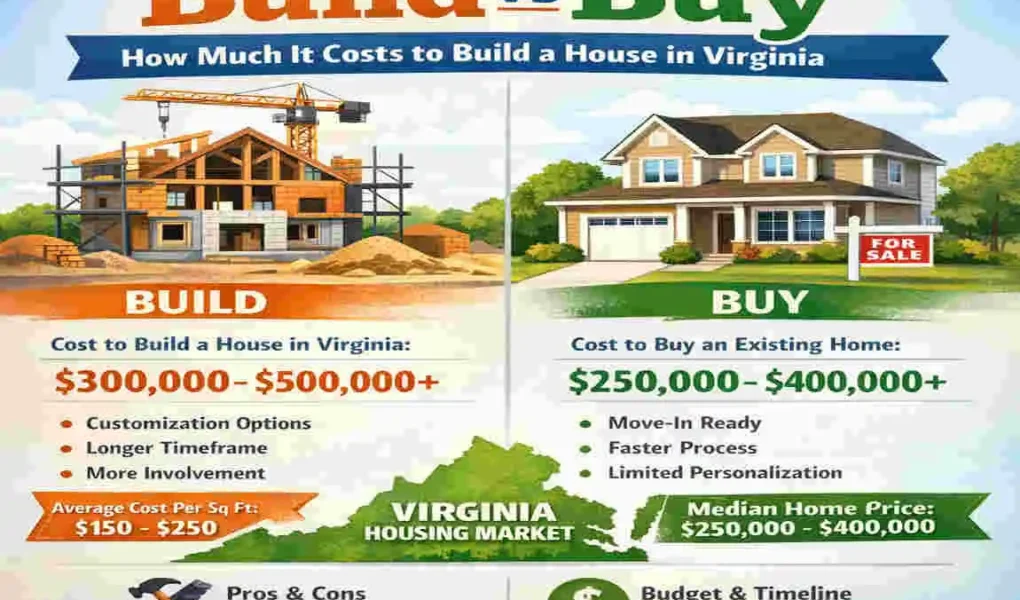
Total Cost $400K–$650K+ excluding land $350K–$450K turnkey
Cost per Sq Ft $155–$300+ for standard builds, higher for custom homes $160–$240+ depending on the market
Timeline 9–12 months or longer 30–60 days in many cases
Customization Full control over design, layout, and finishes Limited to what is already built
Down Payment 20–25% is common for construction loans 3–5% may be possible with FHA or VA loans
The table shows why the decision can be tough. Building may cost more upfront, but it can also give you a better fit for your needs. Buying can save time and reduce stress, especially if you need to move soon.
When Building Wins in 2026
Building may be the better option if you want:
- A specific layout or floor plan
- A larger lot or a quieter location
- Energy-efficient materials and systems
- Long-term value from a home designed for your family
- Less repair work in the first few years
In many Virginia markets, newer homes also tend to perform well because buyers like modern kitchens, open floor plans, and lower utility costs. If your goal is to stay in the home for a long time, building can make more sense even if the initial price is higher.
When Buying Makes More Sense
Buying may be smarter if you want:
- A faster move-in
- Lower upfront risk
- A simpler loan process
- Less stress around weather delays, labor shortages, or permit issues
- A lower total budget
For many households, buying works best because it brings certainty. You know the final price. You know the neighborhood. And you can often close much faster than a new build allows.
So, when people ask how much does it cost to build a house in Virginia, the real answer is not just about the price tag. It is also about what you get for that money, how long you can wait, and how much control you want over the final result.
How Much Does It Cost to Build a House in Virginia?
This is the core question for most future homeowners. The short answer is that Virginia home building costs in 2026 vary widely, but most homes fall within a broad range based on style, location, and finish level.
Cost per Square Foot in Virginia
For a basic to mid-range home, you can often expect costs around:
- $250 to $325 per square foot for a standard, well-finished build
- $325 to $500+ per square foot for custom homes with upgraded materials and details
- $155 to $300+ per square foot in some lower-cost or modular scenarios, depending on site and labor conditions
That spread is wide because no two homes are exactly alike. A simple 1,800-square-foot ranch on a flat lot is much cheaper to build than a 4,000-square-foot custom home with a basement, a high-end kitchen, specialty windows, and complex rooflines.
What That Means for a Typical Home
If you build a 2,000-square-foot home, here is what the cost may look like:
- Lower-end build: about $310,000
- Mid-range build: about $500,000 to $650,000
- Higher-end custom build: $600,000+
For a 3,000-square-foot home, the range becomes even larger:
- Basic to mid-range: around $465,000 to $975,000
- Custom or luxury: $1 million and up
That is why people often see very different answers online when they search for how much it costs to build a house in Virginia. The answer depends on the lot, home size, type of build, and the market you are building in.
Main Cost Components of a Virginia Home Build
A home build is not one single expense. It is a stack of many smaller costs that add up quickly. Some of the biggest parts include:
- Foundation and site prep: often $20,000 to $50,000
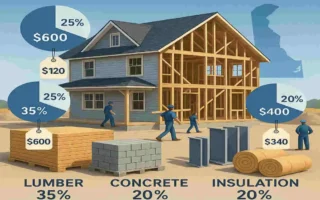
- Framing and structural work: usually 30% to 40% of the total budget
- Roofing, siding, windows, and doors
- Plumbing, electrical, and HVAC systems
- Insulation and drywall
- Flooring, cabinets, countertops, and fixtures
- Paint, trim, and final finishes
- Utilities, hookups, and final inspections
If you are building in a place with difficult soil, steep land, or a long utility run, those costs can rise quickly. A flat, clear lot is much easier and cheaper to develop than a wooded or sloped one.
Why 2026 Prices Feel Higher
Construction prices in 2026 are still influenced by the same factors that pushed costs up over the last few years:
- Material price pressure
- Labor shortages in some regions
- Higher borrowing costs
- Strong demand for housing
- More expensive land in desirable areas
Compared with 2025, many builders are seeing increases of about 5% to 10%, though some local markets move more than that. If you are planning a build, it is smart to expect some price movement rather than assuming today’s estimate will remain fixed throughout the project.
Simple Cost Breakdown Example
To make this easier to picture, here is a rough sample budget for a mid-range Virginia build:
- Land preparation: $25,000
- Foundation: $35,000
- Framing and shell: $160,000
- Mechanical systems: $75,000
- Interior finishes: $120,000
- Permits and inspections: $15,000
- Contingency fund: $40,000
That adds up to $470,000 before land in many cases, and the total can rise fast if the home is larger or the finish level is higher.
The key takeaway is this: the cost to build a house in Virginia is not just about square footage. It is about the full package of land, labor, materials, and finish level.
Regional Cost Variations Across Virginia
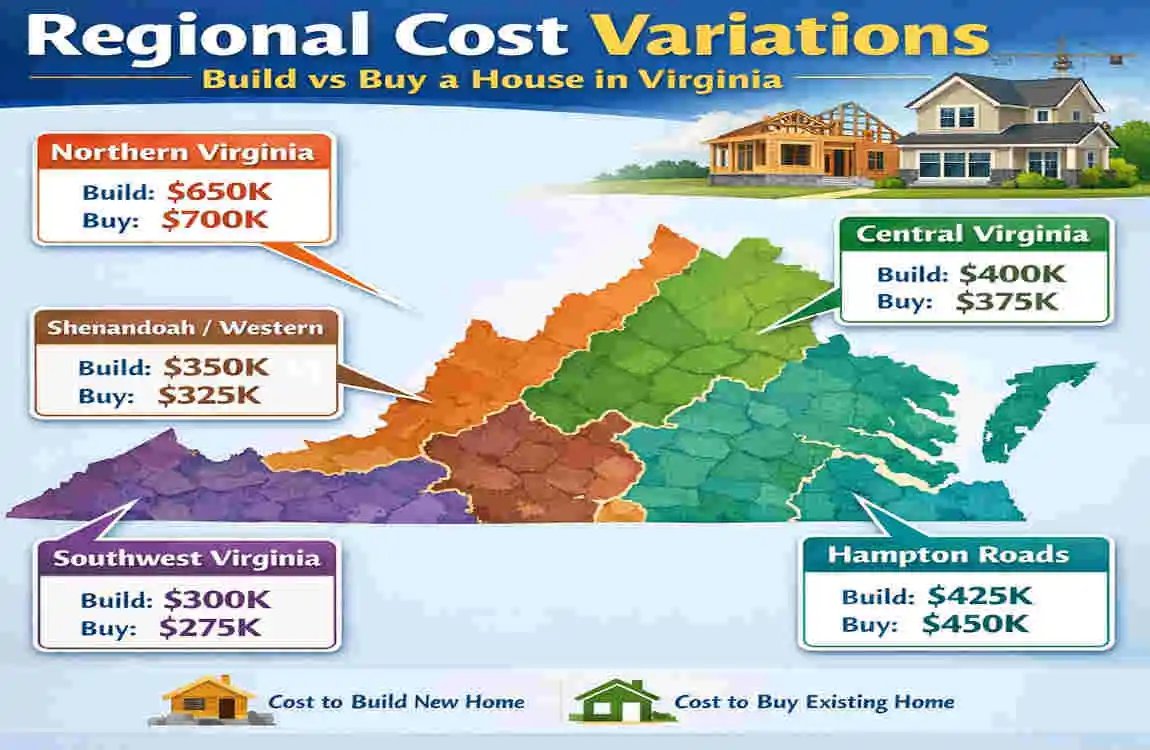
Virginia is not one single housing market. Costs vary widely depending on where you build. Labor rates, land prices, county rules, and local demand all affect the final number.
A home in Northern Virginia will usually cost more than a similar house in a rural part of southwest Virginia. That difference is one of the biggest reasons people researching cost to build a house in Virginia need to focus on their exact region.
Regional Cost Table
RegionCost per Sq FtExample 2,500 Sq Ft Home
Northern Virginia (Arlington, Fairfax, McLean) $200–$300+ $500,000–$750,000+
Richmond Area $170–$220+ $425,000–$550,000
Virginia Beach / Suburban Coastal Areas $150–$250 $375,000–$625,000
Rural / Southwest Virginia $120–$200 $300,000–$500,000
These are broad estimates, but they show the general pattern. The closer you get to high-demand metro areas, the more expensive the build usually becomes.
Northern Virginia: High Demand, Higher Prices
Northern Virginia is often the most expensive part of the state for home building. Land is scarce, labor costs are higher, and local demand stays strong. Many buyers also want larger homes with upgraded finishes, which further pushes prices up.
If you are building in Arlington, Fairfax, Loudoun, or McLean, expect the budget to move toward the higher end of the scale. Even a modest home can become expensive, as the land alone can be costly.
In this region, the cost increase is not just about the house itself. It also comes from:
- Higher land values
- Strict local building rules
- More expensive subcontractors
- Greater demand for premium finishes
If you want to build here, planning matters more than ever. A good builder, clear scope, and realistic contingency fund can save you from major surprises.
Richmond Area: Mid-Range Costs With Strong Demand
Richmond tends to sit in the middle of the Virginia market. You can still find some reasonable opportunities, but prices are rising as more buyers move into the area.
The Richmond region often offers a better balance between cost and convenience. You may pay less than Northern Virginia, but more than a rural market. That makes Richmond attractive for families who want city access without the highest-end pricing.
Typical costs in this region often reflect:
- Moderate labor pricing
- Steady land demand
- A broad mix of home styles
- Good access to builders and trades
For many buyers, Richmond feels like the “middle lane” of Virginia homebuilding costs in 2026. It is not the cheapest option, but it can be a good value if you want growth and flexibility.
Virginia Beach and Coastal Suburbs
Virginia Beach and nearby suburban areas can vary widely. Some neighborhoods are more affordable, while coastal or highly desirable areas can see prices jump quickly.
The coastal market often includes extra expenses tied to:
- Weather exposure
- Flood-zone planning
- Stronger foundation or elevation requirements
- Insurance concerns
- More expensive site prep in certain areas
These added costs matter because they can turn a normal build into a more complex project. A coastal lot might look attractive, but the site work alone can change your budget in a big way.
Rural and Southwest Virginia: Lower Cost, Fewer Pressures
If you build in rural or southwest Virginia, your cost per square foot may be lower. Land is usually more affordable, and labor pressure is often less intense than in larger metro areas.
Still, lower land prices do not always mean an easy project. Some rural locations come with their own challenges, such as:
- Longer utility runs
- Less developed roads
- More grading or site clearing
- Fewer nearby subcontractors
- Longer material delivery times
So while the total cost may be lower, you should still plan carefully. A cheap lot can become expensive if utilities and access are difficult to obtain.
Why the Same House Costs Different Amounts
You might wonder how the same house style can cost so differently across the state. The answer is simple: the house itself is only part of the equation.
A builder in one region may pay more for labor, another may pay more for land, and another may need to spend more to prepare the site. That is why two homes with the same floor plan can have very different final prices.
If you are serious about building, always compare local quotes, not just statewide averages. That is the best way to understand your real budget.
Hidden Costs and Budget Traps You Should Not Ignore
One of the biggest mistakes buyers make is focusing only on the base price of the house. In real life, the hidden costs can be large enough to change the whole project.
If you are trying to figure out how much it costs to build a house in Virginia, you need to include items people often forget. These costs are real and can add tens of thousands of dollars to the final amount.
Common Hidden Costs
Here are some of the most common extra costs:
- Permits and inspections: often $10,000 to $30,000
- Utility hookups: water, sewer, electric, and gas runs
- Land purchase: often $20,000 to $100,000+ per acre, depending on location
- Architect or design fees: usually 10% to 15% of the build cost for custom work
- Driveways and walkways
- Landscaping and yard grading
- Temporary power and water during construction
- Appliance purchases
- Closing costs and loan fees
- Unexpected soil or drainage issues
These costs do not always appear in the first estimate. That is why many homeowners feel surprised midway through the process.
Site Prep Can Change Everything
Site prep is one of the most underestimated parts of the build. A lot that looks simple may still need major work before construction can begin.
For example, you may need to pay for:
- Tree clearing
- Rock removal
- Soil testing
- Excavation
- Grading
- Drainage planning
- Foundation adjustments
A flat, easy lot is much cheaper than a sloped, flood-prone, or heavily wooded lot. This is especially important in parts of Virginia where land can look affordable at first but may require extensive prep work.
Don’t Forget the Finish Level
A home’s finish level can swing the budget by a huge amount. The difference between standard and custom is not small.
A basic home may use:
- Standard cabinets
- Builder-grade flooring
- Basic tile
- Mid-range fixtures
- Simple lighting packages
A custom build may include:
- Hardwood flooring
- High-end countertops
- Special trim work
- Premium appliances
- Larger windows
- Designer lighting
- Custom showers and built-ins
Those upgrades may seem small one by one, but together they can add a lot to the final cost.
Budget Tips That Help You Stay on Track
If you want to avoid surprises, use these simple rules:
- Always add a contingency fund of 10% to 20%
- Get at least 3 builder quotes
- Ask what is included and what is not
- Check if land prep is included
- Avoid changing plans once construction starts
The more complete your plan is at the start, the fewer shocks you will face later.
Financing and Savings Strategies for Virginia Homebuilders
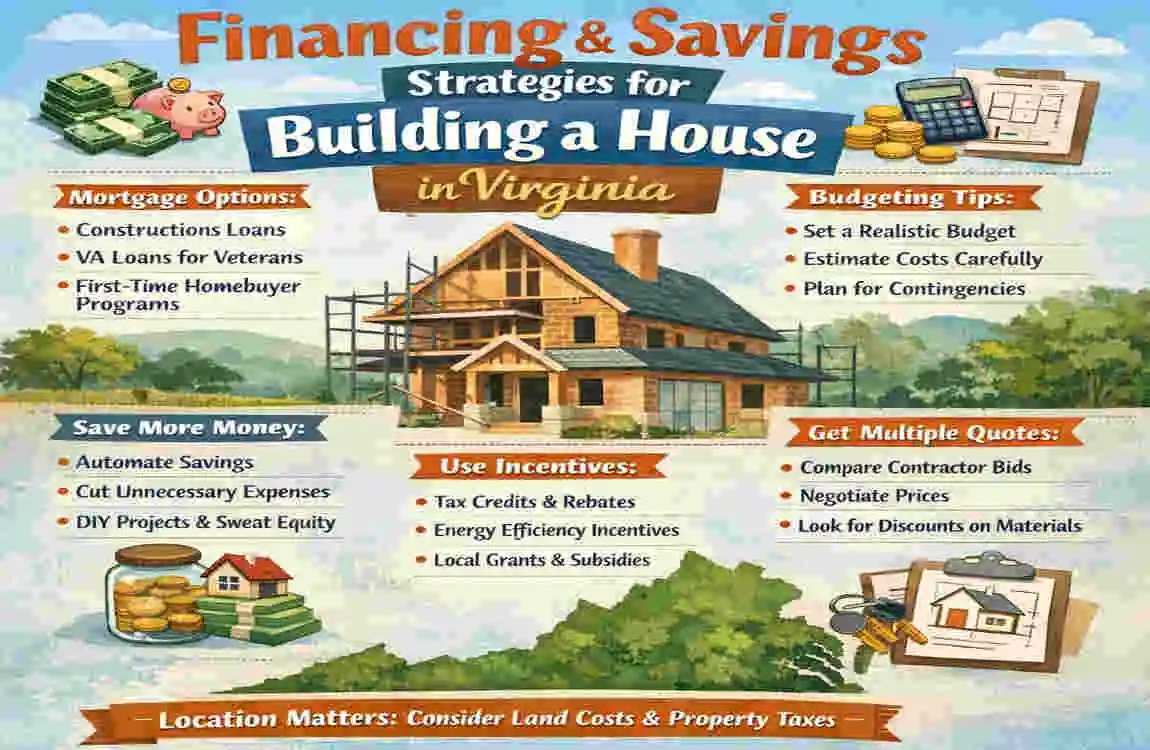
Even if you understand the build cost, financing can still feel confusing. Construction loans work differently from regular home loans, and that difference matters.
If you are serious about building, you need a financing plan that matches the timeline and risk level of a new construction project.
Common Loan Types
The most common option is a construction-to-permanent loan. This kind of loan usually covers the building phase first, then converts to a long-term mortgage after the home is finished.
Other common financing paths include:
- Construction-only loans
- Construction-to-permanent loans
- Cash-funded builds
- Land loans paired with a construction loan
Construction loans often require a larger down payment than a normal mortgage. In many cases, borrowers should expect to put down 20% or more, especially if the land is not already owned.
What Rates Might Look Like in 2026
Loan rates change often, but in 2026 many borrowers are still seeing construction financing in the 6% to 8% range, depending on credit, lender, and loan structure.
That matters because interest during construction can add real cost. Unlike a standard mortgage, a construction loan may only charge interest on the amount drawn so far. Still, those payments can add up if the build takes longer than expected.
Ways to Save Money on a Virginia Build
If you want to lower your total build cost, these strategies can help:
- Choose a simpler floor plan
- Keep the roofline basic
- Avoid too many custom curves or angles
- Build smaller, not just cheaper
- Use standard finishes in low-traffic areas
- Consider modular construction
- Choose a lot with easy access and less prep work
- Work with one builder from start to finish
Modular homes can be a smart choice for some buyers, as they can reduce total costs by around 20% in some cases. They also tend to move faster, which can be helpful when market conditions are changing quickly.
Energy Efficiency Can Pay Off
A more efficient home may cost a little more upfront, but it can save you money over time. Better insulation, efficient windows, and modern HVAC systems can reduce monthly bills and improve comfort.
In some cases, energy-efficient upgrades may also qualify for credits or incentives. Even when they do not, they often make sense because they lower the long-term cost of owning the home.
That is why many homeowners do not think only about the starting price. They also think about the next 10 or 20 years.
Build vs. Buy: Financing Differences
Buying a home usually feels easier from a loan standpoint. Many buyers can qualify for lower down payments, especially with FHA or VA financing. That lower entry cost is one reason buying often looks more affordable at first.
But building can still make sense if you want a home tailored to your life and are prepared for the process. The key is to compare the full monthly payment, not just the first quote.
Real Virginia Case Studies: What Actual Builds Can Look Like
Looking at real-world examples can make the numbers easier to understand. Every build is different, but these sample scenarios show how quickly costs can change based on location and finish level.
Richmond Example: Mid to Upper Mid-Range Build
Imagine a 3,000-square-foot home in the Richmond area. If the final cost lands at around $492 per square foot, the total budget could reach about $1.48 million.
That may sound high, but a custom or highly finished home in a strong location can easily reach that range. The price might include:
- A larger lot
- Better exterior materials
- Upgraded kitchen and bathrooms
- More detailed trim work
- Energy-efficient systems
- Better site prep
This kind of example shows why square footage alone does not tell the whole story. The finish level can matter just as much as the home’s size.
McLean Example: Premium Northern Virginia Build
In a market like McLean, costs can move much higher. A custom home may cost anywhere from $200 to $500+ per square foot, depending on the design and quality.
Why so high? Because the home may include:
- Expensive land
- Premium materials
- Custom architecture
- Complex site work
- High labor costs
- Strong buyer demand
In Northern Virginia, the land alone can be a major budget item. That is why even a moderate-sized home may feel expensive before the foundation is even poured.
What These Examples Teach You
The biggest lesson is that local conditions matter more than national averages. A home that seems expensive in one part of Virginia may be normal in another.
So when you ask how much does it cost to build a house in Virginia, the smartest follow-up question is: where in Virginia, and what kind of house?
That is the only way to get a budget that feels real.
How to Decide Whether Building or Buying Is Better for You
You may already know that both options have value. The question is which one fits your life right now.
Build if You Want:
- A personalized home
- A specific neighborhood or lot
- Modern energy efficiency
- Long-term comfort
- Fewer repairs in the first few years
Building is a strong choice if you are patient and want a home that matches your exact needs.
Buy if You Want:
- Faster move-in
- Less construction risk
- A lower starting budget
- A simpler loan process
- A home that already exists
Buying works better when time matters most or when you want to keep your financial picture more predictable.
Ask Yourself These 5 Questions
Before you decide, ask yourself:
- How soon do I need to move?
- How much control do I want over the design?
- Can I handle possible delays and price changes?
- Do I already own land, or will I need to buy it?
- Am I building for long-term living or short-term resale?
Your answers will point you in the right direction.
Practical Tips to Save Money on a Virginia Home Build
If you do decide to build, there are smart ways to protect your budget without cutting too much quality.
Simple Ways to Keep Costs Under Control
- Keep the home footprint simple
- Avoid major changes after permits are approved
- Choose standard materials where possible
- Build on a lot with fewer grading issues
- Use a builder who gives detailed estimates
- Plan for your needs, not every trend
- Compare multiple bids before signing anything
A lot of people overspend because they fall in love with upgrades too early. A nicer fixture here and a bigger window there may not seem like much, but they can add up quickly.
Focus on the Big Cost Drivers
If you want the biggest savings, focus on:
- Lot selection
- Home size
- Floor plan simplicity
- Finish level
- Foundation type
- Site prep complexity
These are the areas that most influence the final budget. Small savings on hardware are helpful, but big savings come from the structure and the site itself.
FAQ: How Much Does It Cost to Build a House in Virginia?
Q: How much does it cost to build a house in Virginia?
A: The average cost to build a house in Virginia is about $500,000 to $1,500,000, depending on the location, size, design, and finishes. Typical prices also range from $250 to $500+ per square foot .
Q: What is the cheapest way to build in Virginia?
A: A more basic build can be much lower. One guide says Virginia home building costs can start around $120 to $200 per square foot, with an average of about $310,815 excluding land .
Q: How much does a 2,500 sq ft house cost in Virginia Beach?
A: In Virginia Beach, a standard build may cost about $375,000 to $500,000 for a 2,500 sq ft home, while semi-custom or luxury homes can go over $1 million .
Q: What extra costs should I expect besides the house itself?
A: You should budget for items like building permits, which may run $2,000 to $5,000, and architectural plans and engineering, which may cost $5,000 to $15,000 . For a custom home, architectural fees may be 5% to 15% of the total construction cost .
Q: Does land cost count in these estimates?
A: Not always. Some estimates exclude land, so the final total can be higher once you add the lot and site costs .