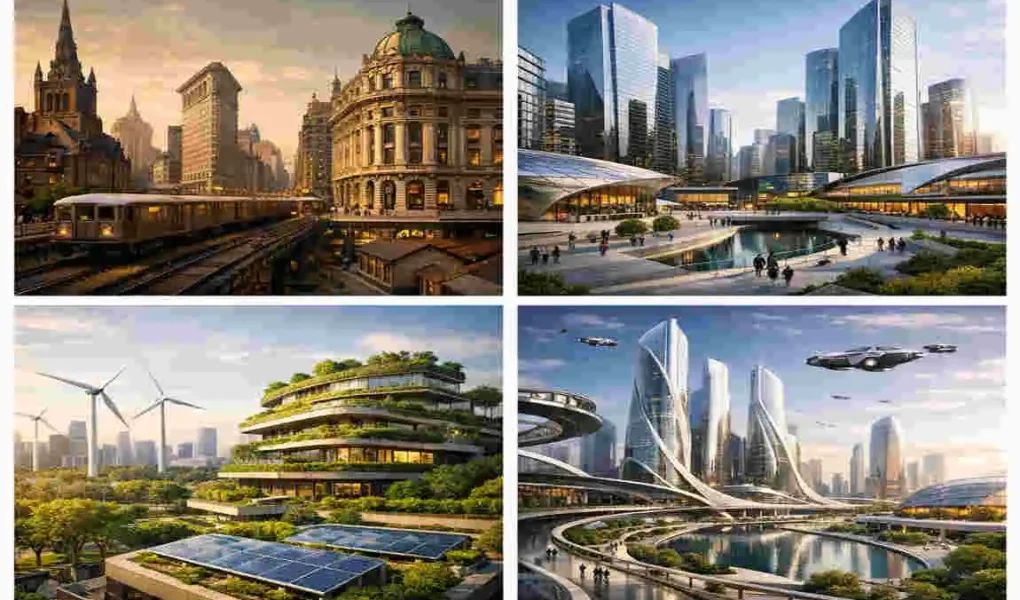
You see glass towers, old brick buildings, busy sidewalks, train stations, public squares, bike lanes, rooftop gardens, and people moving in every direction. It may look like a simple collection of buildings, but it is much more than that. Every street corner, every plaza, every apartment block, and every public transport hub is part of a bigger idea.
So, what is urban architecture, really? In simple words, it is the design of buildings and spaces in cities so people can live, work, travel, shop, and connect more easily. It is not only about making cities look beautiful. It is also about making them functional, efficient, safe, inclusive, and sustainable.
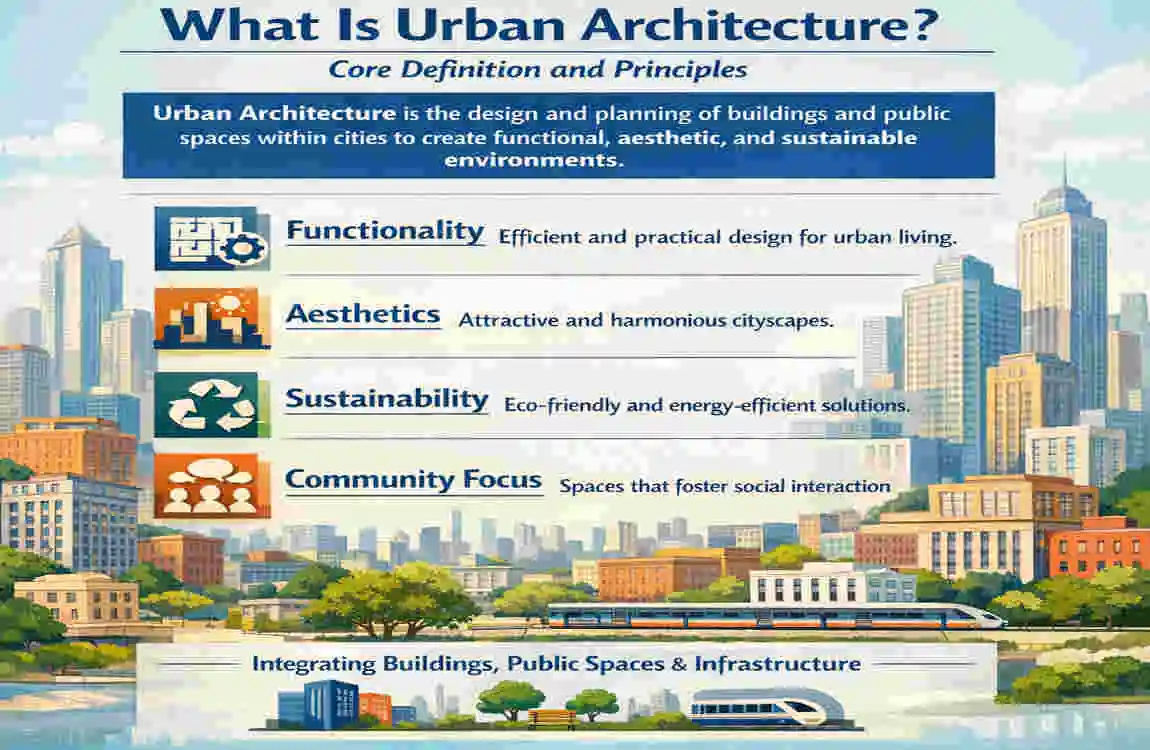
What Is Urban Architecture? Core Definition and Principles
When people ask, what is urban architecture, they usually want a clear answer without too much jargon.
Here it is: urban architecture is the art and science of designing buildings, public spaces, and connected infrastructure in cities. It focuses on how structures work together in dense urban environments. This includes homes, offices, roads, stations, parks, bridges, public squares, utilities, and even the spaces between buildings.
Urban architecture is not just about one building standing alone.
It is about how one building relates to the street, how the street connects to the neighborhood, how that neighborhood fits into the city, and how all of it supports human life.
Why Urban Architecture Matters
Urban architecture matters because cities are complex.
A city needs housing, transport, workplaces, schools, healthcare, green spaces, shopping areas, and public services. If these things are poorly designed, city life becomes stressful. Traffic gets worse. Neighborhoods feel unsafe. Public spaces remain empty. Buildings waste energy.
But when urban architecture works well, the city feels easier to use.
You can walk more comfortably. You can reach daily needs faster. You enjoy public spaces more. Businesses grow. Communities connect. The environment benefits too.
In other words, urban architecture helps turn a crowded city into a livable city.
The Core Idea Behind Urban Architecture
At its heart, urban architecture tries to balance people, place, and purpose.
It asks important questions such as:
- How can we fit more people into a city without making it feel cramped?
- How can buildings support both private life and public life?
- How can design reduce pollution and energy use?
- How can city spaces feel welcoming to children, seniors, workers, and visitors alike?
These questions show that urban architecture is not only about style. It is about solving real urban problems through design.
Key Principles of Urban Architecture
Most successful urban architecture follows a few core principles.
Density and Verticality
Cities have limited land but growing populations.
That is why urban architecture often builds upward instead of outward. High-rise apartments, office towers, and mixed-use towers help use land more efficiently. Vertical design allows more people to live and work in the same area.
But density must be handled carefully.
Too much density without proper planning can create stress, congestion, and poor living conditions. Good urban architecture uses vertical space while still protecting light, air, movement, and comfort.
Functionality
A city cannot rely on beauty alone.
Buildings and public spaces must serve real needs. A neighborhood should support daily life with practical access to transport, schools, shops, workplaces, and recreation. This is why many urban areas now favor mixed-use development, where residential, commercial, and public uses coexist.
This approach saves time and reduces travel distances.
Human-Scale Design
Even the tallest city should still feel usable at street level.
Human-scale design focuses on the experience of people walking, resting, gathering, and moving through the city. Sidewalks, shade, benches, lighting, storefronts, crossings, and small green spaces all matter. These details make large cities feel more personal and more comfortable.
Integration With the Environment
Urban architecture must respect natural systems.
That means considering wind, sunlight, rainwater, local climate, trees, and open space. It also means reducing heat buildup, protecting biodiversity, and designing for long-term environmental health.
Today, this principle has become central to sustainable urban architecture.
Urban Architecture vs. Related Fields
People often confuse urban architecture with urban planning or landscape architecture. They overlap, but they are not the same.
Term Main Focus Example
Urban Architecture Buildings and the city fabric around them Mixed-use towers connected to streets and plazas
Urban Planning Zoning, land use, policy, and city-wide strategy A city master plan for housing and transport
Landscape Architecture Outdoor spaces and environmental design Urban parks, waterfronts, plazas, green corridors
Think of it this way.
Urban planning sets the larger rules.
Urban architecture shapes the physical built form.
Landscape architecture improves the open spaces between and around buildings.
All three work best when they support one another.
Brief History of Urban Architecture: From Ancient Cities to Modern Metropolises
To fully understand what is urban architecture, it helps to look at how cities developed over time.
Urban architecture did not begin with skyscrapers. It began when humans first started building organized settlements, roads, public spaces, and shared systems for living together.
Ancient Roots: The First Urban Forms
The earliest cities gave us the first signs of urban thinking.
In Mesopotamia, early city builders created structured settlements with temples, walls, and marketplaces. These cities were not random collections of huts. They already showed the idea that buildings and civic life should work together.
In the Indus Valley, cities like Mohenjo-Daro displayed remarkably advanced urban organization. Streets followed grid patterns. Drainage systems were carefully planned. Homes connected to shared infrastructure. Even thousands of years ago, people understood that successful city living required smart design.
The Romans pushed this further.
They introduced roads, forums, aqueducts, baths, amphitheaters, and apartment-style housing known as insulae. Roman cities mixed infrastructure, public life, and architecture in highly organized ways. This was a major step in the history of urban architecture because it showed how cities could function as complete systems.
Medieval Cities: Protection, Trade, and Density
After the decline of ancient empires, many cities in Europe and other regions changed in character.
Medieval cities often grew inside protective walls. Streets were narrower. Buildings stood close together. Markets and religious centers became major anchors of urban life. You can still see this character in many old city centers today.
These cities were shaped by defense, commerce, and limited space.
Instead of wide open plans, they developed more organically. Streets curved. Blocks felt tighter. Public life often centered around a church, mosque, market square, or port area.
Cities such as Venice show how urban architecture adapted to local geography. Its canals, bridges, and compact buildings created a city form unlike any other. This reminds us that urban architecture always responds to place.
Renaissance Urbanism: Order, Beauty, and Humanism
The Renaissance brought a fresh way of thinking.
Architects and thinkers began to focus more on symmetry, proportion, public order, and the human experience. Cities were no longer only places of trade and defense. They also became places of civic pride and visual harmony.
In cities like Florence, public buildings and squares reflected this shift. Designers paid closer attention to how architecture shaped movement, perspective, and social life. Streets, facades, and plazas became part of a more intentional urban composition.
This period strengthened the idea that cities should be both useful and beautiful.
The Industrial Revolution: Growth, Speed, and New Problems
The Industrial Revolution changed cities dramatically.
Factories drew huge populations into urban areas. Cities expanded rapidly. Railways, warehouses, tenements, and industrial districts appeared almost everywhere in growing economies. New building materials such as steel and reinforced concrete made taller structures possible.
This was the age when the modern skyscraper began to emerge.
In Chicago, the Home Insurance Building is often seen as an early example of steel-frame high-rise construction. This innovation changed urban architecture forever. Cities could now build vertically at a scale never seen before.
But industrial growth also created serious problems.
Many urban neighborhoods became overcrowded, polluted, and unhealthy. Housing conditions worsened. Streets became chaotic. This prompted architects, reformers, and planners to seek better urban models.
Modernism: Efficiency and Big Ideas
In the 20th century, modernist ideas reshaped how architects imagined cities.
Designers such as Le Corbusier proposed bold visions of tall buildings, open green space, and efficient city layouts. His concept of the Radiant City influenced post-war rebuilding and modern housing projects worldwide.
Modernism favored clean lines, separation of functions, and large-scale planning.
It aimed to solve urban problems through rational design. In some cases, it improved sanitation, housing, and circulation. In other cases, it removed street life. It weakened community connection because it focused too much on efficiency and not enough on everyday human experience.
This period taught an important lesson: cities must serve people, not just ideas.
Postmodern and Contemporary Urban Architecture
By the late 20th century, architects began reacting against rigid modernism.
They reintroduced variety, historical references, mixed uses, and more active public space. Urban architecture became more flexible and more sensitive to local identity.
Adaptive reuse also gained popularity.
Instead of demolishing old industrial sites, cities started converting them into parks, cultural spaces, offices, and housing. A well-known example is the High Line in New York City, where an old elevated rail line was transformed into a public park and urban attraction.
Today, urban architecture is shaped by several major forces:
- Sustainability
- Smart technology
- Climate resilience
- Affordable housing needs
- Walkability and public life
- Adaptive reuse of old buildings
Modern cities like Singapore show how dense development can still include greenery, transit integration, and environmental thinking. This is why contemporary urban architecture often blends innovation with lessons from the past.
The history of urban architecture is really the history of how people learned to live together in growing cities. And that story is still being written.
Key Features of Urban Architecture: What Makes Cities Thrive
Once you understand the definition and history, the next step is to look at the practical side.
What actually makes urban architecture work?
The answer lies in a mix of structure, space, technology, sustainability, and human experience.
Structural and Spatial Features
Urban architecture usually begins with one big challenge: limited space.
Cities need to fit a lot of activity into a small footprint. That is why structure and layout matter so much.
High-Rise Typology
One major feature of urban architecture is the use of high-rise buildings.
These structures help cities grow vertically. Instead of spreading housing and offices across huge areas, they place more uses on smaller plots. This supports compact growth and can reduce pressure on land.
Different structural systems make this possible.
Some buildings rely on load-bearing systems, while many modern towers use framed structures made of steel or reinforced concrete. These systems give architects more flexibility for height, open interiors, and mixed-use design.
Mixed-Use Development
A strong urban district rarely depends on just one purpose.
Mixed-use projects combine homes, offices, retail, dining, entertainment, and public spaces in the same area or even the same building. This creates neighborhoods where people can live, work, and relax without having to travel long distances.
That is why mixed-use design has become one of the most important urban design principles today.
It supports convenience. It activates streets. It also helps local businesses by creating steady foot traffic throughout the day.
Transit-Oriented Design
In a successful city, buildings do not exist separately from transportation.
Urban architecture often connects directly with metro stations, bus routes, bike systems, and pedestrian networks. This is called transit-oriented design. It encourages people to rely less on cars and more on efficient shared transport.
When buildings, sidewalks, and transport hubs work together, city life becomes faster and less stressful.
Sustainable and Tech-Driven Features
Urban architecture now has to do more than accommodate growth. It must also address environmental pressure.
That is where sustainable urban architecture comes in.
Green Roofs and Passive Design
Many urban buildings now include green roofs, planted terraces, shaded facades, and systems that reduce heat gain. These features help control temperature, improve air quality, and soften the hard visual impact of dense construction.
Passive design also plays a big role.
Instead of relying solely on mechanical systems to cool or light buildings, architects use orientation, ventilation, insulation, and daylight to improve performance naturally. This lowers energy use and creates healthier indoor spaces.
Net-Zero and Low-Carbon Thinking
More cities are pushing for buildings that use less energy and produce fewer emissions.
This includes:
- Better materials
- Solar integration
- Efficient glazing
- Smart insulation
- Water-saving systems
- Carbon-aware construction methods
The goal is simple: create city buildings that do less harm and more good over time.
Smart City Technology
Technology is also changing urban architecture.
Buildings can now use sensors, automated lighting, smart climate controls, digital security systems, and real-time energy monitoring. Entire districts may use connected systems to manage traffic, waste, parking, and public services more efficiently.
This does not mean cities should become cold or robotic.
The real goal is to use technology to improve comfort, reduce waste, and make urban life smoother for people.
Resilient Design
Cities face real threats from flooding, rising temperatures, storms, and other climate risks.
Urban architecture must now be resilient. That means buildings and public spaces need to withstand future pressure, not just current needs. Flood barriers, raised ground levels, heat-resistant materials, and emergency-ready systems are becoming more common in coastal and high-risk cities.
Social and Aesthetic Features
Urban architecture is not only technical. It is deeply social.
A city may function well on paper, but if it feels harsh or isolating, people will not enjoy living there.
Public Spaces
Good urban architecture always values public life.
Plazas, courtyards, sidewalks, shaded seating, pocket parks, and waterfront promenades all support community interaction. These spaces invite people to gather, pause, and connect.
Public spaces are especially important in dense cities because private homes are often smaller. The city itself becomes an extended living room.
Inclusive Design
Cities should work for everyone.
That includes children, seniors, people with disabilities, commuters, residents, and visitors. Inclusive urban architecture uses ramps, accessible pathways, safe crossings, lighting, clear signage, and flexible public areas so more people can use the city comfortably.
This is not a bonus feature. It is a core requirement.
Visual Identity
Architecture also shapes how a city feels and how it is remembered.
Some cities are known for historic stone facades. Sleek towers or experimental forms define others. Iconic buildings can create identity, attract tourism, and reflect cultural ambition.
Designers such as Zaha Hadid showed how bold forms and flowing geometry can redefine urban skylines. At the same time, many cities also value quiet architecture that blends into local context rather than overpowering it.
Both approaches can work if they serve the broader urban environment.
Case Study: Burj Khalifa vs. Barcelona’s Eixample
These two examples show that urban architecture can succeed in very different ways.
Burj Khalifa, Dubai
The Burj Khalifa represents extreme vertical innovation.
It shows how engineering, luxury, density, and landmark design can come together in one urban symbol. It reflects ambition, advanced construction methods, and the power of skyscrapers to define a city image.
Eixample, Barcelona
Barcelona’s Eixample district represents a different kind of success.
Instead of focusing on one tower, it uses a smart urban grid. Wide streets, chamfered corners, mixed building blocks, walkability, and neighborhood structure create a city layout that is practical and human-centered.
One is a symbol of height. The other symbolizes planning.
Both teach us that urban architecture is not limited to towers. It includes the whole urban experience.
Urban Architecture Features Checklist
Here is a simple checklist of features often found in successful urban architecture:
- Vertical expansion
- Mixed-use spaces
- Transit integration
- Walkable streets
- Biophilic or nature-based elements
- Adaptive reuse
- Public gathering areas
- Climate-responsive design
- Accessible infrastructure
- Smart building systems
If a city development includes most of these features, it is likely moving in the right direction.
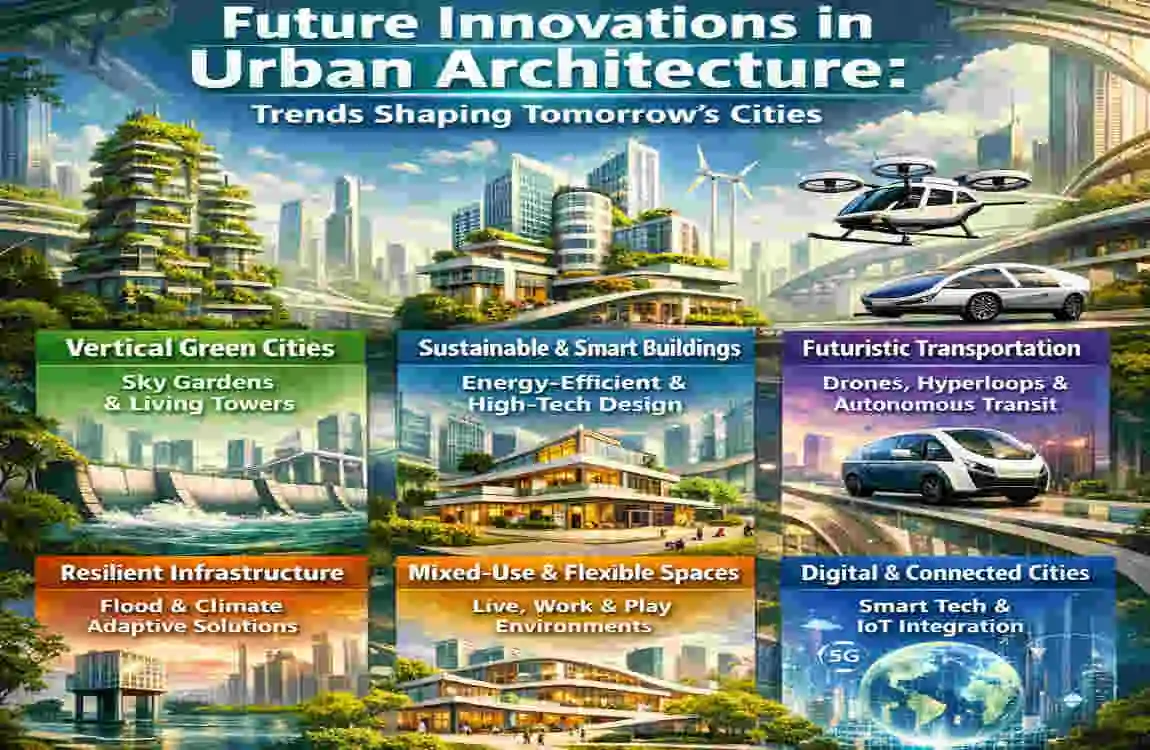
Future Innovations in Urban Architecture: Trends Shaping Tomorrow’s Cities
Cities are changing fast, and urban architecture is changing with them.
The future is not only about taller towers or shinier facades. It is about creating cities that are smarter, greener, healthier, and more adaptable.
Sustainability at Scale
One of the biggest trends in urban architecture is sustainability on a much larger level.
This means going beyond one eco-friendly building and thinking about whole districts and entire city systems.
The 15-Minute City
The idea of the 15-minute city has gained major attention.
In this model, people can reach most daily needs within a short walk or bike ride. That includes schools, grocery stores, parks, healthcare facilities, and workspaces. The goal is to reduce long commutes and improve quality of life.
This approach deeply changes architecture.
Instead of designing isolated towers, architects and city designers focus on creating complete, connected neighborhoods.
Circular Economy and Modular Design
Future cities will also need to build with less waste.
That is where the circular economy comes in. Buildings of the future may use recyclable parts, modular systems, and materials that can be reused instead of thrown away. This reduces waste and supports long-term sustainability.
Modular buildings can also be assembled faster.
That makes them useful for affordable housing, emergency response, and flexible urban growth.
Tech and AI Integration
Technology will play a much bigger role in how cities are designed and managed.
But again, the goal should not be technology for its own sake. It should be technology that improves urban life.
AI-Optimized Design
Artificial intelligence can already help analyze traffic patterns, energy use, sunlight exposure, and building performance.
In the future, AI may help designers create better urban layouts by predicting how people will move, where congestion will happen, and how land can be used more efficiently. This could save time and improve decision-making.
3D-Printed Construction
3D printing is also moving into the urban construction world.
While full 3D-printed skyscrapers are still in development, the technology already shows promise for producing building components quickly and with less material waste. Over time, this could lower costs and speed up urban development.
Vertical Farms and Drone Infrastructure
As cities grow denser, they may bring more production and logistics into the urban core.
Vertical farms can help produce food in compact areas. Drone ports may support delivery systems, emergency services, and future mobility. These ideas still sound futuristic, but parts of them are already being tested.
Climate Adaptation and Resilience
The future of urban architecture cannot ignore climate change.
This is one of the biggest forces shaping tomorrow’s cities.
Flood-Ready Urban Design
Some cities are exploring floating neighborhoods, raised buildings, waterproof infrastructure, and redesigned waterfronts. These ideas are especially relevant in coastal areas facing rising sea levels and stronger storms.
Urban architecture of the future must be prepared, not reactive.
Cooling the City
Heat is another serious issue.
Cities often trap heat due to concrete, asphalt, and dense development. Future architecture will likely include more shade structures, water features, reflective materials, green facades, and urban forests to lower temperatures.
Equity and Affordability
Innovation means very little if only wealthy people benefit from it.
One of the most important future goals in urban architecture is equity. Cities need affordable housing, fair access to transport, and quality public space for all income groups.
That means future innovation should not only focus on luxury towers and iconic design. It should also improve ordinary housing, basic services, and neighborhood infrastructure.
Predictions for the Future of Urban Architecture
InnovationLikely TimelinePotential Impact
AI-assisted urban planning 2026–2030 Faster, data-driven design decisions
Advanced modular housing 2026–2035 Quicker and more affordable urban housing
Bio-inspired building systems 2030+ Lower energy use and smarter climate response
Large-scale vertical farming 2030+ Better food resilience in dense cities
Carbon-negative urban districts 2035+ Major reduction in city emissions
What the Future Really Demands
If you look closely, the future of urban architecture is not just about new tools.
It is about better priorities.
Cities of tomorrow need to be:
- More walkable
- More affordable
- More climate-ready
- More socially inclusive
- More efficient without losing humanity
That is the real challenge.
And it is also the real opportunity.
Real-World Examples: Urban Architecture Success Stories
The best way to understand urban architecture is to see how it works in real places.
Here are a few examples that show different approaches to city design.
Masdar City, Abu Dhabi
Masdar City is often discussed as a model for low-carbon urban development.
It focuses on energy efficiency, walkability, renewable systems, and reduced car dependence. The project has become a major example of how architecture and infrastructure can work together around sustainability goals.
It is not perfect, but it has pushed important conversations about what eco-focused urban districts can look like.
Songdo, South Korea
Songdo is one of the best-known examples of a smart city.
It was designed with digital systems built into daily urban life. Sensors, connected infrastructure, efficient waste management, and integrated planning make it a strong case study in technology-driven urban architecture.
Songdo shows what happens when a city district is planned with smart systems from the beginning rather than added later.
Barcelona, Spain
Barcelona offers one of the clearest examples of how good planning and architecture can support daily life.
The Eixample grid created a structured, walkable urban fabric with strong blocks, corner visibility, and neighborhood logic. More recently, the city has explored superblocks, which reduce traffic and give people more space.
This is a powerful reminder that urban success does not always depend on dramatic skyscrapers. Sometimes it comes from street design and block structure.
New York City, USA
New York shows the layered nature of urban architecture.
Its skyline represents density and vertical growth, but the city’s real strength lies in the mix of transport, public spaces, historic districts, adaptive reuse, and neighborhood identity. Projects like the High Line prove that old infrastructure can become new public value.
New York teaches us that cities evolve through reinvention.
Lahore and Urban Renewal
In cities like Lahore, urban architecture matters deeply because rapid growth creates both opportunity and pressure.
Urban renewal efforts, riverfront ideas, transit expansion, heritage preservation, and mixed-use development all influence how the city will grow in the future. Lahore has the challenge of balancing tradition with modernization.
That balance is at the heart of good urban architecture.
A city should not erase its past to build its future. It should learn how to connect the two.
Challenges in Urban Architecture and How to Overcome Them
Urban architecture can improve city life, but it also faces serious challenges.
Overcrowding and Pressure on Space
As cities grow, land becomes more expensive and more limited.
This can lead to overcrowded housing, poor infrastructure, and a lack of public space. Architects and city leaders must respond with smarter density, not just more density.
Gentrification and Exclusion
New development can improve neighborhoods, but it can also push out long-time residents.
That is why urban architecture should work alongside fair housing policies, inclusive zoning, and community participation. Growth should benefit existing residents, not replace them.
Climate Risk
Flooding, heat waves, air pollution, and resource strain are now major urban concerns.
Cities need stronger resilience strategies, greener materials, water-sensitive design, and better public transit to reduce future damage.
How to Overcome These Problems
The most effective solutions usually include:
- Community input before development begins
- Affordable housing requirements
- Better transit connections
- Green public infrastructure
- Flexible and climate-ready building design
FAQ: Common Questions About Urban Architecture
What is urban architecture in simple terms?
Urban architecture is the design of buildings and spaces in cities. It includes homes, offices, streets, public areas, and supporting infrastructure. The goal is to make city life more organized, livable, efficient, and attractive.
What is the difference between urban architecture and urban planning?
Urban planning focuses on policies, zoning, land use, and city-wide strategy. Urban architecture focuses more on the physical design of buildings and how they shape the urban environment. Planning sets direction, while architecture gives that direction a built form.
Why is urban architecture important?
Urban architecture affects how people live every day. It shapes mobility, comfort, safety, access to services, environmental quality, and even social interaction. Good urban architecture helps cities function better and feel better to live in.
What are the main features of urban architecture?
Common features include high-rise buildings, mixed-use spaces, public plazas, transit integration, walkability, green design, climate resilience, smart technology, and inclusive access. These features help cities stay functional as they grow.
How does urban architecture impact real estate?
Well-designed urban areas often attract residents, businesses, and investors. This can raise property values, improve neighborhood appeal, and increase long-term demand. Green design, transit access, and quality public spaces are especially valuable in real estate.
Who are some famous urban architects?
Well-known names include Norman Foster, Bjarke Ingels, and Zaha Hadid. Their work often blends innovation, sustainability, and bold urban ideas. Many great city projects also result from collaboration between architects, planners, engineers, and local governments.
What is the future of urban architecture innovations?
The future of urban architecture includes AI-assisted planning, modular construction, smart systems, green buildings, vertical farms, resilient waterfronts, and more affordable urban housing. The biggest trend is creating cities that are both smarter and more human-centered.