You’ve just spent your entir Saturday morning scrubbing the kitchen. The countertops are gleaming, the floor is spotless, and there isn’t a crumb in sight. You pour yourself a well-deserved cup of coffee, sit down to relax, and then you hear it—that distinct, maddening buzz.
A clean house fly lands on your arm. You swat it away, but it comes back. Again. And again. It feels aggressive, persistent, and annoying. You start to wonder, is this thing trying to eat me?
It’s a valid concern. When you have a spotless environment, the presence of pests feels like a personal failure or a mystery. Why are they here if there is no garbage? And why do they seem so intent on landing on your skin?
The Burning Question: Do House Flies Bite in Clean Environments?

Let’s rip the bandage off immediately. The short answer is no. The common house fly (Musca domestica) does not bite. They simply cannot.
However, the confusion is completely understandable. If you have ever felt a sharp pinch while sitting on your patio or in your living room, you might swear that a house fly just took a chunk out of you. But here is the reality: Do house flies bite in clean homes? No, but their look-alikes certainly do.
The Anatomy of a Non-Biter
To understand why house flies don’t bite, we have to look at their anatomy. Nature designed the house fly with a very specific set of tools, and a “biter” wasn’t one of them.
House flies possess a proboscis, a mouthpart. Think of this less like a set of teeth or a needle, and more like a soft, spongy vacuum cleaner. Their mouths are designed exclusively for slurping up liquids. They cannot pierce human skin, chew, or sting.
When a house fly lands on your arm, it isn’t sizing you up for a meal in the traditional sense. It is “tasting” you with its feet (yes, really) and using that sponge-like mouth to soak up moisture, salts, and oils from your skin. It tickles, and it is annoying, but it isn’t a bite.
The Case of Mistaken Identity
So, why do people search for terms like “do house flies bite in clean kitchens” so often? Usually, it is because an imposter has bitten them.
There is a cousin to the house fly called the Stable Fly (Stomoxys calcitrans). To the naked eye, a stable fly looks almost identical to a house fly. They are roughly the same size and colour. However, if you look very closely (and you probably don’t want to get that close), the stable fly has a mouthpart that looks like a bayonet or a needle sticking straight out. Those guys bite. And it hurts.
Other biting flies include:
- Deer Flies: Aggressive and painful biters often found in wooded areas.
- Horse Flies: Large, fast, and capable of inflicting a nasty bite.
- Sand Flies: Tiny, but their bite packs a punch.
But the pest buzzing around your fruit bowl? That’s likely just a harmless, albeit gross, housefly.
The Stats Don’t Lie
According to data from the CDC and various entomological studies, while house flies don’t bite, they are far from innocent. They are mechanical vectors for disease. This means they carry pathogens on their bodies. So, while you don’t need to worry about a venomous sting or a blood-sucking bite, you do need to worry about where those feet have been before they landed on your sandwich.
Why House Flies Invade Even the Cleanest Homes
This is the part that frustrates homeowners the most. You keep a tidy ship. You take the trash out. So, why are you still asking, “Do house flies bite in clean rooms?” or rather, why are they hanging out there?
The truth is, “clean” to a human and “clean” to a fly are very different concepts. You might not see dirt, but a fly has sensory superpowers that detect things you miss.
The Sensory Superpowers of the Fly
House flies are biological marvels. They have compound eyes with roughly 4,000 individual lenses in each eye. This gives them a nearly 360-degree field of vision and allows them to detect movement much faster than we can. This is why they are so hard to swat!
More importantly, they have an incredible sense of smell. They can detect odours from miles away. They aren’t just looking for a pile of garbage; they are attracted to:
- Carbon Dioxide (CO2): Like mosquitoes, flies are attracted to the CO2 we exhale. This is why they buzz around your face.
- Warmth: Houses radiate heat, and flies are cold-blooded.
- Moisture: This is the big one. Even a clean home has moisture.
Hidden Breeding Grounds
You might be asking, “Do house flies bite in clean kitchens? No, but they love the hidden crumbs.” And it is true. Even in a sparkling kitchen, attractants hide in plain sight.
- The Kitchen Drain: The number one culprit. A layer of organic slime (biofilm) builds up inside the pipes. You can’t see it, but flies can smell it. It’s a perfect breeding ground.
- Overripe Fruit: That banana bowl looks pretty, but as fruit ripens, it releases ethanol gas, which is like a dinner bell for flies.
- Pet Food: If you leave Kibble out, you are inviting flies.
- Recycling Bins: Even rinsed soda cans have enough sugary residue to attract a swarm.
- Indoor Plants: Overwatered soil creates a humid environment that flies adore.
5 Signs of Fly Hotspots in Clean Homes
If you are spotless but still swarmed, check these five areas immediately:
- Under the appliances: Crumbs often kick under the fridge or stove.
- Window tracks: Dead flies or condensation here attract live ones.
- Trash can liners: Even if the bag is gone, spills at the bottom of the bin smell.
- Dish sponges: A wet sponge is a hydration station for flies.
- Light fixtures: Flies are attracted to light and warmth.
The Real Estate Angle
If you are looking to sell your home, flies can be a deal-breaker. A prospective buyer walking into a kitchen buzzing with flies subconsciously thinks “dirty,” even if the surfaces are polished. Managing these pests is crucial for maintaining the perceived value and comfort of your home.
Health Risks: What House Flies Carry (Even Without Biting)
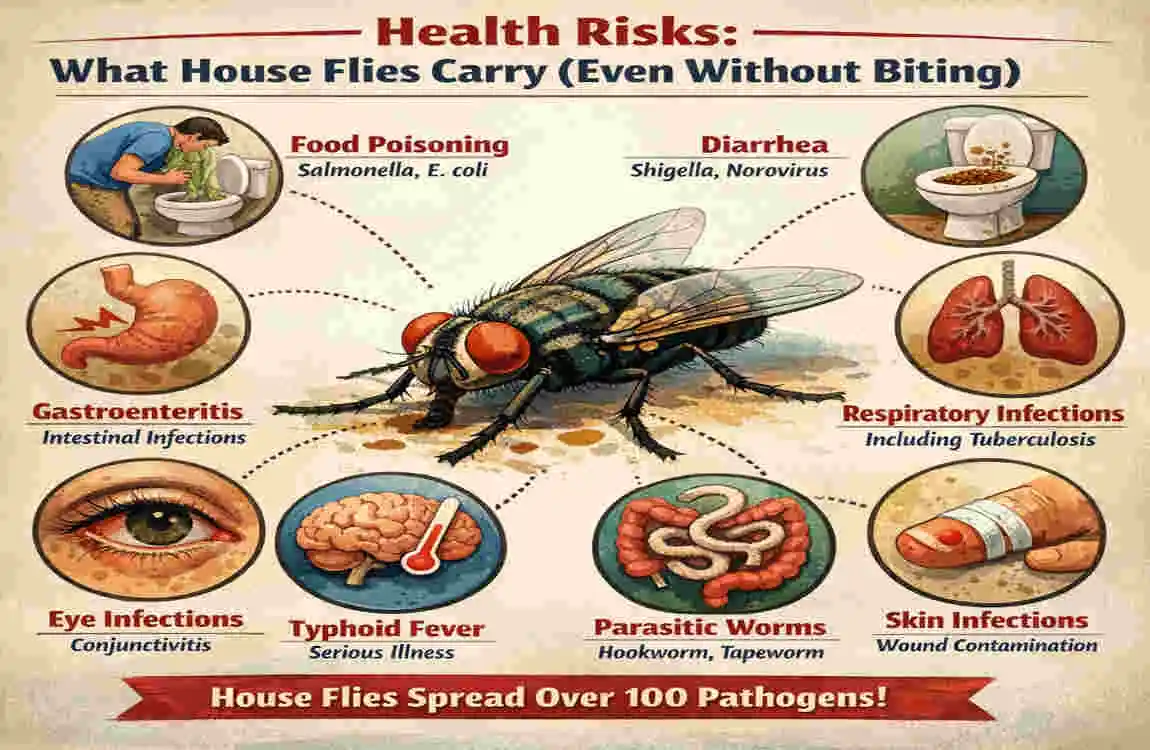
We have established that the answer to “Do house flies bite in clean homes?” is no. But that doesn’t mean you should let them hang around. In fact, a non-biting house fly is more dangerous to your health than a biting spider in the corner.
The “Vomit” Factor
I hate to be the bearer of gross news, but we have to talk about how flies eat. Because they have that sponge mouth, they can only eat liquids. If they find something solid (like your sugar cookie), they have to turn it into liquid first.
They do this by regurgitating digestive enzymes onto the food. Yes, they vomit on your food to dissolve it, and then suck it back up. This happens in seconds. Every time a fly lands on your lunch, there is a high probability that it has left a little vomit spot behind.
Walking Germ Factories
House flies spend their time in the most unsavoury places imaginable: faeces, rotting carcasses, garbage dumps, and sewers. Microscopic hairs on their legs and bodies act like Velcro for bacteria.
When they fly from a trash can to your “clean” counter, they are simply transferring those germs. They are known to transmit over 65 diseases to humans, including:
- Salmonella: Causes food poisoning.
- E. coli: severe stomach cramps and diarrhoea.
- Cholera: Rare, but possible.
- Dysentery: Severe intestinal inflammation.
- Tuberculosis: Bacteria can hitchhike on flies.
The Allergy Link
Interestingly, some people report skin irritation after a fly lands on them. This reinforces the myth and leads them to Google “do house flies bite in clean rooms.”
What is actually happening is an allergic reaction. The cockroach is famous for causing allergies, but house flies can, too. Their “footprints” (bacteria and filth) or the enzymes in their saliva can cause sensitive skin to itch or turn red. It looks like a bite, it feels like a bite, but it is actually a contact dermatitis reaction to the filth the fly is carrying.
Who is Most Vulnerable?
While a healthy adult might get a mild stomachache from fly-contaminated food, vulnerable groups in your clean home are at higher risk.
- Children: Their immune systems are developing, and they are more likely to put things in their mouths.
- The Elderly: Immune response naturally weakens with age.
- Pets: Dogs and cats often snap at flies and eat them, ingesting the bacteria directly.
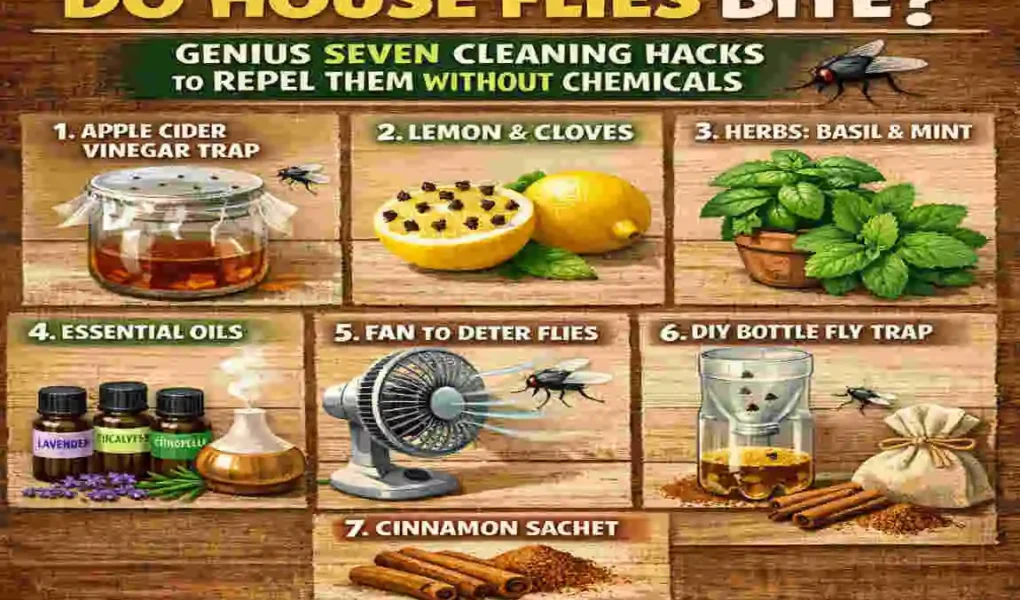
Genius Cleaning Hack The Vinegar-Baking Soda Fly Trap
Okay, enough of the gross stuff. Let’s talk about solutions. You don’t need to spray toxic clouds of insecticide in your kitchen. You likely have everything you need to solve this problem in your pantry right now.
This is my absolute favourite trick. It relies on the science of attraction and surface tension. It answers the plea of everyone asking, “Do house flies bite in clean homes, and how do I get rid of them?”
Why This Hack Works
This trap works on a two-step principle: Lure and Trap.
- The Lure: Apple cider vinegar smells like fermenting fruit. To a fly, this is the scent of a perfect meal. The baking soda creates a fizzing reaction that releases Carbon Dioxide (CO2). Remember, flies are attracted to CO2 because it mimics the breath of mammals.
- The Trap: Dish soap breaks the surface tension of the liquid. Usually, a fly can land on water and take off again because it is so light. But with soap, the moment their feet touch the surface, they sink and drown.
What You Need
- A shallow jar or bowl (an old mason jar or a recycled yoghurt container works great).
- Apple Cider Vinegar (ACV) – if you don’t have ACV, regular vinegar with a pinch of sugar works, but ACV is king.
- Baking Soda.
- Liquid Dish Soap (any brand, lemon-scented is a bonus).
- Plastic wrap and a rubber band (Optional, but helpful).
Step-by-Step Instructions
The Base Pour about 1 cup of Apple Cider Vinegar into your jar. You want enough depth so the flies can sink.
The Fizz. Add 1 teaspoon of baking soda. Do this slowly over the sink! It will bubble up vigorously. This reaction releases CO2, which acts as a supercharged dinner bell for the flies.
The Trap Once the fizzing settles down, add a few hefty squirts of liquid dish soap. Stir it gently. You want the soap mixed in, but try not to create too many bubbles on top, as you want the liquid surface exposed.
The Funnel (Optional) If you have a massive infestation, cover the top of the jar with plastic wrap and secure it with a rubber band. Poke a few holes in the wrap with a fork. This makes it easy for flies to get in, but very hard for them to figure out how to get out. However, for the soap method, an open bowl often works just as well because the soap sinks immediately.
Placement Place these traps near your problem areas: next to the fruit bowl, near the trash can, or by the kitchen window.
Refresh the dump and refill the trap every 24 to 48 hours. The CO2 reaction occurs only initially, but the vinegar smell persists. Refreshing keeps it potent.
The Result: Within a few hours, you will likely see little black specks at the bottom of the jar. It is oddly satisfying to see the proof that your home is becoming a fly-free zone.
7 More Chemical-Free Cleaning Hacks to Repel House Flies
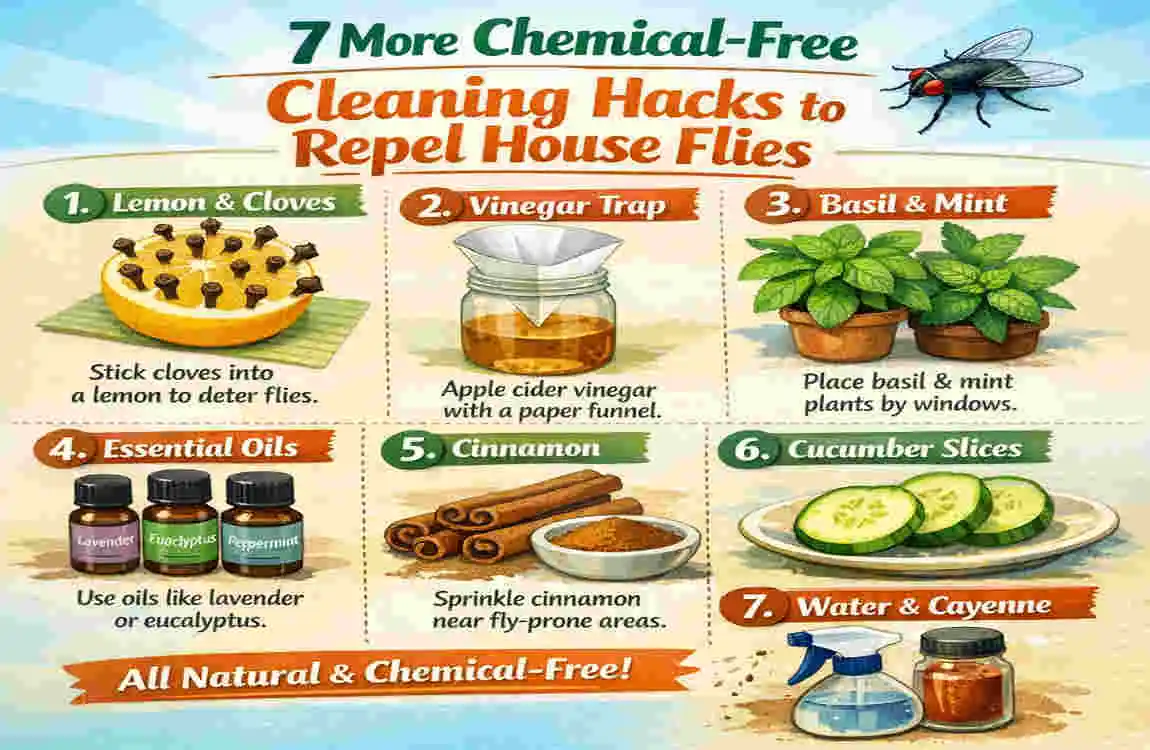
If the vinegar trap is the star of the show, these seven hacks are the supporting cast. Using these in combination will ensure you never have to worry about the question “Do house flies bite in clean homes?” again.
The Essential Oil Shield
Flies hate strong, pungent smells. While we love the smell of a spa, flies detest it.
- What to do: Mix water with 10-15 drops of Lemongrass, Peppermint, Eucalyptus, or Lavender oil in a spray bottle.
- Application: Mist this around your doorframes, windows, and kitchen counters. Not only will your house smell incredible, but flies will pull a U-turn when they catch a whiff. Peppermint is particularly effective because it interferes with their sensory receptors.
The Fresh Herb Barrier
Why not decorate and repel at the same time?
- What to do: Plant pots of Basil, Mint, Rosemary, or Bay Leaves.
- Application: Keep these on your kitchen windowsill. It acts as a green “forcefield.” If you have a fly problem during a barbecue, throw some rosemary sprigs on the coals. The smoke will instantly clear the area of pests.
Steam Clean Your Drains
Remember the biofilm we talked about? Bleach often runs right over it without penetrating.
- What to do: Use a steam cleaner with a nozzle attachment, or pour a pot of boiling water down the drain, followed by ½ cup of baking soda and ½ cup of vinegar.
- Why it works: The heat melts the organic slime where the eggs are laid, and the fizzing physically scrubs the pipes. Do this weekly to prevent breeding.
The Wine Bottle Trap
If you have a little wine left in the bottle (red or white), don’t pour it down the drain.
- What to do: Leave the bottle open on the counter with about an inch of wine at the bottom.
- Why it works: Flies love the fermentation smell. They will fly down the neck of the bottle to get the wine, but the narrow neck makes it nearly impossible for them to fly back out. It’s the perfect lazy-person’s trap.
Airflow Disruption (The Fan Trick)
House flies are actually terrible flyers. They require still air to navigate well.
- What to do: Position oscillating fans to blow across your food prep areas or dining table.
- Why it works: The mechanical wind makes it physically difficult for them to land. It consumes too much of their energy to fight the current, so they go elsewhere.
The Clove-Stuck Lemon
This is an old-school hack that grandma probably used, and it works surprisingly well.
- What to do: Cut a lemon in half. Poke 10-20 whole cloves into the flesh of the lemon.
- Application: Place these bowls on your dining table or picnic table.
- Why it works: The combination of citric acid and strong clove spice creates a scent profile that is repulsive to Musca domestica.
Screen Repair and Caulk
The best offence is a good defence.
- What to do: Inspect your window screens for tiny tears. Flies can squeeze through incredibly small gaps.
- Application: Use clear nail polish to instantly patch small holes in screens. Also, check the weather stripping around your doors. If you can see light coming through the crack under your door, a fly can get in. Re-caulk your windows to seal off their entry points.
Prevention Blueprint: Keep Your Home Fly-Proof Long-Term
You’ve learned the answer to “do house flies bite in clean homes” (No!), and you have set your traps. Now, let’s make sure they don’t come back.
Maintaining a fly-free home isn’t about scrubbing until your hands are raw; it’s about smart, targeted maintenance. Think of this as your “Fly Defence Schedule.”
Daily and Weekly Maintenance Checklist
FrequencyTaskWhy It Works
Daily Wipe Countertops removes invisible food residue and sugary spills that attract scouts.
Daily Empty Kitchen Trash removes the primary food source. Use a bin with a tight-sealing lid.
Daily Pet Food Management: Pick up pet bowls after feeding times. Do not leave wet food out all day.
Weekly Flush Drains: Using the boiling-water method prevents biofilm buildup (a breeding ground).
Weekly Wash Produce Rinse fruit as soon as you buy it to remove potential eggs/larvae from the store.
Weekly Laundry Check : Wet towels or gym clothes can mildew, creating the moisture flies love.
Monthly : Deep Clean Bins: . Scrub the inside of your trash cans with soap and water to remove any leaks.
Seasonal Tips for Homeowners
As the seasons change, so do fly behaviours.
- Spring: Check your screens. Winter storms may have damaged them.
- Summer: This is peak fly season. Humidity is high. Run dehumidifiers to make your home less attractive.
- Autumn: As it gets cold, flies try to move indoors for warmth. Be vigilant about keeping doors closed.
FAQs: Do House Flies Bite? Top Reader Questions Answered
We receive so many questions about this topic. Here are the top answers to settle the debate once and for all.
Q: Do house flies bite in clean homes? A: No, they do not. If you are being bitten in a clean home, you are likely dealing with a Stable Fly or a flea, not a common house fly. House flies have sponge-like mouths and cannot bite.
Q: Are fly bites dangerous? A: Since house flies don’t bite, their “bites” aren’t dangerous. However, if a Stable Fly bites you, it can be painful and prone to infection. The real danger of house flies is the bacteria they leave on your skin or food, which can cause illness.
Q: How fast does the Vinegar-Baking Soda hack work?A: You should see results within a few hours. The CO2 burst initially attracts them, and the scent keeps them coming. A single trap can clear a small kitchen of a dozen flies in about 24 hours.
Q: Why do flies follow me from room to room? A: They are attracted to your body heat, the carbon dioxide you exhale, and the sweat/oils on your skin. You are essentially a walking heater and scent beacon to them.
Q: Can house flies lay eggs in a clean house? A: Yes. They only need a tiny amount of organic material. A single overripe potato in the pantry or a dirty drain is enough for a female to lay up to 150 eggs at a time.